Map of Denmark showing where the Bernhard arms are recorded
The Bernhard arms were recorded in Denmark, c. 1722.
Arms such as these were typically recorded in Sjaælland.
Zealand held the Danish court, the crown's offices and Copenhagen itself. Families who served the king kept estates within reach of it, and royal service was the ordinary route to a coat of arms.
This is where the arms were entered in the register. Families often moved to other parts of the country, so the same name can turn up in more than one region.
The body that granted and recorded arms in Denmark in this period.
Frederik IV of Denmark
Sovereign of the period
Frederik IV of Denmark
1699–1730
Reigning in Denmark when the Bernhard arms are first recorded.
How Arms Worked in Denmark
Danish heraldry during this period was closely tied to noble status and royal favor rather than being open to all citizens. Arms were typically granted by the monarch to individuals, and these symbols were then shared by all members of the noble house. If a family line died out, the right to use those specific arms ended with them.
Granting authority
The Danish royal chancery held the power to issue and regulate official coats of arms for the kingdom.
How they got arms
Families usually received their arms through a formal royal grant that confirmed their noble status and rights.
Where arms were recorded
These grants were officially recorded in the Danish Royal Chancery records starting in the sixteenth century.
The family's standing
Recorded among the armigerous families of Denmark.
Origin & History of the Bernhard Family in Denmark
The name Bernhard has deep roots in the Germanic naming tradition, meaning brave as a bear, and it gradually spread into Denmark through cultural and trade connections. By the early eighteenth century, the family was well-established on the island of Sjaælland, where records confirm their presence by 1722. During this period, Denmark was transitioning toward more formal record-keeping, and families like the Bernhards often lived in rural or semi-urban communities where they were integrated into the local parish life. As the name became more common in the region, it was passed down through generations, reflecting the steady growth of the family within the Danish social structure. Their history in Sjaælland provides a clear window into how names evolved from individual identifiers into lasting family legacies during the late seventeenth and early eighteenth centuries.
Coat of Arms & Family Crest Details
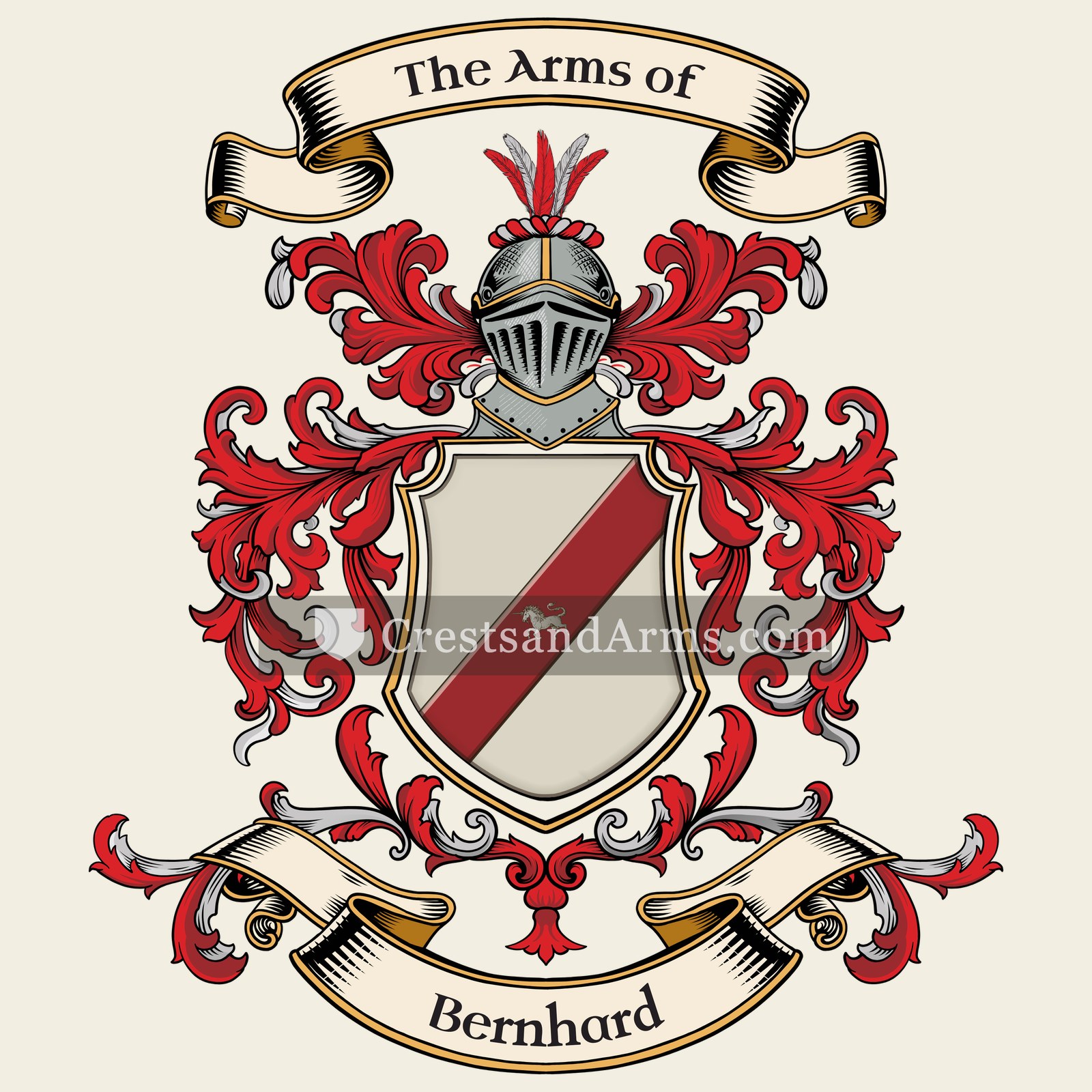
Symbols on this shield
bendDefence, and the scarf of a commander
unicornPurity, and extreme courage in defence of honour
Colours
Silver (Argent)Means: Peace and sincerity
Red (Gules)Means: Military strength
Historical info
Source
J. B. Rietstap, Armorial Général, Gouda: G. B. van Goor Zonen, 1884–87
Blazon (the actual original written record)
“D'arg. à la bande de gu., ch. d'une licorne courante du champ. C.: la licorne, iss., entre un vol de gu. et d'arg., l'aile dextre ch. d'une bande d'arg. et la sen. d'une barre de gu.”
BavariaBavaria, c. 1570
Digital archive packCoat of arms PNG, gold border print PDF, vector SVG and the certificate of authenticity. Sent to your email in minutes.
Map of Germany showing where the Bernhard arms are recorded
The Bernhard arms were recorded in Bavaria, c. 1570.
Bavaria was a country of old landed families and walled market towns. Estates passed down the same line for centuries, and both the landowners and the leading townsmen kept arms, which is why so many Bavarian names sit in the registers.
This is where the arms were entered in the register. Families often moved to other parts of the country, so the same name can turn up in more than one region.
The body that granted and recorded arms in Germany in this period.
Maximilian II, Holy Roman Emperor
Sovereign of the period
Maximilian II, Holy Roman Emperor
1564–1576
Reigning in Denmark when the Bernhard arms are first recorded.
How Arms Worked in Germany
In the Holy Roman Empire, coats of arms were often granted to individuals by the Emperor or his representatives. These arms were then passed down through the generations to all legitimate descendants of the original holder. Younger branches of a family usually kept the same shield design without needing to change it, as the arms belonged to the entire lineage.
Granting authority
The Holy Roman Emperor held the sole power to grant new coats of arms throughout his vast imperial territories.
How they got arms
Families typically obtained their coats of arms through a formal imperial grant or by proving their noble status to the authorities.
Where arms were recorded
These grants were officially recorded in the Imperial Chancery registers, which began keeping formal records of such honors during the Middle Ages.
The family's standing
Recorded among the armigerous families of Bavaria.
Origin & History of the Bernhard Family in Germany
The name Bernhard is a classic Germanic given name that eventually evolved into a hereditary surname. It is composed of the Old High German elements "ber," meaning bear, and "hard," meaning brave or hardy. By the time the family was firmly established in Bavaria in 1570, the name had already been in use for centuries as a personal identifier. During the late Middle Ages, families began adopting fixed surnames to distinguish themselves as populations grew and record-keeping became more formal. In the Bavarian region, the Bernhard family likely lived as farmers or tradespeople during a time of significant religious and social change. Because the name was derived from a popular saint and a strong animal symbol, it was common for families to adopt it as a way to honor their heritage and project strength within their local community.
Bernhard Meaning & Related Branches
Root word
Bernhard
Derived from Germanic elements meaning bear and hardy or brave.
This name
BernhardA name signifying the strength and courage of a bear.
also spelled
Bernhart
Barnard
Related arms
Bernhartvariant spelling
Documented Sources
J. B. Rietstap, Armorial Général, Gouda: G. B. van Goor Zonen, 1884–87
Kruken, Kristoffer and Stemshaug, Ola. Norsk personnamnleksikon. 1995
Nielsen, Oluf. Kjøbenhavns Diplomatarium. 1872
Rigsarkivet (Danish National Archives), Kirkebøger (Parish Registers for Sjaælland), 1722
Rigsarkivet (Danish National Archives), Folketællinger (Census Records), 1787
Digital archive packCoat of arms PNG, gold border print PDF, vector SVG and the certificate of authenticity. Sent to your email in minutes.


 fleur de lisPurity, light, and the sixth son
 fleur de lisPurity, light, and the sixth son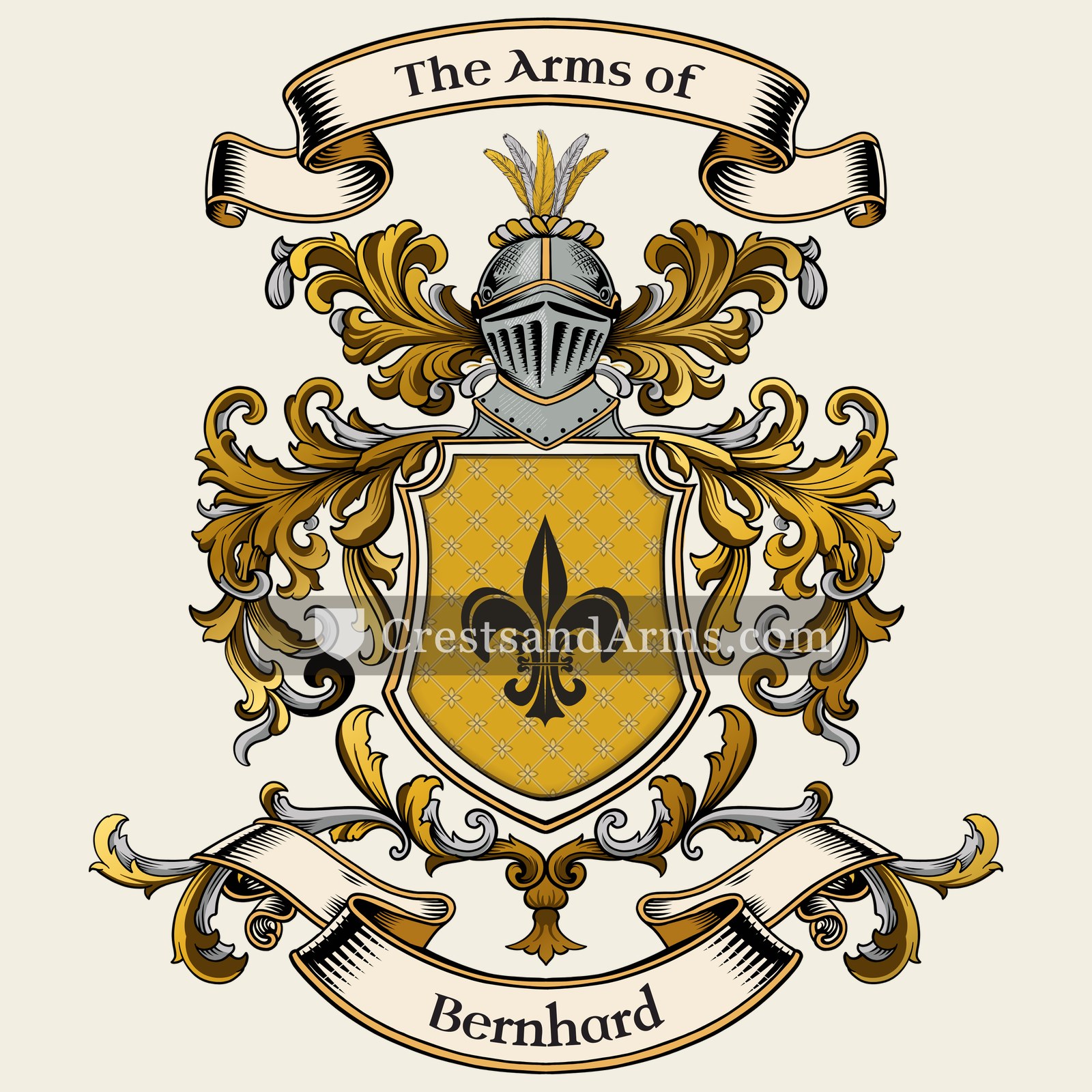


 bendDefence, and the scarf of a commander
 unicornPurity, and extreme courage in defence of honour