A record of documented arms, meaning and origin, researched for the Bernhart family lines. Documented in 3 countries.
Reg. 7851 · German, A–C
Coat of Arms & Family Crest Details
Symbols on this shield
bendDefence, and the scarf of a commander
wolfReward from long service and hard work
Colours
Gold (Or)Means: Generosity
Red (Gules)Means: Military strength
Silver (Argent)Means: Peace and sincerity
Historical info
Source
J. B. Rietstap, Armorial Général, Gouda: G. B. van Goor Zonen, 1884–87
Blazon (the actual original written record)
“Tranché: au 1 d'or à un loup pass. au nat., en bande; au 2 de gu. à la bande d'arg. Cq. cour. C.: le loup, iss. L.: à dextre d'or et de sa., à sen. d'arg. et de gu.”
SaxonySaxony, c. 1765
Digital archive packCoat of arms PNG, gold border print PDF, vector SVG and the certificate of authenticity. Sent to your email in minutes.
Map of Germany showing where the Bernhart arms are recorded
The Bernhart arms were recorded in Saxony, c. 1765.
Saxony had mines, trade and old landed families all at once. Silver made some fortunes and land held others, and both sorts of family kept arms, which is why Saxon names appear so often in the registers.
This is where the arms were entered in the register. Families often moved to other parts of the country, so the same name can turn up in more than one region.
The body that granted and recorded arms in Germany in this period.
Francis I, Holy Roman Emperor
Sovereign of the period
Francis I, Holy Roman Emperor
1745–1765
Reigning in Germany when the Bernhart arms are first recorded.
How Arms Worked in Germany
In the Holy Roman Empire, coats of arms were often granted to individuals by the Emperor or his representatives. These arms were then passed down through the generations to all legitimate descendants of the original holder. Younger branches of a family usually kept the same shield design without needing to change it, as the arms belonged to the entire lineage.
Granting authority
The Holy Roman Emperor held the sole power to grant new coats of arms throughout his vast imperial territories.
How they got arms
Families typically obtained their coats of arms through a formal imperial grant or by proving their noble status to the authorities.
Where arms were recorded
These grants were officially recorded in the Imperial Chancery registers, which began keeping formal records of such honors during the Middle Ages.
The family's standing
Recorded among the armigerous families of Saxony.
Origin & History of the Bernhart Family in Germany
The name Bernhart traces its roots to the Old High German language, where it was formed by combining the words for bear and brave or hardy. This name was popular among Germanic tribes because it suggested the strength and courage associated with the bear, which was a respected animal in early European folklore. By the time the name became established in the region of Saxony during the eighteenth century, it had evolved from a personal name into a hereditary surname. Families living in Saxony in 1765 were often tied to the land through farming or local trades, and they lived during a period of significant social change as the region transitioned through the aftermath of the Seven Years' War. As the family name became fixed in official church and civil records during this era, it reflected the long-standing cultural traditions of the German people who valued both individual character and family lineage.
Coat of Arms & Family Crest Details
Symbols on this shield
bearStrength, cunning and protection of kin
Colours
Silver (Argent)Means: Peace and sincerity
Red (Gules)Means: Military strength
Black (Sable)Means: Constancy
Historical info
Source
J. B. Rietstap, Armorial Général, Gouda: G. B. van Goor Zonen, 1884–87
Blazon (the actual original written record)
“Taillé d'arg. sur gu., l'arg. ch. d'un ours naiss. de sa., mouv. du taillé. C.: l'ours iss. L.: à dextre d'arg. et de gu., à sen. d'arg. et de sa.”
Switzerlandc. 1745
Digital archive packCoat of arms PNG, gold border print PDF, vector SVG and the certificate of authenticity. Sent to your email in minutes.
Map of Switzerland showing where the Bernhart arms are recorded
The Bernhart arms were recorded in Switzerland, c. 1745.
Arms such as these were typically recorded in Bern.
Bern was the largest of the Swiss cantons and ran itself, with its own council and its own courts. Its governing families held office for generations, and office of that kind carried a shield with it.
This is where the arms were entered in the register. Families often moved to other parts of the country, so the same name can turn up in more than one region.
The body that granted and recorded arms in Switzerland in this period.
How Arms Worked in Switzerland
In Switzerland, coats of arms were not restricted to the nobility and were often adopted by common citizens and families. These symbols were passed down through generations to show family identity. When branches of a family grew, they often changed small details of the design to distinguish their own line from the original group.
Granting authority
Cantonal and civic authorities managed the use of coats of arms within their specific regions and local jurisdictions.
How they got arms
Families typically assumed their own coats of arms based on local custom rather than receiving them from a central monarch.
Where arms were recorded
Arms were recorded in various cantonal and civic registers starting from the fourteenth century throughout the Swiss region.
The family's standing
Recorded among the armigerous families of Switzerland.
Origin & History of the Bernhart Family in Switzerland
The name Bernhart belongs to a group of surnames that evolved from ancient Germanic personal names, specifically combining the words for bear and brave. In the context of Switzerland, the name gained a firm foothold in the region of Bern by the mid-18th century. By 1745, families bearing this name were well-established members of the local community, likely participating in the agricultural and trade-based economy that defined the Swiss cantons during that era. Because the name is closely tied to the linguistic roots of the city of Bern, it is probable that early ancestors were deeply integrated into the social and civic structures of the region. These families lived through a period of significant political stability in Switzerland, which allowed them to maintain their presence in the area for generations. As they settled into their lives in the 1700s, the Bernhart family contributed to the local culture and the development of the Swiss identity that persists in the region today.
Coat of Arms & Family Crest Details
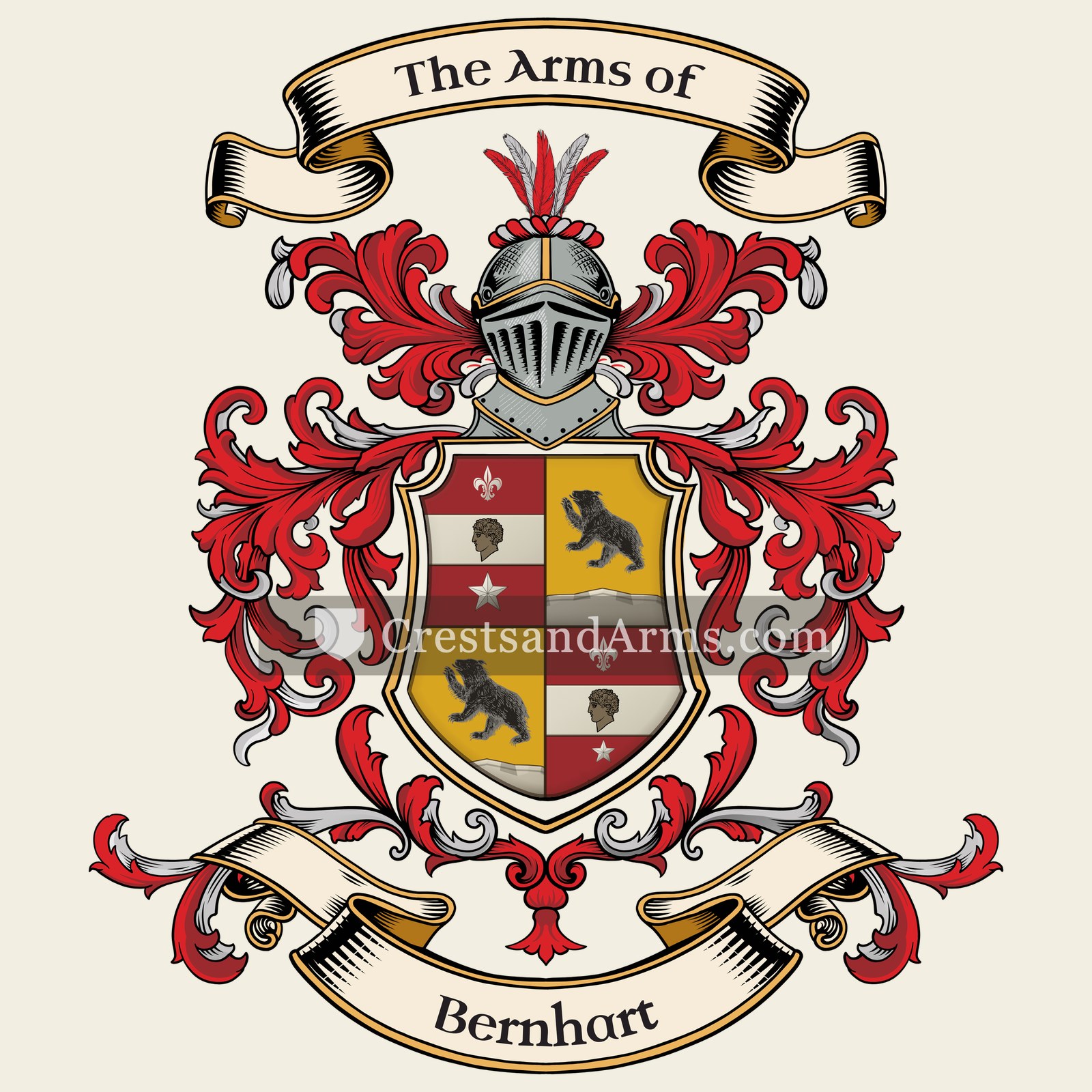
Symbols on this shield
fessThe military belt, and readiness to serve
mountThe ground held, and steadfastness upon it
savages head affrontyAn enemy overcome
fleur de lisPurity, light, and the sixth son
mulletThe third son, and a divine quality from above
bearStrength, cunning and protection of kin
Colours
Red (Gules)Means: Military strength
Gold (Or)Means: Generosity
Silver (Argent)Means: Peace and sincerity
Black (Sable)Means: Constancy
Historical info
Source
J. B. Rietstap, Armorial Général, Gouda: G. B. van Goor Zonen, 1884–87
Blazon (the actual original written record)
“Ec.: aux 1 et 4 de gu. à la fasce d'arg., ch. d'une tête de More, tort. d'or; la fasce acc. en chef d'une fleur-de-lis d'arg. et en p. d'une étoile du même; aux 2 et 3 d'or à un ours ramp. de sa., soutenu d'un tertre d'arg. et tenant entre ses pattes une”
AustriaVienne, c. 1772
Digital archive packCoat of arms PNG, gold border print PDF, vector SVG and the certificate of authenticity. Sent to your email in minutes.
Map of Austria showing where the Bernhart arms are recorded
The Bernhart arms were recorded in Vienne, c. 1772.
This is where the arms were entered in the register. Families often moved to other parts of the country, so the same name can turn up in more than one region.
Region
Vienne
Town
Vienne
First recorded
1772
Granting Authority for the Bernhart Arms
Imperial and Royal chancery
Sodacan · CC BY-SA 3.0
The body that granted and recorded arms in Austria in this period.
Joseph II, Holy Roman Emperor
Sovereign of the period
Joseph II, Holy Roman Emperor
1765–1790
Reigning in Germany when the Bernhart arms are first recorded.
How Arms Worked in Austria
Austrian coats of arms were often linked directly to noble titles granted by the Emperor. These symbols belonged to the entire family line rather than just one individual. When a family grew, new branches kept the original design without needing to change it. This system allowed all members of a noble house to share the same identity across many generations.
Granting authority
The Imperial and Royal chancery managed all heraldic matters and controlled the official granting of arms throughout the Austrian lands.
How they got arms
Families typically received their arms through a formal imperial decree that often accompanied the elevation of a person to noble status.
Where arms were recorded
Official records of these grants were kept in the Imperial Register of Nobility which began its formal documentation process in 1453.
The family's standing
Recorded among the armigerous families of Austria.
Origin & History of the Bernhart Family in Austria
The surname Bernhart finds its roots in the Germanic naming tradition, combining the elements for bear and brave or hardy. By the time the family was established in Vienna in 1772, the name had already become a well-integrated part of the Austrian social landscape. During the late eighteenth century, Vienna served as a vibrant center of the Habsburg Empire, attracting skilled tradespeople and professionals from across the surrounding regions. Families like the Bernharts often occupied roles as artisans or merchants who contributed to the city’s growing urban economy. As the family settled into the capital, they became part of a demographic shift that saw surnames transition from simple descriptors to permanent identifiers passed down through generations. This period of residency in Vienna suggests that the family was likely part of the industrious middle class that helped sustain the administrative and cultural life of the city during the Enlightenment.
Bernhart Meaning & Related Branches
Root word
Bernhard
Derived from Germanic elements meaning bear and brave or hardy.
This name
BernhartA surname signifying someone with the strength, courage, or ferocity of a bear.
also spelled
Bernhard
Bernhardt
Barnhart
Related arms
Gellassimilar arms
Bernhardvariant spelling
Bernhardtvariant spelling
Documented Sources
J. B. Rietstap, Armorial Général, Gouda: G. B. van Goor Zonen, 1884–87
Bahlow, Hans, Deutsches Namenlexikon: Familien- und Vornamen nach Ursprung und Sinn erklärt, 1967
Heintze, Albert, Die deutschen Familien-Namen: geschichtlich, geographisch, sprachlich, 1903
Sächsisches Staatsarchiv, Kirchenbücher der Evangelisch-Lutherischen Landeskirche Sachsens, 1765
Digital archive packCoat of arms PNG, gold border print PDF, vector SVG and the certificate of authenticity. Sent to your email in minutes.


 bendDefence, and the scarf of a commander
 wolfReward from long service and hard work
 bendDefence, and the scarf of a commander
 wolfReward from long service and hard work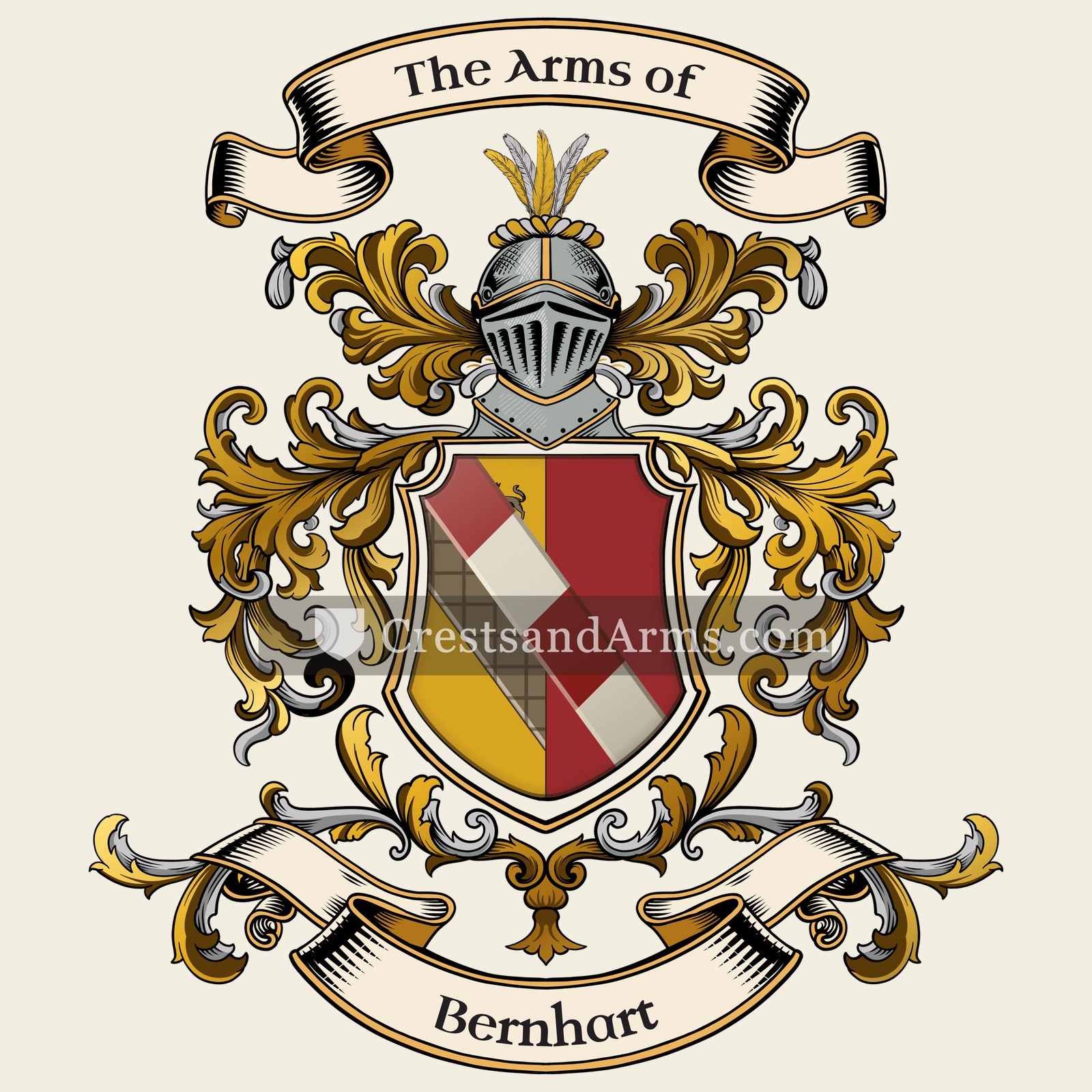


 bearStrength, cunning and protection of kin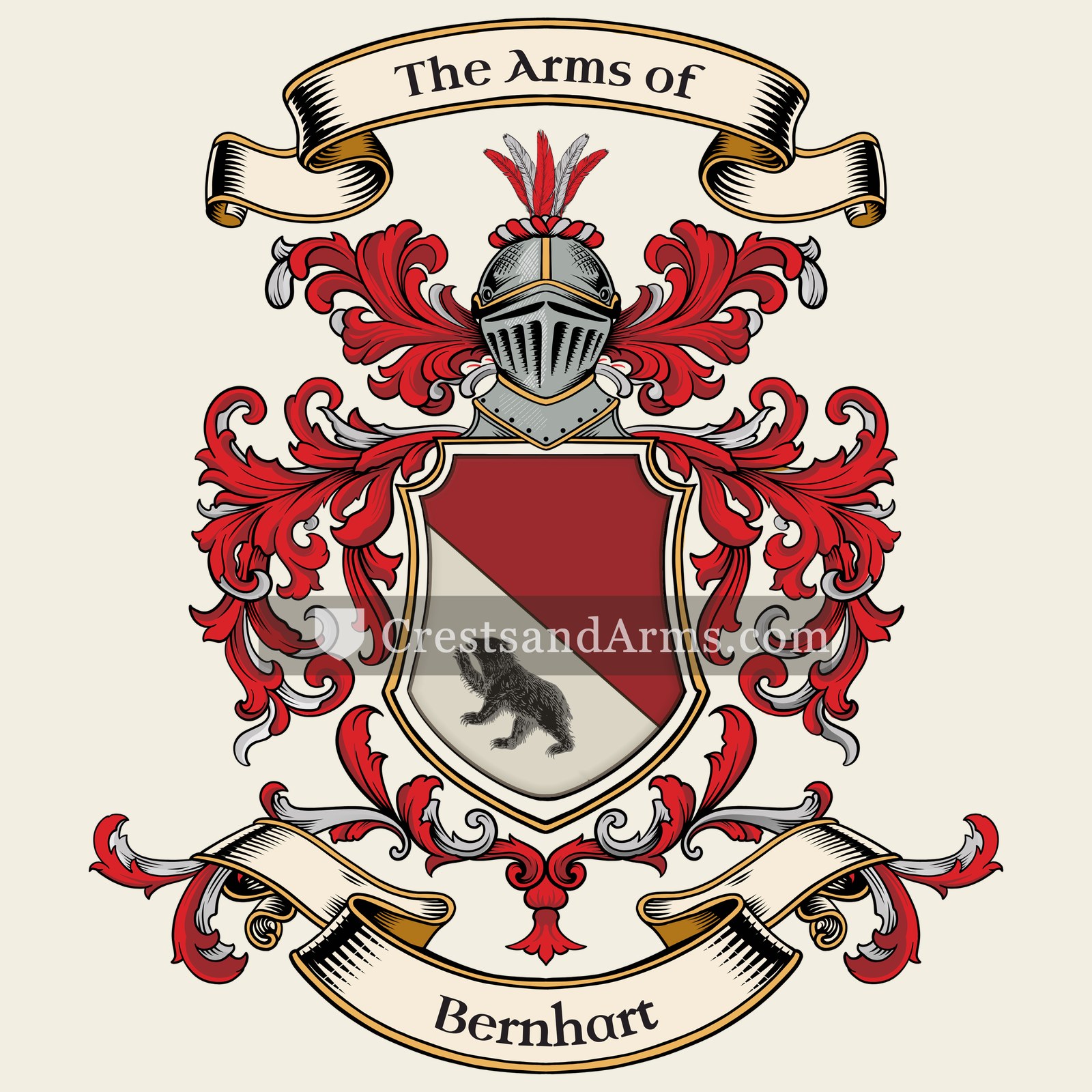

 fessThe military belt, and readiness to serve
 mountThe ground held, and steadfastness upon it
 savages head affrontyAn enemy overcome
 fleur de lisPurity, light, and the sixth son
 mulletThe third son, and a divine quality from above