A record of documented arms, meaning and origin, researched for the Bernstorff family lines. Documented in 2 countries.
Reg. 8801 · German, A–C
Coat of Arms & Family Crest Details
Symbols on this shield
fessThe military belt, and readiness to serve
leafHappiness and abundance
Colours
Red (Gules)Means: Military strength
Silver (Argent)Means: Peace and sincerity
Green (Vert)Means: Hope
Historical info
Source
J. B. Rietstap, Armorial Général, Gouda: G. B. van Goor Zonen, 1884–87
Blazon (the actual original written record)
“De gu. à la fasce ondée d'arg., ch. de trois feuilles de tilleul de sin., les tiges en haut. Cq. cour. C.: une queue de paon, au nat. L. d'arg. et de gu.”
MecklenburgFrancfort s · Mecklenburg, c. 1765
Digital archive packCoat of arms PNG, gold border print PDF, vector SVG and the certificate of authenticity. Sent to your email in minutes.
Map of Germany showing where the Bernstorff arms are recorded
The Bernstorff arms were recorded in Mecklenburg, c. 1765.
Mecklenburg was farming country in the north of Germany, held by a small number of families who kept their estates for generations. Owning land was what entitled a family to arms, so a great many Mecklenburg names ended up in the registers.
This is where the arms were entered in the register. Families often moved to other parts of the country, so the same name can turn up in more than one region.
The body that granted and recorded arms in Germany in this period.
Francis I, Holy Roman Emperor
Sovereign of the period
Francis I, Holy Roman Emperor
1745–1765
Reigning in Germany when the Bernstorff arms are first recorded.
How Arms Worked in Germany
In the Holy Roman Empire, coats of arms were often granted to individuals by the Emperor or his representatives. These arms were then passed down through the generations to all legitimate descendants of the original holder. Younger branches of a family usually kept the same shield design without needing to change it, as the arms belonged to the entire lineage.
Granting authority
The Holy Roman Emperor held the sole power to grant new coats of arms throughout his vast imperial territories.
How they got arms
Families typically obtained their coats of arms through a formal imperial grant or by proving their noble status to the authorities.
Where arms were recorded
These grants were officially recorded in the Imperial Chancery registers, which began keeping formal records of such honors during the Middle Ages.
The family's standing
Recorded among the armigerous families of Mecklenburg.
Origin & History of the Bernstorff Family in Germany
The Bernstorff family name originates from the ancient lands of Mecklenburg in northern Germany, where the family established deep roots as members of the regional nobility. By the time historical records confirm their presence in the area during the mid-eighteenth century, the family had already built a reputation for significant influence within the local government and social hierarchy. The name itself is tied to the geography of the region, reflecting the long-standing tradition of families identifying with their ancestral estates and landholdings. Over many generations, the Bernstorffs became known for their service to the state, often holding high-ranking positions that allowed them to shape the political landscape of Mecklenburg. Their history is defined by a steady rise in prominence, as they transitioned from local landowners to key figures in the broader German administration. This trajectory highlights how a family name can become synonymous with regional leadership and historical continuity over several centuries.
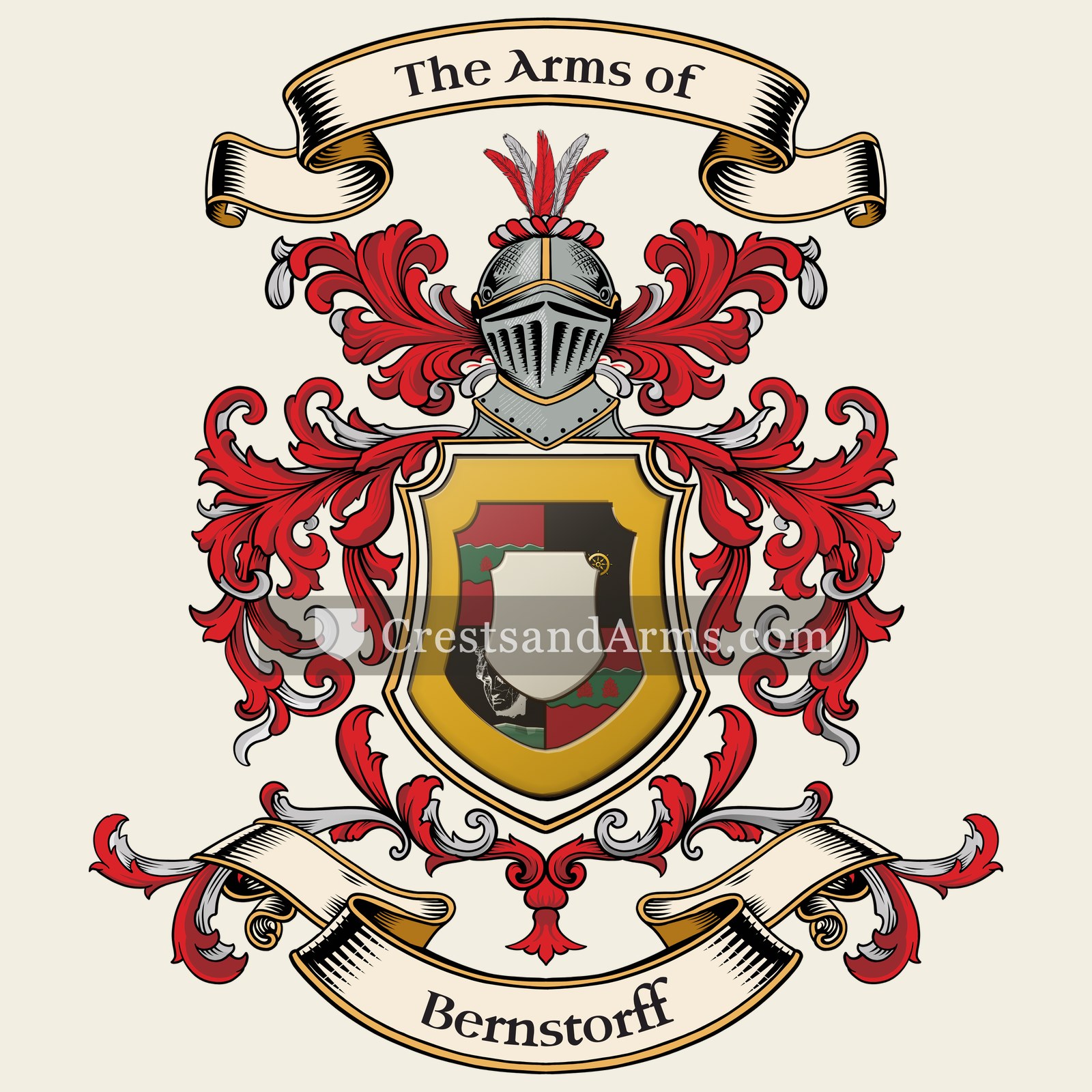
Coat of Arms & Family Crest Details
Symbols on this shield
fessThe military belt, and readiness to serve
mountThe ground held, and steadfastness upon it
leafHappiness and abundance
wheelFortune's turning, and the carter's trade
womanGrace, and the founding of a house
Colours
Red (Gules)Means: Military strength
Black (Sable)Means: Constancy
Silver (Argent)Means: Peace and sincerity
Gold (Or)Means: Generosity
Green (Vert)Means: Hope
Historical info
Source
J. B. Rietstap, Armorial Général, Gouda: G. B. van Goor Zonen, 1884–87
Blazon (the actual original written record)
“Ec.: aux 1 et 4 de gu. à la fasce ondée d'arg., ch. de trois feuilles de tilleul de sin., les tiges en haut; au 2 de sa. à deux demi-roues adossées d'or; au 3 d'azur à une femme cont., hab. de gu., chevelée et cour. d'or, iss. par les genoux d'une colline au nat., supp. de ses mains une couronne civique de sin. L'écu bordé d'une filière d'or. Sur le tout d'arg. à une couronne civique de sin. Trois cq. cour. C.: 1º la femme de l'écu; 1. d'or et de sa.; 2º une queue de paon au nat.; 1. d'arg. et de gu.; 3º un vol à l'antique, aux armes du 2; 1. d'arg. et d'azur. S. à dextre une aigle reg. de sa., bq. et m. d'or, languée de gu.; à sen. un lion d'or, lamp. de gu. (ou, une panthère au nat.) D.: HIER WEISLICH, DORT GLÜCKLICH.”
MecklenburgHan · Mecklenburg, c. 1715
Digital archive packCoat of arms PNG, gold border print PDF, vector SVG and the certificate of authenticity. Sent to your email in minutes.
Map of Denmark showing where the Bernstorff arms are recorded
The Bernstorff arms were recorded in Mecklenburg, c. 1715.
Mecklenburg was farming country in the north of Germany, held by a small number of families who kept their estates for generations. Owning land was what entitled a family to arms, so a great many Mecklenburg names ended up in the registers.
This is where the arms were entered in the register. Families often moved to other parts of the country, so the same name can turn up in more than one region.
The body that granted and recorded arms in Denmark in this period.
Frederik IV of Denmark
Sovereign of the period
Frederik IV of Denmark
1699–1730
Reigning in Germany when the Bernstorff arms are first recorded.
How Arms Worked in Denmark
Danish heraldry during this period was closely tied to noble status and royal favor rather than being open to all citizens. Arms were typically granted by the monarch to individuals, and these symbols were then shared by all members of the noble house. If a family line died out, the right to use those specific arms ended with them.
Granting authority
The Danish royal chancery held the power to issue and regulate official coats of arms for the kingdom.
How they got arms
Families usually received their arms through a formal royal grant that confirmed their noble status and rights.
Where arms were recorded
These grants were officially recorded in the Danish Royal Chancery records starting in the sixteenth century.
The family's standing
Recorded among the armigerous families of Mecklenburg.
Origin & History of the Bernstorff Family in Denmark
The Bernstorff family originated in the region of Mecklenburg before rising to great prominence in the Kingdom of Denmark during the eighteenth century. Andreas Gottlieb von Bernstorff served as a key diplomat and eventually became the leading minister for the Danish crown. His influence helped the family establish deep roots in Danish society and politics. By moving from their ancestral lands in northern Germany to the royal court in Copenhagen, the family secured vast estates and high-ranking government positions. This transition marked the beginning of a long era where the Bernstorffs shaped Danish foreign policy and agricultural reforms. Their legacy remains tied to the modernization of the Danish state and their significant role in the administration of the monarchy.
Bernstorff Meaning & Related Branches
Root word
Bernstorf
A village settlement associated with a person named Bern or Bjorn.
This name
BernstorffRefers to a noble family originating from the village of Bernstorf in Mecklenburg.
also spelled
Bernstorf
Bernstorfe
Documented Sources
J. B. Rietstap, Armorial Général, Gouda: G. B. van Goor Zonen, 1884–87
Kneschke, Ernst Heinrich, Neues allgemeines deutsches Adels-Lexicon, 1859


 fessThe military belt, and readiness to serve
 leafHappiness and abundance
 fessThe military belt, and readiness to serve
 leafHappiness and abundance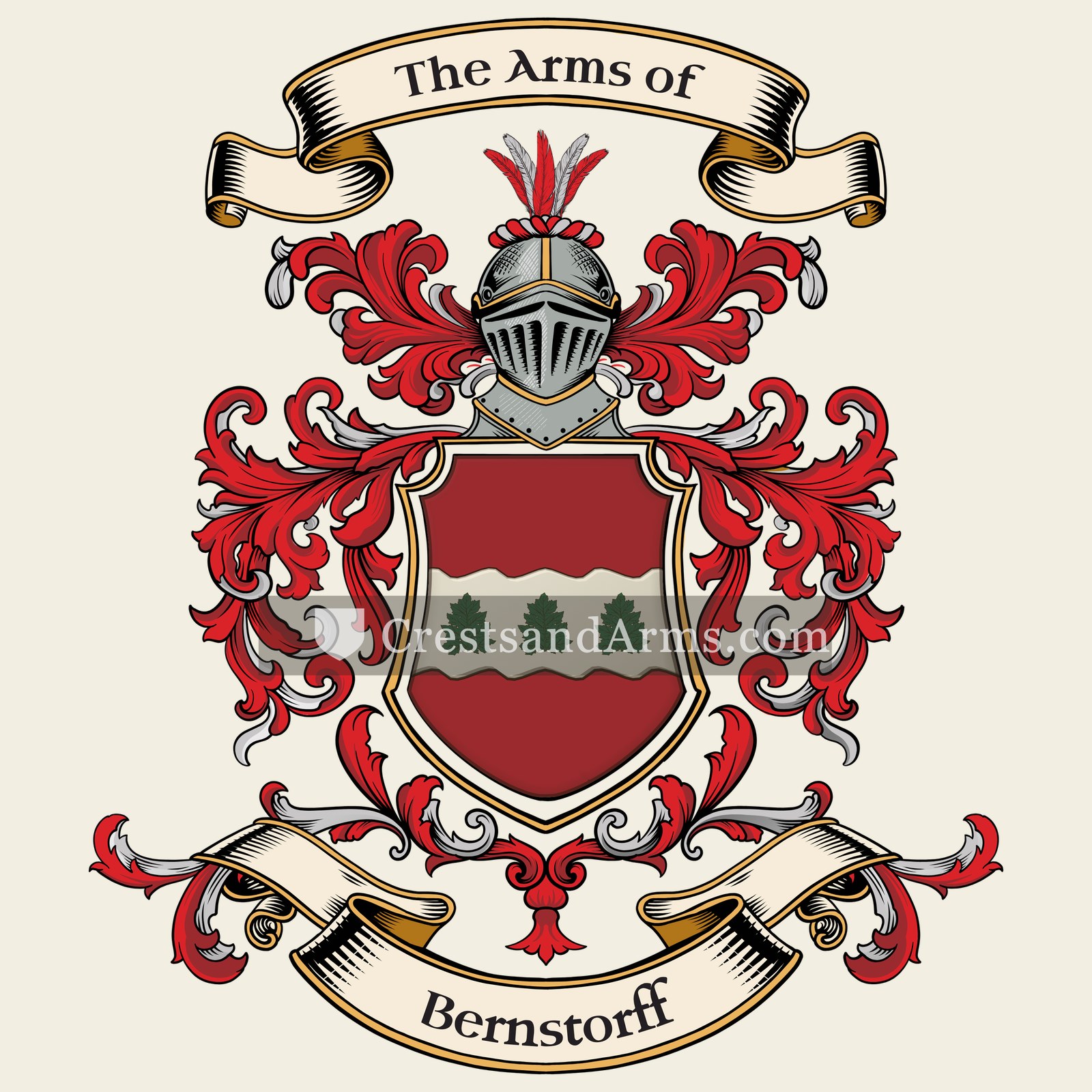


 mountThe ground held, and steadfastness upon it
 wheelFortune's turning, and the carter's trade
 womanGrace, and the founding of a house