A record of documented arms, meaning and origin, researched for the Berrington family lines. Documented in 2 countries.
Reg. 5971 · Welsh, A–C
Coat of Arms & Family Crest Details
Symbols on this shield
greyhoundCourage, vigilance and loyalty
wolfReward from long service and hard work
Colours
Black (Sable)Means: Constancy
Blue (Azure)Means: Loyalty and truth
Silver (Argent)Means: Peace and sincerity
Historical info
Source
Sir Bernard Burke, The General Armory of England, Scotland, Ireland and Wales, London: Harrison & Sons, 1884
Blazon (the actual original written record)
“Quarterly, 1st and 4th, sa. three greyhounds courant ar.; 2nd and 3rd, az. a wolf saliant ar., for Davies, descended from Lydwal Gloff, fifth son of Rodri Mawr, a Prince of the 9th century”
MonmouthPant-y-Goitre · Monmouth, c. 1647
Digital archive packCoat of arms PNG, gold border print PDF, vector SVG and the certificate of authenticity. Sent to your email in minutes.
Map of Wales showing where the Berrington arms are recorded
The Berrington arms were recorded in Monmouth, c. 1647.
Monmouthshire lay on the Welsh border, where land was held in return for military service. Families were expected to arm and to fight, and fighting households carried shields of their own.
This is where the arms were entered in the register. Families often moved to other parts of the country, so the same name can turn up in more than one region.
The body that granted and recorded arms in Wales in this period.
Charles I of England
Sovereign of the period
Charles I of England
1625–1649
Reigning in Wales when the Berrington arms are first recorded.
How Arms Worked in Wales
English heraldry allowed arms to be shared by all legitimate descendants of the original owner. These symbols were treated as personal property that moved through the generations to all children. While the eldest son kept the original design, other family members could use the same shield without needing to change it or register their own unique versions.
Granting authority
The College of Arms in London has regulated the use of coats of arms throughout England and Wales since 1484.
How they got arms
Families typically obtained their coats of arms through a formal grant from the Crown or by proving their ancient right to them.
Where arms were recorded
All official coats of arms are recorded in the registers kept at the College of Arms, which date back to the fifteenth century.
The family's standing
Recorded among the armigerous families of Monmouth.
Origin & History of the Berrington Family in Wales
The Berrington family name carries a deep connection to the borderlands between England and Wales, specifically within the historic county of Monmouthshire. By the mid-seventeenth century, the family was firmly established in the town of Monmouth, a strategic location nestled at the confluence of the Monnow and Wye rivers. During this period, the region was a complex landscape of shifting loyalties and social change, particularly following the turmoil of the English Civil War. Records from 1647 confirm that members of the Berrington family were active participants in the local life of Monmouth, likely navigating the transition from military conflict to civil administration. As residents of a Welsh border town, they were part of a unique cultural exchange where English administrative systems and Welsh social structures met. Their presence in the area suggests they were integrated into the local gentry or merchant classes who helped maintain stability in the region during a time of significant national upheaval.
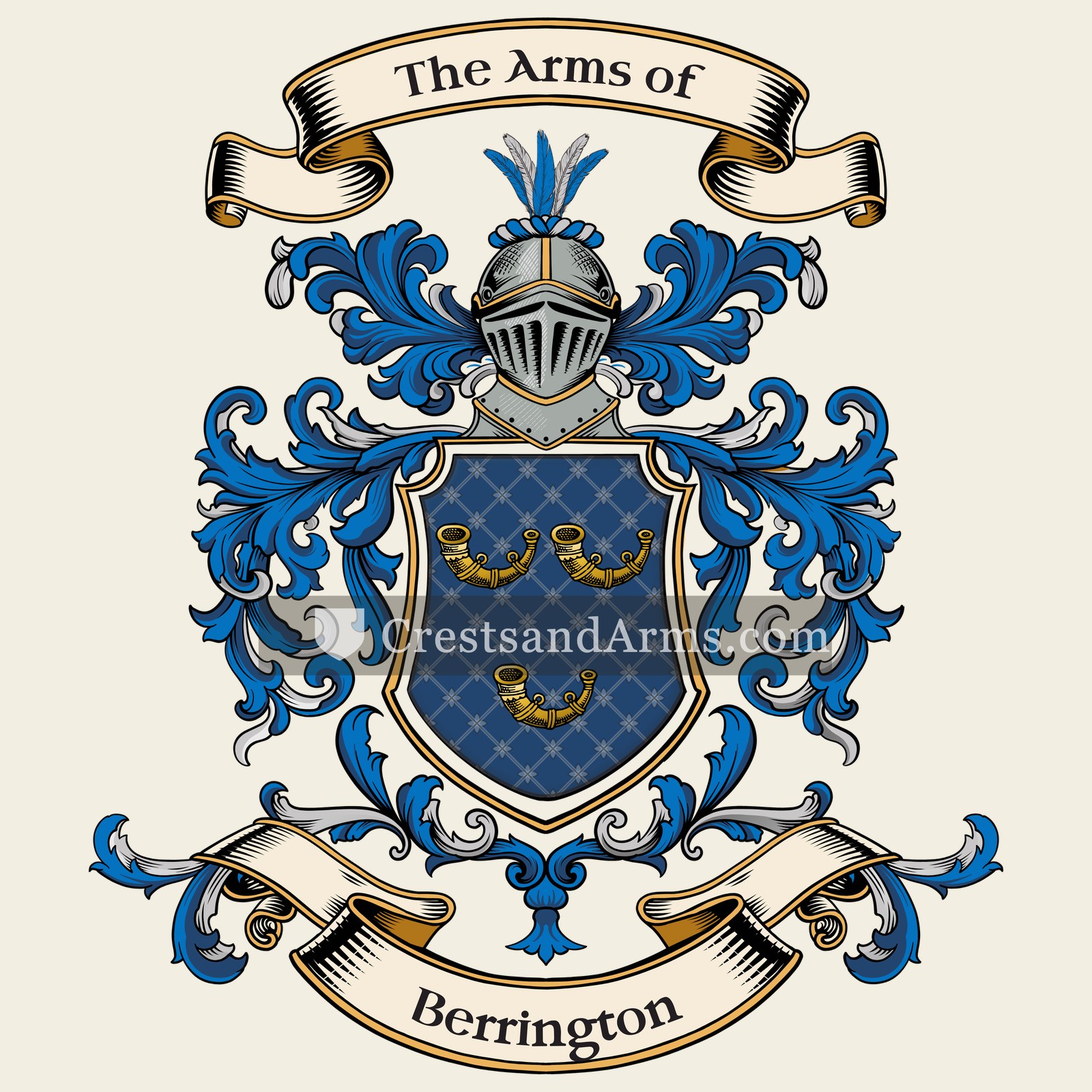
Coat of Arms & Family Crest Details
Symbols on this shield
hunting horn stringedOne who delights in the chase
Colours
Blue (Azure)Means: Loyalty and truth
Gold (Or)Means: Generosity
Historical info
Source
Sir Bernard Burke, The General Armory of England, Scotland, Ireland and Wales, London: Harrison & Sons, 1884
Blazon (the actual original written record)
“Az. three bugle horns stringed or”
DevonDevon, c. 1620
Digital archive packCoat of arms PNG, gold border print PDF, vector SVG and the certificate of authenticity. Sent to your email in minutes.
Map of England showing where the Berrington arms are recorded
The Berrington arms were recorded in Devon, c. 1620.
Devon was a county of small manors and seafaring families. Its gentry were spread thickly across the countryside, and money made at sea often bought an estate, which in turn brought a coat of arms.
This is where the arms were entered in the register. Families often moved to other parts of the country, so the same name can turn up in more than one region.
The body that granted and recorded arms in England in this period.
James VI and I
Sovereign of the period
James VI and I
1603–1625
Reigning in Wales when the Berrington arms are first recorded.
How Arms Worked in England
English heraldry allowed arms to be shared by all legitimate descendants of the original owner. These symbols were treated as personal property that moved through the generations to all children. While the eldest son kept the original design, other family members could use the same shield without needing to change it or register their own unique versions.
Granting authority
The College of Arms in London has regulated the use of coats of arms throughout England and Wales since 1484.
How they got arms
Families typically obtained their coats of arms through a formal grant from the Crown or by proving their ancient right to them.
Where arms were recorded
All official coats of arms are recorded in the registers kept at the College of Arms, which date back to the fifteenth century.
The family's standing
Recorded among the armigerous families of Devon.
Origin & History of the Berrington Family in England
The surname Berrington is a locational name that originated from small settlements in England, typically referring to a town or estate belonging to a person named Beorn. By the early 17th century, the family had established a notable presence in the county of Devon. During this period, the region was a hub of maritime activity and agricultural development, which likely influenced the movement and settlement patterns of the family. The name reflects the common practice in medieval England of identifying individuals by their place of origin or residence. As the family settled in Devon by 1620, they became part of the local social fabric during a time of significant transition in English history. Their presence in the historical records of the region suggests that they were integrated into the local community life, contributing to the growth and identity of the area during the early modern era.
Berrington Meaning & Related Branches
Root word
Bere-tun
An enclosure or settlement associated with barley or a bear.
This name
BerringtonRefers to a person originating from a settlement located near a barley field or bear habitat.
also spelled
Berintun
Beryngton
Related arms
Machellsimilar arms
Allenrecorded with Berrington, same area
Dragerecorded with Berrington, same area
Edwardsrecorded with Berrington, same area
Documented Sources
Sir Bernard Burke, The General Armory of England, Scotland, Ireland and Wales, London: Harrison & Sons, 1884
The National Archives, State Papers Domestic, 1647
Gwent Archives, Monmouthshire Quarter Sessions Records
Bradney, Joseph, A History of Monmouthshire from the Coming of the Normans into Wales down to the Present Time, 1904
Kissack, Keith, Monmouth: The Making of a County Town, 1975
Digital archive packCoat of arms PNG, gold border print PDF, vector SVG and the certificate of authenticity. Sent to your email in minutes.


 greyhoundCourage, vigilance and loyalty
 wolfReward from long service and hard work
 greyhoundCourage, vigilance and loyalty
 wolfReward from long service and hard work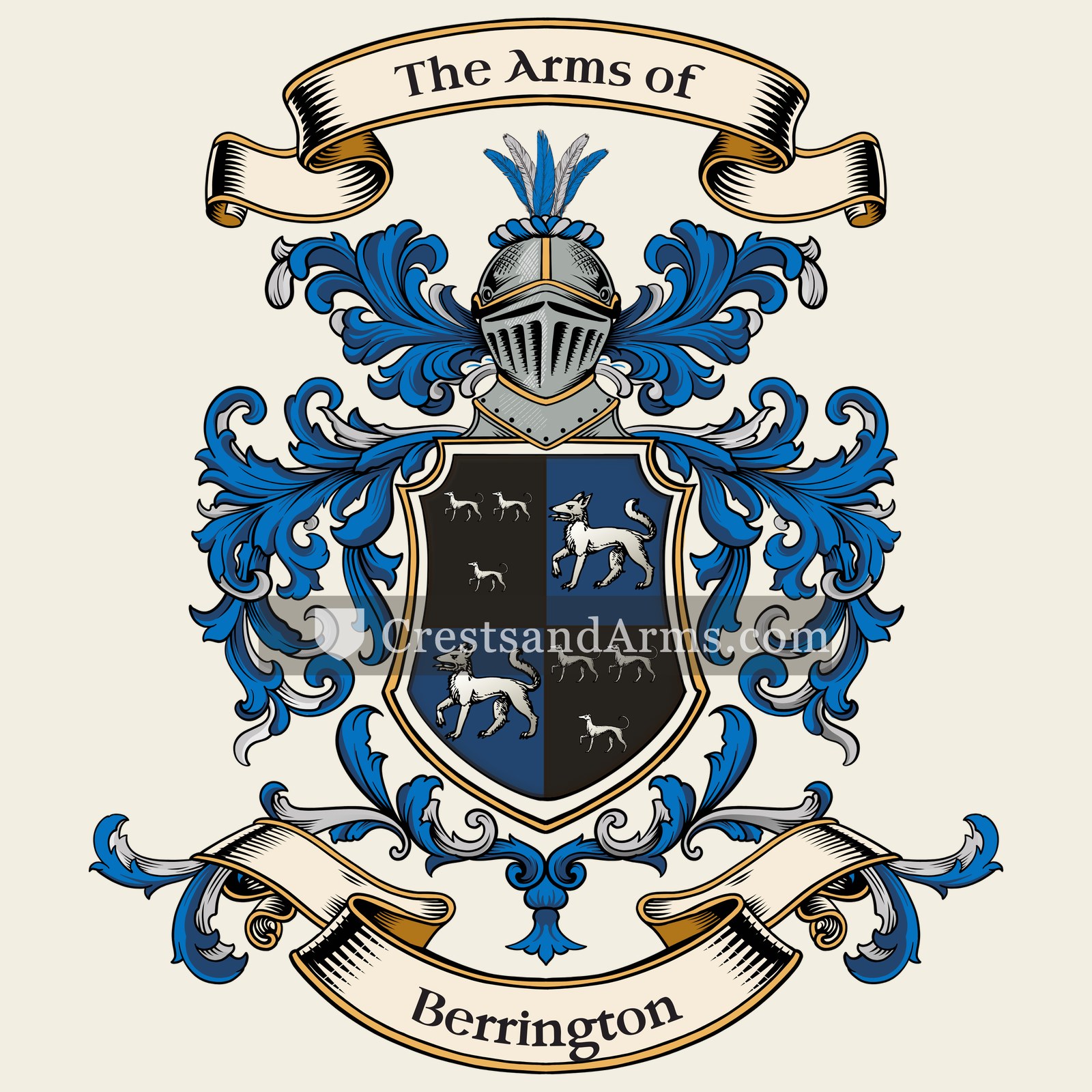


 hunting horn stringedOne who delights in the chase