Map of Switzerland showing where the Berthoud arms are recorded
The Berthoud arms were recorded in Neufchâtel, c. 1745.
This is where the arms were entered in the register. Families often moved to other parts of the country, so the same name can turn up in more than one region.
The body that granted and recorded arms in Switzerland in this period.
How Arms Worked in Switzerland
In Switzerland, coats of arms were not restricted to the nobility and were often adopted by common citizens and families. These symbols were passed down through generations to show family identity. When branches of a family grew, they often changed small details of the design to distinguish their own line from the original group.
Granting authority
Cantonal and civic authorities managed the use of coats of arms within their specific regions and local jurisdictions.
How they got arms
Families typically assumed their own coats of arms based on local custom rather than receiving them from a central monarch.
Where arms were recorded
Arms were recorded in various cantonal and civic registers starting from the fourteenth century throughout the Swiss region.
The family's standing
Recorded among the armigerous families of Switzerland.
Origin & History of the Berthoud Family in Switzerland
The Berthoud family name originates from the French-speaking regions of Switzerland, with deep roots in the canton of Neuchâtel. By the mid-18th century, the family was firmly established in this area, as evidenced by records dating back to 1745. The name itself is derived from the ancient Germanic personal name Berhtwald, which combines elements meaning bright and ruler. Over many generations, the family became well-known for their exceptional skills in precision craftsmanship, particularly in the field of horology. Many early members of the family were highly respected watchmakers who contributed significantly to the development of marine chronometers and scientific instruments. Their dedication to technical innovation helped define the reputation of the Neuchâtel region as a global center for high-quality clockmaking during the Enlightenment era.
Berthoud Meaning & Related Branches
Root word
Berht
Old High German term meaning bright, famous, or illustrious.
This name
BerthoudDerived from a Germanic personal name signifying a bright or noble ruler.
also spelled
Berthoudd
Berthout
Berthoude
Berto
Related arms
du Lyssimilar arms
Hordal du Lyssimilar arms
Perthessimilar arms
Berthoutvariant spelling
Documented Sources
J. B. Rietstap, Armorial Général, Gouda: G. B. van Goor Zonen, 1884–87
Bailly, Jean-Claude. Le Temps des Berthoud. 1984
Tissot, Laurent. Naissance d'une industrie: l'horlogerie en Suisse. 1995
Archives de l'État de Neuchâtel, Fonds de la famille Berthoud, 1745–1850
Digital archive packCoat of arms PNG, gold border print PDF, vector SVG and the certificate of authenticity. Sent to your email in minutes.


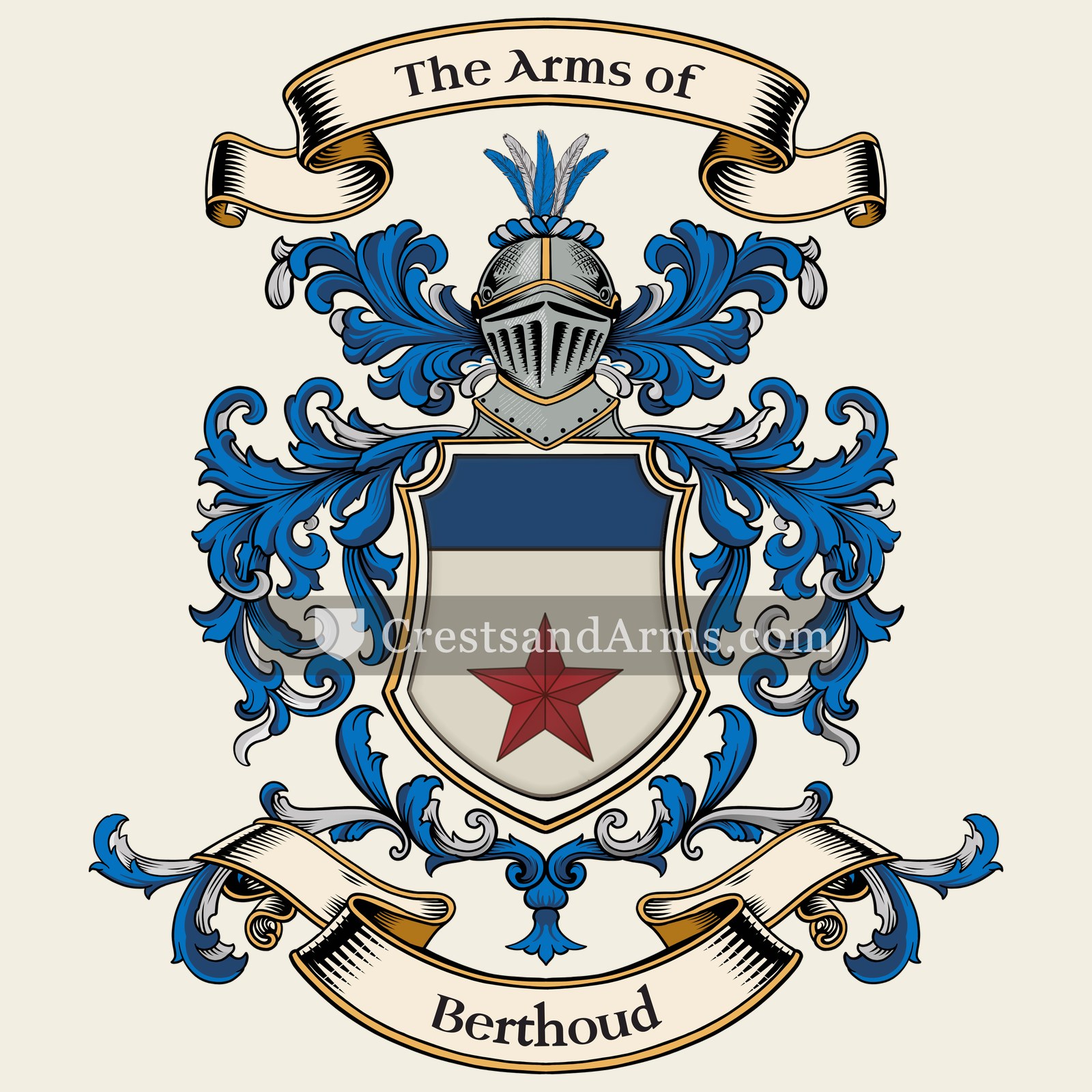
 chiefAuthority, wisdom and dominion
 mulletThe third son, and a divine quality from above
 chiefAuthority, wisdom and dominion
 mulletThe third son, and a divine quality from above