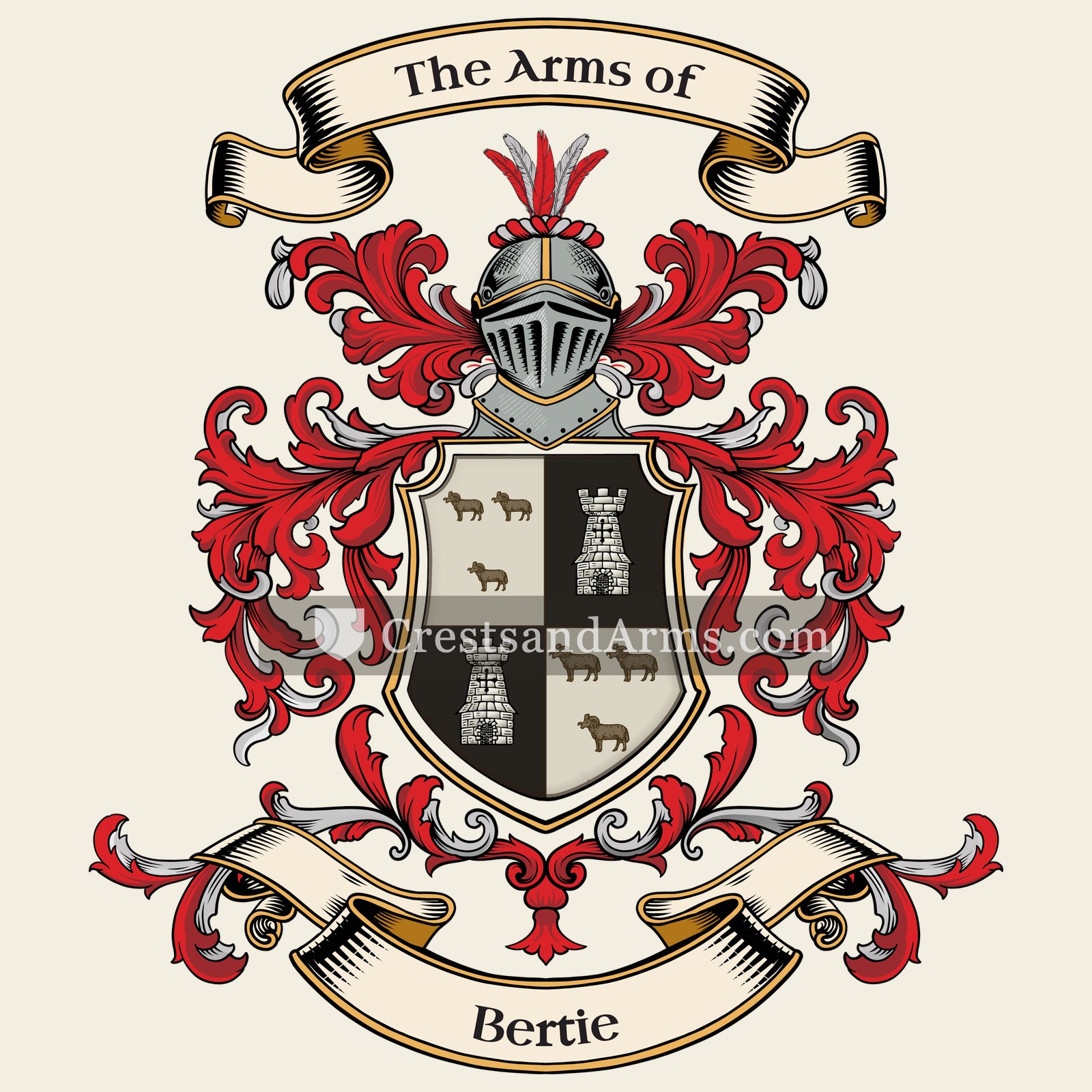
A record of documented arms, meaning and origin, researched for the Bertie family lines. Documented in 2 countries.
Reg. 6391 · German, A–C
Coat of Arms & Family Crest Details
Symbols on this shield
ramLeadership and authority
towerGrandeur and solidity, and a stronghold defended
Colours
Silver (Argent)Means: Peace and sincerity
Black (Sable)Means: Constancy
Historical info
Source
J. B. Rietstap, Armorial Général, Gouda: G. B. van Goor Zonen, 1884–87
Blazon (the actual original written record)
“Ec.: aux 1 et 4 d'arg. à trois béliers militaires au nat., les têtes et les chaines d'azur, posés en fasces, l'un sur l'autre (Bertie); aux 2 et 3 de sa. à la tour masurée d'arg., sommée de trois tourelles du même. C.: un buste de Sarasin au nat., cour. d'or, ch. sur sa poitrine d'une frette d'azur (Willoughby de Eresby). T.: à dextre un moine, tenant un bâton appuyé sur le sol; à sen. un sauvage de earn., ceint et cour. de lierre; ch. tous deux sur leur poitrine d'une frette d'azur. D.: VIRTUS ARIETE FORTIOR.”
Germanyc. 1572
Digital archive packCoat of arms PNG, gold border print PDF, vector SVG and the certificate of authenticity. Sent to your email in minutes.
Map of Germany showing where the Bertie arms are recorded
The Bertie arms were recorded in Germany, c. 1572.
Arms such as these were typically recorded in Bavaria.
Bavaria was a country of old landed families and walled market towns. Estates passed down the same line for centuries, and both the landowners and the leading townsmen kept arms, which is why so many Bavarian names sit in the registers.
This is where the arms were entered in the register. Families often moved to other parts of the country, so the same name can turn up in more than one region.
The body that granted and recorded arms in Germany in this period.
Maximilian II, Holy Roman Emperor
Sovereign of the period
Maximilian II, Holy Roman Emperor
1564–1576
Reigning in Germany when the Bertie arms are first recorded.
How Arms Worked in Germany
In the Holy Roman Empire, coats of arms were often granted to individuals by the Emperor or his representatives. These arms were then passed down through the generations to all legitimate descendants of the original holder. Younger branches of a family usually kept the same shield design without needing to change it, as the arms belonged to the entire lineage.
Granting authority
The Holy Roman Emperor held the sole power to grant new coats of arms throughout his vast imperial territories.
How they got arms
Families typically obtained their coats of arms through a formal imperial grant or by proving their noble status to the authorities.
Where arms were recorded
These grants were officially recorded in the Imperial Chancery registers, which began keeping formal records of such honors during the Middle Ages.
The family's standing
Recorded among the armigerous families of Germany.
Origin & History of the Bertie Family in Germany
The family name Bertie has deep roots in the historical landscape of southern Germany, specifically within the region of Bavaria. By the year 1572, records confirm that members of the family were established residents in this area, living during a time of significant religious and social transition. The name itself likely evolved from older Germanic naming traditions that favored short, descriptive roots related to brightness or nobility. As the family settled into Bavarian life, they integrated into the local economy and social structures that defined the late sixteenth century. Their presence in the region suggests they were part of the growing middle class or landed citizenry who helped shape the local culture of the Holy Roman Empire. Over time, the family name became a permanent fixture in the local records, reflecting the broader movement of families across the German states during the early modern period.
Coat of Arms & Family Crest Details
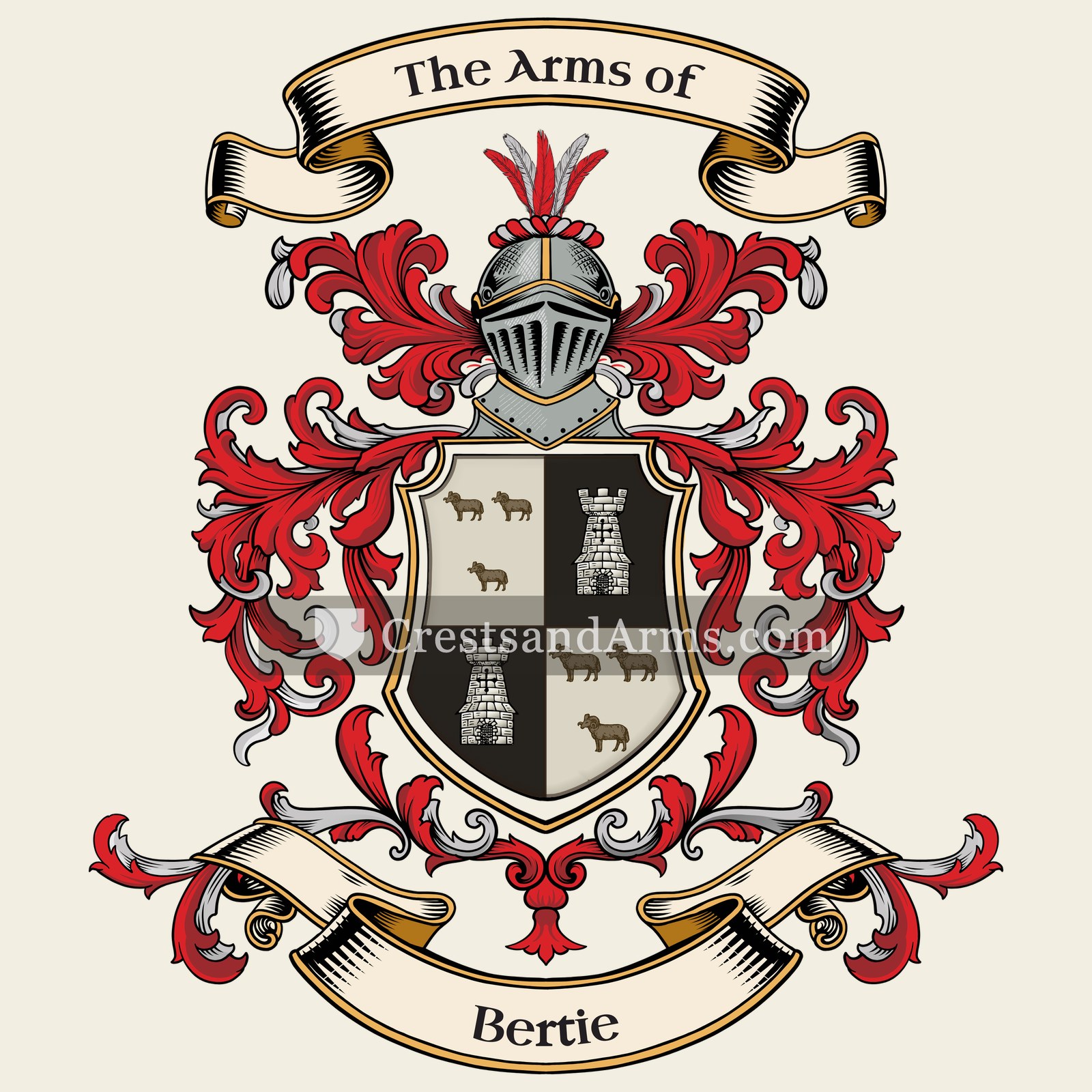
Symbols on this shield
ramLeadership and authority
towerGrandeur and solidity, and a stronghold defended
Colours
Silver (Argent)Means: Peace and sincerity
Black (Sable)Means: Constancy
Historical info
Source
Sir Bernard Burke, The General Armory of England, Scotland, Ireland and Wales, London: Harrison & Sons, 1884
Blazon (the actual original written record)
“1st and 4th, ar. three battering rams barways in pale ppr. headed and garnished az.; 2nd and 3rd, sa. a shattered castle triple towered ar”
EnglandLindsey, c. 1620
Digital archive packCoat of arms PNG, gold border print PDF, vector SVG and the certificate of authenticity. Sent to your email in minutes.
Map of England showing where the Bertie arms are recorded
The Bertie arms were recorded in Lindsey, c. 1620.
Arms such as these were typically recorded in York.
Yorkshire is the largest of the English counties, and it held more gentry families than any other. Land there was split among a great many households rather than a few, so a great many of them carried arms.
This is where the arms were entered in the register. Families often moved to other parts of the country, so the same name can turn up in more than one region.
The body that granted and recorded arms in England in this period.
James VI and I
Sovereign of the period
James VI and I
1603–1625
Reigning in Germany when the Bertie arms are first recorded.
How Arms Worked in England
English heraldry allowed arms to be shared by all legitimate descendants of the original owner. These symbols were treated as personal property that moved through the generations to all children. While the eldest son kept the original design, other family members could use the same shield without needing to change it or register their own unique versions.
Granting authority
The College of Arms in London has regulated the use of coats of arms throughout England and Wales since 1484.
How they got arms
Families typically obtained their coats of arms through a formal grant from the Crown or by proving their ancient right to them.
Where arms were recorded
All official coats of arms are recorded in the registers kept at the College of Arms, which date back to the fifteenth century.
The family's standing
Recorded among the armigerous families of England.
Origin & History of the Bertie Family in England
The family name Bertie has deep roots in the social fabric of early modern England, with records confirming their presence in the historic city of York by 1620. During this period, the name was associated with families who often lived as merchants or local officials within the bustling trade centers of Northern England. While the name likely evolved from earlier Germanic or Old French naming traditions, those who carried it in the seventeenth century were firmly established as part of the growing urban middle class. By settling in a major administrative hub like York, these early ancestors were well-positioned to participate in the civic and economic life of the region. Their presence in the city archives during the early 1600s reflects a time when families were increasingly documenting their lives through property deeds, parish registers, and trade guild memberships. This transition into the written record helps illustrate how the Bertie name became a permanent part of the English landscape long before the modern era.
Bertie Meaning & Related Branches
Root word
Berht
Old High German word meaning bright, famous, or illustrious.
This name
BertieA diminutive form representing someone who is bright, shining, or glorious.
also spelled
Berty
Bertye
Berti
Bertey
Related arms
Bertyvariant spelling
Farnhamrecorded with Bertie, same area
Documented Sources
J. B. Rietstap, Armorial Général, Gouda: G. B. van Goor Zonen, 1884–87


 ramLeadership and authority
 towerGrandeur and solidity, and a stronghold defended
 ramLeadership and authority
 towerGrandeur and solidity, and a stronghold defended