Map of Britain showing where the Bertram arms are recorded
The Bertram arms were recorded in Britain, c. 1700.
Arms such as these were typically recorded in Kent.
Kent sits between London and the short crossing to Europe, and the trade passing through made it wealthy. Merchant families bought land with that money, and it was landowners who took coats of arms.
This is where the arms were entered in the register. Families often moved to other parts of the country, so the same name can turn up in more than one region.
The body that granted and recorded arms in Britain in this period.
William III of England
Sovereign of the period
William III of England
1694–1702
Reigning in Britain when the Bertram arms are first recorded.
How Arms Worked in Britain
English heraldry allowed arms to be shared by all legitimate descendants of the original owner. These symbols were treated as personal property that moved through the generations to all children. While the eldest son kept the original design, other family members could use the same shield without needing to change it or register their own unique versions.
Granting authority
The College of Arms in London has regulated the use of coats of arms throughout England and Wales since 1484.
How they got arms
Families typically obtained their coats of arms through a formal grant from the Crown or by proving their ancient right to them.
Where arms were recorded
All official coats of arms are recorded in the registers kept at the College of Arms, which date back to the fifteenth century.
The family's standing
Recorded among the armigerous families of Britain.
Origin & History of the Bertram Family in Britain
The name Bertram has deep roots in the British Isles, originating from the Old German name Berhtram, which combines the words for bright and raven. While the name was brought to England by the Normans in the eleventh century, it eventually spread throughout the country as a common surname. By the time the family established a documented presence in Kent during the early 1700s, the name had already been part of the English landscape for hundreds of years. Families in this region during the eighteenth century often lived in rural or market communities, where they worked in trades or agriculture. Because the name was passed down through generations, it reflects the long history of migration and settlement that shaped the local population of Kent. Over time, the name evolved from its ancient linguistic origins into a permanent part of the social fabric of southern England.
Coat of Arms & Family Crest Details
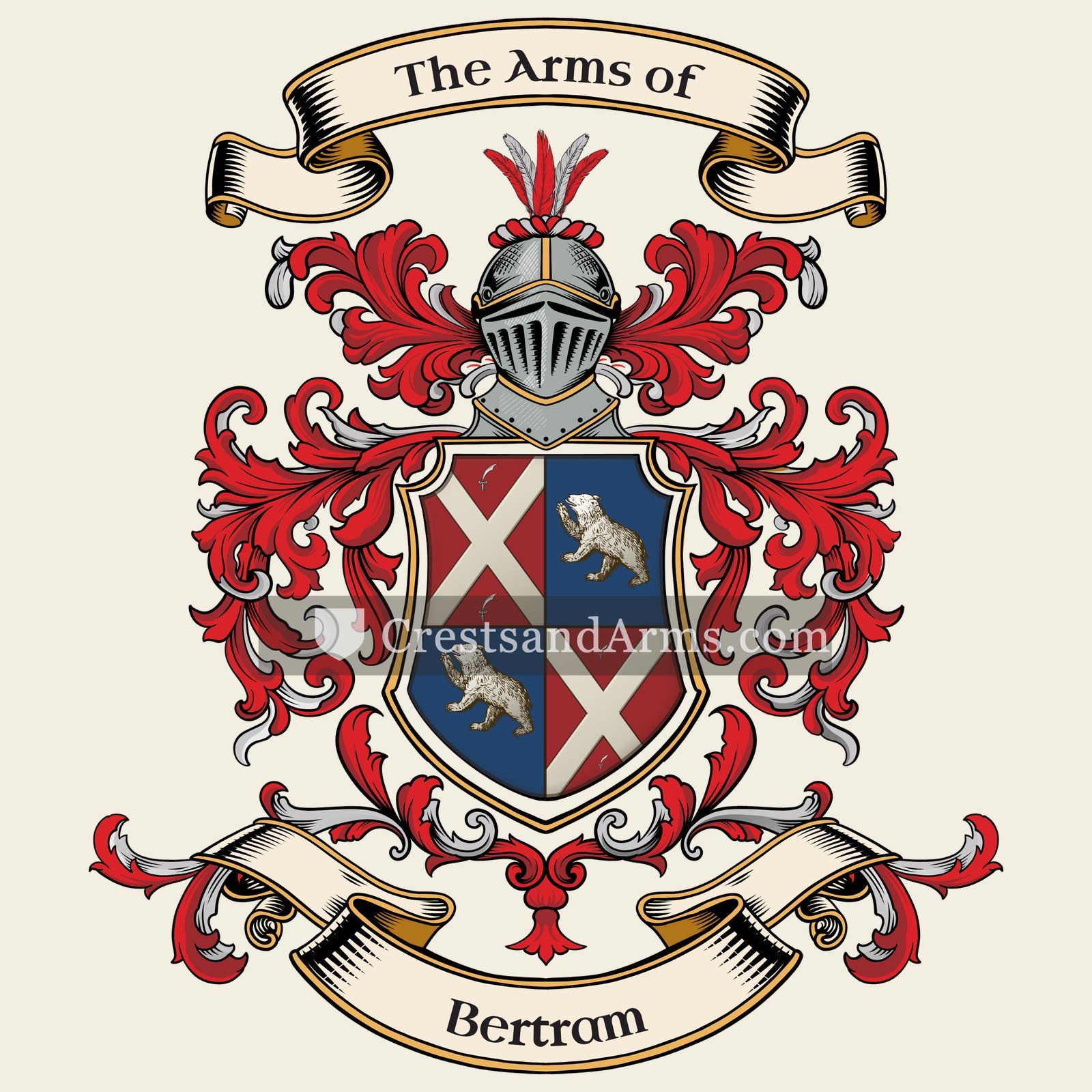
Symbols on this shield
saltireResolution, and St Andrew's cross
swordJustice, and military honour
bearStrength, cunning and protection of kin
Colours
Red (Gules)Means: Military strength
Blue (Azure)Means: Loyalty and truth
Silver (Argent)Means: Peace and sincerity
Historical info
Source
J. B. Rietstap, Armorial Général, Gouda: G. B. van Goor Zonen, 1884–87
Blazon (the actual original written record)
“Ec.: aux 1 et 4 de gu. à deux épées d'arg., garnies d'or, passées en saut.; aux 2 et 3 d'azur à un ours ramp. au nat. Sur le tout un écusson d'arg., timbré d'une couronne à cinq perles, ch. de trois asters de couleur rose, bout. d'or, tigés et feuillés de sin., mouv. d'un tertre de trois coupeaux de sin. Deux cq. cour. C.: 1° les épées du 1, br. sur un ours iss. au nat.; entre un vol de sa.; l. d'arg. et d'azur; 2° un ours iss. au [?]”
Germanyc. 1789
Digital archive packCoat of arms PNG, gold border print PDF, vector SVG and the certificate of authenticity. Sent to your email in minutes.
Map of Germany showing where the Bertram arms are recorded
The Bertram arms were recorded in Germany, c. 1789.
Arms such as these were typically recorded in Bavaria.
Bavaria was a country of old landed families and walled market towns. Estates passed down the same line for centuries, and both the landowners and the leading townsmen kept arms, which is why so many Bavarian names sit in the registers.
This is where the arms were entered in the register. Families often moved to other parts of the country, so the same name can turn up in more than one region.
The body that granted and recorded arms in Germany in this period.
Joseph II, Holy Roman Emperor
Sovereign of the period
Joseph II, Holy Roman Emperor
1765–1790
Reigning in Britain when the Bertram arms are first recorded.
How Arms Worked in Germany
In the Holy Roman Empire, coats of arms were often granted to individuals by the Emperor or his representatives. These arms were then passed down through the generations to all legitimate descendants of the original holder. Younger branches of a family usually kept the same shield design without needing to change it, as the arms belonged to the entire lineage.
Granting authority
The Holy Roman Emperor held the sole power to grant new coats of arms throughout his vast imperial territories.
How they got arms
Families typically obtained their coats of arms through a formal imperial grant or by proving their noble status to the authorities.
Where arms were recorded
These grants were officially recorded in the Imperial Chancery registers, which began keeping formal records of such honors during the Middle Ages.
The family's standing
Recorded among the armigerous families of Germany.
Origin & History of the Bertram Family in Germany
The name Bertram originates from the Old High German words "beraht," meaning bright, and "hramn," meaning raven. This combination was a popular given name in the Middle Ages, often associated with strength and wisdom. By the late 18th century, the name had transitioned from a first name into a hereditary surname used by families across the German-speaking lands. In Bavaria, where records confirm the family’s presence by 1789, the name was likely carried by individuals working in agriculture or local trades. During this era, families often lived in the same rural villages for generations, which helped solidify the name as a permanent family identifier. As the family grew, they became part of the social fabric of the Bavarian countryside, contributing to the local economy and community life long before the modern era of industrialization.
Coat of Arms & Family Crest Details
Colours
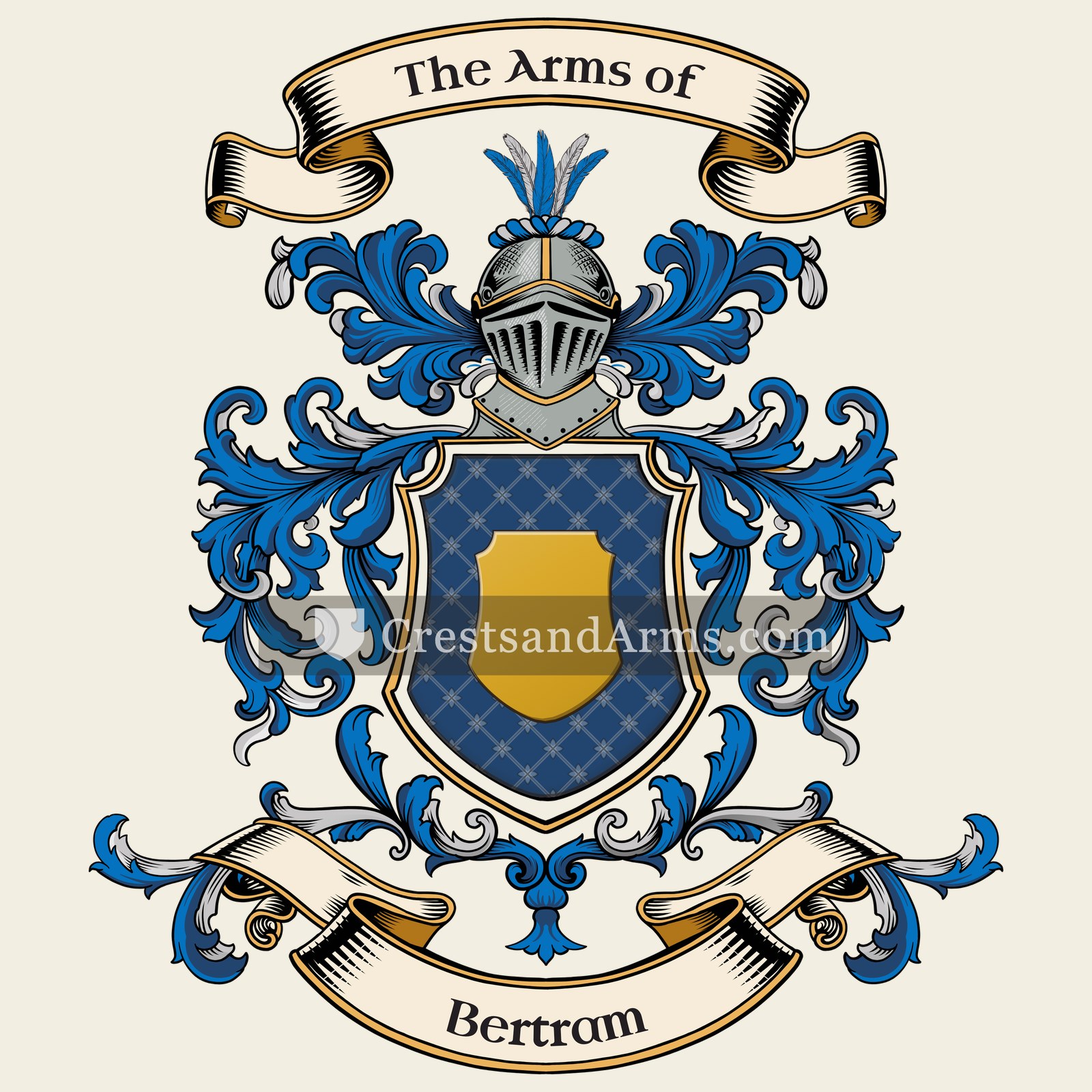
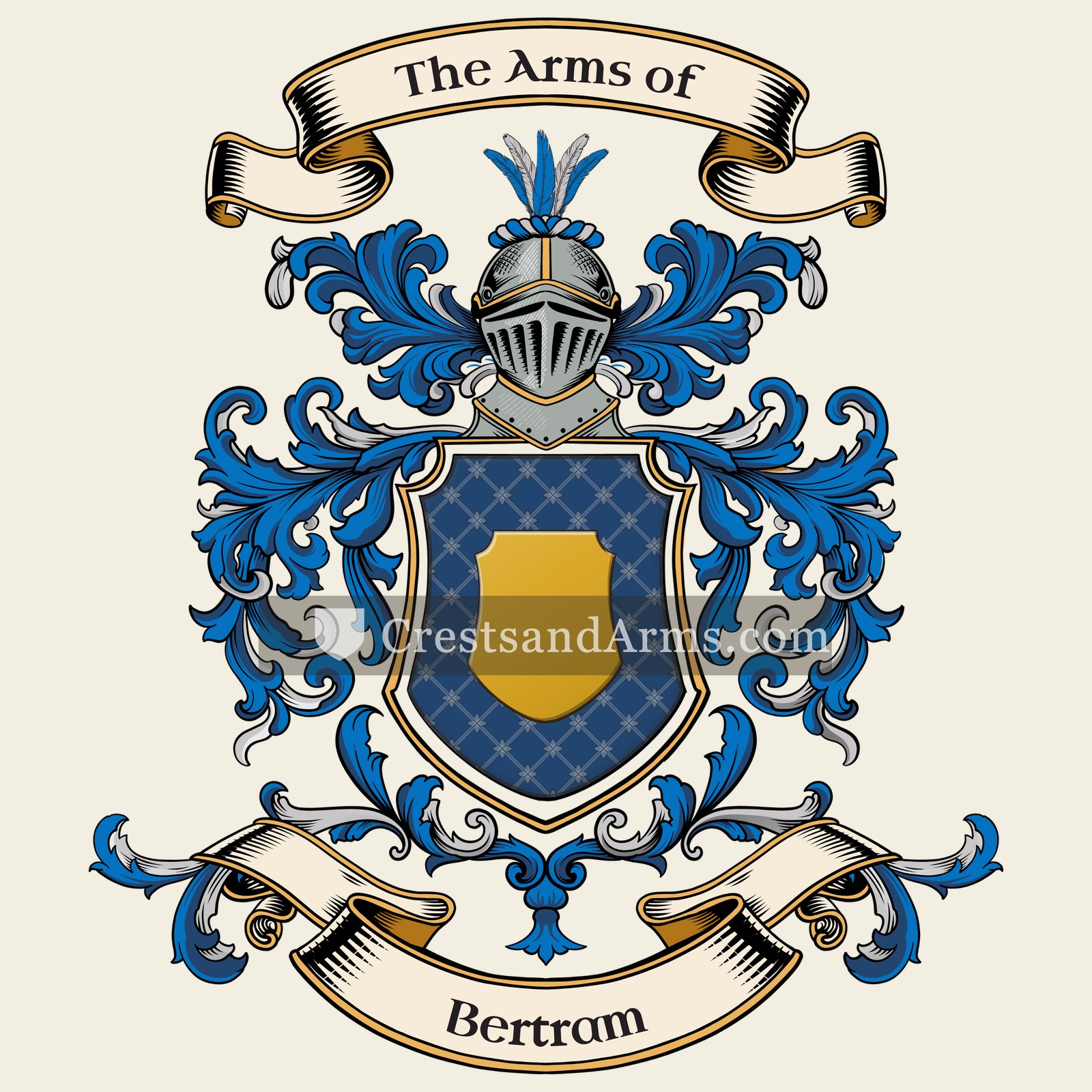
Blue (Azure)Means: Loyalty and truth
Gold (Or)Means: Generosity
Historical info
Source
Sir Bernard Burke, The General Armory of England, Scotland, Ireland and Wales, London: Harrison & Sons, 1884
Blazon (the actual original written record)
“Az. an escutcheon or”
NorthumberlandLords Bertram · Northumberland, c. 1264
Digital archive packCoat of arms PNG, gold border print PDF, vector SVG and the certificate of authenticity. Sent to your email in minutes.
Map of England showing where the Bertram arms are recorded
The Bertram arms were recorded in Northumberland, c. 1264.
Northumberland was border country facing Scotland, raided and fought over for three hundred years. Families held their land in return for defending it, and a defending household carried a shield.
This is where the arms were entered in the register. Families often moved to other parts of the country, so the same name can turn up in more than one region.
The body that granted and recorded arms in England in this period.
Henry III of England
Sovereign of the period
Henry III of England
1216–1272
Reigning in Britain when the Bertram arms are first recorded.
How Arms Worked in England
English heraldry allowed arms to be shared by all legitimate descendants of the original owner. These symbols were treated as personal property that moved through the generations to all children. While the eldest son kept the original design, other family members could use the same shield without needing to change it or register their own unique versions.
Granting authority
The College of Arms in London has regulated the use of coats of arms throughout England and Wales since 1484.
How they got arms
Families typically obtained their coats of arms through a formal grant from the Crown or by proving their ancient right to them.
Where arms were recorded
All official coats of arms are recorded in the registers kept at the College of Arms, which date back to the fifteenth century.
The family's standing
Recorded among the armigerous families of Northumberland.
Origin & History of the Bertram Family in England
The family name Bertram has deep roots in the northern regions of England, particularly within the county of Northumberland. The name itself is of Germanic origin and translates to bright raven, which reflects the naming traditions brought to Britain by early settlers. By the year 1264, the Bertram family was well established in the north, where they held significant lands and played a role in the local governance of the border territories. During this medieval period, the family was closely connected to the shifting political landscape of the Anglo-Scottish border. They were often involved in the management of rural estates and the complex feudal obligations required by the English crown. Because of their strategic location in Northumberland, the early members of the family were frequently tasked with maintaining order in a region that faced constant military and social pressure. This history highlights their transition from landholders to influential figures in the development of northern English society.
Bertram Meaning & Related Branches
Root word
Berht-hramn
Derived from Germanic elements meaning bright and raven.
This name
BertramA name signifying a bright or glorious raven, often associated with wisdom and light.
also spelled
Bertramm
Bartram
Bertrand
Related arms
Georgelsimilar arms
Pichard de Verneysimilar arms
Regaussimilar arms
Bartramvariant spelling
Documented Sources
J. B. Rietstap, Armorial Général, Gouda: G. B. van Goor Zonen, 1884–87
Reaney, P.H. and Wilson, R.M., A Dictionary of English Surnames, 1991
Hanks, Patrick and Hodges, Flavia, A Dictionary of Surnames, 1988
The National Archives, Parish registers of Kent, 1700–1750
Digital archive packCoat of arms PNG, gold border print PDF, vector SVG and the certificate of authenticity. Sent to your email in minutes.




 saltireResolution, and St Andrew's cross
 swordJustice, and military honour
 bearStrength, cunning and protection of kin