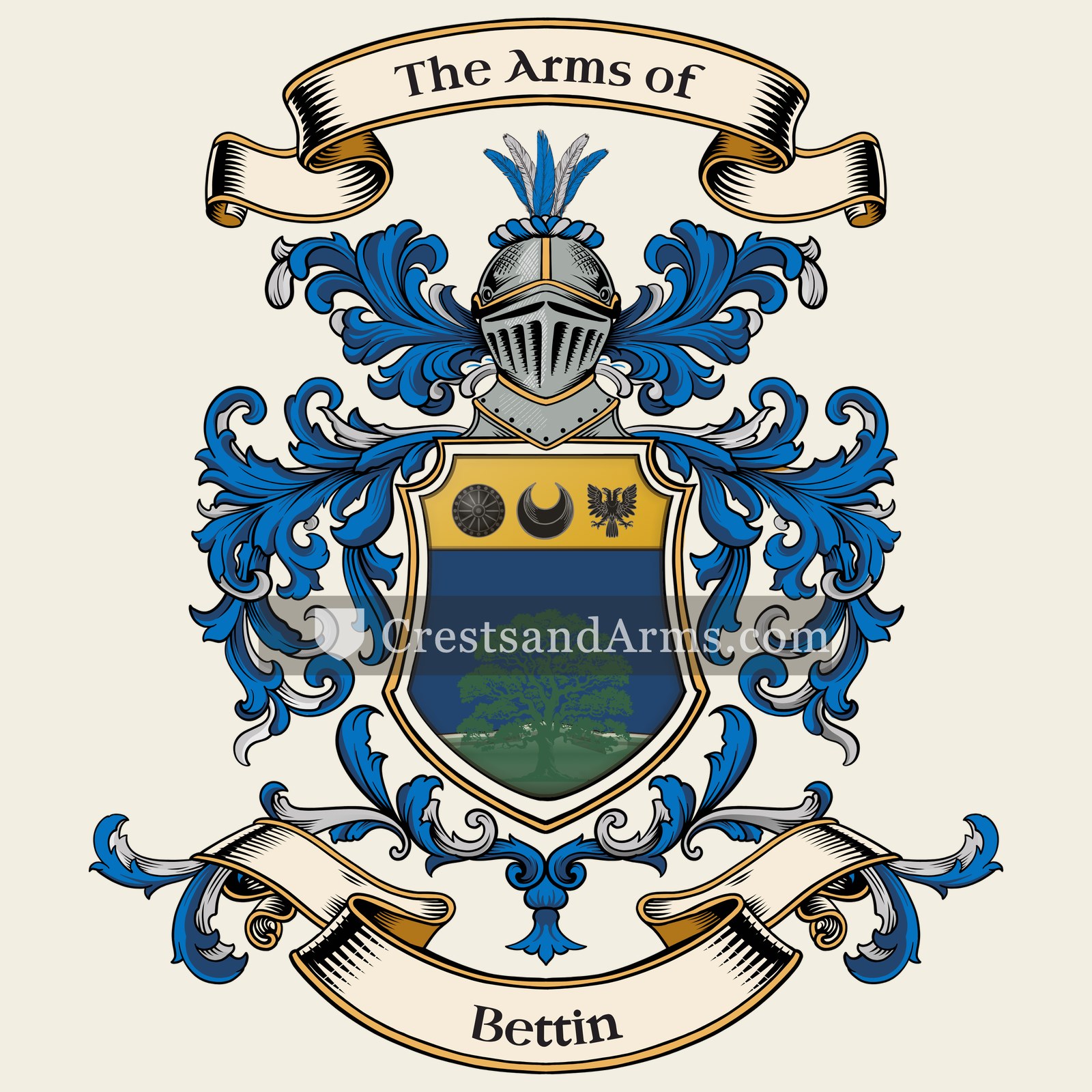
A record of documented arms, meaning and origin, researched for the Bettin family of Switzerland.
Reg. 6674 · Swiss, A–C
Coat of Arms & Family Crest Details
Symbols on this shield
mountThe ground held, and steadfastness upon it
chiefAuthority, wisdom and dominion
treeLife, endurance and deep roots
roundelA coin, and one who has been to the crusades
crescentHonour by the sovereign, and the second son
eagleNobility, strength and a keen mind
Colours
Blue (Azure)Means: Loyalty and truth
Gold (Or)Means: Generosity
Green (Vert)Means: Hope
Black (Sable)Means: Constancy
Historical info
Source
J. B. Rietstap, Armorial Général, Gouda: G. B. van Goor Zonen, 1884–87
Blazon (the actual original written record)
“D'azur à un arbré de sin., sommé d'un oiseau de sa. et posé sur un tertre du sec.; le tout acc. en chef à dextre d'un besant d'or et à sen. d'un croiss. tourné du même; au chef d'or, ch. d'une aigle de sa., cour. d'or. C.: l'aigle. L.: à dextre d'or et de sa., à sen. d'or et d'azur.”
SwitzerlandSoleure, c. 1745
Digital archive packCoat of arms PNG, gold border print PDF, vector SVG and the certificate of authenticity. Sent to your email in minutes.
Map of Switzerland showing where the Bettin arms are recorded
The Bettin arms were recorded in Soleure, c. 1745.
This is where the arms were entered in the register. Families often moved to other parts of the country, so the same name can turn up in more than one region.
The body that granted and recorded arms in Switzerland in this period.
How Arms Worked in Switzerland
In Switzerland, coats of arms were not restricted to the nobility and were often adopted by common citizens and families. These symbols were passed down through generations to show family identity. When branches of a family grew, they often changed small details of the design to distinguish their own line from the original group.
Granting authority
Cantonal and civic authorities managed the use of coats of arms within their specific regions and local jurisdictions.
How they got arms
Families typically assumed their own coats of arms based on local custom rather than receiving them from a central monarch.
Where arms were recorded
Arms were recorded in various cantonal and civic registers starting from the fourteenth century throughout the Swiss region.
The family's standing
Recorded among the armigerous families of Switzerland.
Origin & History of the Bettin Family in Switzerland
The surname Bettin carries a deep connection to the historical landscape of Switzerland, particularly within the region of Soleure, where records confirm the family was established by 1745. The name likely originated as a shortened or affectionate variation of names ending in "bet," such as Elizabeth or Benedict, which were common throughout Europe during the Middle Ages. As families began to adopt permanent surnames to distinguish themselves in growing urban centers, the name Bettin emerged as a way to identify specific lineages within local communities. By the mid-eighteenth century, members of the family were integrated into the social and economic fabric of Soleure, participating in the daily life of a region known for its strategic importance and rich cultural heritage. This period marked a time when families like the Bettins helped define the local population through their work, trade, and contributions to the development of their Swiss home.
Bettin Meaning & Related Branches
Root word
Benedictus
Latin for blessed or well spoken of.
This name
BettinA patronymic or diminutive form derived from the name Benedict, signifying one who is blessed.
also spelled
Betin
Betyin
Related arms
Betinvariant spelling
Documented Sources
J. B. Rietstap, Armorial Général, Gouda: G. B. van Goor Zonen, 1884–87
Staatsarchiv des Kantons Solothurn, Kirchenbücher der Stadt Solothurn, 1745
Müller, Josef, Die Familiennamen des Kantons Solothurn, 1952
Digital archive packCoat of arms PNG, gold border print PDF, vector SVG and the certificate of authenticity. Sent to your email in minutes.


 mountThe ground held, and steadfastness upon it
 chiefAuthority, wisdom and dominion
 treeLife, endurance and deep roots
 roundelA coin, and one who has been to the crusades
 crescentHonour by the sovereign, and the second son
 eagleNobility, strength and a keen mind
 mountThe ground held, and steadfastness upon it
 chiefAuthority, wisdom and dominion
 treeLife, endurance and deep roots
 roundelA coin, and one who has been to the crusades
 crescentHonour by the sovereign, and the second son
 eagleNobility, strength and a keen mind