A record of documented arms, meaning and origin, researched for the Beust family lines. Documented in 2 countries.
Reg. 9369 · Austrian, A–C
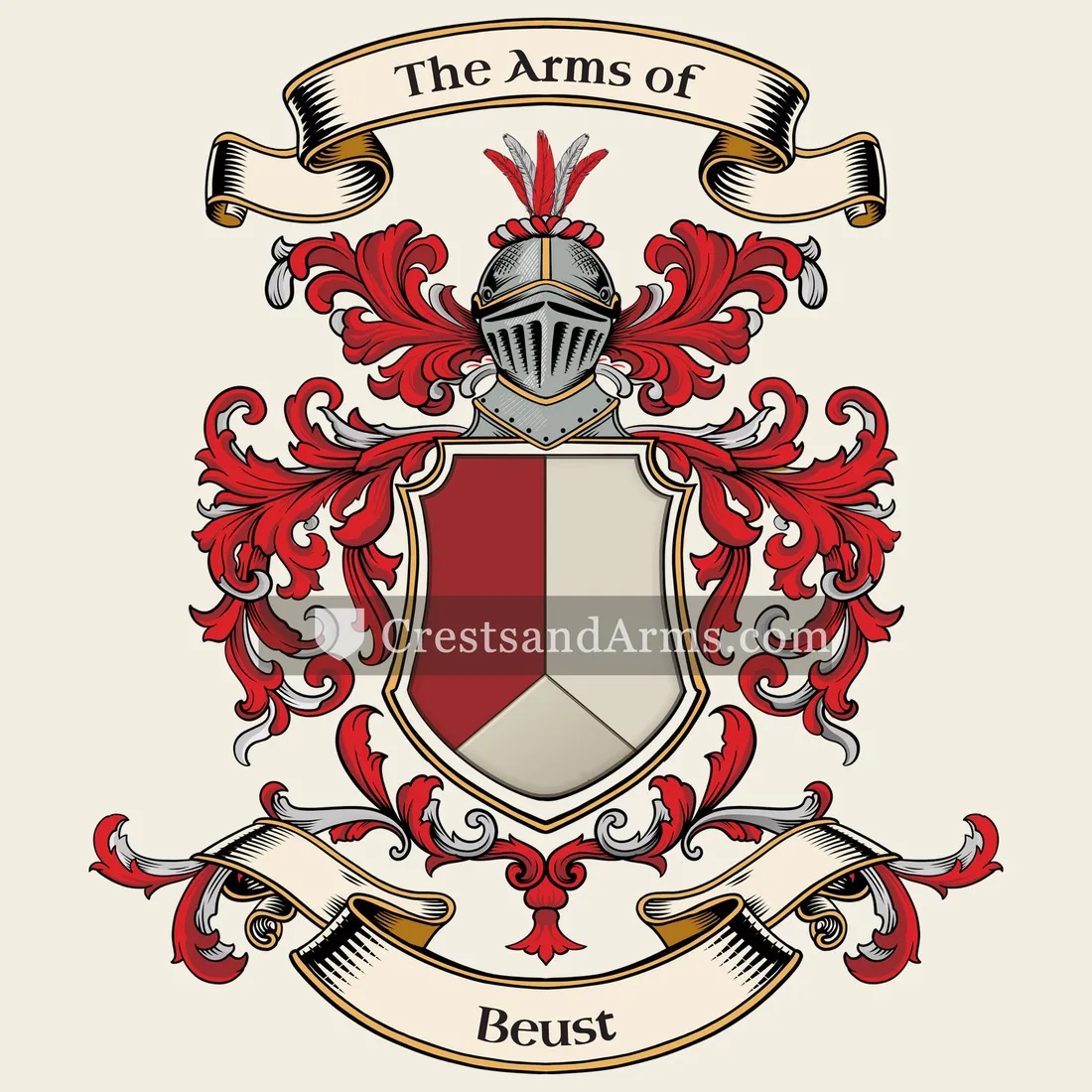
Meaning of the Beust family crest colors & symbols
Colours
Red (Gules)Means: Military strength
Silver (Argent)Means: Peace and sincerity
Historical info
Source
J. B. Rietstap, Armorial Général, Gouda: G. B. van Goor Zonen, 1884–87
Blazon (the actual original written record)
“Parti-émanché de deux pièces et demie de gu. sur arg. Cq. cour. C.: une jeune fille iss., cour. de roses de gu., les cheveux épars, hab. d'une fascé de gu. et d'arg., tenant de chaque main une banderole aux armes de l'écu, bordée de gu. S.: à dextre un lion reg. d'or, lamp. de gu.; à sen. un ours reg. de sa. D.: NIL ADMIRARI.”
Austriac. 1772
Digital archive packCoat of arms PNG, gold border print PDF, vector SVG and the certificate of authenticity. Sent to your email in minutes.
Map of Austria showing where the Beust arms are recorded
The Beust arms were recorded in Austria, c. 1772.
Arms such as these were typically recorded in Tyrol.
Tyrol was mountain country in western Austria, where the valleys were held by families who had been there a very long time. Old tenure counted for more than money, and old families carried arms.
This is where the arms were entered in the register. Families often moved to other parts of the country, so the same name can turn up in more than one region.
Region
Tyrol
First recorded
1772
Granting Authority for the Beust Arms
Imperial and Royal chancery
Sodacan · CC BY-SA 3.0
The body that granted and recorded arms in Austria in this period.
Joseph II, Holy Roman Emperor
Sovereign of the period
Joseph II, Holy Roman Emperor
1765–1790
Reigning in Austria when the Beust arms are first recorded.
How Arms Worked in Austria
Austrian coats of arms were often linked directly to noble titles granted by the Emperor. These symbols belonged to the entire family line rather than just one individual. When a family grew, new branches kept the original design without needing to change it. This system allowed all members of a noble house to share the same identity across many generations.
Granting authority
The Imperial and Royal chancery managed all heraldic matters and controlled the official granting of arms throughout the Austrian lands.
How they got arms
Families typically received their arms through a formal imperial decree that often accompanied the elevation of a person to noble status.
Where arms were recorded
Official records of these grants were kept in the Imperial Register of Nobility which began its formal documentation process in 1453.
The family's standing
Recorded among the armigerous families of Austria.
Origin & History of the Beust Family in Austria
The history of the Beust family in Austria is deeply rooted in the mountainous landscape of Tyrol, where members of the family were officially documented as early as 1772. While the name originates from broader Germanic regions, its presence in this alpine province suggests that the family played a role in the local administration or the social fabric of the Habsburg lands during the eighteenth century. By settling in Tyrol, the family integrated into a region known for its strategic importance and its unique cultural identity within the Austrian Empire. Over time, the name became associated with individuals who moved through various professional and social circles, reflecting the mobility often seen among families of that era. This early documentation serves as a vital anchor point for understanding how the family established its presence in the region before expanding their influence further into the heart of the Austrian state.
Meaning of the Beust family crest colors & symbols
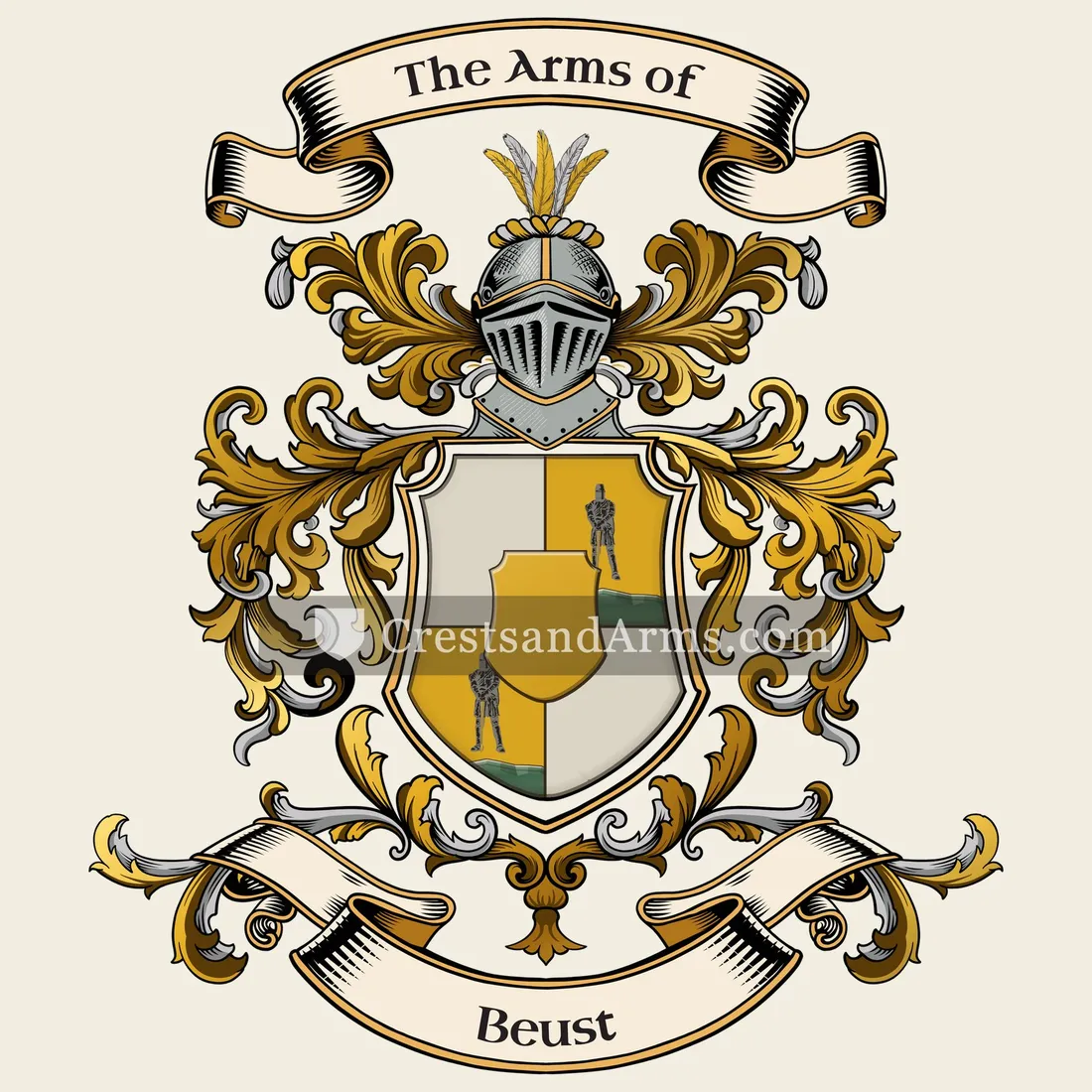
Symbols on this shield
mountThe ground held, and steadfastness upon it
knightChivalry and service in arms
Colours
Silver (Argent)Means: Peace and sincerity
Gold (Or)Means: Generosity
Green (Vert)Means: Hope
Historical info
Source
J. B. Rietstap, Armorial Général, Gouda: G. B. van Goor Zonen, 1884–87
Blazon (the actual original written record)
“Ec.: aux 1 et 4 d'arg. à cinq trangies de gu.; aux 2 et 3 d'or à un chevalier, la visière baissée, arm. de toutes pièces, posé sur une terrasse de sin., tenant de sa main dextre un guidon de gu. flottant au-dessus de sa tête, et de sa sen. une épée abaissée, la pointe touchant le sol. Sur le tout les armes précédentes des barons de Beust. Trois cq. cour. C.: 1º un lion iss. et cont. d'or, lamp. de gu.; 2º le cimier des barons de Beust; 3º le chevalier, iss. par les genoux. L.: à dextre d'arg. et de gu., à sen. d'or et de sa. S.: à dextre un lion reg. d'or, lamp. de gu.; à sen. un ours de sa.”
SaxonySaxony, c. 1775
Digital archive packCoat of arms PNG, gold border print PDF, vector SVG and the certificate of authenticity. Sent to your email in minutes.
Map of Germany showing where the Beust arms are recorded
The Beust arms were recorded in Saxony, c. 1775.
Saxony had mines, trade and old landed families all at once. Silver made some fortunes and land held others, and both sorts of family kept arms, which is why Saxon names appear so often in the registers.
This is where the arms were entered in the register. Families often moved to other parts of the country, so the same name can turn up in more than one region.
The body that granted and recorded arms in Germany in this period.
Joseph II, Holy Roman Emperor
Sovereign of the period
Joseph II, Holy Roman Emperor
1765–1790
Reigning in Austria when the Beust arms are first recorded.
How Arms Worked in Germany
In the Holy Roman Empire, coats of arms were often granted to individuals by the Emperor or his representatives. These arms were then passed down through the generations to all legitimate descendants of the original holder. Younger branches of a family usually kept the same shield design without needing to change it, as the arms belonged to the entire lineage.
Granting authority
The Holy Roman Emperor held the sole power to grant new coats of arms throughout his vast imperial territories.
How they got arms
Families typically obtained their coats of arms through a formal imperial grant or by proving their noble status to the authorities.
Where arms were recorded
These grants were officially recorded in the Imperial Chancery registers, which began keeping formal records of such honors during the Middle Ages.
The family's standing
Recorded among the armigerous families of Saxony.
Origin & History of the Beust Family in Germany
The family name Beust traces its roots to the historic region of Saxony, where members of the family established themselves as prominent figures in German society. By the year 1775, the family was already well-integrated into the local nobility and held significant influence within the political and administrative structures of the Electorate of Saxony. The name itself is thought to be of locative origin, likely derived from a specific place or estate that the family held during the medieval period as they rose through the ranks of the regional aristocracy. Over the following centuries, the family expanded their reach, with various members serving as diplomats, military officers, and high-ranking government officials who helped shape the course of German history. Their presence in Saxony served as the foundation for a legacy that eventually spread across various German territories, marking them as a family deeply connected to the development of the state.
Beust Meaning & Related Branches
Root word
Bust
A Middle High German term referring to a dwelling or homestead.
This name
BeustA topographic surname identifying someone who lived at or near a specific homestead.
also spelled
Beustt
Beuste
Boost
Documented Sources
J. B. Rietstap, Armorial Général, Gouda: G. B. van Goor Zonen, 1884–87
Tiroler Landesarchiv, Tiroler Steuerkataster 1772
Huter, Franz, Archiv für Geschichte und Landeskunde Vorarlbergs, 1955
Digital archive packCoat of arms PNG, gold border print PDF, vector SVG and the certificate of authenticity. Sent to your email in minutes.




 mountThe ground held, and steadfastness upon it
 knightChivalry and service in arms