Map of Wales showing where the Bevan arms are recorded
The Bevan arms were recorded in Carmarthen, c. 1695.
Carmarthenshire was south-west Welsh country of river valleys and hill farms. Land was held in a great many small estates, and each one brought its own claim to a coat of arms.
This is where the arms were entered in the register. Families often moved to other parts of the country, so the same name can turn up in more than one region.
The body that granted and recorded arms in Wales in this period.
William III of England
Sovereign of the period
William III of England
1694–1702
Reigning in Wales when the Bevan arms are first recorded.
How Arms Worked in Wales
English heraldry allowed arms to be shared by all legitimate descendants of the original owner. These symbols were treated as personal property that moved through the generations to all children. While the eldest son kept the original design, other family members could use the same shield without needing to change it or register their own unique versions.
Granting authority
The College of Arms in London has regulated the use of coats of arms throughout England and Wales since 1484.
How they got arms
Families typically obtained their coats of arms through a formal grant from the Crown or by proving their ancient right to them.
Where arms were recorded
All official coats of arms are recorded in the registers kept at the College of Arms, which date back to the fifteenth century.
The family's standing
Recorded among the armigerous families of Carmarthen.
Origin & History of the Bevan Family in Wales
The surname Bevan is a classic example of a Welsh patronymic name, which means it evolved from a father’s given name rather than a trade or a location. It is a shortened form of the Welsh phrase *ap Ieuan*, which translates to "son of Ieuan," a name that is the Welsh equivalent of John. Over many generations, the "ap" prefix gradually merged with the name Ieuan to create the single word Bevan. By the time the family was firmly established in Carmarthen in 1695, this transition was complete, reflecting a period when Welsh families were increasingly adopting fixed surnames to align with English administrative practices. This shift helped families maintain a clear sense of lineage during a time of significant social and legal change in Wales. The presence of the Bevan name in Carmarthen suggests that the family was part of the growing merchant and professional class that helped define the town as a major hub for trade and local government in the late seventeenth century.
Meaning of the Bevan family crest colors & symbols
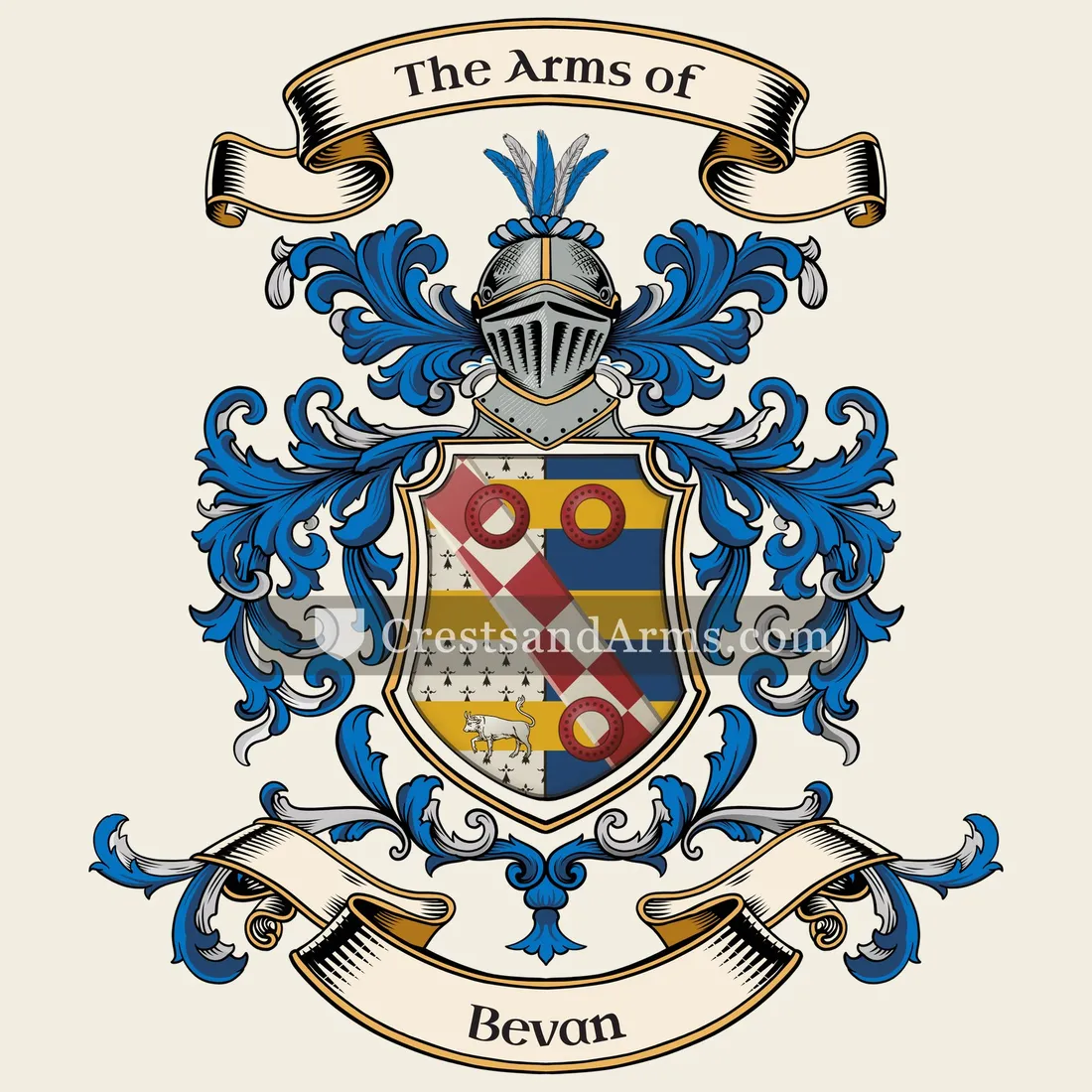
Symbols on this shield
bendDefence, and the scarf of a commander
bullValour and generosity
ringFidelity, and a promise kept
Colours
ErmineMeans: Dignity
Blue (Azure)Means: Loyalty and truth
Gold (Or)Means: Generosity
Silver (Argent)Means: Peace and sincerity
Red (Gules)Means: Military strength
Historical info
Source
Sir Bernard Burke, The General Armory of England, Scotland, Ireland and Wales, London: Harrison & Sons, 1884
Blazon (the actual original written record)
“Erm. a bull pass. betw. three annulets gu. quartering, az. three bars engr. or, a bend lozengy ar. and gu., for Lee”
WiltsFosbury · Wilts, c. 1620
Digital archive packCoat of arms PNG, gold border print PDF, vector SVG and the certificate of authenticity. Sent to your email in minutes.
Map of England showing where the Bevan arms are recorded
The Bevan arms were recorded in Wilts, c. 1620.
Wiltshire was sheep country, and wool made money steadily for hundreds of years. Families who made it bought manors on the downs, and holding a manor was the usual reason to take arms.
This is where the arms were entered in the register. Families often moved to other parts of the country, so the same name can turn up in more than one region.
The body that granted and recorded arms in England in this period.
James VI and I
Sovereign of the period
James VI and I
1603–1625
Reigning in Wales when the Bevan arms are first recorded.
How Arms Worked in England
English heraldry allowed arms to be shared by all legitimate descendants of the original owner. These symbols were treated as personal property that moved through the generations to all children. While the eldest son kept the original design, other family members could use the same shield without needing to change it or register their own unique versions.
Granting authority
The College of Arms in London has regulated the use of coats of arms throughout England and Wales since 1484.
How they got arms
Families typically obtained their coats of arms through a formal grant from the Crown or by proving their ancient right to them.
Where arms were recorded
All official coats of arms are recorded in the registers kept at the College of Arms, which date back to the fifteenth century.
The family's standing
Recorded among the armigerous families of Wilts.
Origin & History of the Bevan Family in England
The surname Bevan is a patronymic name that originated from the Welsh phrase ap Evan, which translates to son of Evan. While the name is deeply rooted in Welsh heritage, it spread across the border into England as families migrated for work and land ownership. By the year 1620, records confirm that members of the Bevan family were well established in the county of Wiltshire. During this period, families often settled in rural parishes where they worked as farmers or tradespeople. The transition from the Welsh naming style to the fixed English surname Bevan likely occurred as these families integrated into local English communities. Over time, the name became a permanent fixture in the region, reflecting the movement of people across the border and the blending of regional cultures in early modern England.
Bevan Meaning & Related Branches
Root word
ap Ifan
A Welsh patronymic prefix meaning son of John.
This name
BevanA surname derived from the Welsh patronymic indicating descent from a person named John.
also spelled
Beavan
Beaven
Related arms
Beavanvariant spelling
Bevensvariant spelling
Bruererecorded with Bevan, same area
Rhys Grugrecorded with Bevan, same area
Documented Sources
Sir Bernard Burke, The General Armory of England, Scotland, Ireland and Wales, London: Harrison & Sons, 1884
Morgan, T. J. and Morgan, Prys, Welsh Surnames, 1985
National Library of Wales, Carmarthenshire Quarter Sessions Records, 1695
Rowlands, John and Rowlands, Sheila, The Surnames of Wales, 1996
Digital archive packCoat of arms PNG, gold border print PDF, vector SVG and the certificate of authenticity. Sent to your email in minutes.


 dovePeace, love and the Holy Spirit
 ringFidelity, and a promise kept
 dovePeace, love and the Holy Spirit
 ringFidelity, and a promise kept
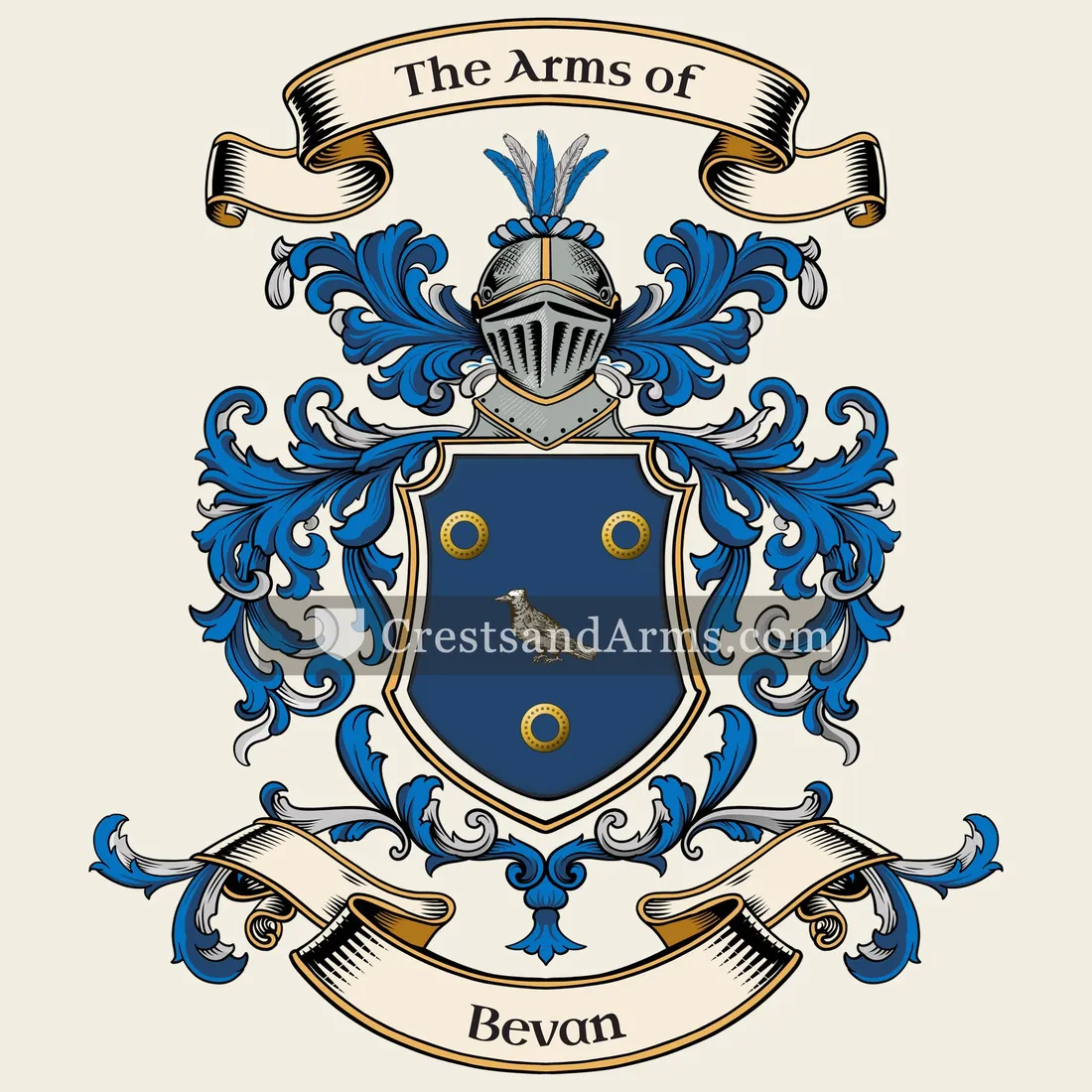


 bendDefence, and the scarf of a commander
 bullValour and generosity