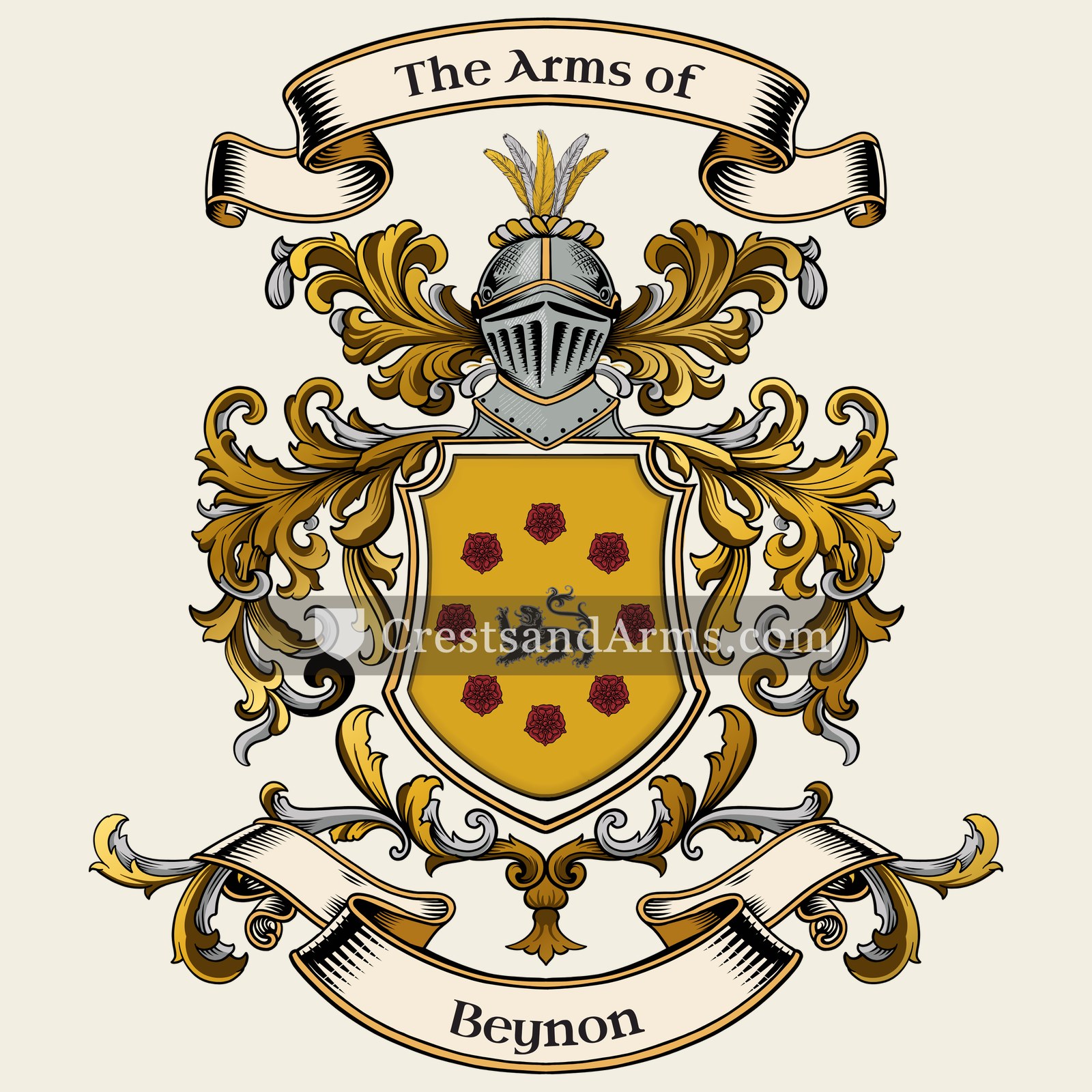
A record of documented arms, meaning and origin, researched for the Beynon family lines. Documented in 2 countries.
Reg. 6011 · English, A–C
Coat of Arms & Family Crest Details
Symbols on this shield
bendDefence, and the scarf of a commander
cross symbolChristian faith and service
cantonA mark of honour granted by the sovereign
griffinValour and vigilance, guarding great treasure
millrind / fer de molineThe mill's iron, and the grinding of grain
Colours
Silver (Argent)Means: Peace and sincerity
Gold (Or)Means: Generosity
Black (Sable)Means: Constancy
Green (Vert)Means: Hope
Historical info
Source
Sir Bernard Burke, The General Armory of England, Scotland, Ireland and Wales, London: Harrison & Sons, 1884
Blazon (the actual original written record)
“Quarterly, 1st and 4th, per pale wavy az. and gu. on a bend cottised or, three crosses crosslet vert, for BEYNON; 2nd and 3rd, ar. a griffin segreant pean a canton sa. charged with a millrind or, for BATLEY”
SurreyCarshalton · Surrey, c. 1620
Digital archive packCoat of arms PNG, gold border print PDF, vector SVG and the certificate of authenticity. Sent to your email in minutes.
Map of England showing where the Beynon arms are recorded
The Beynon arms were recorded in Surrey, c. 1620.
Surrey sat just south of London and filled up with families who had made money in the City. Buying an estate there was the usual next step, and an estate was the usual reason to take arms.
This is where the arms were entered in the register. Families often moved to other parts of the country, so the same name can turn up in more than one region.
The body that granted and recorded arms in England in this period.
James VI and I
Sovereign of the period
James VI and I
1603–1625
Reigning in England when the Beynon arms are first recorded.
How Arms Worked in England
English heraldry allowed arms to be shared by all legitimate descendants of the original owner. These symbols were treated as personal property that moved through the generations to all children. While the eldest son kept the original design, other family members could use the same shield without needing to change it or register their own unique versions.
Granting authority
The College of Arms in London has regulated the use of coats of arms throughout England and Wales since 1484.
How they got arms
Families typically obtained their coats of arms through a formal grant from the Crown or by proving their ancient right to them.
Where arms were recorded
All official coats of arms are recorded in the registers kept at the College of Arms, which date back to the fifteenth century.
The family's standing
Recorded among the armigerous families of Surrey.
Origin & History of the Beynon Family in England
The surname Beynon is a patronymic name, which means it originated as a way to identify a person as the son of a man named Benyon or ap-Eynon. This name has deep roots in the Welsh language, where the prefix ap signifies the son of a father. As families moved from Wales into England, the spelling often shifted to better fit the English language. By the year 1620, records confirm that members of the Beynon family were well-established in the county of Surrey. During this period, families often settled in specific regions to work in agriculture or local trades. The presence of the family in Surrey suggests that they were part of the steady migration of Welsh families who integrated into English society during the early seventeenth century. Over time, the name became a permanent fixture in local parish registers, marking the family as a stable part of the community.
Coat of Arms & Family Crest Details
Symbols on this shield
lionCourage, strength and royalty
roseThe seventh son, and beauty with grace
Colours
Gold (Or)Means: Generosity
Black (Sable)Means: Constancy
Red (Gules)Means: Military strength
Historical info
Source
Sir Bernard Burke, The General Armory of England, Scotland, Ireland and Wales, London: Harrison & Sons, 1884
Blazon (the actual original written record)
“Or, a lion ramp. sa. betw. eight roses gu”
PembrokeTrewern · Pembroke, c. 1647
Digital archive packCoat of arms PNG, gold border print PDF, vector SVG and the certificate of authenticity. Sent to your email in minutes.
Map of Wales showing where the Beynon arms are recorded
The Beynon arms were recorded in Pembroke, c. 1647.
Pembrokeshire was settled from England early enough to be called Little England beyond Wales. Its landed families were Norman in origin and held their ground for centuries, which is what put them in the records.
This is where the arms were entered in the register. Families often moved to other parts of the country, so the same name can turn up in more than one region.
The body that granted and recorded arms in Wales in this period.
Charles I of England
Sovereign of the period
Charles I of England
1625–1649
Reigning in England when the Beynon arms are first recorded.
How Arms Worked in Wales
English heraldry allowed arms to be shared by all legitimate descendants of the original owner. These symbols were treated as personal property that moved through the generations to all children. While the eldest son kept the original design, other family members could use the same shield without needing to change it or register their own unique versions.
Granting authority
The College of Arms in London has regulated the use of coats of arms throughout England and Wales since 1484.
How they got arms
Families typically obtained their coats of arms through a formal grant from the Crown or by proving their ancient right to them.
Where arms were recorded
All official coats of arms are recorded in the registers kept at the College of Arms, which date back to the fifteenth century.
The family's standing
Recorded among the armigerous families of Pembroke.
Origin & History of the Beynon Family in Wales
The surname Beynon is a classic example of a patronymic name, which means it was formed by taking the father’s first name and adding a prefix or suffix to show descent. In the Welsh language, the name evolved from "ap Einion," meaning "son of Einion." Over several generations, the "ap" was dropped and the sounds merged to create the modern spelling of Beynon. By the mid-17th century, the family had established a firm presence in the county of Pembrokeshire. Records confirm that members of the Beynon family were living in this region by 1647, a time when Pembrokeshire was a significant area for trade and agriculture in West Wales. Because Pembrokeshire was a gateway for maritime travel and cultural exchange, the family name became well-integrated into the local social and economic life of the Welsh coast during this period.
Beynon Meaning & Related Branches
Root word
Ap Einion
A Welsh patronymic meaning son of Einion.
This name
BeynonDerived from the Welsh personal name Einion, which signifies anvil or purity.
also spelled
Bennon
Bynon
Related arms
Reynoldsrecorded with Beynon, same area
Documented Sources
Sir Bernard Burke, The General Armory of England, Scotland, Ireland and Wales, London: Harrison & Sons, 1884
Reaney, P.H. and Wilson, R.M., A Dictionary of English Surnames, 1991
Surrey History Centre, Parish Register Records, 1620
Morgan, T.J. and Morgan, P., Welsh Surnames, 1985
Digital archive packCoat of arms PNG, gold border print PDF, vector SVG and the certificate of authenticity. Sent to your email in minutes.


 bendDefence, and the scarf of a commander
 cross symbolChristian faith and service
 cantonA mark of honour granted by the sovereign
 griffinValour and vigilance, guarding great treasure
 millrind / fer de molineThe mill's iron, and the grinding of grain
 bendDefence, and the scarf of a commander
 cross symbolChristian faith and service
 cantonA mark of honour granted by the sovereign
 griffinValour and vigilance, guarding great treasure
 millrind / fer de molineThe mill's iron, and the grinding of grain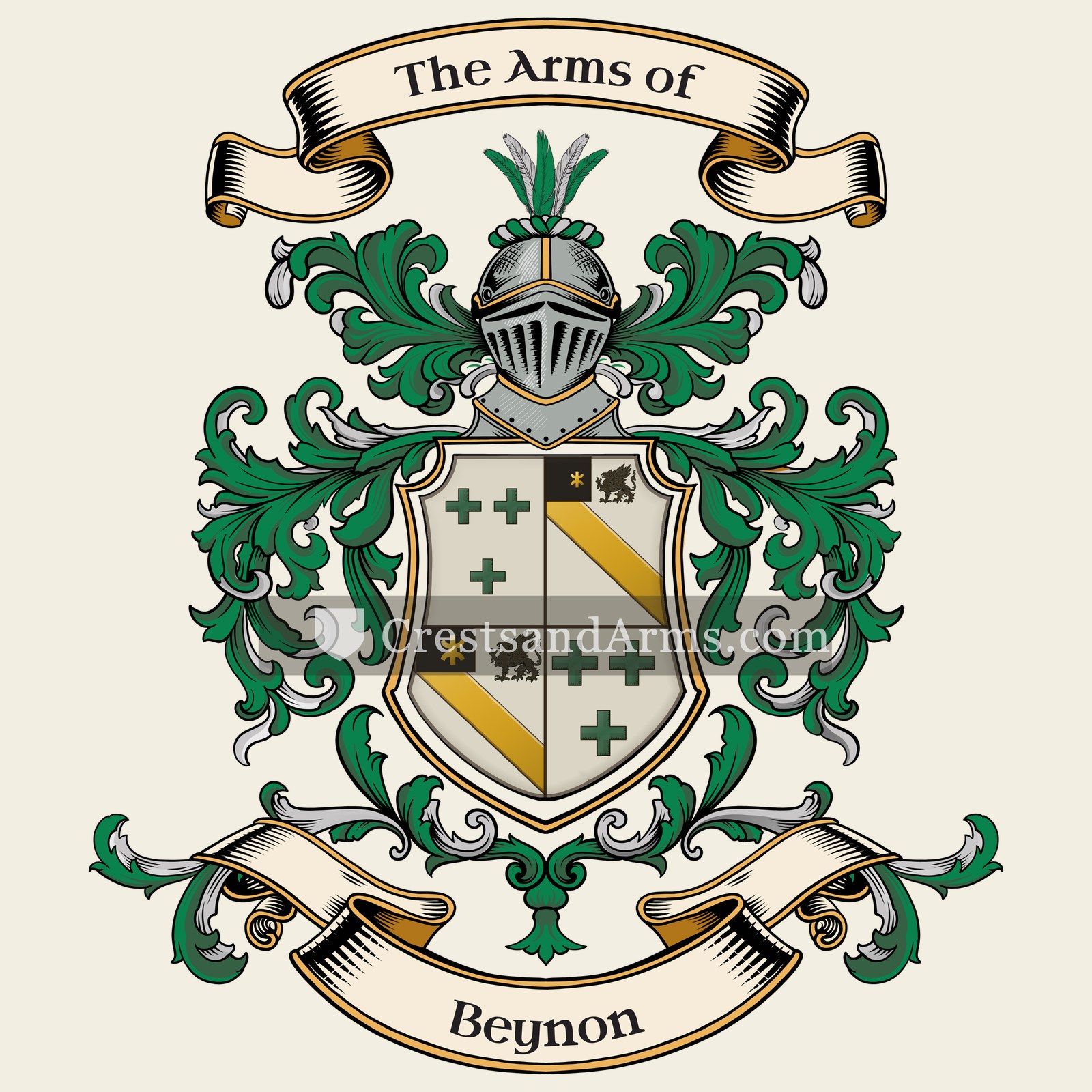


 lionCourage, strength and royalty
 roseThe seventh son, and beauty with grace