Map of England showing where the Bhambra arms are recorded
The Bhambra arms were recorded in Lancaster, c. 1620.
Lancashire was divided among a great many small landed families, more than most northern counties. Estates were passed down whole rather than split up, so the same names hold the same ground for centuries in the records.
This is where the arms were entered in the register. Families often moved to other parts of the country, so the same name can turn up in more than one region.
The body that granted and recorded arms in England in this period.
James VI and I
Sovereign of the period
James VI and I
1603–1625
Reigning in England when the Bhambra arms are first recorded.
How Arms Worked in England
English heraldry allowed arms to be shared by all legitimate descendants of the original owner. These symbols were treated as personal property that moved through the generations to all children. While the eldest son kept the original design, other family members could use the same shield without needing to change it or register their own unique versions.
Granting authority
The College of Arms in London has regulated the use of coats of arms throughout England and Wales since 1484.
How they got arms
Families typically obtained their coats of arms through a formal grant from the Crown or by proving their ancient right to them.
Where arms were recorded
All official coats of arms are recorded in the registers kept at the College of Arms, which date back to the fifteenth century.
The family's standing
Recorded among the armigerous families of Lancaster.
Origin & History of the Bhambra Family in England
The history of the Bhambra family in England is rooted in a fascinating connection to the city of Lancaster, where records confirm the presence of family members as early as 1620. During this period, Lancaster was a bustling hub of trade and regional administration, placing the family within a community that was rapidly evolving during the seventeenth century. While the name itself carries deep historical ties to South Asia, its early appearance in northern England suggests a story of movement and integration that predates the more widely documented migrations of later centuries. These early settlers likely navigated the social and economic challenges of the Stuart era, establishing a foothold in a landscape defined by local commerce and shifting religious landscapes. By settling in such a prominent town, the family became part of the long-term narrative of English social history, contributing to the diverse tapestry of the region’s population long before the industrial transformations that would later reshape the country.
Meaning of the Bhambra family crest colors & symbols
Symbols on this shield
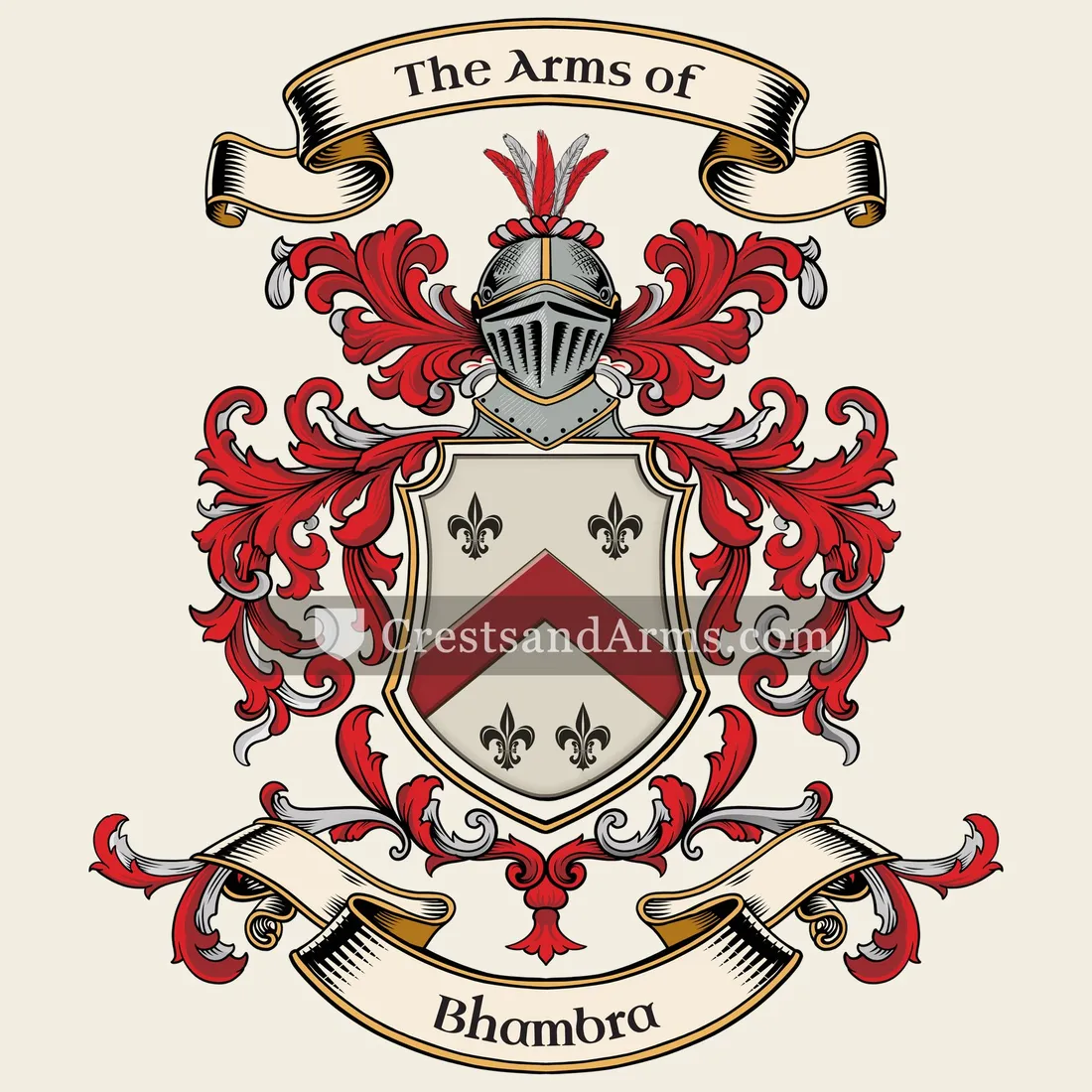
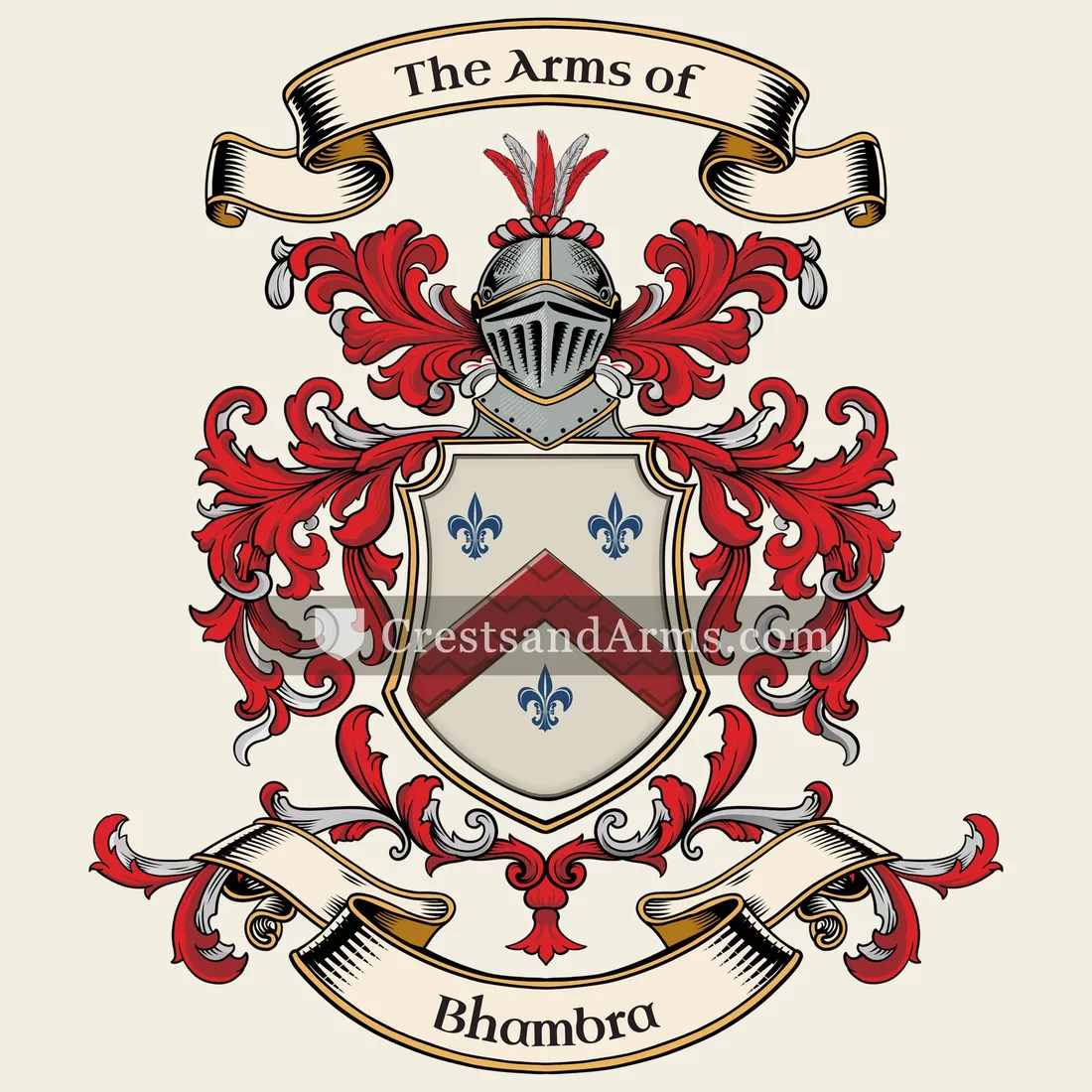
chevronProtection, and faithful service completed
fleur de lisPurity, light, and the sixth son
Colours
Silver (Argent)Means: Peace and sincerity
Red (Gules)Means: Military strength
Blue (Azure)Means: Loyalty and truth
Historical info
Source
Sir Bernard Burke, The General Armory of England, Scotland, Ireland and Wales, London: Harrison & Sons, 1884
Blazon (the actual original written record)
“Ar. two chev. gu. betw. three fleurs-de-lis az”
DublinDublin, c. 1711
Digital archive packCoat of arms PNG, gold border print PDF, vector SVG and the certificate of authenticity. Sent to your email in minutes.
Map of Ireland showing where the Bhambra arms are recorded
The Bhambra arms were recorded in Dublin, c. 1711.
Dublin was the seat of government in Ireland and the place where grants were sought and recorded. Families with business at the castle or the courts settled nearby, and settling there put their arms on record.
This is where the arms were entered in the register. Families often moved to other parts of the country, so the same name can turn up in more than one region.
The body that granted and recorded arms in Ireland in this period.
Anne of Great Britain
Sovereign of the period
Anne of Great Britain
1707–1714
Reigning in England when the Bhambra arms are first recorded.
How Arms Worked in Ireland
The Ulster King of Arms granted coats of arms to individuals who proved their social standing and good character. These symbols were typically inherited by all legitimate descendants of the original holder. If a family branch wanted a unique look, they could apply for a specific change to their design through the office to ensure their identity remained distinct.
Granting authority
The Ulster King of Arms acted as the official body that regulated and issued all coats of arms throughout Ireland.
How they got arms
Families obtained their arms through formal grants issued by the office after proving their eligibility and paying the required fees.
Where arms were recorded
All official grants were recorded in the registers held by the Ulster King of Arms starting from the year 1552.
The family's standing
Recorded among the armigerous families of Dublin.
Origin & History of the Bhambra Family in Ireland
The history of the Bhambra family in Ireland begins with documented evidence of family members residing in Dublin as early as 1711. During this period, Dublin was a bustling center of trade and social change, serving as a primary gateway for families arriving from diverse regions. While the name itself carries roots that suggest a connection to broader migration patterns across the British Empire, its presence in early eighteenth-century Dublin indicates that the family was part of the urban fabric of the city during a time of significant transition. These early settlers likely integrated into the local economy, navigating the complex social and legal structures of the era. By establishing a foothold in the capital, the Bhambra family became part of the long and varied history of families who contributed to the development of Dublin as a cosmopolitan hub. Their presence in the city records from 1711 provides a clear starting point for tracing their long-standing connection to Irish history.
Bhambra Meaning & Related Branches
Root word
Bham
Derived from the Sanskrit word for earth or ground.
This name
BhambraA locative surname referring to individuals originating from the Bhambra region in Punjab, India.
also spelled
Bambir
Bambur
Documented Sources
Sir Bernard Burke, The General Armory of England, Scotland, Ireland and Wales, London: Harrison & Sons, 1884


 chevronProtection, and faithful service completed
 fleur de lisPurity, light, and the sixth son
 chevronProtection, and faithful service completed
 fleur de lisPurity, light, and the sixth son