Map of Britain showing where the Biagiotti arms are recorded
The Biagiotti arms were recorded in Britain, c. 1700.
Arms such as these were typically recorded in Kent.
Kent sits between London and the short crossing to Europe, and the trade passing through made it wealthy. Merchant families bought land with that money, and it was landowners who took coats of arms.
This is where the arms were entered in the register. Families often moved to other parts of the country, so the same name can turn up in more than one region.
The body that granted and recorded arms in Britain in this period.
William III of England
Sovereign of the period
William III of England
1694–1702
Reigning in Britain when the Biagiotti arms are first recorded.
How Arms Worked in Britain
English heraldry allowed arms to be shared by all legitimate descendants of the original owner. These symbols were treated as personal property that moved through the generations to all children. While the eldest son kept the original design, other family members could use the same shield without needing to change it or register their own unique versions.
Granting authority
The College of Arms in London has regulated the use of coats of arms throughout England and Wales since 1484.
How they got arms
Families typically obtained their coats of arms through a formal grant from the Crown or by proving their ancient right to them.
Where arms were recorded
All official coats of arms are recorded in the registers kept at the College of Arms, which date back to the fifteenth century.
The family's standing
Recorded among the armigerous families of Britain.
Origin & History of the Biagiotti Family in Britain
The Biagiotti name originates from the Italian personal name Biagio, which is the equivalent of the English name Blaise. By the early 18th century, members of the family had established a presence in the county of Kent. During this period, Kent served as a vital gateway for continental travelers and merchants arriving from across the English Channel. It is likely that these early settlers were part of the small but influential groups of European artisans or traders who moved to England to seek new economic opportunities. As they integrated into local society, the family name remained a distinct marker of their Mediterranean heritage. Over time, these early residents contributed to the diverse cultural landscape of the region while maintaining the linguistic roots of their ancestors.
Coat of Arms & Family Crest Details
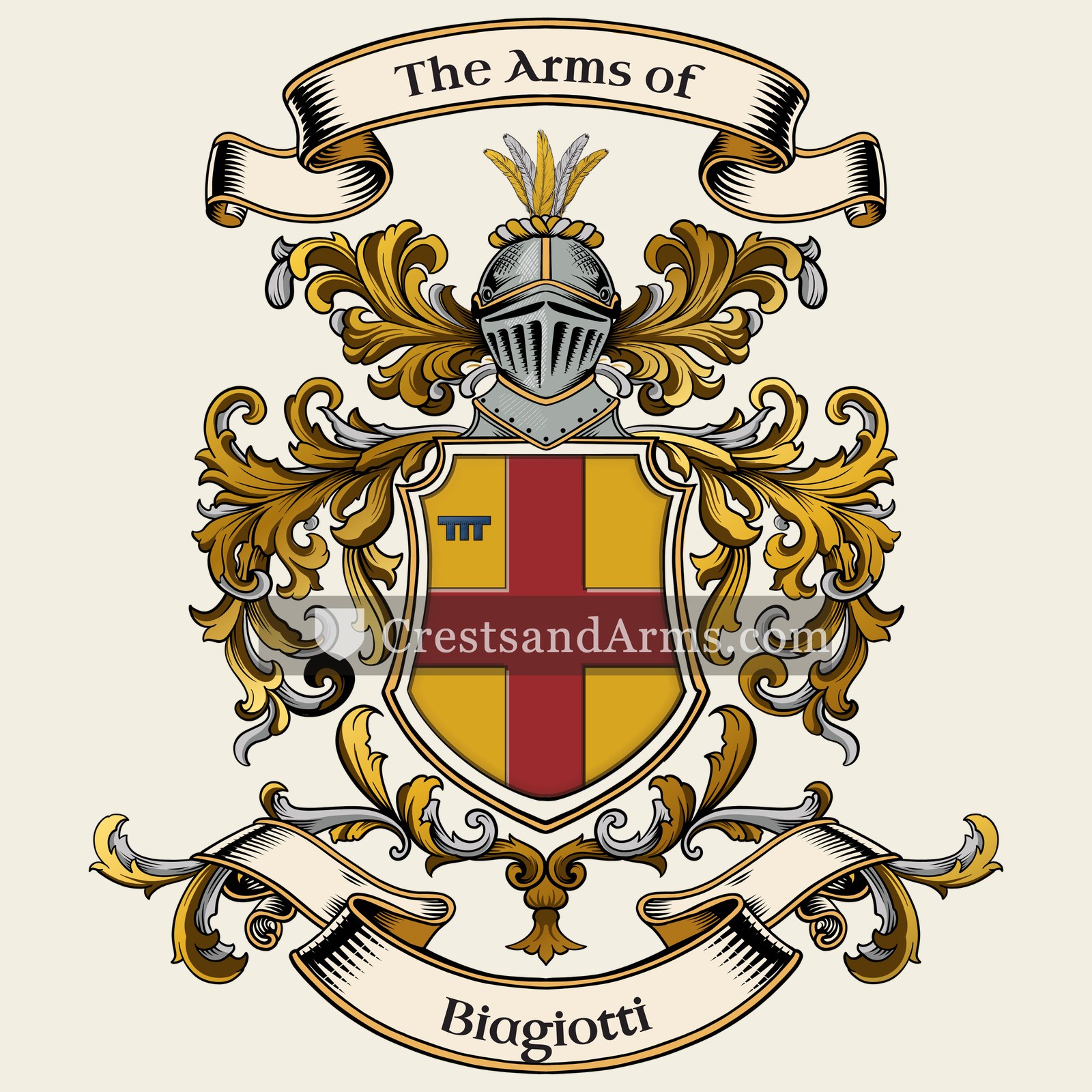
Symbols on this shield
cross symbolChristian faith and service
labelThe eldest son, during his father's life
Colours
Gold (Or)Means: Generosity
Red (Gules)Means: Military strength
Blue (Azure)Means: Loyalty and truth
Historical info
Source
Sir Bernard Burke, The General Armory of England, Scotland, Ireland and Wales, London: Harrison & Sons, 1884
Blazon (the actual original written record)
“Or, a cross gu. (another, adds a label of five points az.)”
Englandc. 1620
Digital archive packCoat of arms PNG, gold border print PDF, vector SVG and the certificate of authenticity. Sent to your email in minutes.
Map of England showing where the Biagiotti arms are recorded
The Biagiotti arms were recorded in England, c. 1620.
Arms such as these were typically recorded in York.
Yorkshire is the largest of the English counties, and it held more gentry families than any other. Land there was split among a great many households rather than a few, so a great many of them carried arms.
This is where the arms were entered in the register. Families often moved to other parts of the country, so the same name can turn up in more than one region.
The body that granted and recorded arms in England in this period.
James VI and I
Sovereign of the period
James VI and I
1603–1625
Reigning in Britain when the Biagiotti arms are first recorded.
How Arms Worked in England
English heraldry allowed arms to be shared by all legitimate descendants of the original owner. These symbols were treated as personal property that moved through the generations to all children. While the eldest son kept the original design, other family members could use the same shield without needing to change it or register their own unique versions.
Granting authority
The College of Arms in London has regulated the use of coats of arms throughout England and Wales since 1484.
How they got arms
Families typically obtained their coats of arms through a formal grant from the Crown or by proving their ancient right to them.
Where arms were recorded
All official coats of arms are recorded in the registers kept at the College of Arms, which date back to the fifteenth century.
The family's standing
Recorded among the armigerous families of England.
Origin & History of the Biagiotti Family in England
The Biagiotti family name carries a distinct Italian origin, yet historical records confirm that members of the family were established in the city of York by 1620. During the early seventeenth century, England was a hub for international trade and religious movement, which often drew skilled artisans and merchants from across the European continent. The presence of the Biagiottis in a northern English center like York suggests they were likely part of a small but influential community of foreign settlers who integrated into local commerce. By living in a city known for its historic guilds and merchant networks, these early family members would have navigated the complexities of English society while maintaining their unique cultural identity. Their transition into life in York highlights how families from abroad adapted to new environments during a period of significant social change in England.
Biagiotti Meaning & Related Branches
Root word
Biagio
Derived from the Latin name Blasius meaning stammering or lisping.
This name
BiagiottiA diminutive form indicating a descendant of someone named Biagio.
also spelled
Bygott
Bigot
Bygot
Documented Sources
J. B. Rietstap, Armorial Général, Gouda: G. B. van Goor Zonen, 1884–87
Cottle, Basil. The Penguin Dictionary of Surnames. 1967
Reaney, Percy Hide. A Dictionary of British Surnames. 1958
The National Archives, Kew. Records of the Prerogative Court of Canterbury, PROB 11
Kent History and Library Centre. Parish Registers of Kent, P series
Digital archive packCoat of arms PNG, gold border print PDF, vector SVG and the certificate of authenticity. Sent to your email in minutes.


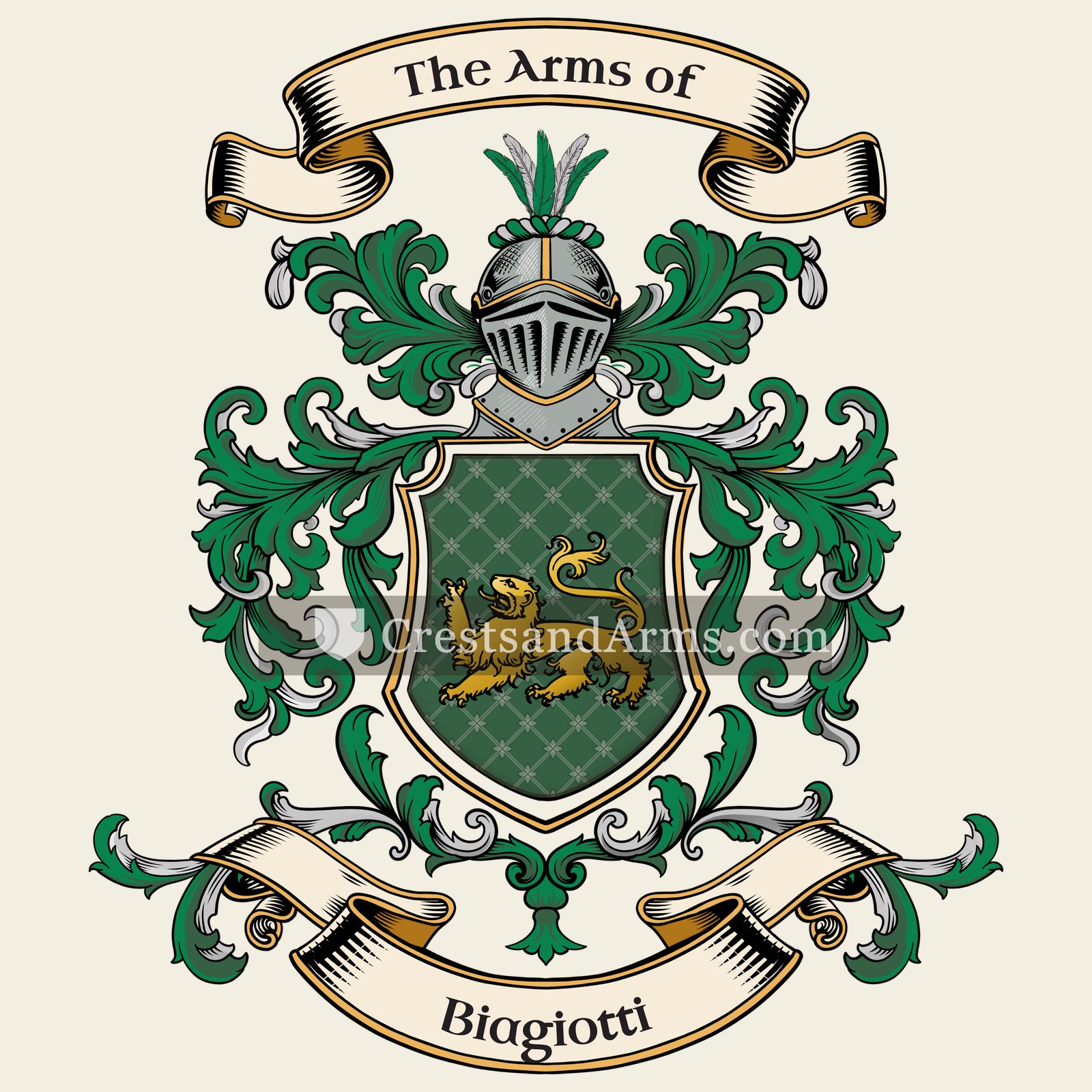
 lionCourage, strength and royalty
 lionCourage, strength and royalty


 cross symbolChristian faith and service
 labelThe eldest son, during his father's life