A record of documented arms, meaning and origin, researched for the Bianco family lines. Documented in 2 countries.
Reg. 5421 · French, A–C
Coat of Arms & Family Crest Details
Symbols on this shield
fleur de lisPurity, light, and the sixth son
Colours
Red (Gules)Means: Military strength
Silver (Argent)Means: Peace and sincerity
Historical info
Source
J. B. Rietstap, Armorial Général, Gouda: G. B. van Goor Zonen, 1884–87
Blazon (the actual original written record)
“De gu. à trois fleurs-de-lis d'arg. Deux cq. cour. C.: 1º une fleur-de-lis partie de gu. et d'arg., entre un vol d'arg. et de gu.; 2º deux lances de tournoi au nat., passées en saut., avec leurs pennons d'arg.; entre deux prob., d'arg. et de gu. S.: deux lions reg. au nat. [Quelquefois ces armes sont représentées sans supports et timbrées d'un seul casque, celui de dextre.]”
Francec. 1663
Digital archive packCoat of arms PNG, gold border print PDF, vector SVG and the certificate of authenticity. Sent to your email in minutes.
Map of France showing where the Bianco arms are recorded
The Bianco arms were recorded in France, c. 1663.
Arms such as these were typically recorded in Bretagne.
More families held coats of arms in Bretagne than anywhere else in France. The land was divided into many small estates rather than a few large ones, so far more households counted as gentry, and each needed a shield of its own to be told apart.
This is where the arms were entered in the register. Families often moved to other parts of the country, so the same name can turn up in more than one region.
The body that granted and recorded arms in France in this period.
Louis XIV of France
Sovereign of the period
Louis XIV of France
1643–1715
Reigning in France when the Bianco arms are first recorded.
How Arms Worked in France
In France, a coat of arms was a mark of honor that passed down through the male line to all legitimate descendants. Families often used the same shield without changes to show their shared heritage. If a branch wanted to stand out, they could add a small mark to their shield to show their specific place in the family tree.
Granting authority
The Juge d'armes de France acted as the official authority that regulated and verified coats of arms across the country.
How they got arms
Families typically inherited their arms from ancestors, though they could also receive them through royal grants or by proving their noble status.
Where arms were recorded
Coats of arms were officially recorded in the Armorial Général de France, which began its main collection in the year 1696.
The family's standing
Recorded among the armigerous families of France.
Origin & History of the Bianco Family in France
The history of the Bianco name in France is deeply connected to the regional identity of Bretagne during the seventeenth century. While the name itself carries roots that suggest a link to the Italian word for white, its presence in northwestern France indicates a family that integrated into the local social fabric of the Breton countryside by at least 1663. During this era, families often settled in specific parishes where they became part of the agricultural or artisan communities that defined the province. Records from this time show that the Bianco family lived alongside other established local families, participating in the daily life and religious traditions of the region. Their survival and growth in Bretagne suggest they were well-adapted to the distinct cultural environment of the area, which was known for its strong sense of local autonomy and maritime connections. By establishing themselves in this specific corner of France, the early members of the family helped weave their name into the long and complex history of the Breton people.
Coat of Arms & Family Crest Details
Symbols on this shield
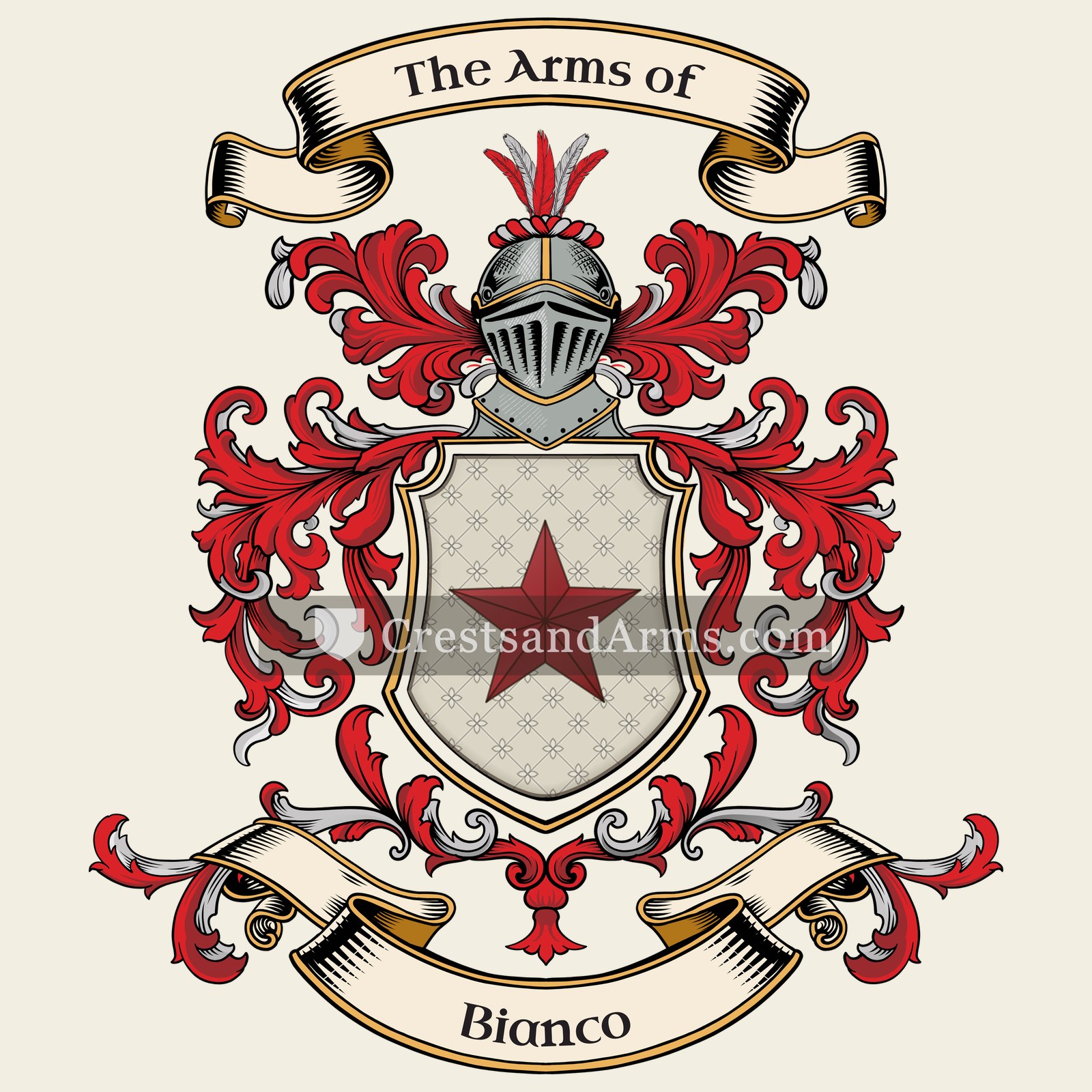
mulletThe third son, and a divine quality from above
Colours
Silver (Argent)Means: Peace and sincerity
Red (Gules)Means: Military strength
Historical info
Source
J. B. Rietstap, Armorial Général, Gouda: G. B. van Goor Zonen, 1884–87
Blazon (the actual original written record)
“D'arg. à une étoile (8) de gu.”
VeniceVenice, c. 1775
Digital archive packCoat of arms PNG, gold border print PDF, vector SVG and the certificate of authenticity. Sent to your email in minutes.
Map of Italy showing where the Bianco arms are recorded
The Bianco arms were recorded in Venice, c. 1775.
Venice ran on trade, and its great families were merchants before they were anything else. The city kept a formal list of its noble houses, and a name on that list carried arms as a matter of record.
This is where the arms were entered in the register. Families often moved to other parts of the country, so the same name can turn up in more than one region.
The body that granted and recorded arms in Italy in this period.
Alvise Giovanni Mocenigo
Sovereign of the period
Alvise Giovanni Mocenigo
1763–1778
Reigning in France when the Bianco arms are first recorded.
How Arms Worked in Italy
In the Italian states, coats of arms were often used by noble families to show their status and history. These symbols were passed down through the generations to all legitimate male descendants. Younger branches of a family usually kept the original design but sometimes added small changes to distinguish their specific line from the main branch.
Granting authority
Various local rulers and city governments controlled the use of coats of arms across the different Italian states.
How they got arms
Families often assumed their own arms or received them as official grants from local lords, popes, or city councils.
Where arms were recorded
Arms were recorded in local city archives or private family books rather than in one single national register.
The family's standing
Recorded among the armigerous families of Venice.
Origin & History of the Bianco Family in Italy
The surname Bianco originates from the Italian word for white, which was historically used as a descriptive nickname for individuals with fair hair or a pale complexion. By the time the family was documented in Venice in 1775, the name had already been established across various regions of Italy for several centuries. During the Middle Ages, surnames often emerged from physical traits or personal characteristics to help distinguish people in growing urban populations. In the context of Venice, a city defined by its maritime trade and complex social structure, families like the Bianco line were often integrated into the local merchant or artisan classes. As the family settled into the Venetian social fabric, they became part of a long tradition of Italian lineage naming that prioritized simple, descriptive identifiers. This history reflects the broader evolution of Italian society, where names transitioned from informal nicknames into permanent family identifiers passed down through generations.
Bianco Meaning & Related Branches
Root word
Blancus
A Late Latin term meaning white or fair-skinned.
This name
BiancoA descriptive surname originally used to identify someone with white hair or a pale complexion.
also spelled
Byanco
Bianko
Byanko
White
Documented Sources
J. B. Rietstap, Armorial Général, Gouda: G. B. van Goor Zonen, 1884–87
Archives départementales du Morbihan, Collection des registres paroissiaux et d'état civil
Gautier, Hervé, Histoire de la Bretagne, 1993
Le Moyne de La Borderie, Arthur, Histoire de Bretagne, 1896
Digital archive packCoat of arms PNG, gold border print PDF, vector SVG and the certificate of authenticity. Sent to your email in minutes.


 fleur de lisPurity, light, and the sixth son
 fleur de lisPurity, light, and the sixth son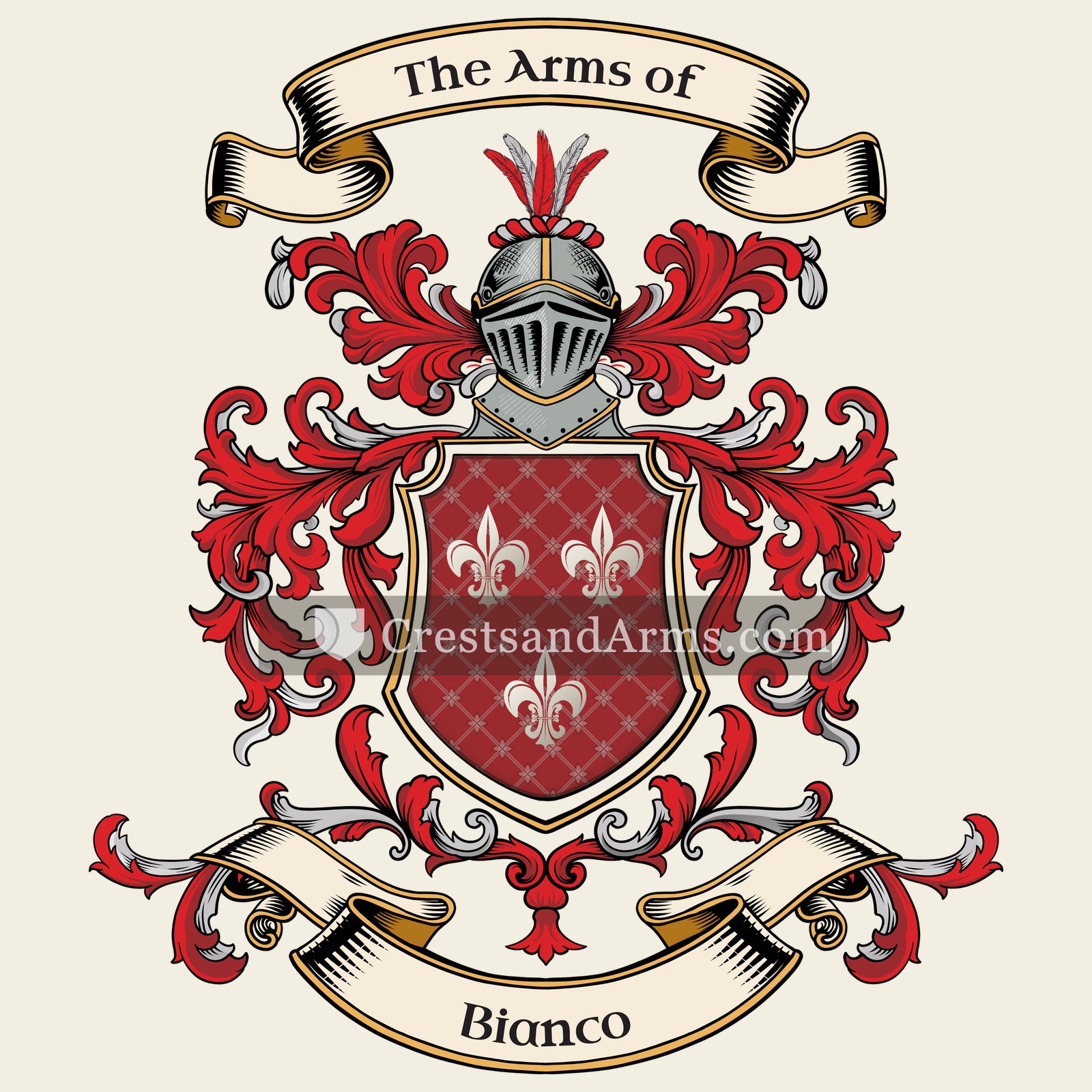


 mulletThe third son, and a divine quality from above