Map of England showing where the Biddulph arms are recorded
The Biddulph arms were recorded in Stafford, c. 1583.
Staffordshire was mixed country of moorland, farmland and early ironworking. Its landed families were spread widely rather than concentrated, and each holding brought its own claim to arms.
This is where the arms were entered in the register. Families often moved to other parts of the country, so the same name can turn up in more than one region.
The body that granted and recorded arms in England in this period.
Elizabeth I of England
Sovereign of the period
Elizabeth I of England
1558–1603
Reigning in England when the Biddulph arms are first recorded.
How Arms Worked in England
English heraldry allowed arms to be shared by all legitimate descendants of the original owner. These symbols were treated as personal property that moved through the generations to all children. While the eldest son kept the original design, other family members could use the same shield without needing to change it or register their own unique versions.
Granting authority
The College of Arms in London has regulated the use of coats of arms throughout England and Wales since 1484.
How they got arms
Families typically obtained their coats of arms through a formal grant from the Crown or by proving their ancient right to them.
Where arms were recorded
All official coats of arms are recorded in the registers kept at the College of Arms, which date back to the fifteenth century.
The family's standing
Recorded among the armigerous families of Stafford.
Origin & History of the Biddulph Family in England
The Biddulph family name originates from a specific place in the county of Staffordshire in England. The name is derived from the Old English words for a valley and a wolf, suggesting that the original family members lived near a geographical feature associated with that animal. By the late sixteenth century, the family had firmly established itself within the local landscape, with records confirming their presence in Staffordshire by 1583. During this period, the family operated as members of the landed gentry, managing estates and participating in the local governance of the region. Their history is deeply tied to the development of the English countryside, as they maintained their influence in the Midlands for several generations. This long-standing connection to the land helped the family name persist through centuries of social and political change in England.
Coat of Arms & Family Crest Details
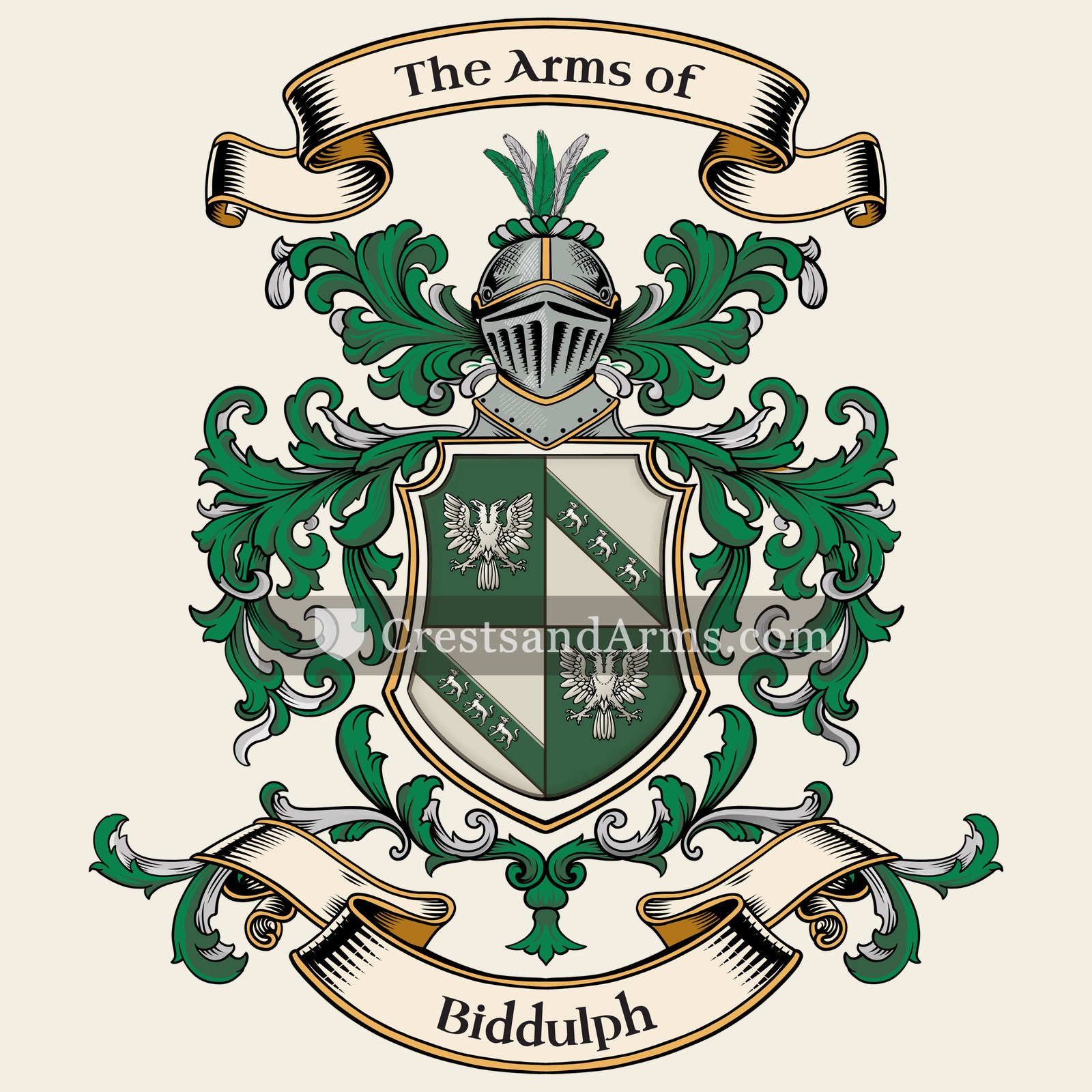
Symbols on this shield
bendDefence, and the scarf of a commander
eagleNobility, strength and a keen mind
wolfReward from long service and hard work
Colours
Green (Vert)Means: Hope
Silver (Argent)Means: Peace and sincerity
Historical info
Source
Sir Bernard Burke, The General Armory of England, Scotland, Ireland and Wales, London: Harrison & Sons, 1884
Blazon (the actual original written record)
“Quarterly, 1st and 4th, vert, an eagle displ. ar. armed and langued gu. for Biddulph; 2nd and 3rd, ar. on a bend vert three wolves heads erased of the field, for Myddelton”
DenbighChirk Castle · Denbigh, c. 1647
Digital archive packCoat of arms PNG, gold border print PDF, vector SVG and the certificate of authenticity. Sent to your email in minutes.
Map of Wales showing where the Biddulph arms are recorded
The Biddulph arms were recorded in Denbigh, c. 1647.
Denbighshire was north Welsh country of hills and small estates. Land was held by a great many families rather than a few, and each holding brought its own claim to a coat of arms.
This is where the arms were entered in the register. Families often moved to other parts of the country, so the same name can turn up in more than one region.
The body that granted and recorded arms in Wales in this period.
Charles I of England
Sovereign of the period
Charles I of England
1625–1649
Reigning in England when the Biddulph arms are first recorded.
How Arms Worked in Wales
English heraldry allowed arms to be shared by all legitimate descendants of the original owner. These symbols were treated as personal property that moved through the generations to all children. While the eldest son kept the original design, other family members could use the same shield without needing to change it or register their own unique versions.
Granting authority
The College of Arms in London has regulated the use of coats of arms throughout England and Wales since 1484.
How they got arms
Families typically obtained their coats of arms through a formal grant from the Crown or by proving their ancient right to them.
Where arms were recorded
All official coats of arms are recorded in the registers kept at the College of Arms, which date back to the fifteenth century.
The family's standing
Recorded among the armigerous families of Denbigh.
Origin & History of the Biddulph Family in Wales
The Biddulph family name has deep roots in the borderlands between England and Wales, with a significant recorded presence in the town of Denbigh by 1647. During this period, the family became integrated into the local governance and social fabric of North Wales, a region defined by its complex history of shifting borders and political tension. The name itself is of Old English origin, likely derived from a location in Staffordshire, but as the family moved westward, they became prominent landowners and officials within the Welsh Marches. By the mid-seventeenth century, members of the Biddulph family were active participants in the administrative life of Denbighshire, navigating the turbulent years of the English Civil War. Their transition into Welsh society reflects a broader pattern of families moving across the border to manage estates and hold positions of authority in the growing market towns of the region.
Biddulph Meaning & Related Branches
Root word
Byde-wulf
Old English elements meaning valley and wolf.
This name
BiddulphDerived from a place name in Staffordshire, signifying a wolf living in a valley.
also spelled
Bydulph
Biddolfe
Biddilph
Related arms
Skipperecorded with Biddulph, same area
Documented Sources
Sir Bernard Burke, The General Armory of England, Scotland, Ireland and Wales, London: Harrison & Sons, 1884
Duignan, W. H., Notes on Staffordshire Place Names, 1902
Staffordshire Record Office, D1790: Biddulph of Biddulph Hall Collection, 1583–1900
Wedgwood, J. C., Staffordshire Parliamentary History, 1917
Digital archive packCoat of arms PNG, gold border print PDF, vector SVG and the certificate of authenticity. Sent to your email in minutes.


 eagleNobility, strength and a keen mind
 eagleNobility, strength and a keen mind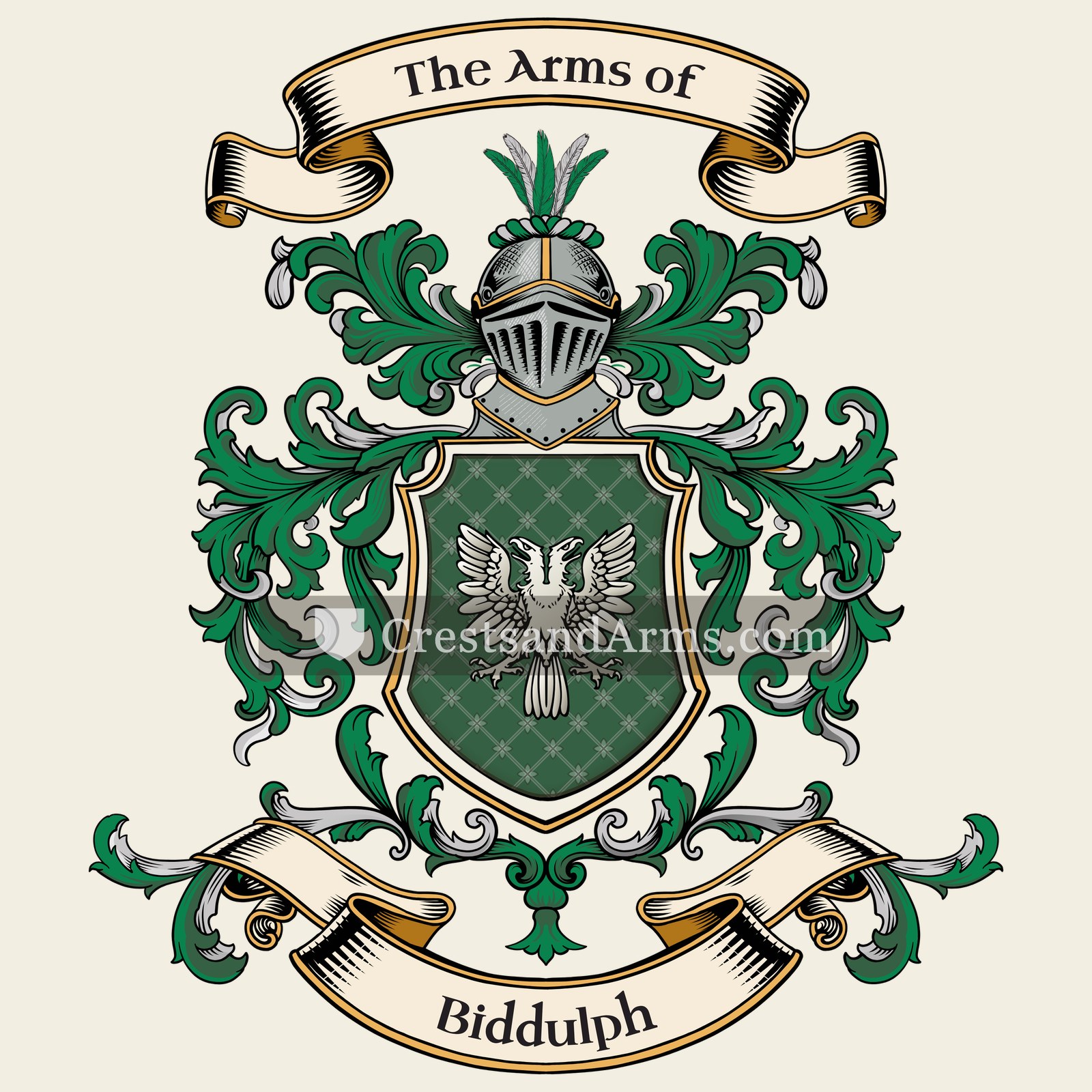


 bendDefence, and the scarf of a commander
 wolfReward from long service and hard work