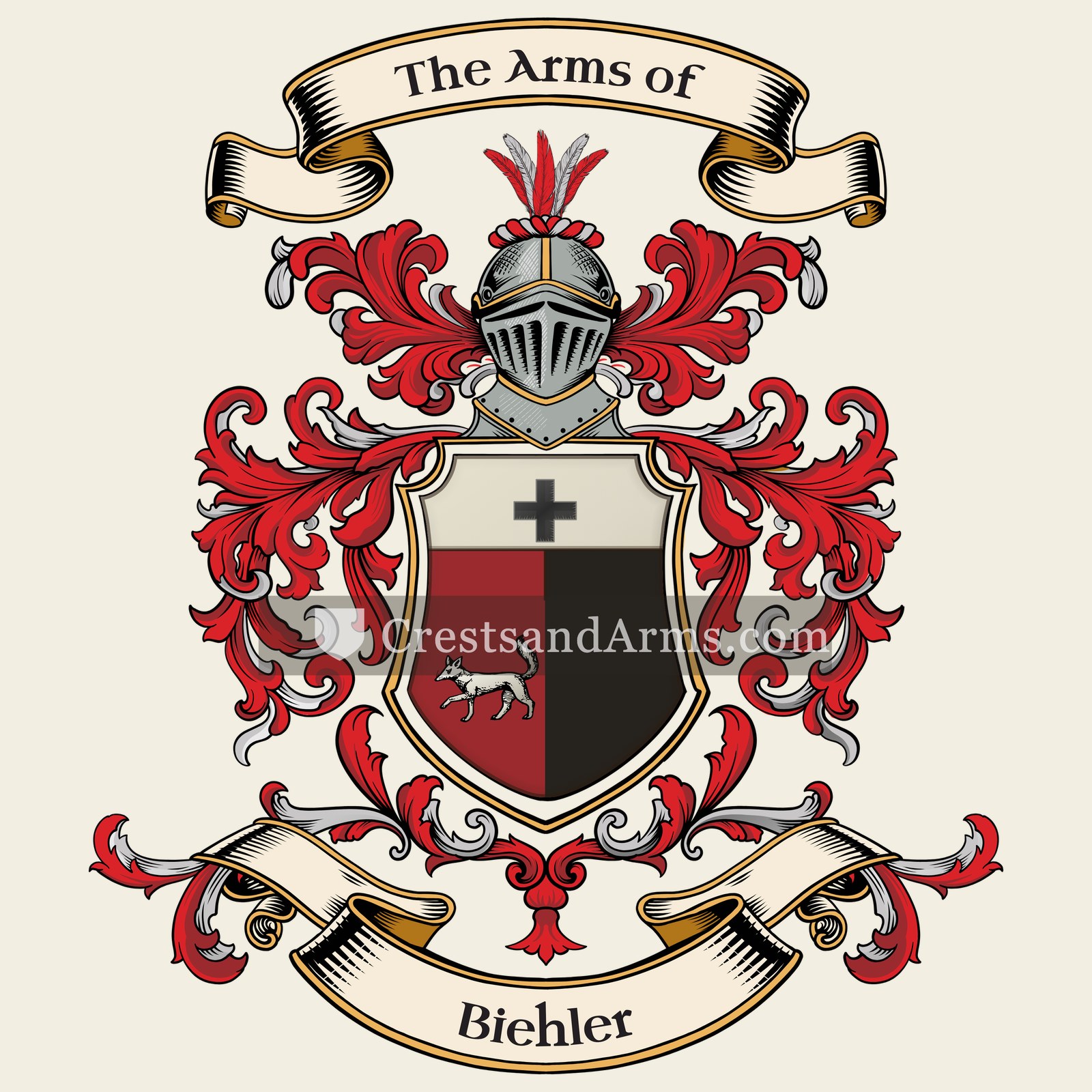
A record of documented arms, meaning and origin, researched for the Biehler family of Germany.
Reg. 7043 · German, A–C
Coat of Arms & Family Crest Details
Symbols on this shield
chiefAuthority, wisdom and dominion
cross symbolChristian faith and service
foxWit and wisdom in defence
Colours
Red (Gules)Means: Military strength
Black (Sable)Means: Constancy
Silver (Argent)Means: Peace and sincerity
Historical info
Source
J. B. Rietstap, Armorial Général, Gouda: G. B. van Goor Zonen, 1884–87
Blazon (the actual original written record)
“Parti: au 1 de gu. au renard courant d'arg.; au 2 de sa. à un crochet d'escalade de trois traverses d'arg. Au chef d'arg.; ch. de la Croix de fer. C.: un château de couleur rougeâtre, sommé du drapeau allemand. L.: à dextre d'arg. et de gu., à sen. d'arg. et de sa.”
Germanyc. 1871
Digital archive packCoat of arms PNG, gold border print PDF, vector SVG and the certificate of authenticity. Sent to your email in minutes.
Map of Germany showing where the Biehler arms are recorded
The Biehler arms were recorded in Germany, c. 1871.
Arms such as these were typically recorded in Bavaria.
Bavaria was a country of old landed families and walled market towns. Estates passed down the same line for centuries, and both the landowners and the leading townsmen kept arms, which is why so many Bavarian names sit in the registers.
This is where the arms were entered in the register. Families often moved to other parts of the country, so the same name can turn up in more than one region.
The body that granted and recorded arms in Germany in this period.
Wilhelm I
Sovereign of the period
Wilhelm I
1861–1888
Reigning in Germany when the Biehler arms are first recorded.
How Arms Worked in Germany
Prussian heraldry was strictly tied to social rank and noble status rather than being a free choice for every citizen. These symbols were treated as permanent family property that moved through the generations to all legitimate heirs. If a family branch wanted to change their design to stand out, they had to apply for official permission to alter their specific version of the shield.
Granting authority
The Prussian Heroldsamt acted as the central state office that managed and strictly controlled all noble titles and coats of arms.
How they got arms
Families usually obtained their arms through formal royal grants or by proving their long-standing noble status to the state authorities.
Where arms were recorded
All official coats of arms were kept in the rolls of the Prussian Heroldsamt, which functioned from 1706 until 1918.
The family's standing
Recorded among the armigerous families of Germany.
Origin & History of the Biehler Family in Germany
The surname Biehler is a topographical name that originated in the southern German regions, particularly within the historical borders of Bavaria. It is derived from the Middle High German word "biehel," which refers to a small hill or a mound of earth. During the medieval period, people often adopted surnames based on the physical features of the land where they lived or worked. Families carrying this name were likely identified as those who resided on or near a prominent hill in their local village. By the time the German Empire was established in 1871, the Biehler family was well-rooted in the Bavarian landscape, reflecting a long history of agricultural life and regional settlement that had persisted for generations before the unification of the country.
Biehler Meaning & Related Branches
Root word
Bühel
A Middle High German term for a hill or mound.
This name
BiehlerRefers to someone who lived on or near a hill or small mountain.
also spelled
Byehler
Beeler
Documented Sources
J. B. Rietstap, Armorial Général, Gouda: G. B. van Goor Zonen, 1884–87
Bahlow, Hans, Deutsches Namenlexikon: Familien- und Vornamen nach Ursprung und Sinn erklärt, 1967
Heintze, Albert, Die deutschen Familiennamen: geschichtlich, geographisch, sprachlich, 1903
Bayerisches Hauptstaatsarchiv, Kirchenbücher und Standesamtsregister, 1871
Digital archive packCoat of arms PNG, gold border print PDF, vector SVG and the certificate of authenticity. Sent to your email in minutes.


 chiefAuthority, wisdom and dominion
 cross symbolChristian faith and service
 foxWit and wisdom in defence
 chiefAuthority, wisdom and dominion
 cross symbolChristian faith and service
 foxWit and wisdom in defence