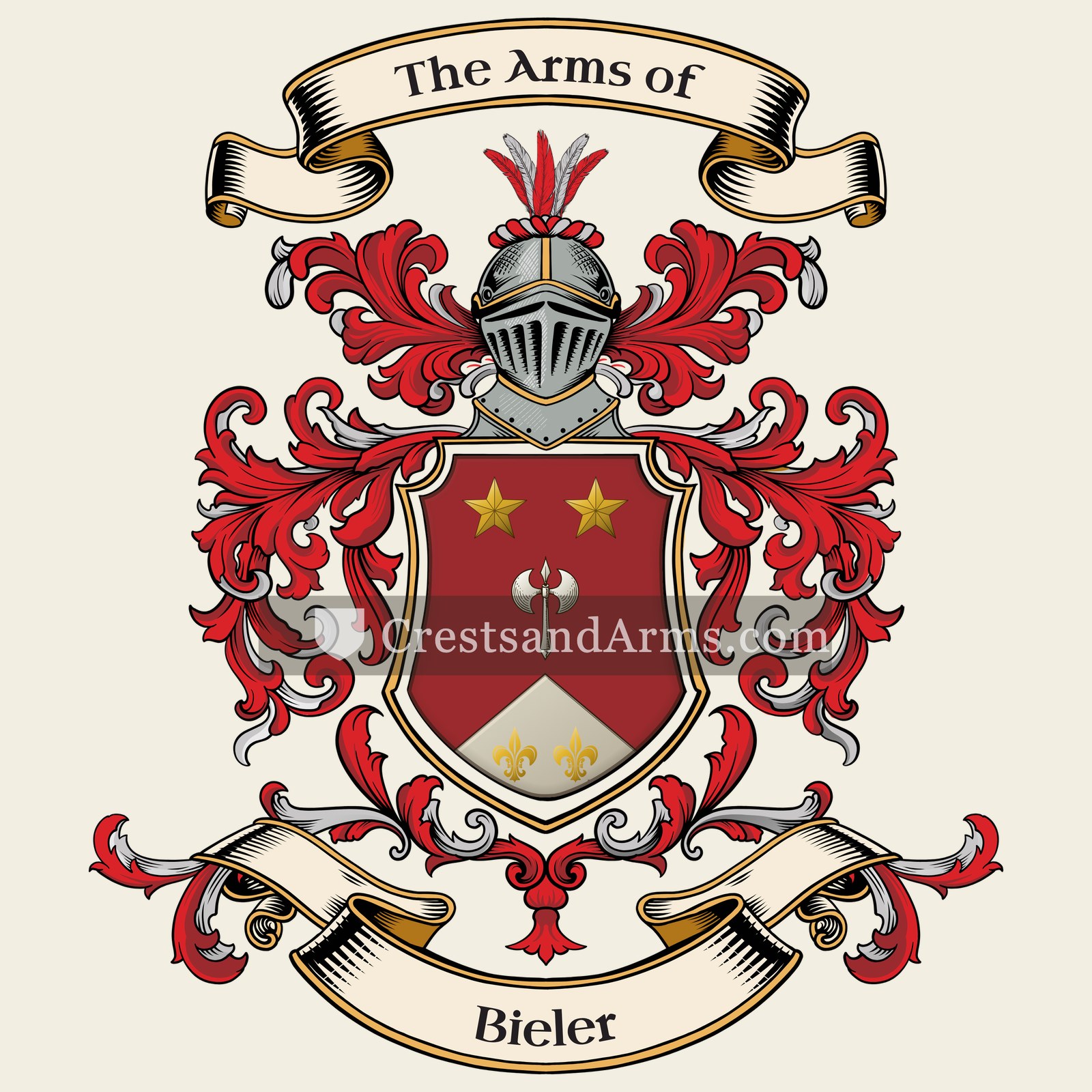
A record of documented arms, meaning and origin, researched for the Bieler family of Switzerland.
Reg. 2019 · Swiss, A–C
Coat of Arms & Family Crest Details
Symbols on this shield
axeThe execution of military duty
mulletThe third son, and a divine quality from above
fleur de lisPurity, light, and the sixth son
Colours
Red (Gules)Means: Military strength
Silver (Argent)Means: Peace and sincerity
Gold (Or)Means: Generosity
Historical info
Source
J. B. Rietstap, Armorial Général, Gouda: G. B. van Goor Zonen, 1884–87
Blazon (the actual original written record)
“De gu. à une hache d'arg., emm. d'or, posée en barre, le manche à sen., le tranchant en bas; ladite hache cant. en chef de deux étoiles d'or et en p. de deux fleurs-de-lis du même; à un tertre de trois coupeaux de sin., mouv. de la p. C.: une étoile d'or. L. d'or et de gu.”
SwitzerlandSoleure, c. 1745
Digital archive packCoat of arms PNG, gold border print PDF, vector SVG and the certificate of authenticity. Sent to your email in minutes.
Map of Switzerland showing where the Bieler arms are recorded
The Bieler arms were recorded in Soleure, c. 1745.
This is where the arms were entered in the register. Families often moved to other parts of the country, so the same name can turn up in more than one region.
The body that granted and recorded arms in Switzerland in this period.
How Arms Worked in Switzerland
In Switzerland, coats of arms were not restricted to the nobility and were often adopted by common citizens and families. These symbols were passed down through generations to show family identity. When branches of a family grew, they often changed small details of the design to distinguish their own line from the original group.
Granting authority
Cantonal and civic authorities managed the use of coats of arms within their specific regions and local jurisdictions.
How they got arms
Families typically assumed their own coats of arms based on local custom rather than receiving them from a central monarch.
Where arms were recorded
Arms were recorded in various cantonal and civic registers starting from the fourteenth century throughout the Swiss region.
The family's standing
Recorded among the armigerous families of Switzerland.
Origin & History of the Bieler Family in Switzerland
The surname Bieler is deeply rooted in the history of the Swiss canton of Solothurn, where records confirm the family was well-established by the year 1745. The name is generally considered a topographic descriptor, likely derived from the Middle High German word "biel," which referred to a small hill or a rocky outcrop. This suggests that the earliest ancestors to carry the name were people who lived near a prominent local landmark or a specific elevated piece of land. Over time, as families became more settled and communities grew, this descriptive nickname evolved into a permanent hereditary surname passed down through generations. By the mid-18th century, the Bieler family had become an integral part of the social and civic fabric of the region, participating in the daily life and administrative traditions of Solothurn.
Bieler Meaning & Related Branches
Root word
Biel
A geographical term referring to a settlement or a small town.
This name
BielerA topographic name for someone who lived near or in a small settlement.
also spelled
Byeler
Beeler
Related arms
Bihlervariant spelling
Documented Sources
J. B. Rietstap, Armorial Général, Gouda: G. B. van Goor Zonen, 1884–87
Staatsarchiv des Kantons Solothurn, Kirchenbücher der Stadt Solothurn
Staatsarchiv des Kantons Solothurn, Bürgerrodel der Stadt Solothurn
Bahlow, Hans, Deutsches Namenlexikon: Familien- und Vornamen nach Ursprung und Sinn erklärt, 1967
Zoder, Rudolf, Familiennamen in Ostfalen, 1968
Digital archive packCoat of arms PNG, gold border print PDF, vector SVG and the certificate of authenticity. Sent to your email in minutes.


 axeThe execution of military duty
 mulletThe third son, and a divine quality from above
 fleur de lisPurity, light, and the sixth son
 axeThe execution of military duty
 mulletThe third son, and a divine quality from above
 fleur de lisPurity, light, and the sixth son