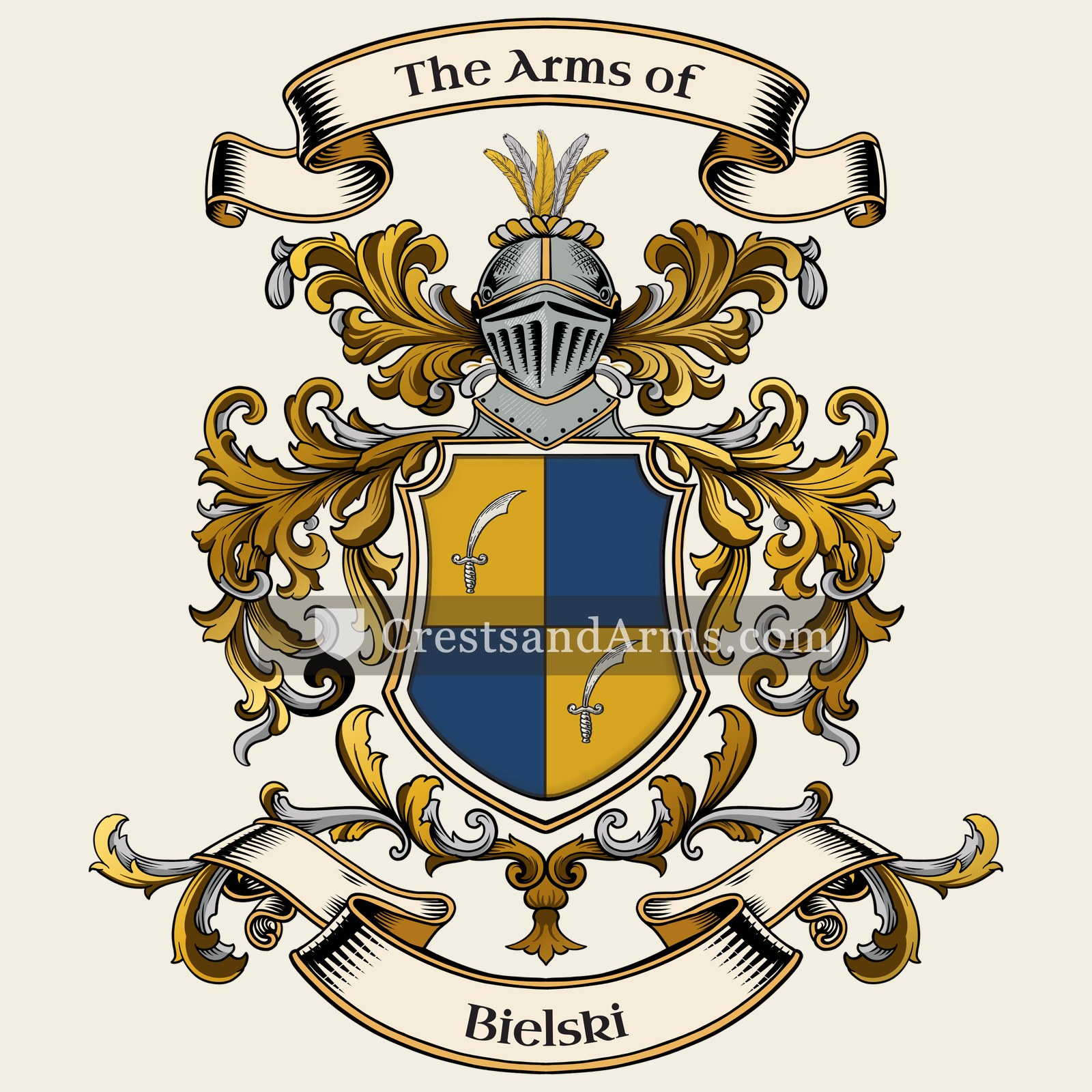
A record of documented arms, meaning and origin, researched for the Bielski family of Poland.
Reg. 4410 · Polish, A–C
Coat of Arms & Family Crest Details
Symbols on this shield
swordJustice, and military honour
Colours
Gold (Or)Means: Generosity
Blue (Azure)Means: Loyalty and truth
Silver (Argent)Means: Peace and sincerity
Historical info
Source
J. B. Rietstap, Armorial Général, Gouda: G. B. van Goor Zonen, 1884–87
Blazon (the actual original written record)
“Ec.: aux 1 et 4 d'or à un cimeterre d'arg., garni de sa., la pointe en bas, celui du 1 en bande et celui du 4 en barre; aux 2 et 3 gironné d'azur et d'or, de seize pièces. Sur le tout de gu. à une croix de Lorraine d'arg. à laquelle manque le bras inférieur à sen., acc. en chef de deux étoiles d'or et en p. d'un croiss. figuré montant du même. Cq. cour. C.: un bouc iss. d'arg., acorné d'or, langué de gu. L.: à dextre d'or et d'azur, à sen. d'arg. et de gu. S.: deux ours de sa., lamp. de gu.”
LivoniaEsthonie · Livonia, c. 1772
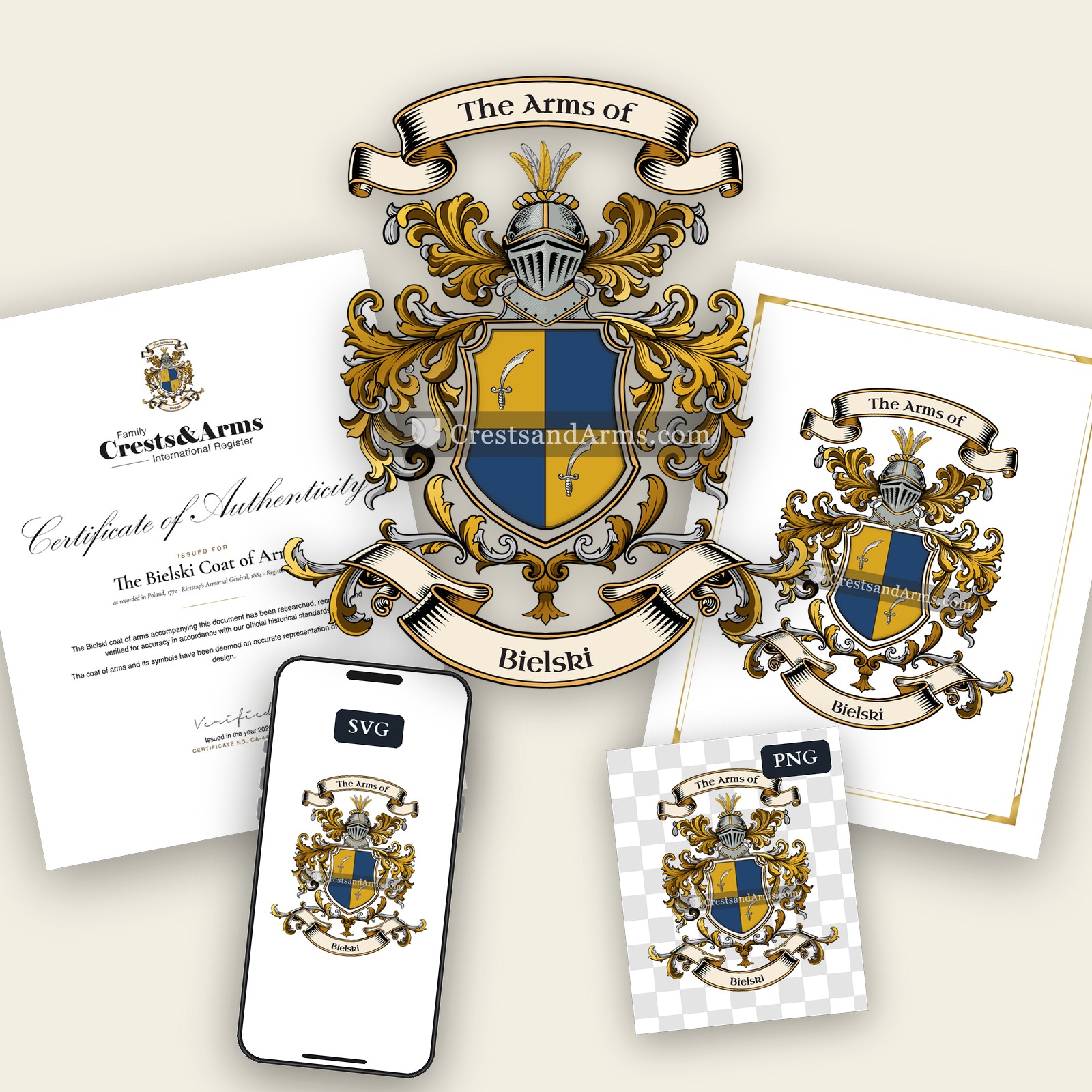
Digital archive packCoat of arms PNG, gold border print PDF, vector SVG and the certificate of authenticity. Sent to your email in minutes.
Map of Poland showing where the Bielski arms are recorded
The Bielski arms were recorded in Livonia, c. 1772.
Livonia was Baltic country held by a small number of landed families who kept their estates for centuries. Land there passed down whole rather than being divided, and long unbroken tenure is what fills a register.
This is where the arms were entered in the register. Families often moved to other parts of the country, so the same name can turn up in more than one region.
Region
Livonia
Town
Esthonie
First recorded
1772
Granting Authority for the Bielski Arms
Ennoblement by the Sejm
Author: Olek Remesz · CC BY-SA 3.0
The body that granted and recorded arms in Poland in this period.
Stanisław August Poniatowski
Sovereign of the period
Stanisław August Poniatowski
1764–1795
Reigning in Poland when the Bielski arms are first recorded.
How Arms Worked in Poland
Polish noble families shared a single coat of arms across many different surnames, creating large clans rather than individual designs. These symbols were held collectively by all members of the clan regardless of their specific family name. When a new family joined the nobility, they were adopted into an existing clan and began using that group's established shield.
Granting authority
The Sejm, which was the Polish parliament, held the power to grant noble status and the right to bear arms.
How they got arms
Families typically received their coat of arms through a formal act of ennoblement granted by the Sejm for distinguished service.
Where arms were recorded
These grants were officially recorded in the Crown Metrica, which served as the central archive for state documents starting in the sixteenth century.
The family's standing
Recorded among the armigerous families of Livonia.
Origin & History of the Bielski Family in Poland
The Bielski family name is rooted in the Slavic linguistic tradition, typically deriving from the word "biel," which means white. This suggests that early ancestors may have been identified by a physical trait like light hair or perhaps by their residence in a place known for its bright or white appearance. By 1772, historical records confirm that members of the family were well-established in the region of Livonia. This area, which spans parts of modern-day Estonia and Latvia, was a complex crossroads of cultures and languages at that time. Living in Livonia during the late eighteenth century meant the family was part of a society shaped by shifting borders and the influence of the Polish-Lithuanian Commonwealth and the Russian Empire. These early Bielskis likely navigated a world of agricultural estates and growing trade centers, helping to anchor the family name in the Baltic landscape long before the modern era.
Bielski Meaning & Related Branches
Root word
Biały
A Slavic adjective meaning white or fair-colored.
This name
BielskiA topographic or habitational name referring to someone from a place called Bielsk or a white-colored location.
also spelled
Bielski
Byelsky
Documented Sources
J. B. Rietstap, Armorial Général, Gouda: G. B. van Goor Zonen, 1884–87
Dunsdorfs, Edgars. Der große schwedische Kataster in Livland 1681–1710. 1974
Latvian State Historical Archives (Latvijas Valsts vēstures arhīvs), Fond 235: Livland Landtag Records
Plakans, Andrejs. The Latvians: A Short History. 1995
Digital archive packCoat of arms PNG, gold border print PDF, vector SVG and the certificate of authenticity. Sent to your email in minutes.


 swordJustice, and military honour
 swordJustice, and military honour