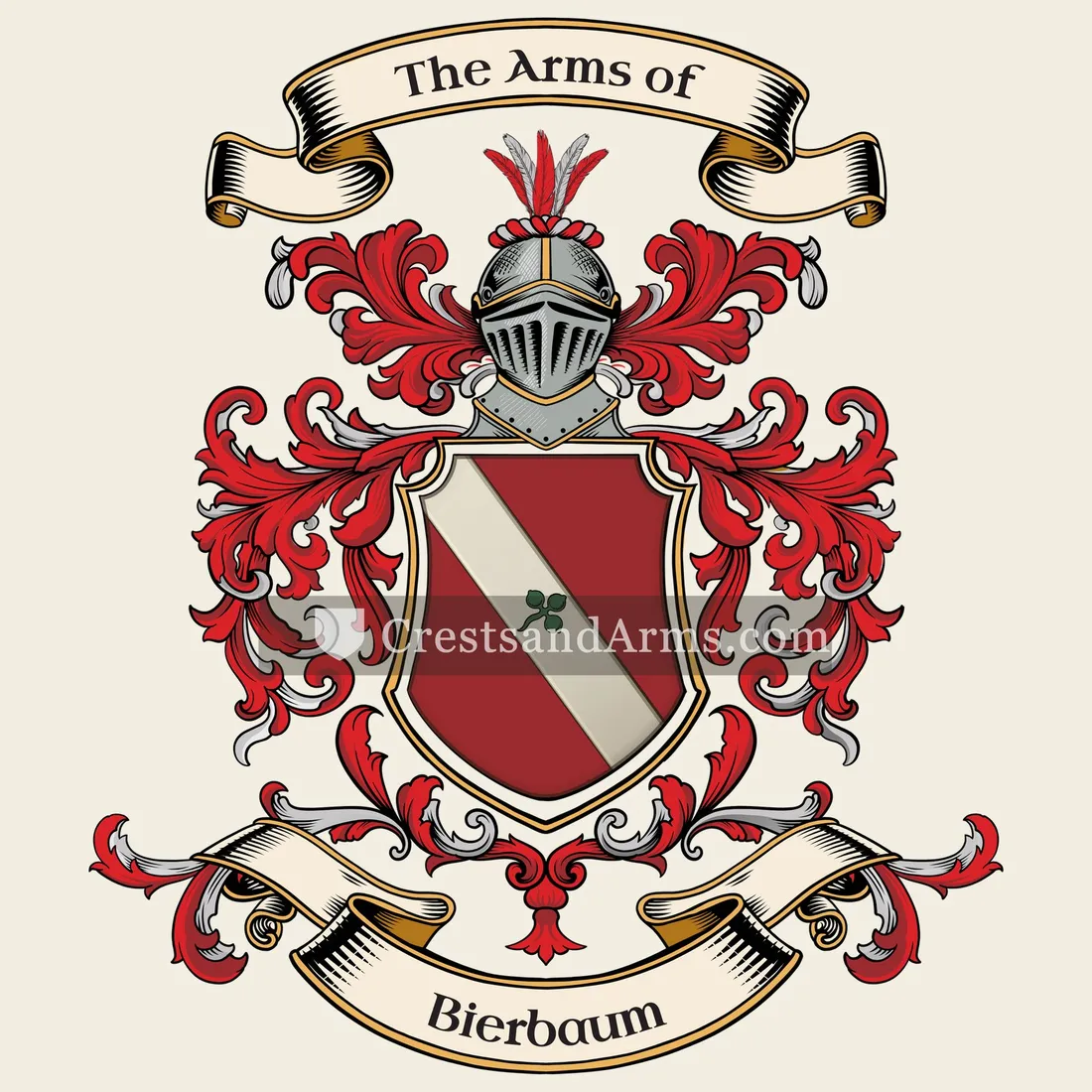
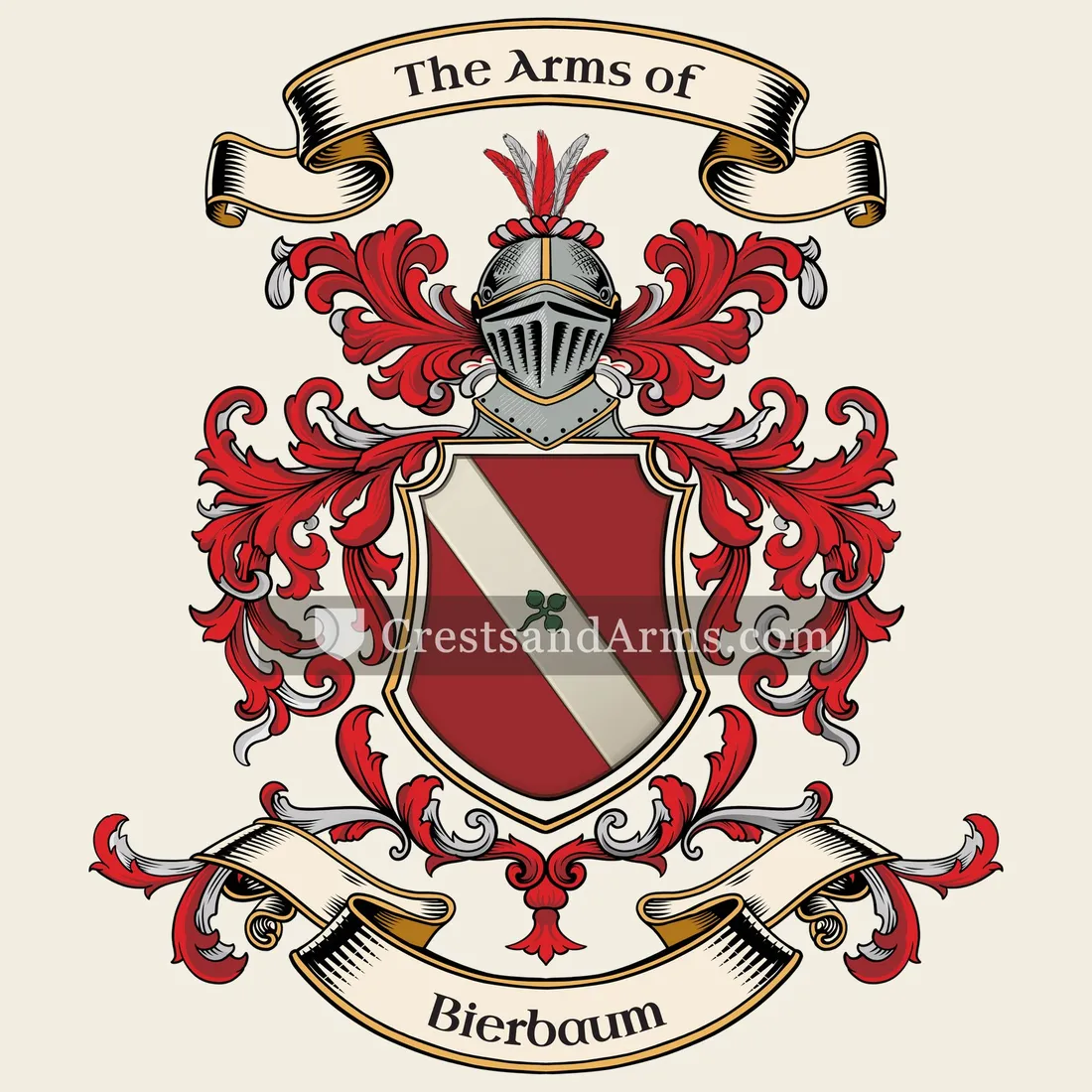
A record of documented arms, meaning and origin, researched for the Bierbaum family lines. Documented in 2 countries.
Reg. 4996 · German, A–C
Meaning of the Bierbaum family crest colors & symbols
Symbols on this shield
bendDefence, and the scarf of a commander
trefoilPerpetuity, and the Trinity
Colours
Red (Gules)Means: Military strength
Silver (Argent)Means: Peace and sincerity
Green (Vert)Means: Hope
Historical info
Source
J. B. Rietstap, Armorial Général, Gouda: G. B. van Goor Zonen, 1884–87
Blazon (the actual original written record)
“De gu. à la bande ondée d'arg., ch. d'un trèfle de sin., posé en le sens de la bande. Cq. cour. C.: une tête et col de cygne d'arg., tenant en son bec un trèfle de sin. L.: d'arg. et de gu.”
Germanyc. 1765
Digital archive packCoat of arms PNG, gold border print PDF, vector SVG and the certificate of authenticity. Sent to your email in minutes.
Map of Germany showing where the Bierbaum arms are recorded
The Bierbaum arms were recorded in Germany, c. 1765.
Arms such as these were typically recorded in Bavaria.
Bavaria was a country of old landed families and walled market towns. Estates passed down the same line for centuries, and both the landowners and the leading townsmen kept arms, which is why so many Bavarian names sit in the registers.
This is where the arms were entered in the register. Families often moved to other parts of the country, so the same name can turn up in more than one region.
The body that granted and recorded arms in Germany in this period.
Francis I, Holy Roman Emperor
Sovereign of the period
Francis I, Holy Roman Emperor
1745–1765
Reigning in Germany when the Bierbaum arms are first recorded.
How Arms Worked in Germany
In the Holy Roman Empire, coats of arms were often granted to individuals by the Emperor or his representatives. These arms were then passed down through the generations to all legitimate descendants of the original holder. Younger branches of a family usually kept the same shield design without needing to change it, as the arms belonged to the entire lineage.
Granting authority
The Holy Roman Emperor held the sole power to grant new coats of arms throughout his vast imperial territories.
How they got arms
Families typically obtained their coats of arms through a formal imperial grant or by proving their noble status to the authorities.
Where arms were recorded
These grants were officially recorded in the Imperial Chancery registers, which began keeping formal records of such honors during the Middle Ages.
The family's standing
Recorded among the armigerous families of Germany.
Origin & History of the Bierbaum Family in Germany
The surname Bierbaum originates from the German language and translates literally to "beer tree." This name belongs to a class of surnames known as topographic names, which were often given to people based on the specific landscape or landmark near their home. In the context of early German history, a family living near a prominent tree or a specific orchard might have been identified by their neighbors through this descriptive title. By 1765, records confirm that members of the Bierbaum family were well-established in the region of Bavaria. During this era, life in Bavaria was deeply tied to the land and local agricultural traditions, and families often remained in the same villages for generations. As the family grew and moved throughout the German states, the name served as a link to their ancestral roots and the rural environment that first defined their identity.
Meaning of the Bierbaum family crest colors & symbols
Symbols on this shield
bendDefence, and the scarf of a commander
trefoilPerpetuity, and the Trinity
Colours
Red (Gules)Means: Military strength
Silver (Argent)Means: Peace and sincerity
Green (Vert)Means: Hope
Historical info
Source
J. B. Rietstap, Armorial Général, Gouda: G. B. van Goor Zonen, 1884–87
Blazon (the actual original written record)
“De gu. à la bande ondee d'arg., ch. d'un trèfle de sin., posé dans le sens de la bande.”
Netherlandsc. 1815
Digital archive packCoat of arms PNG, gold border print PDF, vector SVG and the certificate of authenticity. Sent to your email in minutes.
Map of Netherlands showing where the Bierbaum arms are recorded
The Bierbaum arms were recorded in Netherlands, c. 1815.
Arms such as these were typically recorded in Friesland.
Friesland was low, wet country on the northern coast of the Netherlands, farmed by families who had held the same land for centuries. Free landholders were unusually common there, and a free landholder could carry arms.
This is where the arms were entered in the register. Families often moved to other parts of the country, so the same name can turn up in more than one region.
Region
Friesland
First recorded
1815
Granting Authority for the Bierbaum Arms
Hoge Raad van Adel
Photograph made by me · CC BY-SA 3.0
The body that granted and recorded arms in Netherlands in this period.
William I of the Netherlands
Sovereign of the period
William I of the Netherlands
1815–1840
Reigning in Germany when the Bierbaum arms are first recorded.
How Arms Worked in Netherlands
In the Netherlands, coats of arms were often used by noble families and those who held specific public offices. These arms were passed down through the generations to legitimate descendants. Younger branches of a family usually kept the original design without needing to add special marks. This system ensured that the family identity remained clear and consistent over many years.
Granting authority
The Hoge Raad van Adel is the official body that regulates and manages noble titles and coats of arms in the Netherlands.
How they got arms
Families typically obtained their coats of arms through official royal grants or by proving their long-standing historical use of the symbols.
Where arms were recorded
Coats of arms are officially recorded in the registers held by the Hoge Raad van Adel, which began its work in 1814.
The family's standing
Recorded among the armigerous families of Netherlands.
Origin & History of the Bierbaum Family in Netherlands
The family name Bierbaum, which translates literally to "beer tree," likely originated as a descriptive name for someone who lived near a prominent tree or worked in the brewing trade. While the name has strong roots in German-speaking regions, its presence in the Netherlands became documented during the early nineteenth century, particularly within the northern province of Friesland. By 1815, the Netherlands had recently transitioned into a kingdom, and the government began enforcing strict civil registration laws that required all citizens to formalize their surnames. Families living in Friesland at this time often integrated into the local agricultural and maritime communities, adapting their traditional names to fit the Dutch linguistic landscape. This period of administrative reform provides a clear starting point for tracing the Bierbaum lineage, as official birth and marriage records from this era offer a reliable window into how the family established their presence in the region.
Bierbaum Meaning & Related Branches
Root word
Birbaum
A compound of words for pear and tree.
This name
BierbaumRefers to someone who lived near a prominent pear tree or worked in an orchard.
also spelled
Byerbaumer
Beerbowmer
Documented Sources
J. B. Rietstap, Armorial Général, Gouda: G. B. van Goor Zonen, 1884–87
Bahlow, Hans, Deutsches Namenlexikon: Familien- und Vornamen nach Ursprung und Sinn erklärt, 1967
Heintze, Albert, Die deutschen Familien-Namen: geschichtlich, geographisch, sprachlich, 1903


 bendDefence, and the scarf of a commander
 trefoilPerpetuity, and the Trinity
 bendDefence, and the scarf of a commander
 trefoilPerpetuity, and the Trinity