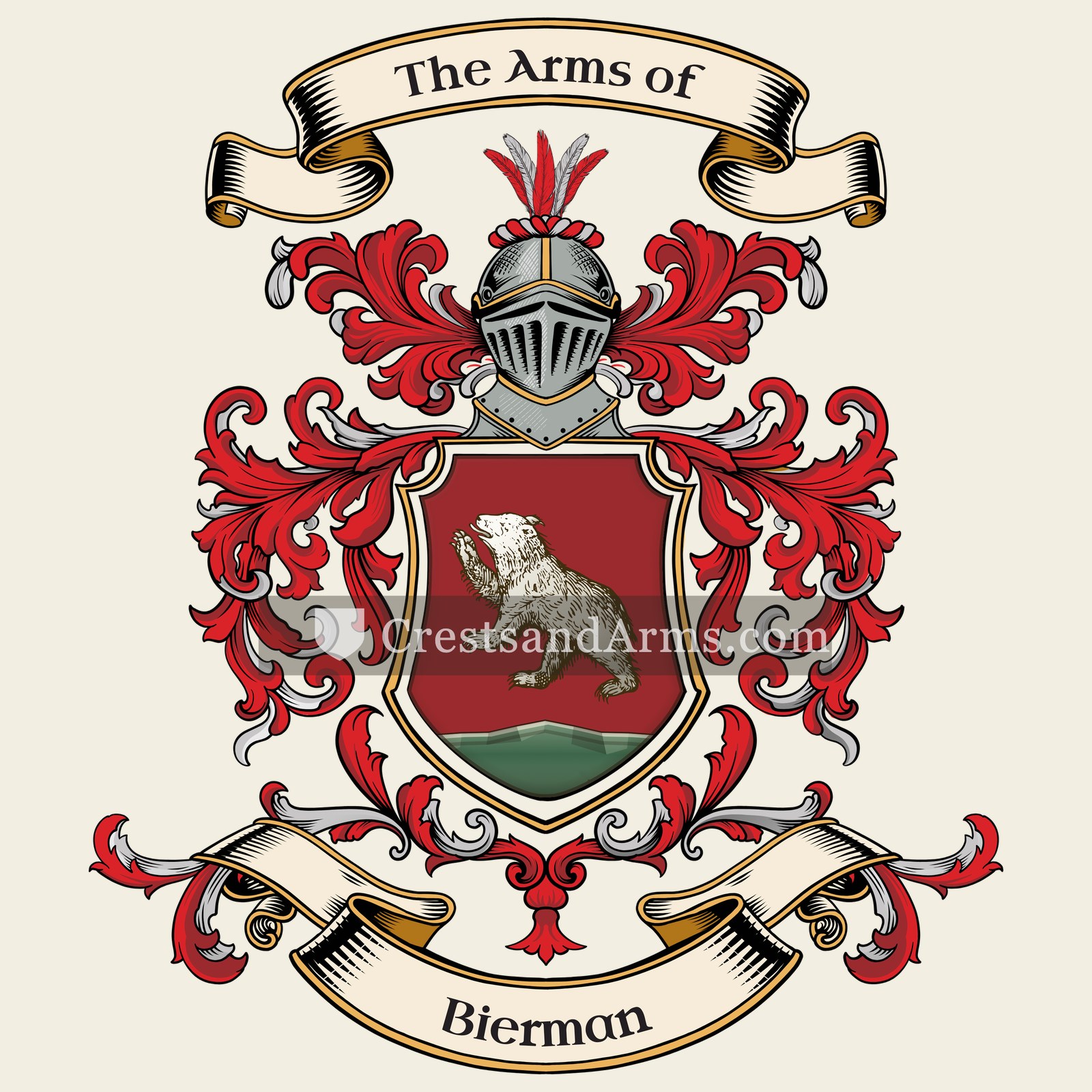
A record of documented arms, meaning and origin, researched for the Bierman family of Netherlands.
Reg. 4367 · Dutch, A–C
Coat of Arms & Family Crest Details
Symbols on this shield
mountThe ground held, and steadfastness upon it
bearStrength, cunning and protection of kin
Colours
Red (Gules)Means: Military strength
Green (Vert)Means: Hope
Historical info
Source
J. B. Rietstap, Armorial Général, Gouda: G. B. van Goor Zonen, 1884–87
Blazon (the actual original written record)
“De gu. à l'ours, au nat., coll. d'or, pass. sur une terrasse de sin.”
GueldersGuelders, c. 1815
Where the Bierman Arms Were Recorded
Guelders
Map of Netherlands showing where the Bierman arms are recorded
The Bierman arms were recorded in Guelders, c. 1815.
Guelders was river country in the east of the Netherlands, held by families whose estates sat along the water. Land there stayed in the same hands for generations, and long tenure is what fills a register of arms.
This is where the arms were entered in the register. Families often moved to other parts of the country, so the same name can turn up in more than one region.
Region
Guelders
First recorded
1815
Granting Authority for the Bierman Arms
Hoge Raad van Adel
Photograph made by me · CC BY-SA 3.0
The body that granted and recorded arms in Netherlands in this period.
William I of the Netherlands
Sovereign of the period
William I of the Netherlands
1815–1840
Reigning in Netherlands when the Bierman arms are first recorded.
How Arms Worked in Netherlands
In the Netherlands, coats of arms were often used by noble families and those who held specific public offices. These arms were passed down through the generations to legitimate descendants. Younger branches of a family usually kept the original design without needing to add special marks. This system ensured that the family identity remained clear and consistent over many years.
Granting authority
The Hoge Raad van Adel is the official body that regulates and manages noble titles and coats of arms in the Netherlands.
How they got arms
Families typically obtained their coats of arms through official royal grants or by proving their long-standing historical use of the symbols.
Where arms were recorded
Coats of arms are officially recorded in the registers held by the Hoge Raad van Adel, which began its work in 1814.
The family's standing
Recorded among the armigerous families of Guelders.
Origin & History of the Bierman Family in Netherlands
The surname Bierman originates from the Germanic linguistic tradition, where it functioned as an occupational name for a person who worked with beer. In the Middle Ages, this likely referred to a brewer or a tavern keeper who served the local community. By the early 19th century, records confirm that families bearing this name were well-established in the region of Guelders, which is a historical territory located in the eastern part of the Netherlands. During this period, the name was common among families who lived and worked in the rural landscapes of the Low Countries. As these families grew, they maintained their connection to the region through local trade and agriculture, eventually spreading across the surrounding provinces as they sought new opportunities in the changing economic landscape of the 1800s.
Related Branches & Arms
Root word
bier
A fermented alcoholic beverage made from malt and hops.
This name
BiermanAn occupational surname for a person who brewed or sold beer.
also spelled
Byerman
Beerman
Documented Sources
J. B. Rietstap, Armorial Général, Gouda: G. B. van Goor Zonen, 1884–87
Beider, Alexander. A Dictionary of German-Jewish Surnames. 2010
Gelders Archief. Burgerlijke stand Gelderland, dubbelen. 1815
Heintze, Albert. Die deutschen Familien-Namen, geschichtlich, geographisch, sprachlich. 1903
Digital archive packCoat of arms PNG, gold border print PDF, vector SVG and the certificate of authenticity. Sent to your email in minutes.


 mountThe ground held, and steadfastness upon it
 bearStrength, cunning and protection of kin
 mountThe ground held, and steadfastness upon it
 bearStrength, cunning and protection of kin