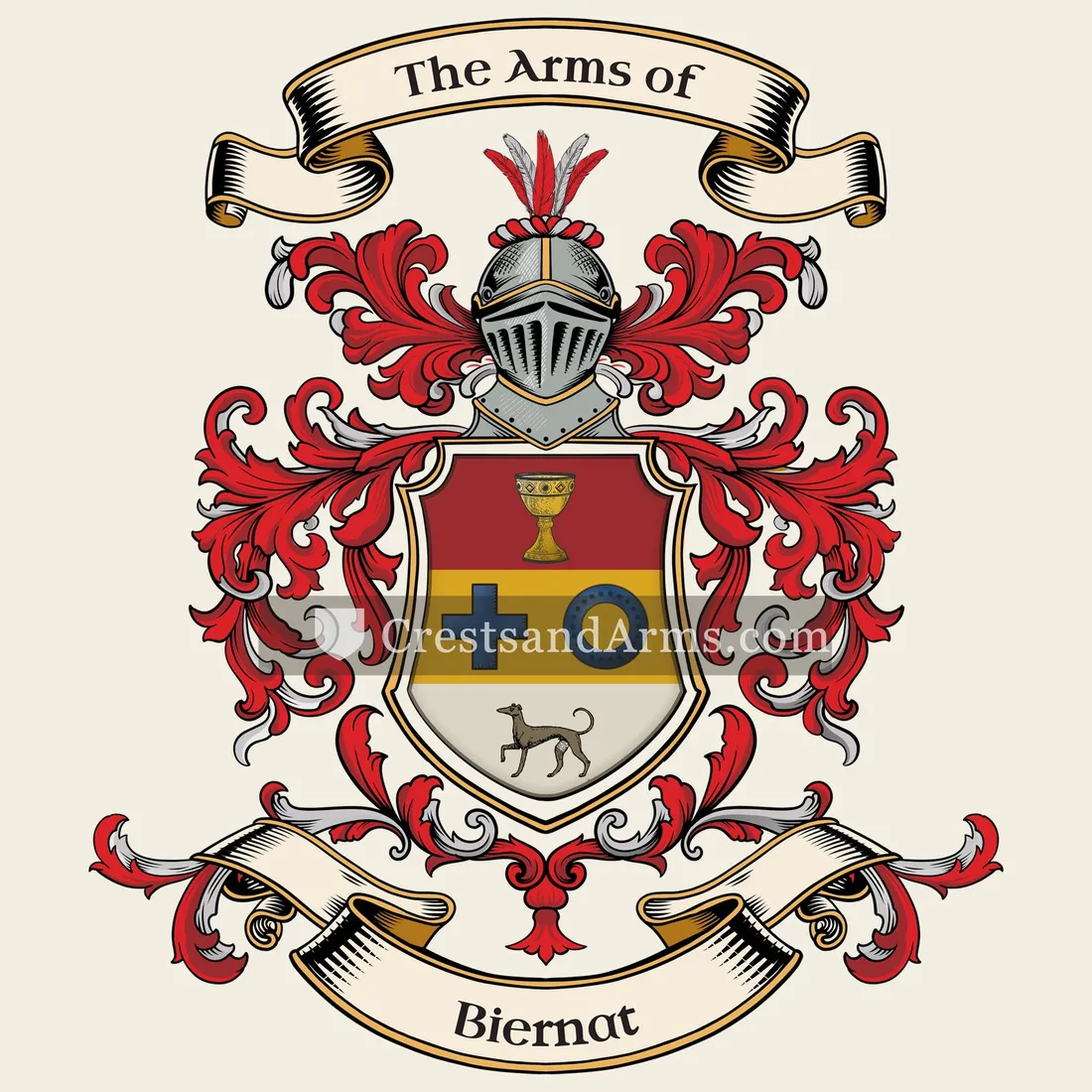
A record of documented arms, meaning and origin, researched for the Biernat family of Spain.
Reg. 7031 · Spanish, A–C
Meaning of the Biernat family crest colors & symbols
Symbols on this shield
cross symbolChristian faith and service
cupFaith, office, and a trust discharged
ringFidelity, and a promise kept
greyhoundCourage, vigilance and loyalty
Colours
Red (Gules)Means: Military strength
Gold (Or)Means: Generosity
Silver (Argent)Means: Peace and sincerity
Blue (Azure)Means: Loyalty and truth
Historical info
Source
J. B. Rietstap, Armorial Général, Gouda: G. B. van Goor Zonen, 1884–87
Blazon (the actual original written record)
“Tiercé en fasce: au 1 de gu. à une coupe couverte d'or: au 2 d'or à un tau d'azur ayant en haut un annelet du même; au 3 d'arg. à un chien braque pass. au nat. [V. Bernal.]”
CataloniaCatalonia, c. 1722
Digital archive packCoat of arms PNG, gold border print PDF, vector SVG and the certificate of authenticity. Sent to your email in minutes.
Map of Spain showing where the Biernat arms are recorded
The Biernat arms were recorded in Catalonia, c. 1722.
Catalonia lived by sea trade, and its merchant houses were as powerful as its landowners. Both sorts of family took arms, and Barcelona kept records of the houses entitled to bear them.
This is where the arms were entered in the register. Families often moved to other parts of the country, so the same name can turn up in more than one region.
The body that granted and recorded arms in Spain in this period.
Philip V of Spain
Sovereign of the period
Philip V of Spain
1714–1724
Reigning in Spain when the Biernat arms are first recorded.
How Arms Worked in Spain
In Spain, a coat of arms was considered a form of property that belonged to the entire family line. These arms were passed down from a father to all his children equally. Younger branches of the family usually kept the original design without needing to add any special marks to distinguish their specific line.
Granting authority
The Cronista Rey de Armas was the official body that regulated and granted coats of arms throughout Spain.
How they got arms
Families often obtained their arms through royal grants or by proving their noble status to the official heraldic authority.
Where arms were recorded
Coats of arms were officially recorded in the registers of the Cronista Rey de Armas starting in 1496.
The family's standing
Recorded among the armigerous families of Catalonia.
Origin & History of the Biernat Family in Spain
The surname Biernat is deeply rooted in the history of Central and Eastern Europe, where it originated as a variation of the name Bernard. While the name is most commonly associated with Polish origins, historical records confirm that members of the family were established in Catalonia by 1722. During this era, the movement of families across European borders was often driven by trade, military service, or the search for new agricultural opportunities. Settling in the Catalonia region during the early 18th century suggests that these ancestors were part of a period of significant social and economic transition in Spain. As they integrated into local communities, the family likely adapted their traditional naming customs to fit the linguistic patterns of their new home. This migration highlights the resilience of the family as they maintained their identity while navigating the complex cultural landscape of the Mediterranean coast.
Biernat Meaning & Related Branches
Root word
Bernhard
Derived from the Germanic elements for bear and brave or hardy.
This name
BiernatA patronymic surname originating from the Germanic personal name meaning brave bear.
Documented Sources
J. B. Rietstap, Armorial Général, Gouda: G. B. van Goor Zonen, 1884–87
Arxiu de la Corona d'Aragó, Registre de l'Audiència de Catalunya, 1722
Krzysztof, Rymut, Nazwiska Polaków: Słownik historyczno-etymologiczny, 1999
Moll, Francesc de Borja, Els llinatges catalans, 1959
Digital archive packCoat of arms PNG, gold border print PDF, vector SVG and the certificate of authenticity. Sent to your email in minutes.


 cross symbolChristian faith and service
 cupFaith, office, and a trust discharged
 ringFidelity, and a promise kept
 greyhoundCourage, vigilance and loyalty
 cross symbolChristian faith and service
 cupFaith, office, and a trust discharged
 ringFidelity, and a promise kept
 greyhoundCourage, vigilance and loyalty