A record of documented arms, meaning and origin, researched for the Bildstein family lines. Documented in 2 countries.
Reg. 1239 · French, A–C
Coat of Arms & Family Crest Details
Symbols on this shield
bendDefence, and the scarf of a commander
fessThe military belt, and readiness to serve
swordJustice, and military honour
Colours
Gold (Or)Means: Generosity
Red (Gules)Means: Military strength
Silver (Argent)Means: Peace and sincerity
Black (Sable)Means: Constancy
Historical info
Source
J. B. Rietstap, Armorial Général, Gouda: G. B. van Goor Zonen, 1884–87
Blazon (the actual original written record)
“Ec.: aux 1 et 4 d'or à une épée de sa., posée en barre, la pointe en bas; à la bande de gu., br. sur l'épée, ch. de trois alérions d'arg., posés dans le sens de la bande; aux 2 et 3 d'or à trois fasces de gu.”
LorraineLorraine, c. 1696
Digital archive packCoat of arms PNG, gold border print PDF, vector SVG and the certificate of authenticity. Sent to your email in minutes.
Map of France showing where the Bildstein arms are recorded
The Bildstein arms were recorded in Lorraine, c. 1696.
Lorraine sat on the border between France and the German lands, and border country bred soldiers. Families here held small estates and served in arms, and a fighting man was exactly the sort who carried a shield of his own.
This is where the arms were entered in the register. Families often moved to other parts of the country, so the same name can turn up in more than one region.
The body that granted and recorded arms in France in this period.
Louis XIV of France
Sovereign of the period
Louis XIV of France
1643–1715
Reigning in France when the Bildstein arms are first recorded.
How Arms Worked in France
In France, a coat of arms was a mark of honor that passed down through the male line to all legitimate descendants. Families often used the same shield without changes to show their shared heritage. If a branch wanted to stand out, they could add a small mark to their shield to show their specific place in the family tree.
Granting authority
The Juge d'armes de France acted as the official authority that regulated and verified coats of arms across the country.
How they got arms
Families typically inherited their arms from ancestors, though they could also receive them through royal grants or by proving their noble status.
Where arms were recorded
Coats of arms were officially recorded in the Armorial Général de France, which began its main collection in the year 1696.
The family's standing
Recorded among the armigerous families of Lorraine.
Origin & History of the Bildstein Family in France
The family name Bildstein has deep roots in the Lorraine region of France, where records confirm the family was established by at least 1696. The name itself is of Germanic origin, combining the words for image or statue and stone, which suggests that the earliest ancestors may have been skilled stonemasons or artisans who carved religious figures for cathedrals. During the late 17th century, Lorraine was a crossroads of culture and industry, and families like the Bildsteins often moved between local villages to provide their specialized construction skills for rebuilding efforts after regional conflicts. By settling in this area, they became part of a long tradition of craftsmanship that defined the professional identity of many families in eastern France. Over time, the name became a permanent marker of their lineage, reflecting a history tied to the physical development and architectural heritage of the Lorraine landscape.
Coat of Arms & Family Crest Details
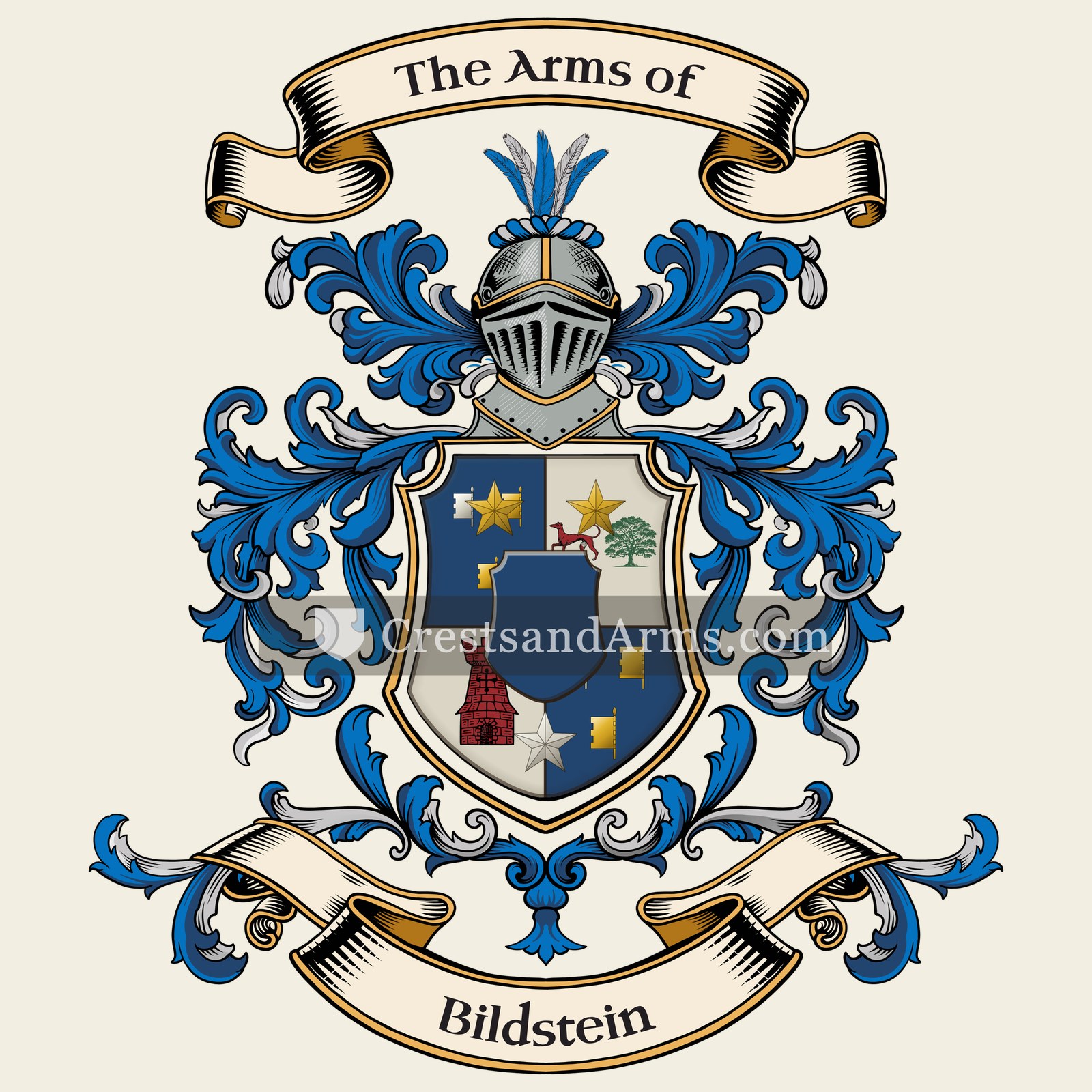
Symbols on this shield
mulletThe third son, and a divine quality from above
flag / pennantA command held, and a following kept
greyhoundCourage, vigilance and loyalty
treeLife, endurance and deep roots
towerGrandeur and solidity, and a stronghold defended
Colours
Blue (Azure)Means: Loyalty and truth
Silver (Argent)Means: Peace and sincerity
Gold (Or)Means: Generosity
Red (Gules)Means: Military strength
Green (Vert)Means: Hope
Historical info
Source
J. B. Rietstap, Armorial Général, Gouda: G. B. van Goor Zonen, 1884–87
Blazon (the actual original written record)
“Ec.: aux 1 et 4 d'azur à une bannière d'arg., br. sur deux bannières d'or, passées en saut., les hampes de sa.; au 2 d'arg. à un lévrier de gu., pass. sur un sapin arr. de sin., posé en fasce, les racines à dextre; au 3 d'arg. à la tour de gu. Sur le tout d'azur à la fasce losangée d'or et de gu., acc. en chef de deux étoiles (5) d'or et en p. d'une étoile (5) d'arg. Deux cq. cour. C.: 1° la fasce du surtout, supp. un chev. d'azur, ch. de trois étoiles (5) d'arg.; entre deux prob. coupées alt. d'or et d'azur; 2° une branche de laurier de sin., en pal, entre deux bannières, celle à dextre d'or, celle à sen. d'azur, frangée d'or.”
Swedenc. 1718
Digital archive packCoat of arms PNG, gold border print PDF, vector SVG and the certificate of authenticity. Sent to your email in minutes.
Map of Sweden showing where the Bildstein arms are recorded
The Bildstein arms were recorded in Sweden, c. 1718.
Arms such as these were typically recorded in Stockholm.
Stockholm held the Swedish court and the House of Nobility, where every noble family's arms were entered and kept. Families ennobled for service registered there, which is why so many are recorded around the city.
This is where the arms were entered in the register. Families often moved to other parts of the country, so the same name can turn up in more than one region.
The body that granted and recorded arms in Sweden in this period.
Carl XII of Sweden
Sovereign of the period
Carl XII of Sweden
1697–1718
Reigning in France when the Bildstein arms are first recorded.
How Arms Worked in Sweden
In Sweden, a coat of arms belonged to a noble family as a whole rather than just one individual. These arms were passed down through the generations to all legitimate descendants. Younger branches of the family used the same shield without needing to change it. This system ensured that the entire lineage shared the same identity and status under the law.
Granting authority
The Riddarhuset, or House of Nobility, regulated all noble coats of arms in Sweden under royal authority.
How they got arms
Families received their coats of arms through royal grants of nobility which were then officially registered with the House.
Where arms were recorded
Coats of arms were officially recorded in the Swedish House of Nobility register starting in the year 1626.
The family's standing
Recorded among the armigerous families of Sweden.
Origin & History of the Bildstein Family in Sweden
The family name Bildstein first appears in the historical records of Stockholm around 1718, marking a period of significant transition for the Swedish capital. During the early eighteenth century, Stockholm was a bustling center for trade and military administration, and families with German-sounding names like Bildstein often arrived as part of the growing merchant class or as skilled artisans seeking new opportunities in the Nordic region. The name itself suggests a connection to stone masonry or architecture, which were highly valued professions in a city undergoing frequent urban expansion and reconstruction. By settling in Stockholm during this time, the early members of the family became part of the city’s evolving social fabric, contributing to the professional life of the capital as it recovered from the hardships of the Great Northern War. Over the following decades, the family name became firmly established within the local community, reflecting the broader patterns of migration and professional specialization that defined eighteenth-century Swedish urban life.
Bildstein Meaning & Related Branches
Root word
Bild + Stein
Image or picture combined with stone or rock.
This name
BildsteinRefers to a person living near a stone statue, a carved boundary marker, or a rocky outcrop.
also spelled
Byldstein
Bildsteyn
Bildstine
Documented Sources
J. B. Rietstap, Armorial Général, Gouda: G. B. van Goor Zonen, 1884–87
Archives départementales de la Meurthe-et-Moselle, Registres paroissiaux et d'état civil de la commune de Lorraine
Bastien, Jean-Pierre, L'artisanat et les métiers en Lorraine au XVIIe siècle, 1982
Martin, François, Histoire des familles de la province de Lorraine, 1995
Digital archive packCoat of arms PNG, gold border print PDF, vector SVG and the certificate of authenticity. Sent to your email in minutes.


 bendDefence, and the scarf of a commander
 fessThe military belt, and readiness to serve
 swordJustice, and military honour
 bendDefence, and the scarf of a commander
 fessThe military belt, and readiness to serve
 swordJustice, and military honour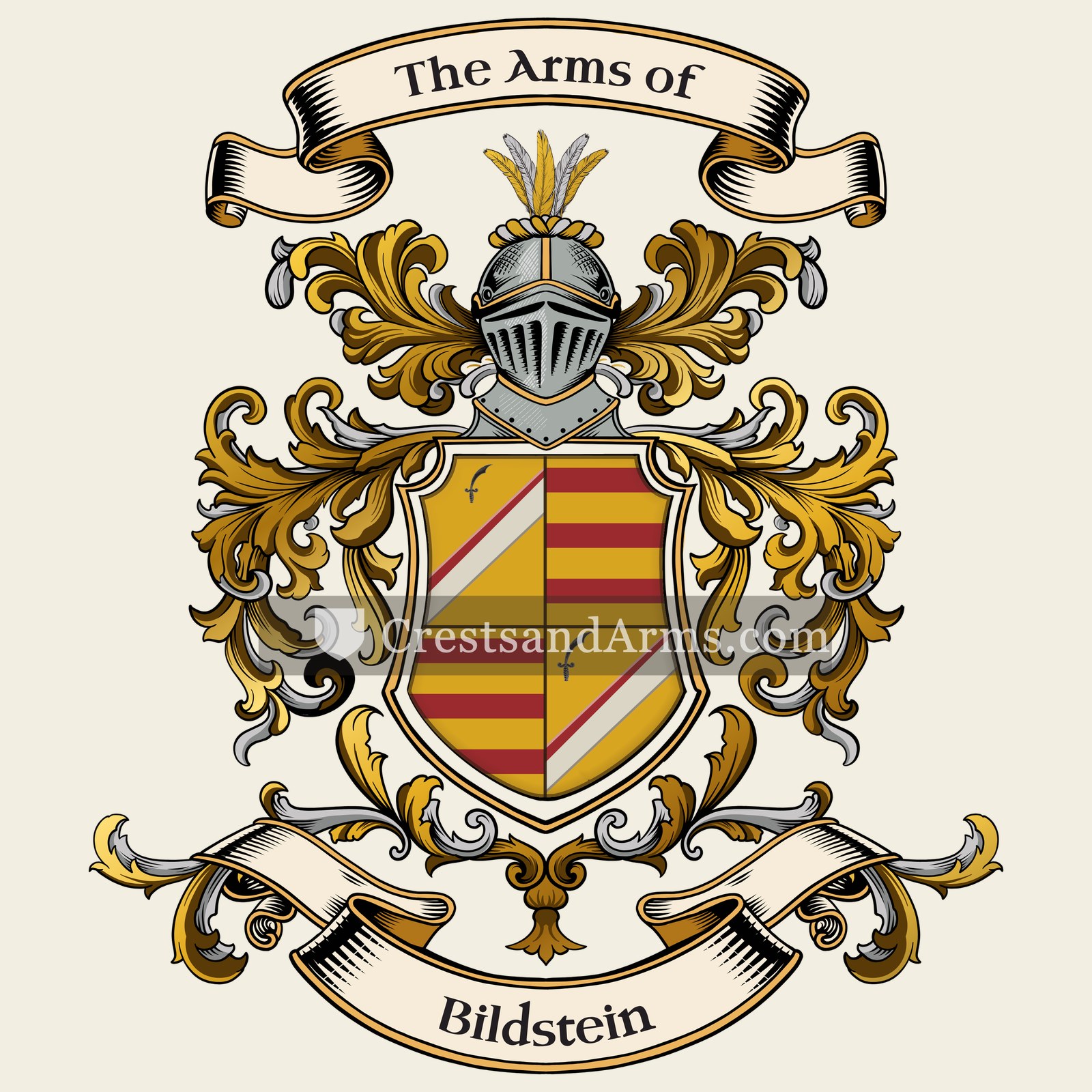


 mulletThe third son, and a divine quality from above
 flag / pennantA command held, and a following kept
 greyhoundCourage, vigilance and loyalty
 treeLife, endurance and deep roots
 towerGrandeur and solidity, and a stronghold defended