A record of documented arms, meaning and origin, researched for the Billinger family lines. Documented in 2 countries.
Reg. 1370 · Austrian, A–C
Coat of Arms & Family Crest Details
Symbols on this shield
mulletThe third son, and a divine quality from above
hunting horn stringedOne who delights in the chase
Colours
Red (Gules)Means: Military strength
Gold (Or)Means: Generosity
Black (Sable)Means: Constancy
Historical info
Source
J. B. Rietstap, Armorial Général, Gouda: G. B. van Goor Zonen, 1884–87
Blazon (the actual original written record)
“Ec.: aux 1 et 4 de gu. à une étoile d'or; aux 2 et 3 d'or au cor-de-chasse de sa., l'embouchure à dextre. C.: un homme, hab. d'or, coiffé d'un chapeau pyramidal du même, donnant dans un cor de sa. L. d'or et de gu.”
BavariaBavaria, c. 1772
Digital archive packCoat of arms PNG, gold border print PDF, vector SVG and the certificate of authenticity. Sent to your email in minutes.
Map of Austria showing where the Billinger arms are recorded
The Billinger arms were recorded in Bavaria, c. 1772.
Bavaria was a country of old landed families and walled market towns. Estates passed down the same line for centuries, and both the landowners and the leading townsmen kept arms, which is why so many Bavarian names sit in the registers.
This is where the arms were entered in the register. Families often moved to other parts of the country, so the same name can turn up in more than one region.
Region
Bavaria
First recorded
1772
Granting Authority for the Billinger Arms
Imperial and Royal chancery
Sodacan · CC BY-SA 3.0
The body that granted and recorded arms in Austria in this period.
Joseph II, Holy Roman Emperor
Sovereign of the period
Joseph II, Holy Roman Emperor
1765–1790
Reigning in Austria when the Billinger arms are first recorded.
How Arms Worked in Austria
Austrian coats of arms were often linked directly to noble titles granted by the Emperor. These symbols belonged to the entire family line rather than just one individual. When a family grew, new branches kept the original design without needing to change it. This system allowed all members of a noble house to share the same identity across many generations.
Granting authority
The Imperial and Royal chancery managed all heraldic matters and controlled the official granting of arms throughout the Austrian lands.
How they got arms
Families typically received their arms through a formal imperial decree that often accompanied the elevation of a person to noble status.
Where arms were recorded
Official records of these grants were kept in the Imperial Register of Nobility which began its formal documentation process in 1453.
The family's standing
Recorded among the armigerous families of Bavaria.
Origin & History of the Billinger Family in Austria
The surname Billinger originates from the Germanic linguistic tradition, likely serving as a topographic or habitational name that identified individuals based on their residence near a specific settlement or geographic feature. While the family established a documented presence in Bavaria by 1772, the name’s roots in the broader Alpine region suggest a long history of migration across the porous borders between modern-day Germany and Austria. During the eighteenth century, families often moved along the Danube River trade routes, seeking new agricultural opportunities in the fertile valleys of Upper Austria. As these early ancestors settled into their new communities, they integrated into the local parish systems, which were responsible for maintaining the vital records that track the family's gradual expansion throughout the Austrian territories. This movement was typical of the era, as economic shifts and regional stability encouraged families to establish roots in areas that offered better land and social connections.
Coat of Arms & Family Crest Details
Symbols on this shield
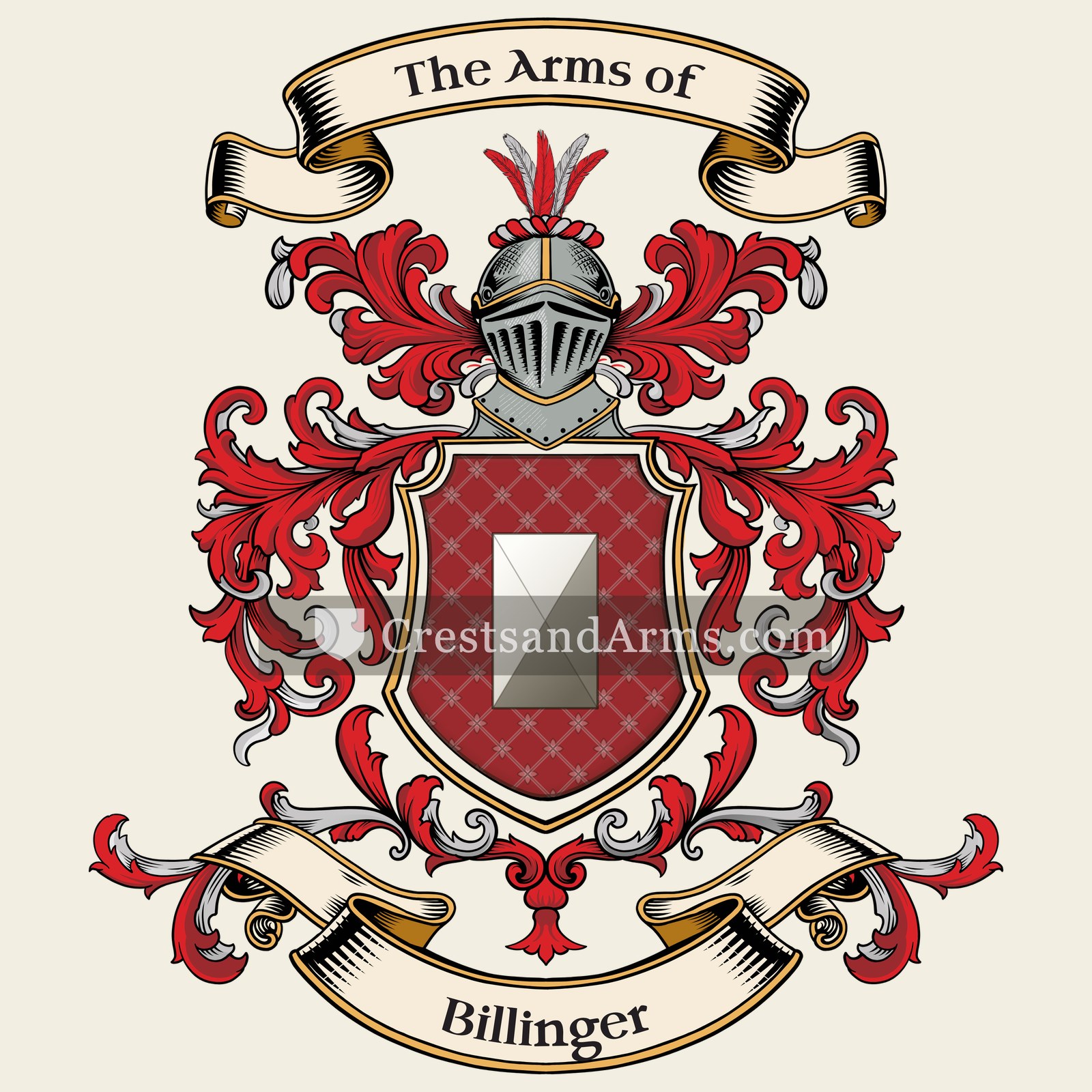
billetThe sealed letter, and a message delivered
Colours
Red (Gules)Means: Military strength
Silver (Argent)Means: Peace and sincerity
Historical info
Source
Sir Bernard Burke, The General Armory of England, Scotland, Ireland and Wales, London: Harrison & Sons, 1884
Blazon (the actual original written record)
“Billettée counter billettée gu. and ar”
Englandc. 1620
Digital archive packCoat of arms PNG, gold border print PDF, vector SVG and the certificate of authenticity. Sent to your email in minutes.
Map of England showing where the Billinger arms are recorded
The Billinger arms were recorded in England, c. 1620.
Arms such as these were typically recorded in York.
Yorkshire is the largest of the English counties, and it held more gentry families than any other. Land there was split among a great many households rather than a few, so a great many of them carried arms.
This is where the arms were entered in the register. Families often moved to other parts of the country, so the same name can turn up in more than one region.
The body that granted and recorded arms in England in this period.
James VI and I
Sovereign of the period
James VI and I
1603–1625
Reigning in Austria when the Billinger arms are first recorded.
How Arms Worked in England
English heraldry allowed arms to be shared by all legitimate descendants of the original owner. These symbols were treated as personal property that moved through the generations to all children. While the eldest son kept the original design, other family members could use the same shield without needing to change it or register their own unique versions.
Granting authority
The College of Arms in London has regulated the use of coats of arms throughout England and Wales since 1484.
How they got arms
Families typically obtained their coats of arms through a formal grant from the Crown or by proving their ancient right to them.
Where arms were recorded
All official coats of arms are recorded in the registers kept at the College of Arms, which date back to the fifteenth century.
The family's standing
Recorded among the armigerous families of England.
Origin & History of the Billinger Family in England
The surname Billinger is deeply rooted in the historical landscape of Northern England, with significant evidence placing the family in the city of York by the early seventeenth century. The name likely originated as a locative or descriptive identifier, evolving from Old English or Germanic linguistic roots that often denoted people living near a specific landmark or belonging to a particular settlement. By 1620, members of the Billinger family were already established as part of the urban fabric of York, a city that served as a vital center for trade, religion, and regional administration. During this period, families like the Billingers often worked in skilled trades or local commerce, contributing to the steady growth of the city during the transition from the Elizabethan era to the Stuart period. Their presence in York suggests they were part of a stable community that navigated the social and economic shifts of northern England, leaving behind a legacy that reflects the common experiences of families living in historic English market towns.
Billinger Meaning & Related Branches
Root word
Biling
An ancient Germanic personal name derived from the word for sword.
This name
BillingerRefers to the descendants or people belonging to the clan of Biling.
also spelled
Byllinger
Billinge
Bilinger
Byllynger
Billingar
Documented Sources
J. B. Rietstap, Armorial Général, Gouda: G. B. van Goor Zonen, 1884–87
Kohlheim, Rosa and Volker Kohlheim. Duden Familiennamen: Herkunft und Bedeutung von 20.000 Nachnamen. 2005
Oberösterreichisches Landesarchiv. Pfarrmatriken (Parish Registers of Upper Austria). 1770–1850
Udolph, Jürgen. Professor Udolphs Buch der Namen: Woher kommt Ihr Name?. 2005
Digital archive packCoat of arms PNG, gold border print PDF, vector SVG and the certificate of authenticity. Sent to your email in minutes.


 mulletThe third son, and a divine quality from above
 hunting horn stringedOne who delights in the chase
 mulletThe third son, and a divine quality from above
 hunting horn stringedOne who delights in the chase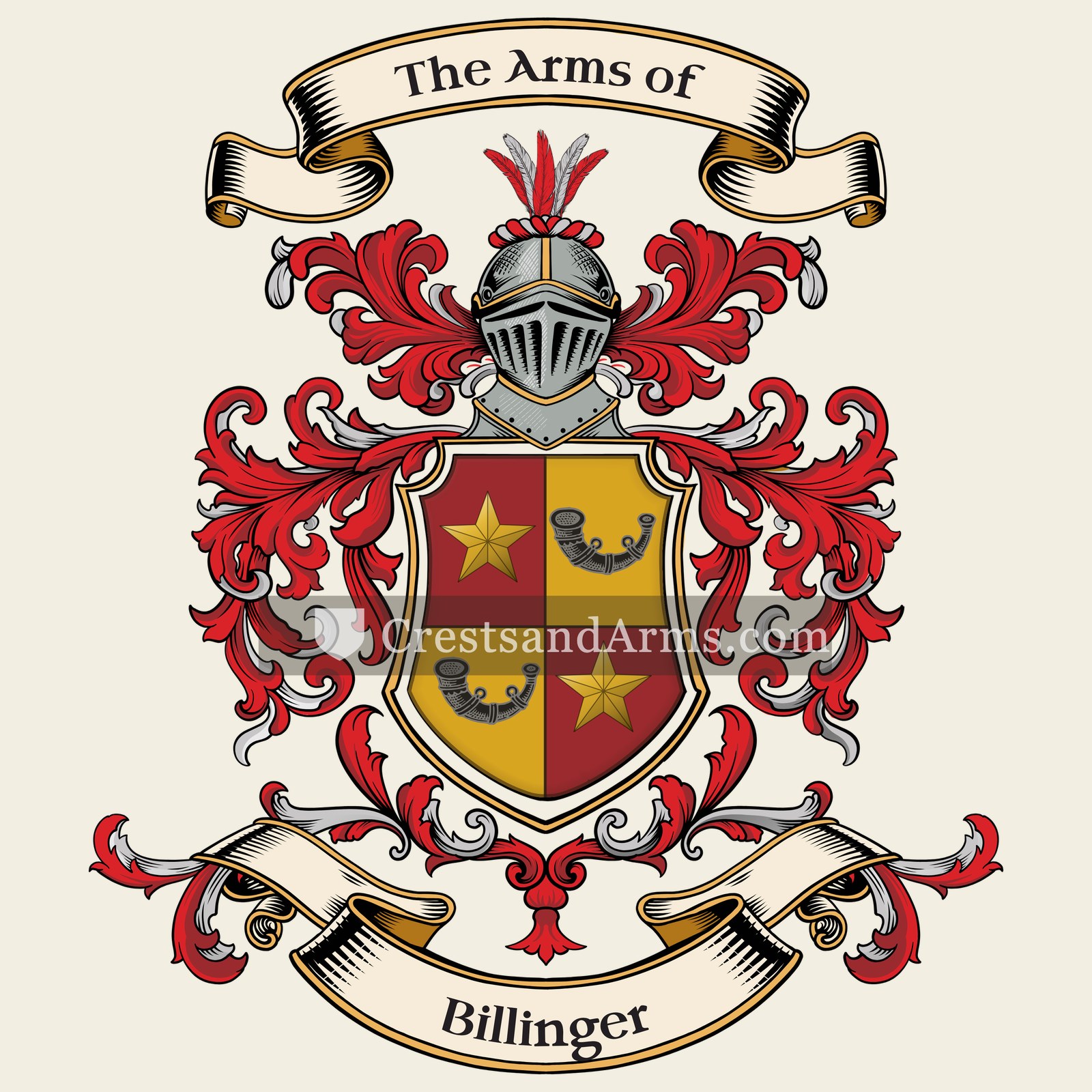


 billetThe sealed letter, and a message delivered