A record of documented arms, meaning and origin, researched for the Binder family lines. Documented in 3 countries.
Reg. 3834 · Swiss, A–C
Coat of Arms & Family Crest Details
Symbols on this shield
knightChivalry and service in arms
lionCourage, strength and royalty
ladderAmbition, and a fearless assault
Colours
Red (Gules)Means: Military strength
Blue (Azure)Means: Loyalty and truth
Silver (Argent)Means: Peace and sincerity
Gold (Or)Means: Generosity
Historical info
Source
J. B. Rietstap, Armorial Général, Gouda: G. B. van Goor Zonen, 1884–87
Blazon (the actual original written record)
“Ec.: aux 1 et 4 de gu. à un chevalier, arm. de toutes pièces d'arg., la visière levée, le casque panaché d'or et de sa., tenant de sa main dextre une épée et de sa sen. une rondache; au 2 d'azur au lion d'or, gravissant six gradins d'arg., mouv. du parti; au 3 d'azur au lion cont. d'or, gravissant six gradins d'arg., mouv. du parti. Deux cq. cour. C.: 1° le chevalier du 1, iss., entre deux bannieres de gu. à la fasce d'arg.; l. d'arg. et de gu.; 2° un lion iss. d'or, entre deux prob., celle à dextre bandée d'arg. et de gu., celle à sen. barrée d'or et d'azur: l. d'or et d'azur.”
Switzerlandc. 1745
Digital archive packCoat of arms PNG, gold border print PDF, vector SVG and the certificate of authenticity. Sent to your email in minutes.
Map of Switzerland showing where the Binder arms are recorded
The Binder arms were recorded in Switzerland, c. 1745.
Arms such as these were typically recorded in Bern.
Bern was the largest of the Swiss cantons and ran itself, with its own council and its own courts. Its governing families held office for generations, and office of that kind carried a shield with it.
This is where the arms were entered in the register. Families often moved to other parts of the country, so the same name can turn up in more than one region.
The body that granted and recorded arms in Switzerland in this period.
How Arms Worked in Switzerland
In Switzerland, coats of arms were not restricted to the nobility and were often adopted by common citizens and families. These symbols were passed down through generations to show family identity. When branches of a family grew, they often changed small details of the design to distinguish their own line from the original group.
Granting authority
Cantonal and civic authorities managed the use of coats of arms within their specific regions and local jurisdictions.
How they got arms
Families typically assumed their own coats of arms based on local custom rather than receiving them from a central monarch.
Where arms were recorded
Arms were recorded in various cantonal and civic registers starting from the fourteenth century throughout the Swiss region.
The family's standing
Recorded among the armigerous families of Switzerland.
Origin & History of the Binder Family in Switzerland
The surname Binder is an occupational name that originated from the Middle High German word *binder*, which refers to a cooper or a barrel maker. In the context of Swiss history, this name identifies ancestors who were skilled craftspeople essential to the local economy, as barrels were necessary for storing wine, grain, and other trade goods. By the time members of the family were documented in Bern in 1745, they were likely part of a well-established guild system that controlled trade and manufacturing in the city. These early Binders lived during a period when Switzerland was transitioning toward greater industrial organization, and their trade would have been highly respected within the urban centers of the Swiss Confederacy. Because the name describes a specific profession, it suggests that the family was deeply integrated into the daily commerce and logistical needs of the Bernese region during the eighteenth century.
Coat of Arms & Family Crest Details
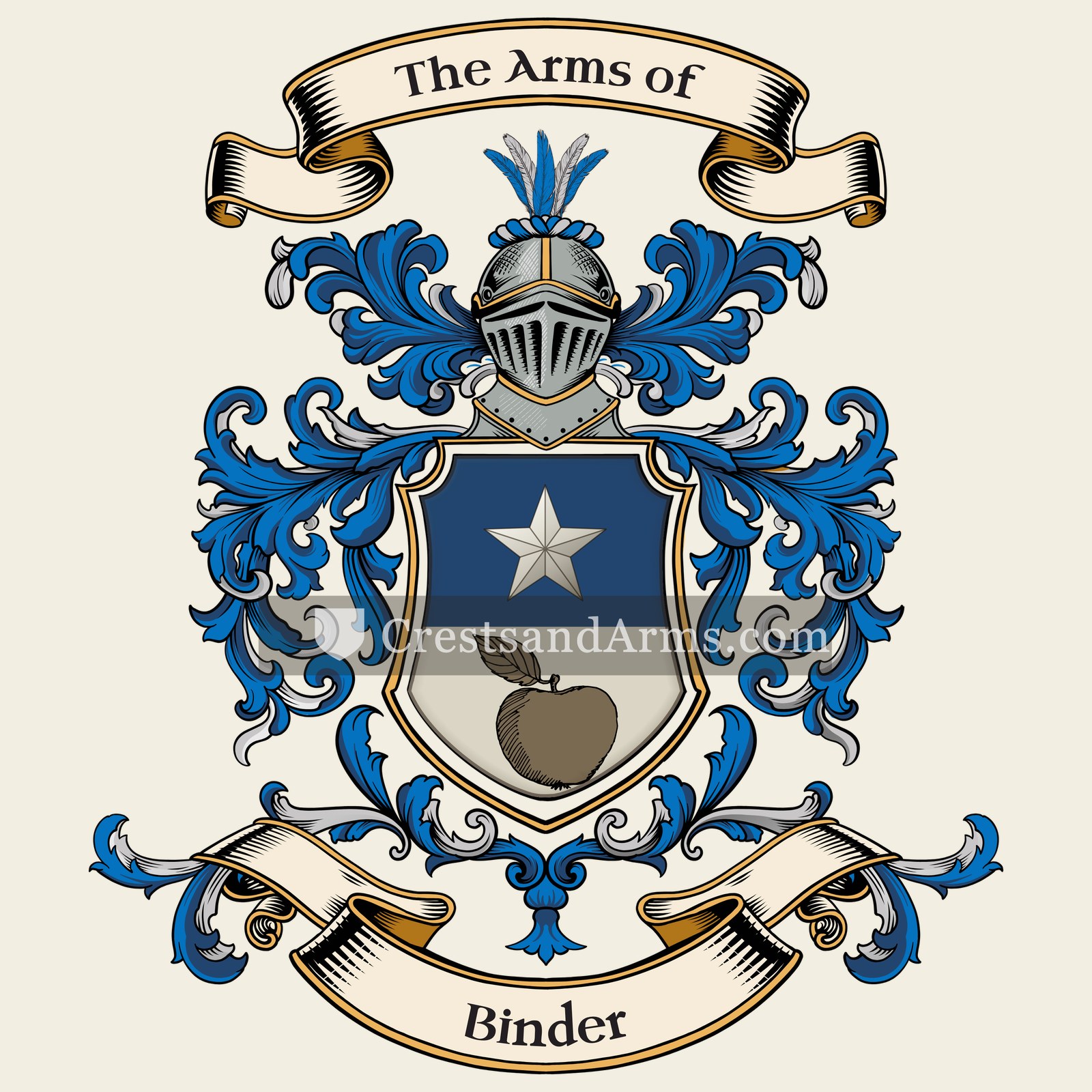
Symbols on this shield
mulletThe third son, and a divine quality from above
applePeace, plenty and long-standing settlement
Colours
Blue (Azure)Means: Loyalty and truth
Silver (Argent)Means: Peace and sincerity
Historical info
Source
J. B. Rietstap, Armorial Général, Gouda: G. B. van Goor Zonen, 1884–87
Blazon (the actual original written record)
“Coupé: au 1 d'azur à une étoile d'arg.; au 2 d'arg. à une grenade tigée et feuillée, au nat. C.: l'étoile, entre deux prob., coupées alt. d'arg. et d'azur. L. d'arg. et d'azur.”
Austriac. 1772
Digital archive packCoat of arms PNG, gold border print PDF, vector SVG and the certificate of authenticity. Sent to your email in minutes.
Map of Austria showing where the Binder arms are recorded
The Binder arms were recorded in Austria, c. 1772.
Arms such as these were typically recorded in Tyrol.
Tyrol was mountain country in western Austria, where the valleys were held by families who had been there a very long time. Old tenure counted for more than money, and old families carried arms.
This is where the arms were entered in the register. Families often moved to other parts of the country, so the same name can turn up in more than one region.
Region
Tyrol
First recorded
1772
Granting Authority for the Binder Arms
Imperial and Royal chancery
Sodacan · CC BY-SA 3.0
The body that granted and recorded arms in Austria in this period.
Joseph II, Holy Roman Emperor
Sovereign of the period
Joseph II, Holy Roman Emperor
1765–1790
Reigning in Switzerland when the Binder arms are first recorded.
How Arms Worked in Austria
Austrian coats of arms were often linked directly to noble titles granted by the Emperor. These symbols belonged to the entire family line rather than just one individual. When a family grew, new branches kept the original design without needing to change it. This system allowed all members of a noble house to share the same identity across many generations.
Granting authority
The Imperial and Royal chancery managed all heraldic matters and controlled the official granting of arms throughout the Austrian lands.
How they got arms
Families typically received their arms through a formal imperial decree that often accompanied the elevation of a person to noble status.
Where arms were recorded
Official records of these grants were kept in the Imperial Register of Nobility which began its formal documentation process in 1453.
The family's standing
Recorded among the armigerous families of Austria.
Origin & History of the Binder Family in Austria
The surname Binder is an occupational name that originated from the medieval German word for a cooper, which was a craftsman who made wooden barrels, buckets, and tubs. In the alpine region of Tyrol, this profession was essential to the local economy because wooden containers were necessary for storing wine, grain, and dairy products in mountain households. By 1772, families carrying this name were well-established members of the Tyrolean community, often living in small villages where their trade supported the agricultural lifestyle of the area. Because the name was tied to a specific craft, it was likely adopted by various families across the region who shared the same line of work. These early Binders were typically integrated into the local parish systems, which kept detailed records of their births, marriages, and deaths as they contributed to the development of the Austrian countryside.
Coat of Arms & Family Crest Details
Colours
Blue (Azure)Means: Loyalty and truth
Historical info
Source
Sir Bernard Burke, The General Armory of England, Scotland, Ireland and Wales, London: Harrison & Sons, 1884
Blazon (the actual original written record)
“Az. the head of an avosetta ppr”
Englandc. 1620
Digital archive packCoat of arms PNG, gold border print PDF, vector SVG and the certificate of authenticity. Sent to your email in minutes.
Map of England showing where the Binder arms are recorded
The Binder arms were recorded in England, c. 1620.
Arms such as these were typically recorded in York.
Yorkshire is the largest of the English counties, and it held more gentry families than any other. Land there was split among a great many households rather than a few, so a great many of them carried arms.
This is where the arms were entered in the register. Families often moved to other parts of the country, so the same name can turn up in more than one region.
The body that granted and recorded arms in England in this period.
James VI and I
Sovereign of the period
James VI and I
1603–1625
Reigning in Switzerland when the Binder arms are first recorded.
How Arms Worked in England
English heraldry allowed arms to be shared by all legitimate descendants of the original owner. These symbols were treated as personal property that moved through the generations to all children. While the eldest son kept the original design, other family members could use the same shield without needing to change it or register their own unique versions.
Granting authority
The College of Arms in London has regulated the use of coats of arms throughout England and Wales since 1484.
How they got arms
Families typically obtained their coats of arms through a formal grant from the Crown or by proving their ancient right to them.
Where arms were recorded
All official coats of arms are recorded in the registers kept at the College of Arms, which date back to the fifteenth century.
The family's standing
Recorded among the armigerous families of England.
Origin & History of the Binder Family in England
The surname Binder originated as an occupational name, identifying individuals who worked as skilled craftsmen in the production of barrels, casks, and other bound wooden containers. By the early 17th century, the family had established a notable presence in the historic city of York, a major northern hub for trade and commerce. During this era, men with this name likely operated workshops near the city markets, where their expertise in coopering was essential for transporting goods like ale, salted fish, and wool. These early Binders were part of the growing urban middle class that helped sustain the local economy of York during the reign of King James I. Their presence in city records from 1620 suggests that they were settled members of the community who contributed to the daily life and industrial output of the region.
Binder Meaning & Related Branches
Root word
binden
To tie, fasten, or bind together with cords or bands.
This name
BinderAn occupational surname for a cooper or barrel maker who binds wooden staves.
also spelled
Bynder
Bindar
Related arms
Baes de Ruddervoorde dit van den Baersesimilar arms
Hermannsimilar arms
Karacsaysimilar arms
Documented Sources
J. B. Rietstap, Armorial Général, Gouda: G. B. van Goor Zonen, 1884–87
Bahlow, Hans, Deutsches Namenlexikon: Familien- und Vornamen nach Ursprung und Sinn erklärt, 1967
Heer, Gottlieb Heinrich, Die Zünfte der Stadt Bern, 1928
Staatsarchiv des Kantons Bern, Bürgerrodel der Stadt Bern
Digital archive packCoat of arms PNG, gold border print PDF, vector SVG and the certificate of authenticity. Sent to your email in minutes.


 knightChivalry and service in arms
 lionCourage, strength and royalty
 ladderAmbition, and a fearless assault
 knightChivalry and service in arms
 lionCourage, strength and royalty
 ladderAmbition, and a fearless assault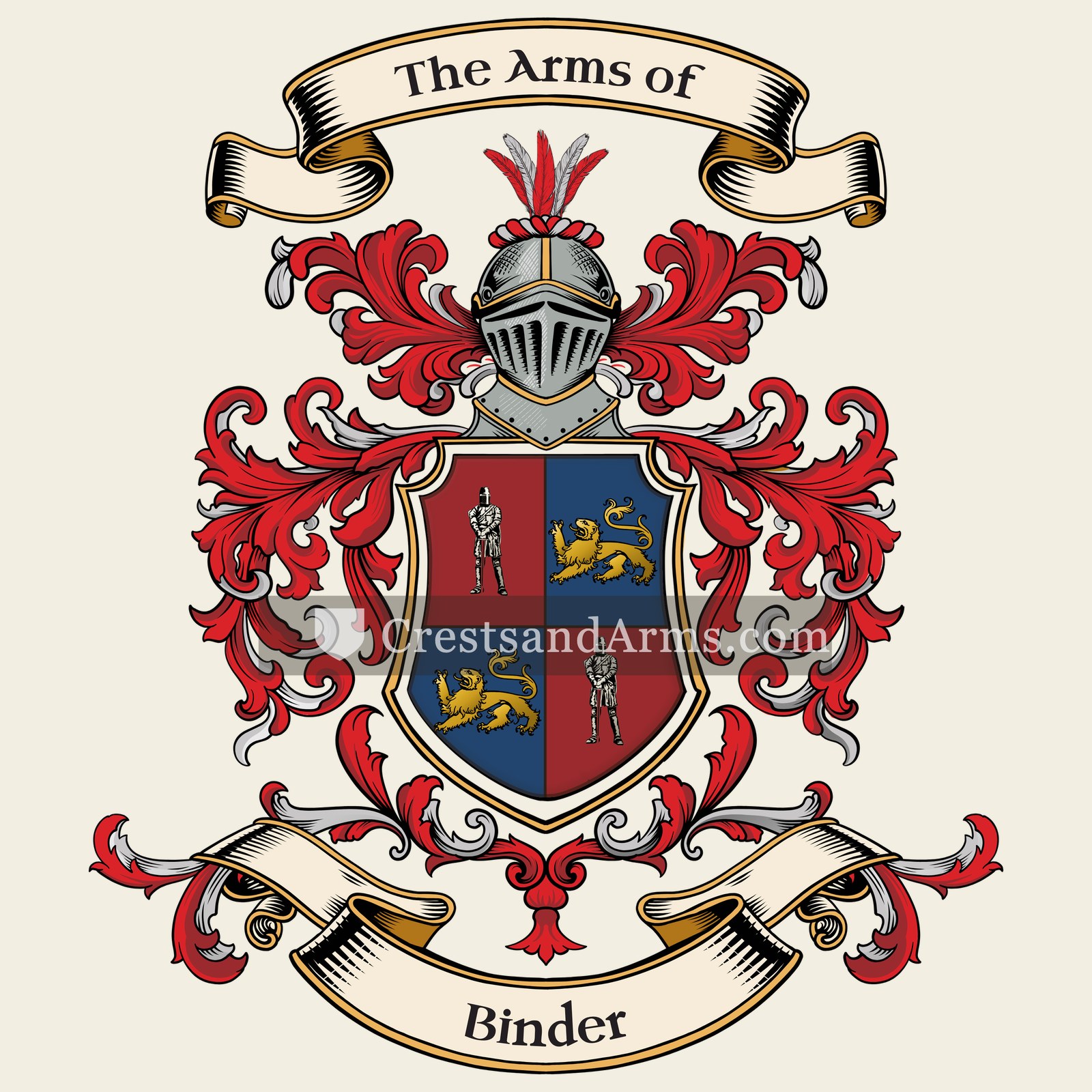

 mulletThe third son, and a divine quality from above
 applePeace, plenty and long-standing settlement