A record of documented arms, meaning and origin, researched for the Bing family lines. Documented in 2 countries.
Reg. 2044 · Danish, A–C
Coat of Arms & Family Crest Details
Symbols on this shield
towerGrandeur and solidity, and a stronghold defended
Colours
Red (Gules)Means: Military strength
Silver (Argent)Means: Peace and sincerity
Historical info
Source
J. B. Rietstap, Armorial Général, Gouda: G. B. van Goor Zonen, 1884–87
Blazon (the actual original written record)
“Ec.: aux 1 et 4 de gu. plein; aux 2 et 3 d'arg. à deux pignons de trois degrés de gu., l'un sur l'autre. C.: deux prob., coupées alt. d'arg. et de gu.”
Denmarkc. 1722
Digital archive packCoat of arms PNG, gold border print PDF, vector SVG and the certificate of authenticity. Sent to your email in minutes.
Map of Denmark showing where the Bing arms are recorded
The Bing arms were recorded in Denmark, c. 1722.
Arms such as these were typically recorded in Sjaælland.
Zealand held the Danish court, the crown's offices and Copenhagen itself. Families who served the king kept estates within reach of it, and royal service was the ordinary route to a coat of arms.
This is where the arms were entered in the register. Families often moved to other parts of the country, so the same name can turn up in more than one region.
The body that granted and recorded arms in Denmark in this period.
Frederik IV of Denmark
Sovereign of the period
Frederik IV of Denmark
1699–1730
Reigning in Denmark when the Bing arms are first recorded.
How Arms Worked in Denmark
Danish heraldry during this period was closely tied to noble status and royal favor rather than being open to all citizens. Arms were typically granted by the monarch to individuals, and these symbols were then shared by all members of the noble house. If a family line died out, the right to use those specific arms ended with them.
Granting authority
The Danish royal chancery held the power to issue and regulate official coats of arms for the kingdom.
How they got arms
Families usually received their arms through a formal royal grant that confirmed their noble status and rights.
Where arms were recorded
These grants were officially recorded in the Danish Royal Chancery records starting in the sixteenth century.
The family's standing
Recorded among the armigerous families of Denmark.
Origin & History of the Bing Family in Denmark
The history of the Bing family in Denmark begins with documented records of members living on the island of Sjælland as early as 1722. During this period, the name was closely associated with the growing urban culture of Copenhagen and the surrounding regions. Many early family members were part of the rising merchant class, which allowed them to build connections within the Danish capital. As the eighteenth century progressed, the family became increasingly integrated into the social and economic fabric of the country. They were known for their involvement in trade and professional life, which helped establish the name as a recognized part of the local community. By settling in Sjælland, the family secured a firm foundation that allowed their influence to grow throughout Denmark over the following generations.
Coat of Arms & Family Crest Details
Symbols on this shield
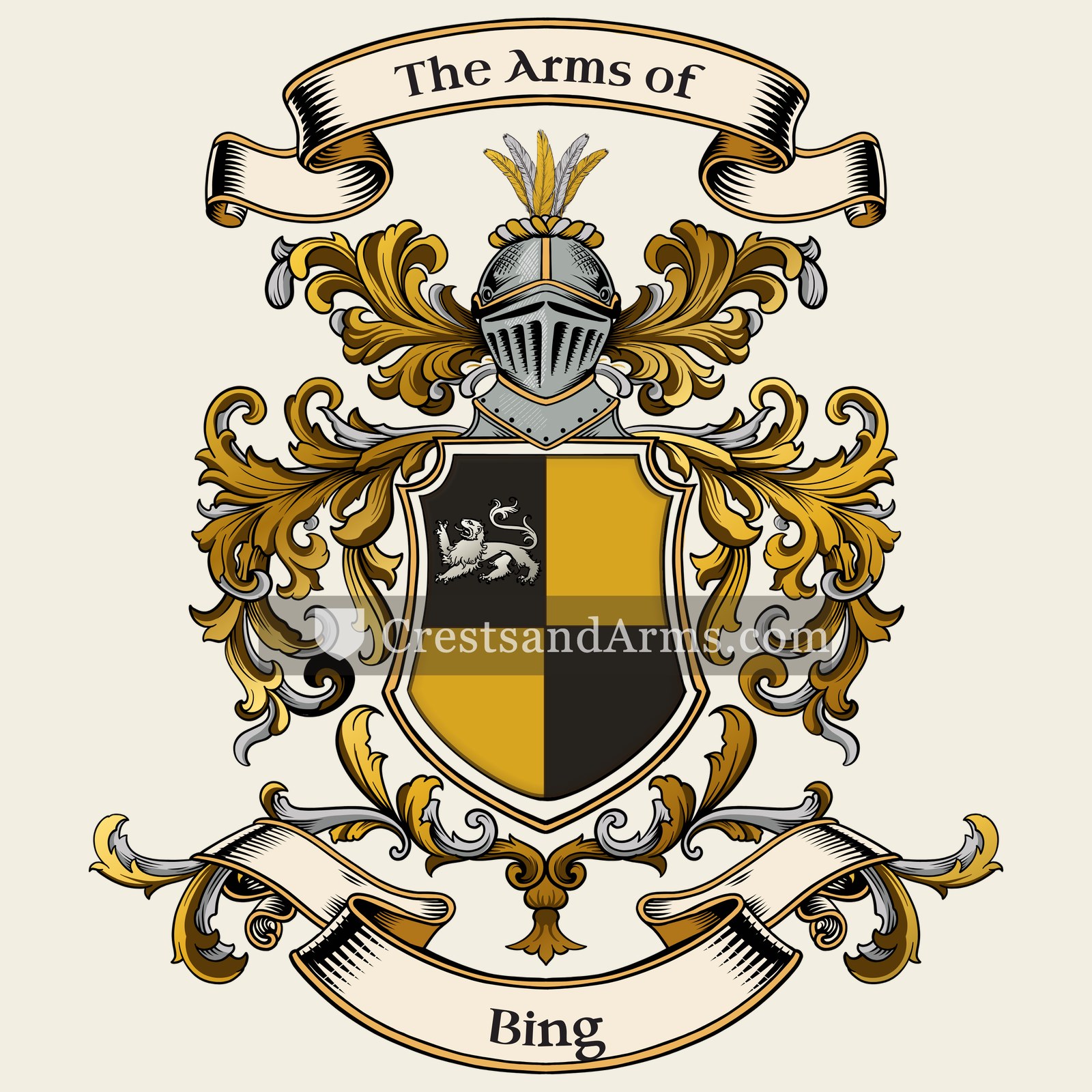
lionCourage, strength and royalty
Colours
Black (Sable)Means: Constancy
Gold (Or)Means: Generosity
Historical info
Source
Sir Bernard Burke, The General Armory of England, Scotland, Ireland and Wales, London: Harrison & Sons, 1884
Blazon (the actual original written record)
“Quarterly, sa. and or, in the dexter chief quarter a lion ramp. guard. of the last”
KentKent, c. 1620
Digital archive packCoat of arms PNG, gold border print PDF, vector SVG and the certificate of authenticity. Sent to your email in minutes.
Map of England showing where the Bing arms are recorded
The Bing arms were recorded in Kent, c. 1620.
Kent sits between London and the short crossing to Europe, and the trade passing through made it wealthy. Merchant families bought land with that money, and it was landowners who took coats of arms.
This is where the arms were entered in the register. Families often moved to other parts of the country, so the same name can turn up in more than one region.
The body that granted and recorded arms in England in this period.
James VI and I
Sovereign of the period
James VI and I
1603–1625
Reigning in Denmark when the Bing arms are first recorded.
How Arms Worked in England
English heraldry allowed arms to be shared by all legitimate descendants of the original owner. These symbols were treated as personal property that moved through the generations to all children. While the eldest son kept the original design, other family members could use the same shield without needing to change it or register their own unique versions.
Granting authority
The College of Arms in London has regulated the use of coats of arms throughout England and Wales since 1484.
How they got arms
Families typically obtained their coats of arms through a formal grant from the Crown or by proving their ancient right to them.
Where arms were recorded
All official coats of arms are recorded in the registers kept at the College of Arms, which date back to the fifteenth century.
The family's standing
Recorded among the armigerous families of Kent.
Origin & History of the Bing Family in England
The surname Bing is deeply rooted in the history of the English county of Kent, where records confirm the family was well-established by the year 1620. The name likely originated as a topographical identifier, referring to people who lived near a specific piece of land or a prominent feature in the landscape. During the seventeenth century, the Bing family became active members of the local community in Kent, participating in the agricultural and social life of the region. Many families with this name were involved in the shifting economic landscape of the time, often working as landowners or tradespeople who helped shape the rural character of southeastern England. By the early 1600s, the name had become a permanent fixture in parish registers and local administrative documents, reflecting the family's steady integration into the fabric of English society.
Bing Meaning & Related Branches
Root word
binge
A hollow, a cavity, or a heap of grain.
This name
BingA topographic name for someone who lived near a hollow or a storage area for grain.
also spelled
Byng
Binge
Bynge
Related arms
Bowdensimilar arms
Byngvariant spelling
Byngevariant spelling
Documented Sources
J. B. Rietstap, Armorial Général, Gouda: G. B. van Goor Zonen, 1884–87
C.F. Bricka, Dansk Biografisk Lexikon, 1887
Albert Fabritius, Slægten Bing, 1945
Rigsarkivet, Kirkebøger for København
Rigsarkivet, Folketællinger 1787
Digital archive packCoat of arms PNG, gold border print PDF, vector SVG and the certificate of authenticity. Sent to your email in minutes.


 towerGrandeur and solidity, and a stronghold defended
 towerGrandeur and solidity, and a stronghold defended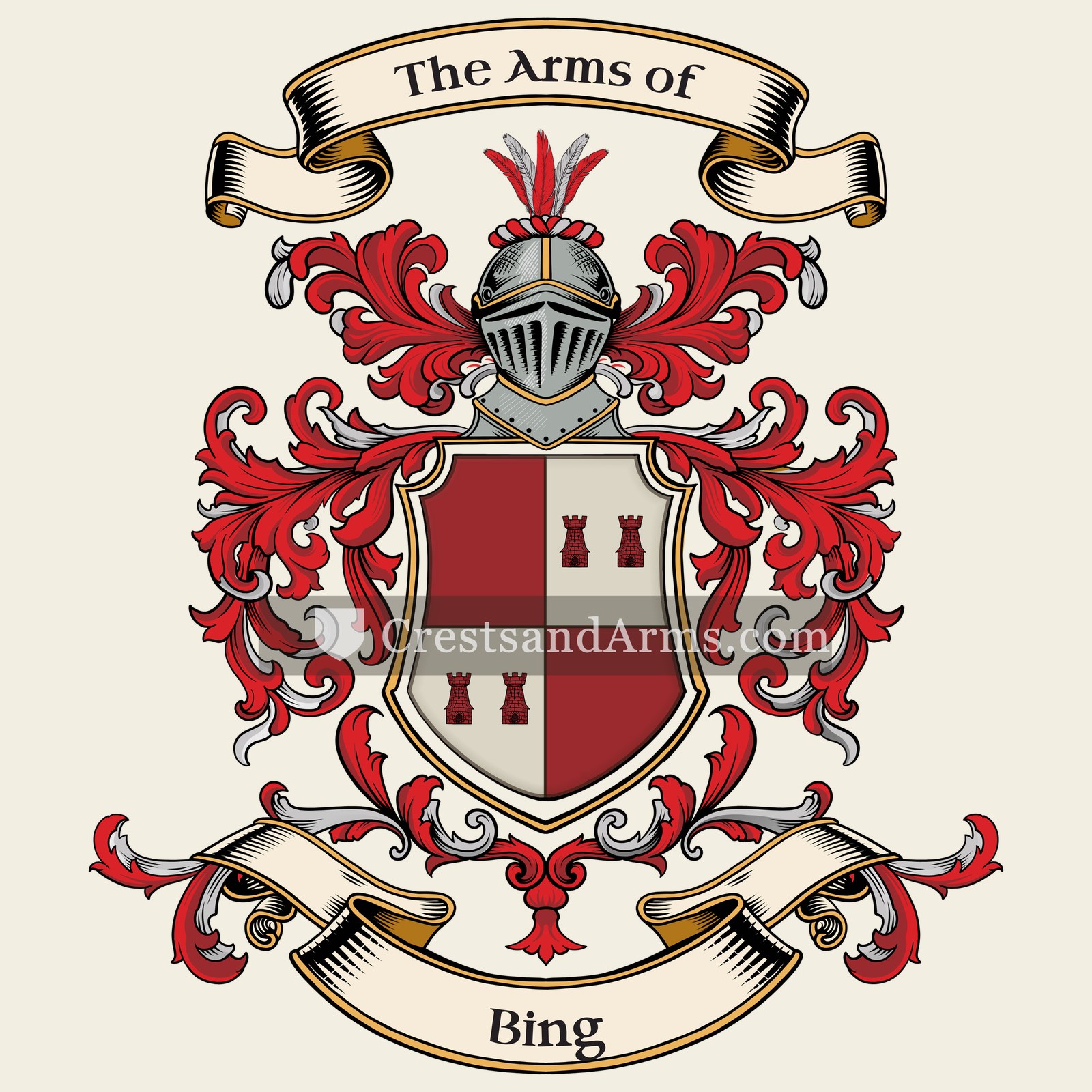


 lionCourage, strength and royalty