Map of France showing where the Bint arms are recorded
The Bint arms were recorded in Paris, c. 1663.
This is where the arms were entered in the register. Families often moved to other parts of the country, so the same name can turn up in more than one region.
The body that granted and recorded arms in France in this period.
Louis XIV of France
Sovereign of the period
Louis XIV of France
1643–1715
Reigning in France when the Bint arms are first recorded.
How Arms Worked in France
In France, a coat of arms was a mark of honor that passed down through the male line to all legitimate descendants. Families often used the same shield without changes to show their shared heritage. If a branch wanted to stand out, they could add a small mark to their shield to show their specific place in the family tree.
Granting authority
The Juge d'armes de France acted as the official authority that regulated and verified coats of arms across the country.
How they got arms
Families typically inherited their arms from ancestors, though they could also receive them through royal grants or by proving their noble status.
Where arms were recorded
Coats of arms were officially recorded in the Armorial Général de France, which began its main collection in the year 1696.
The family's standing
Recorded among the armigerous families of France.
Origin & History of the Bint Family in France
The family name Bint appears in the historical records of Paris as early as 1663, placing its origins within the vibrant urban landscape of the seventeenth century. During this era, Paris was a center of rapid social change and professional growth under the rule of King Louis XIV. Families living in the city at this time often navigated a complex society defined by trade guilds, parish life, and the strict administrative control of the royal government. While the name Bint is rare, its presence in the capital suggests that early members were likely integrated into the working life of the city, perhaps as skilled artisans or merchants who contributed to the bustling economy of the Ancien Régime. These early ancestors lived through a period of immense cultural development, witnessing the expansion of the city and the rise of French influence across Europe. By maintaining a presence in Paris during the mid-1600s, the Bint family became part of the long and intricate narrative of urban French history.
Coat of Arms & Family Crest Details
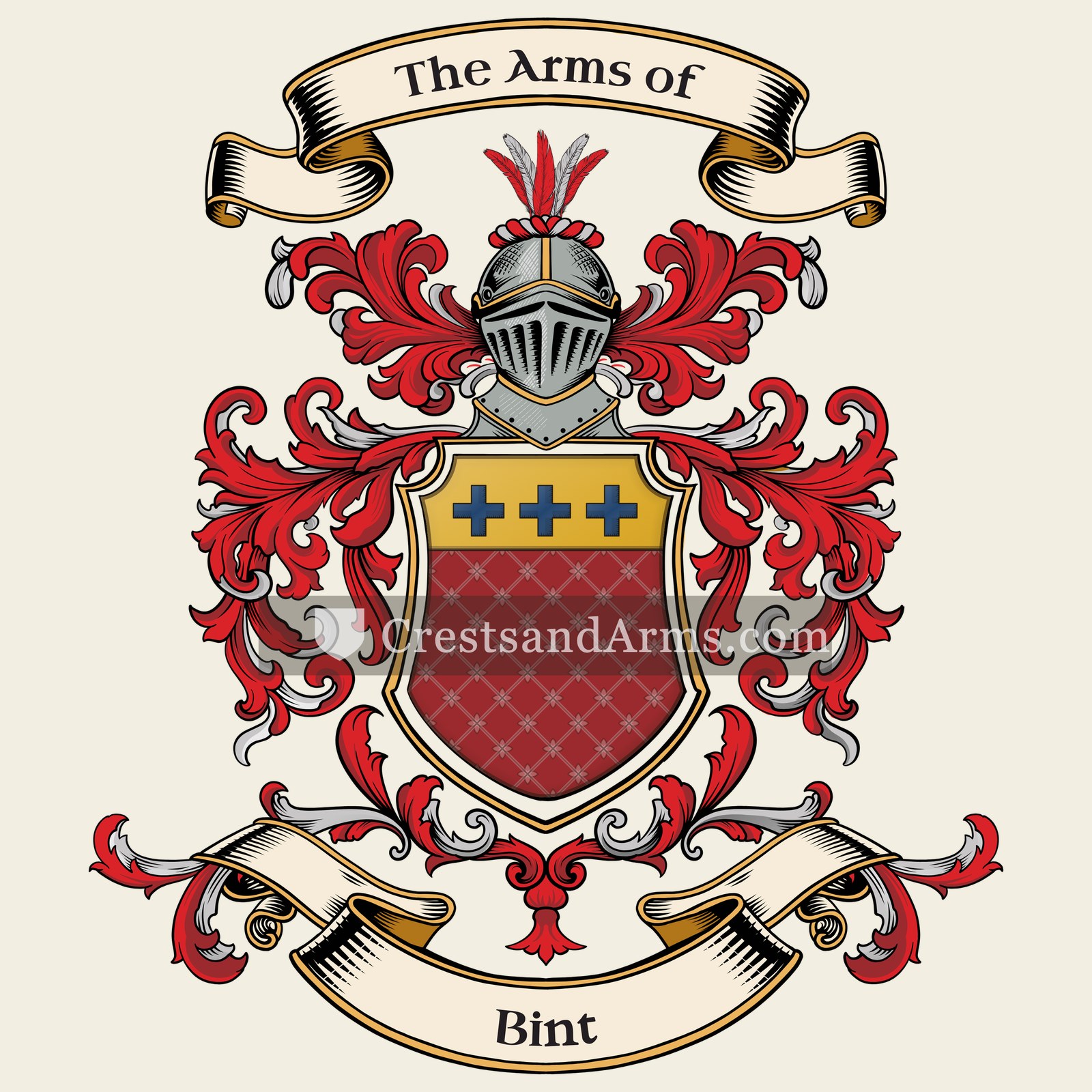
Symbols on this shield
chiefAuthority, wisdom and dominion
cross symbolChristian faith and service
Colours
Red (Gules)Means: Military strength
Gold (Or)Means: Generosity
Blue (Azure)Means: Loyalty and truth
Historical info
Source
Sir Bernard Burke, The General Armory of England, Scotland, Ireland and Wales, London: Harrison & Sons, 1884
Blazon (the actual original written record)
“Gu. on a chief or, three crosses crosslet fitchée az”
JerseyJersey, c. 1688
Digital archive packCoat of arms PNG, gold border print PDF, vector SVG and the certificate of authenticity. Sent to your email in minutes.
The body that granted and recorded arms in Jersey in this period.
James II of England
Sovereign of the period
James II of England
1685–1688
Reigning in France when the Bint arms are first recorded.
How Arms Worked in Jersey
Arms in the Channel Islands were granted and recorded by the College of Arms in London, under the same law of arms as England. They could be used by all legitimate descendants of the original owner: the eldest son kept the original design, and other family members used the same shield without registering a version of their own.
Granting authority
The College of Arms in London has regulated the use of coats of arms for Jersey and the other Channel Islands since 1484.
How they got arms
Families typically obtained their coats of arms through a formal grant from the Crown or by proving their ancient right to them.
Where arms were recorded
All official coats of arms are recorded in the registers kept at the College of Arms, which date back to the fifteenth century.
The family's standing
Recorded among the armigerous families of Jersey.
Origin & History of the Bint Family in Jersey
The Bint family established a firm presence on the island of Jersey by 1688, a period defined by the island’s unique position between the cultures of France and England. During this era, Jersey functioned as a self-governing territory with its own legal customs and a strong maritime economy. Families like the Bints often integrated into the local parish systems, which served as the primary centers for social life, record-keeping, and community governance. Living on a small island meant that the family likely engaged in a mix of small-scale farming and trade, as the local economy relied heavily on the export of wool and the production of cider. As they settled into the landscape of the Channel Islands, the Bints became part of a resilient population that navigated the complex political tensions between the British Crown and the French monarchy. Their early history in Jersey reflects the quiet persistence of families who helped shape the island’s distinct identity during the late seventeenth century.
Related Branches & Arms
Root word
Benoît
Derived from the Latin word benedictus meaning blessed.
This name
BintA French patronymic or descriptive surname indicating a descendant of someone named Benedict.
also spelled
Bynet
Binett
Binete
Binay
Documented Sources
J. B. Rietstap, Armorial Général, Gouda: G. B. van Goor Zonen, 1884–87
Archives nationales, Minutier central des notaires de Paris
Boudon, Françoise, Sauval et l'urbanisme parisien au XVIIe siècle, 1989
Foisil, Madeleine, La vie quotidienne au temps de Louis XIV, 1984
Digital archive packCoat of arms PNG, gold border print PDF, vector SVG and the certificate of authenticity. Sent to your email in minutes.


 chevronProtection, and faithful service completed
 mulletThe third son, and a divine quality from above
 chevronProtection, and faithful service completed
 mulletThe third son, and a divine quality from above


 chiefAuthority, wisdom and dominion
 cross symbolChristian faith and service