Map of Netherlands showing where the Bircham arms are recorded
The Bircham arms were recorded in Brabant, c. 1815.
Brabant lay at the heart of the Low Countries, where the trade routes met. Its towns were wealthy and its landowners many, and both kinds of family kept arms, which is why the region is so heavily represented.
This is where the arms were entered in the register. Families often moved to other parts of the country, so the same name can turn up in more than one region.
Region
Brabant
First recorded
1815
Granting Authority for the Bircham Arms
Hoge Raad van Adel
Photograph made by me · CC BY-SA 3.0
The body that granted and recorded arms in Netherlands in this period.
William I of the Netherlands
Sovereign of the period
William I of the Netherlands
1815–1840
Reigning in Netherlands when the Bircham arms are first recorded.
How Arms Worked in Netherlands
In the Netherlands, coats of arms were often used by noble families and those who held specific public offices. These arms were passed down through the generations to legitimate descendants. Younger branches of a family usually kept the original design without needing to add special marks. This system ensured that the family identity remained clear and consistent over many years.
Granting authority
The Hoge Raad van Adel is the official body that regulates and manages noble titles and coats of arms in the Netherlands.
How they got arms
Families typically obtained their coats of arms through official royal grants or by proving their long-standing historical use of the symbols.
Where arms were recorded
Coats of arms are officially recorded in the registers held by the Hoge Raad van Adel, which began its work in 1814.
The family's standing
Recorded among the armigerous families of Brabant.
Origin & History of the Bircham Family in Netherlands
The surname Bircham is rooted in the landscape of medieval England, likely originating as a topographic name for someone who lived near a settlement of birch trees. While the name has deep English origins, the family history took a significant turn during the early nineteenth century. Records confirm that members of the Bircham family were present in the Brabant region of the Low Countries by 1815. This period was a time of great upheaval in Europe due to the Napoleonic Wars, and the presence of the family in this area suggests they were likely involved in the military movements or the administrative shifts that defined the aftermath of the Battle of Waterloo. Over time, the family established a presence that bridged these distinct European regions, reflecting the broader patterns of migration and movement that shaped many families during the nineteenth century.
Bircham Meaning & Related Branches
Root word
Berk
A type of deciduous tree belonging to the genus Betula.
This name
BirchamDerived from a location characterized by a settlement near a birch tree forest.
also spelled
Berchamme
Documented Sources
Sir Bernard Burke, The General Armory of England, Scotland, Ireland and Wales, London: Harrison & Sons, 1884
Reaney, P.H. and Wilson, R.M., A Dictionary of English Surnames, 1997
State Archives in Belgium (Rijksarchief), Civil Registration Records of the Province of Brabant, 1815
Digital archive packCoat of arms PNG, gold border print PDF, vector SVG and the certificate of authenticity. Sent to your email in minutes.


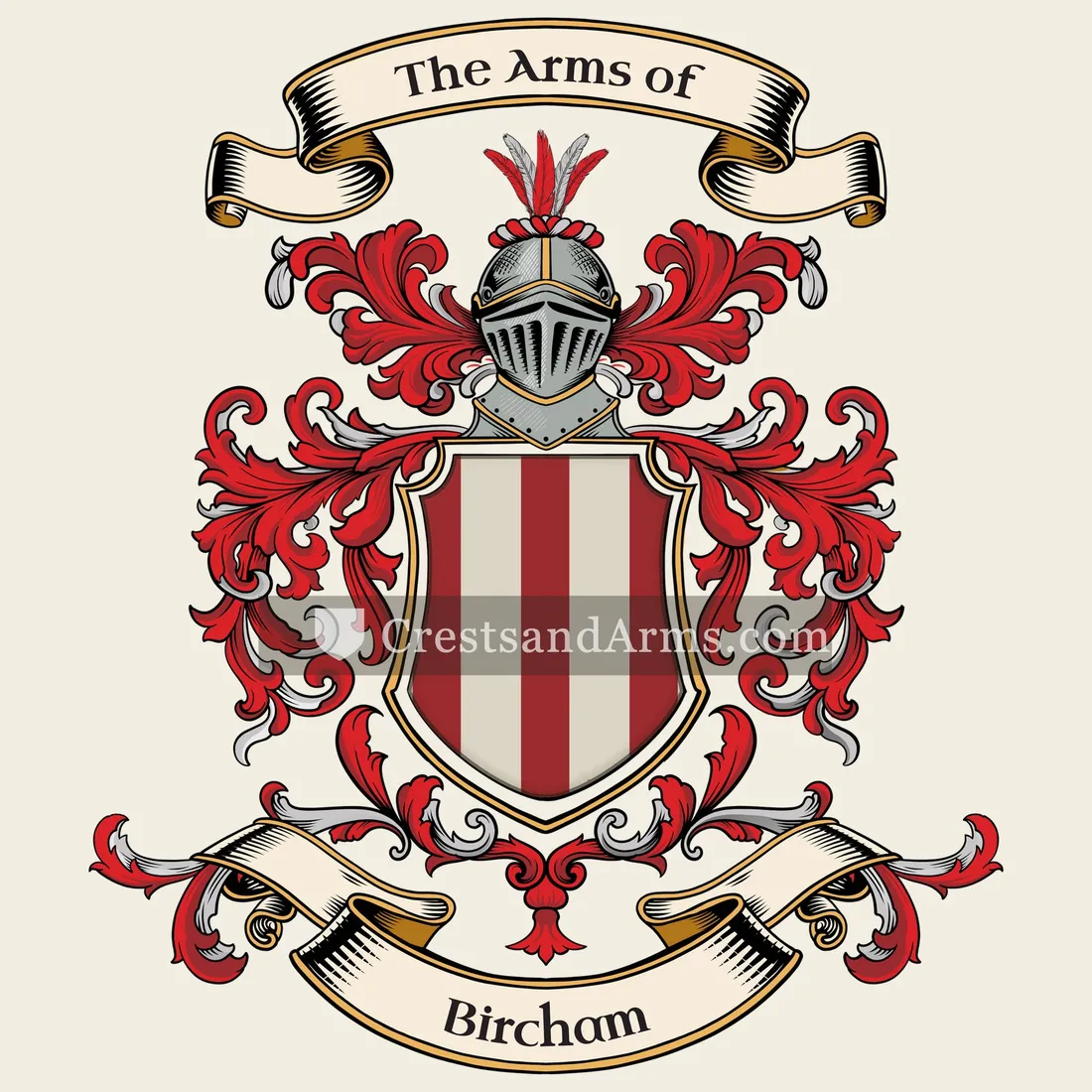
 paleMilitary strength, and a fortified defence
 paleMilitary strength, and a fortified defence