Map of Poland showing where the Birken arms are recorded
The Birken arms were recorded in Thorn Prusse, c. 1772.
This is where the arms were entered in the register. Families often moved to other parts of the country, so the same name can turn up in more than one region.
Region
Thorn
Town
Thorn Prusse
First recorded
1772
Granting Authority for the Birken Arms
Ennoblement by the Sejm
Author: Olek Remesz · CC BY-SA 3.0
The body that granted and recorded arms in Poland in this period.
Stanisław August Poniatowski
Sovereign of the period
Stanisław August Poniatowski
1764–1795
Reigning in Poland when the Birken arms are first recorded.
How Arms Worked in Poland
Polish noble families shared a single coat of arms across many different surnames, creating large clans rather than individual designs. These symbols were held collectively by all members of the clan regardless of their specific family name. When a new family joined the nobility, they were adopted into an existing clan and began using that group's established shield.
Granting authority
The Sejm, which was the Polish parliament, held the power to grant noble status and the right to bear arms.
How they got arms
Families typically received their coat of arms through a formal act of ennoblement granted by the Sejm for distinguished service.
Where arms were recorded
These grants were officially recorded in the Crown Metrica, which served as the central archive for state documents starting in the sixteenth century.
The family's standing
Recorded among the armigerous families of Poland.
Origin & History of the Birken Family in Poland
The family name Birken has deep roots in the city of Thorn, known today as Toruń, which was a vital center of trade and culture in the Polish-Lithuanian Commonwealth. By 1772, the year of the First Partition of Poland, members of the Birken family were already established residents within this historic city. The name itself is derived from the German word for birch tree, suggesting that the family’s earliest ancestors likely lived near a prominent grove or forest. During this period, Thorn served as a melting pot for merchants and craftsmen, and families like the Birkens often played active roles in the local urban economy. As the region transitioned through complex political changes in the late 18th century, the family remained part of the city’s enduring social fabric. Their presence in Thorn reflects the broader history of families who navigated the shifting borders and cultural exchanges that defined life in the Vistula River region during the Enlightenment.
Coat of Arms & Family Crest Details
Symbols on this shield
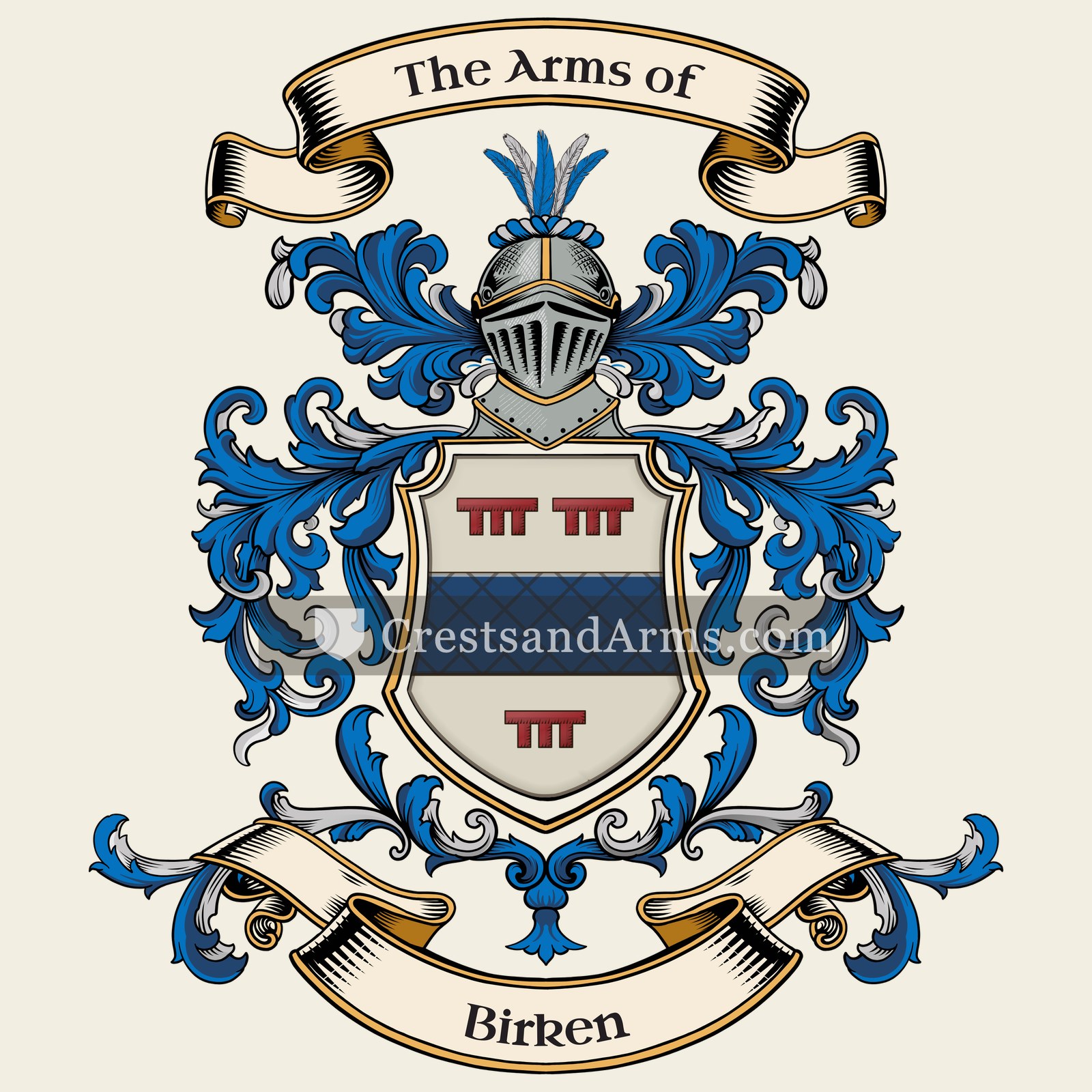
fessThe military belt, and readiness to serve
labelThe eldest son, during his father's life
Colours
Silver (Argent)Means: Peace and sincerity
Blue (Azure)Means: Loyalty and truth
Red (Gules)Means: Military strength
Historical info
Source
Sir Bernard Burke, The General Armory of England, Scotland, Ireland and Wales, London: Harrison & Sons, 1884
Blazon (the actual original written record)
“Ar. a fesse az. and a label of three points gu”
YorkshireYorkshire, c. 1620
Digital archive packCoat of arms PNG, gold border print PDF, vector SVG and the certificate of authenticity. Sent to your email in minutes.
Map of England showing where the Birken arms are recorded
The Birken arms were recorded in Yorkshire, c. 1620.
This is where the arms were entered in the register. Families often moved to other parts of the country, so the same name can turn up in more than one region.
The body that granted and recorded arms in England in this period.
James VI and I
Sovereign of the period
James VI and I
1603–1625
Reigning in Poland when the Birken arms are first recorded.
How Arms Worked in England
English heraldry allowed arms to be shared by all legitimate descendants of the original owner. These symbols were treated as personal property that moved through the generations to all children. While the eldest son kept the original design, other family members could use the same shield without needing to change it or register their own unique versions.
Granting authority
The College of Arms in London has regulated the use of coats of arms throughout England and Wales since 1484.
How they got arms
Families typically obtained their coats of arms through a formal grant from the Crown or by proving their ancient right to them.
Where arms were recorded
All official coats of arms are recorded in the registers kept at the College of Arms, which date back to the fifteenth century.
The family's standing
Recorded among the armigerous families of Yorkshire.
Origin & History of the Birken Family in England
The family name Birken is deeply rooted in the landscape of Northern England, with confirmed records placing the family in Yorkshire as early as 1620. The name itself is topographical in origin, likely derived from the Old English word "birce," which refers to a birch tree. Families during this period often took their surnames from the specific natural features near their homes, suggesting that the earliest ancestors lived near a prominent grove or woodland area. By the seventeenth century, the Birken family was part of the growing population in the West Riding of Yorkshire, a region known for its developing agricultural and textile industries. Living in this area meant that the family was part of a robust local community that relied on the fertile land and the proximity to growing market towns. As the family established their roots in the region, they became part of the social fabric of rural England, contributing to the local economy and the steady growth of the Yorkshire population during the early modern era.
Birken Meaning & Related Branches
Root word
Birke
Germanic term referring to the birch tree.
This name
BirkenA topographic name for someone who lived near a birch tree or birch forest.
also spelled
Byrken
Berken
Related arms
Byrken, Byrkin, or Byrkynvariant spelling
Documented Sources
J. B. Rietstap, Armorial Général, Gouda: G. B. van Goor Zonen, 1884–87
Archiwum Państwowe w Toruniu, Akta miasta Torunia (Records of the City of Toruń)
Biskup, Marian, Historia Torunia (History of Toruń), 1992
Czacharowski, Antoni, Toruń w czasach nowożytnych (Toruń in Modern Times), 1994
Digital archive packCoat of arms PNG, gold border print PDF, vector SVG and the certificate of authenticity. Sent to your email in minutes.


 chevronProtection, and faithful service completed
 mulletThe third son, and a divine quality from above
 chevronProtection, and faithful service completed
 mulletThe third son, and a divine quality from above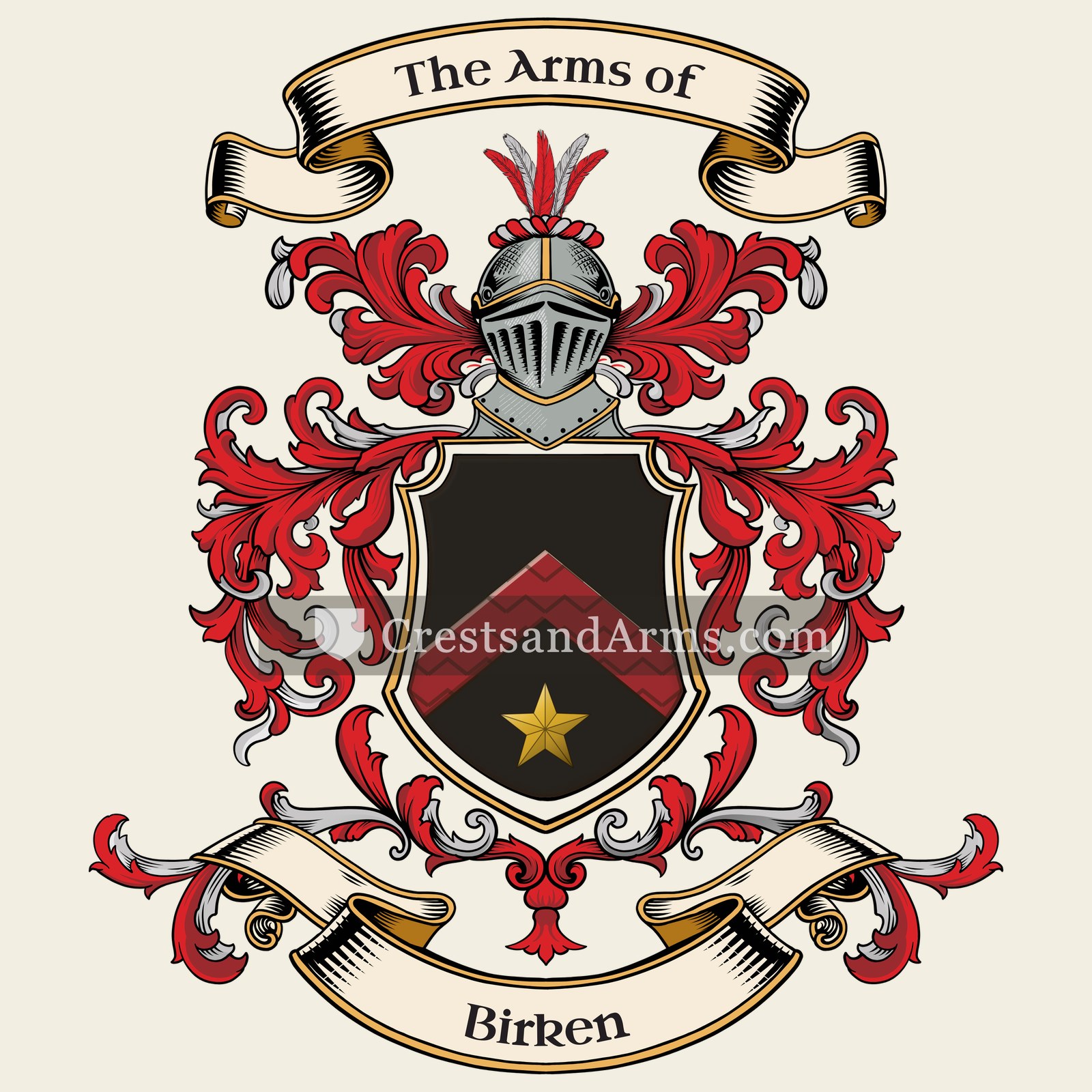


 fessThe military belt, and readiness to serve
 labelThe eldest son, during his father's life