A record of documented arms, meaning and origin, researched for the Biron family lines. Documented in 3 countries.
Reg. 1232 · French, A–C
Coat of Arms & Family Crest Details
Symbols on this shield
eagleNobility, strength and a keen mind
Colours
Gold (Or)Means: Generosity
Black (Sable)Means: Constancy
Historical info
Source
J. B. Rietstap, Armorial Général, Gouda: G. B. van Goor Zonen, 1884–87
Blazon (the actual original written record)
“d'or, ch. d'une aigle ép. iss. de sa. Cq. cour. C.: un corbeau cont. de sa., la tête retournée, entre deux branches de chêne effeuillées, englantées chacune de trois pièces. L.: à dextre d'or et de sa., à sen. d'arg. et de gu.)”
Francec. 1663
Digital archive packCoat of arms PNG, gold border print PDF, vector SVG and the certificate of authenticity. Sent to your email in minutes.
Map of France showing where the Biron arms are recorded
The Biron arms were recorded in France, c. 1663.
Arms such as these were typically recorded in Bretagne.
More families held coats of arms in Bretagne than anywhere else in France. The land was divided into many small estates rather than a few large ones, so far more households counted as gentry, and each needed a shield of its own to be told apart.
This is where the arms were entered in the register. Families often moved to other parts of the country, so the same name can turn up in more than one region.
The body that granted and recorded arms in France in this period.
Louis XIV of France
Sovereign of the period
Louis XIV of France
1643–1715
Reigning in France when the Biron arms are first recorded.
How Arms Worked in France
In France, a coat of arms was a mark of honor that passed down through the male line to all legitimate descendants. Families often used the same shield without changes to show their shared heritage. If a branch wanted to stand out, they could add a small mark to their shield to show their specific place in the family tree.
Granting authority
The Juge d'armes de France acted as the official authority that regulated and verified coats of arms across the country.
How they got arms
Families typically inherited their arms from ancestors, though they could also receive them through royal grants or by proving their noble status.
Where arms were recorded
Coats of arms were officially recorded in the Armorial Général de France, which began its main collection in the year 1696.
The family's standing
Recorded among the armigerous families of France.
Origin & History of the Biron Family in France
The family name Biron has deep roots in the historical landscape of France, with documented evidence placing members of the family in the region of Bretagne by 1663. During this era, the name was closely tied to the social and agricultural structures of the French provinces, where families often identified themselves by the lands they cultivated or the specific parishes where they resided. As the family established itself in Bretagne, they became part of a complex network of local society that relied on parish registers to track births, marriages, and deaths. These early records suggest that the Biron family was integrated into the local community life, participating in the traditions and economic activities that defined the region during the seventeenth century. Over time, the name persisted as a marker of identity for these individuals as they navigated the shifting political and social tides of the French countryside.
Coat of Arms & Family Crest Details
Colours
Red (Gules)Means: Military strength
Historical info
Source
J. B. Rietstap, Armorial Général, Gouda: G. B. van Goor Zonen, 1884–87
Blazon (the actual original written record)
“De gu. à un corbeau de sa., la tête cont., tenant en son bec une branche de chêne englantée de trois pièces, et posé sur un tronc d'arbre coupé au nat., posé en pal; le tronc poussant en haut à sen. un petit rameau feuillé de cinq pièces de sin. C.: un corbeau de sa., la tête cont., accosté de deux branches de chêne effeuillées, englantées chacune de trois pièces. L. d'arg. et de gu. D.: PERIT, SED IN ARMIS.”
SilesiaSilesia, c. 1765
Digital archive packCoat of arms PNG, gold border print PDF, vector SVG and the certificate of authenticity. Sent to your email in minutes.
Map of Germany showing where the Biron arms are recorded
The Biron arms were recorded in Silesia, c. 1765.
Silesia was farming country in the east of the German lands, held in large estates by families who stayed put for generations. Owning land was what entitled a family to arms, so the region fills a good deal of the register.
This is where the arms were entered in the register. Families often moved to other parts of the country, so the same name can turn up in more than one region.
The body that granted and recorded arms in Germany in this period.
Francis I, Holy Roman Emperor
Sovereign of the period
Francis I, Holy Roman Emperor
1745–1765
Reigning in France when the Biron arms are first recorded.
How Arms Worked in Germany
In the Holy Roman Empire, coats of arms were often granted to individuals by the Emperor or his representatives. These arms were then passed down through the generations to all legitimate descendants of the original holder. Younger branches of a family usually kept the same shield design without needing to change it, as the arms belonged to the entire lineage.
Granting authority
The Holy Roman Emperor held the sole power to grant new coats of arms throughout his vast imperial territories.
How they got arms
Families typically obtained their coats of arms through a formal imperial grant or by proving their noble status to the authorities.
Where arms were recorded
These grants were officially recorded in the Imperial Chancery registers, which began keeping formal records of such honors during the Middle Ages.
The family's standing
Recorded among the armigerous families of Silesia.
Origin & History of the Biron Family in Germany
The Biron family name has deep roots in the historical region of Silesia, which was a significant territory within the German-speaking lands during the eighteenth century. By 1765, records confirm that members of this family were well-established in the area, often associated with the social and political shifts occurring under the influence of the Prussian monarchy. The name itself is thought to have evolved from early Germanic naming traditions, reflecting the movement of families across central Europe during a time of rapid territorial change. As the family grew in prominence, they became integrated into the local administrative and landholding structures of the region. Their presence in Silesia during this period highlights how families of that era navigated the complex transitions between regional loyalties and the expanding power of the Prussian state.
Coat of Arms & Family Crest Details
Symbols on this shield
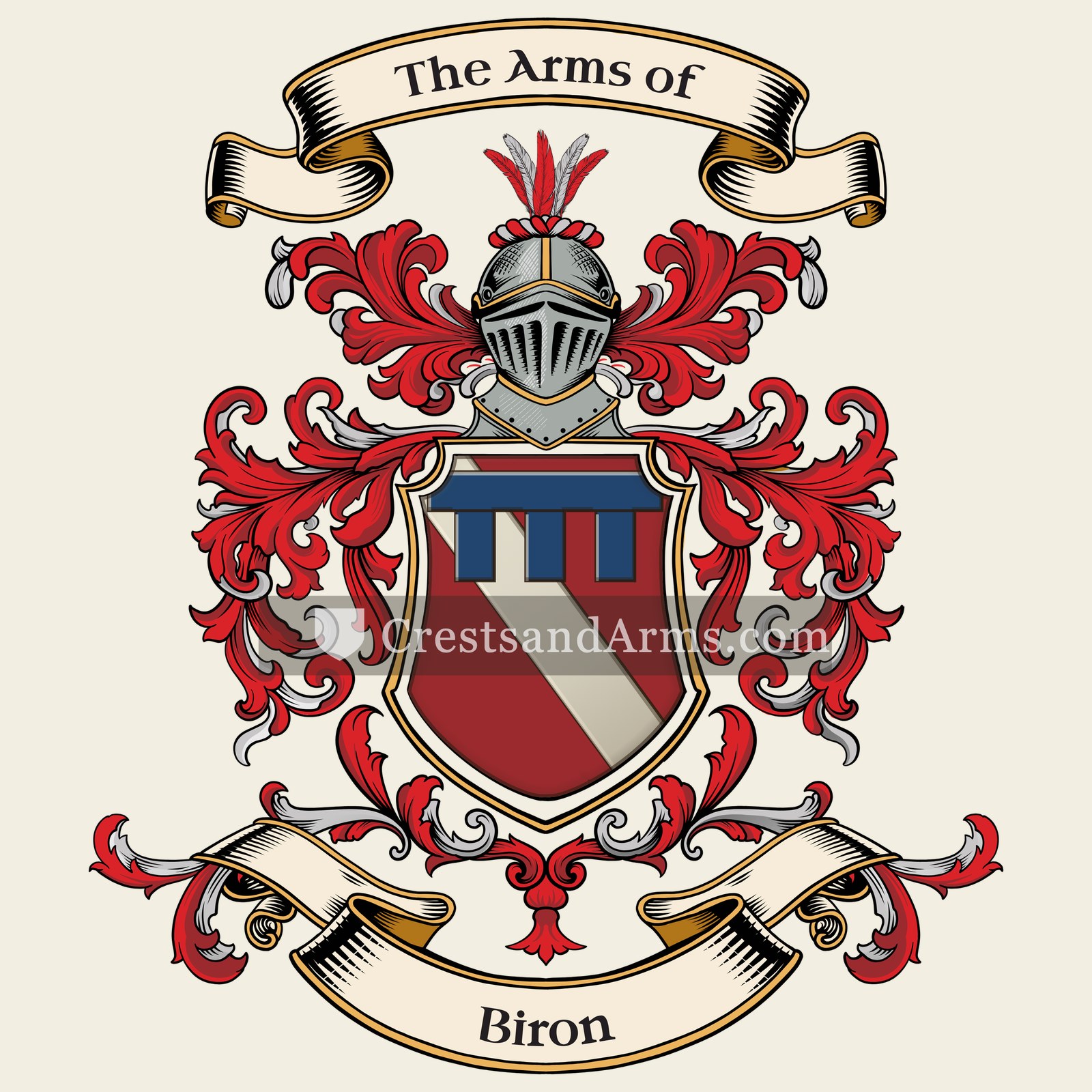
bendDefence, and the scarf of a commander
labelThe eldest son, during his father's life
Colours
Red (Gules)Means: Military strength
Silver (Argent)Means: Peace and sincerity
Blue (Azure)Means: Loyalty and truth
Historical info
Source
Sir Bernard Burke, The General Armory of England, Scotland, Ireland and Wales, London: Harrison & Sons, 1884
Blazon (the actual original written record)
“Gu. three bends ar. (another adds a label az.)”
Irelandc. 1645
Digital archive packCoat of arms PNG, gold border print PDF, vector SVG and the certificate of authenticity. Sent to your email in minutes.
Map of Ireland showing where the Biron arms are recorded
The Biron arms were recorded in Ireland, c. 1645.
Arms such as these were typically recorded in Dublin.
Dublin was the seat of government in Ireland and the place where grants were sought and recorded. Families with business at the castle or the courts settled nearby, and settling there put their arms on record.
This is where the arms were entered in the register. Families often moved to other parts of the country, so the same name can turn up in more than one region.
The body that granted and recorded arms in Ireland in this period.
Charles I of England
Sovereign of the period
Charles I of England
1625–1649
Reigning in France when the Biron arms are first recorded.
How Arms Worked in Ireland
The Ulster King of Arms granted coats of arms to individuals who proved their social standing and good character. These symbols were typically inherited by all legitimate descendants of the original holder. If a family branch wanted a unique look, they could apply for a specific change to their design through the office to ensure their identity remained distinct.
Granting authority
The Ulster King of Arms acted as the official body that regulated and issued all coats of arms throughout Ireland.
How they got arms
Families obtained their arms through formal grants issued by the office after proving their eligibility and paying the required fees.
Where arms were recorded
All official grants were recorded in the registers held by the Ulster King of Arms starting from the year 1552.
The family's standing
Recorded among the armigerous families of Ireland.
Origin & History of the Biron Family in Ireland
The Biron family name established a documented presence in Dublin by 1645, marking a significant chapter in the family history during a period of intense political transition in Ireland. While the name has roots that stretch across European borders, its early Irish iteration was shaped by the urban growth and shifting social structures of seventeenth-century Dublin. During this era, families with the Biron name integrated into the local merchant and administrative classes of the city. They navigated the complexities of life in a capital undergoing rapid change, often participating in the civic and economic activities that defined the bustling port city. By settling in Dublin, these early members of the family became part of the diverse tapestry of people who contributed to the development of the city's unique cultural and historical identity.
Biron Meaning & Related Branches
Root word
Biron
Derived from the Old French word biron meaning a small iron tool.
This name
BironA locative surname referring to someone living near a specific iron-rich location or forge.
also spelled
Byron
Beeron
Byrun
Birun
Related arms
Byronvariant spelling
Documented Sources
J. B. Rietstap, Armorial Général, Gouda: G. B. van Goor Zonen, 1884–87
Archives départementales d'Ille-et-Vilaine, Registres paroissiaux et d'état civil, 1663
Pottier, Jean-Pierre, Histoire de la Bretagne et des Bretons, 2005
Digital archive packCoat of arms PNG, gold border print PDF, vector SVG and the certificate of authenticity. Sent to your email in minutes.


 eagleNobility, strength and a keen mind
 eagleNobility, strength and a keen mind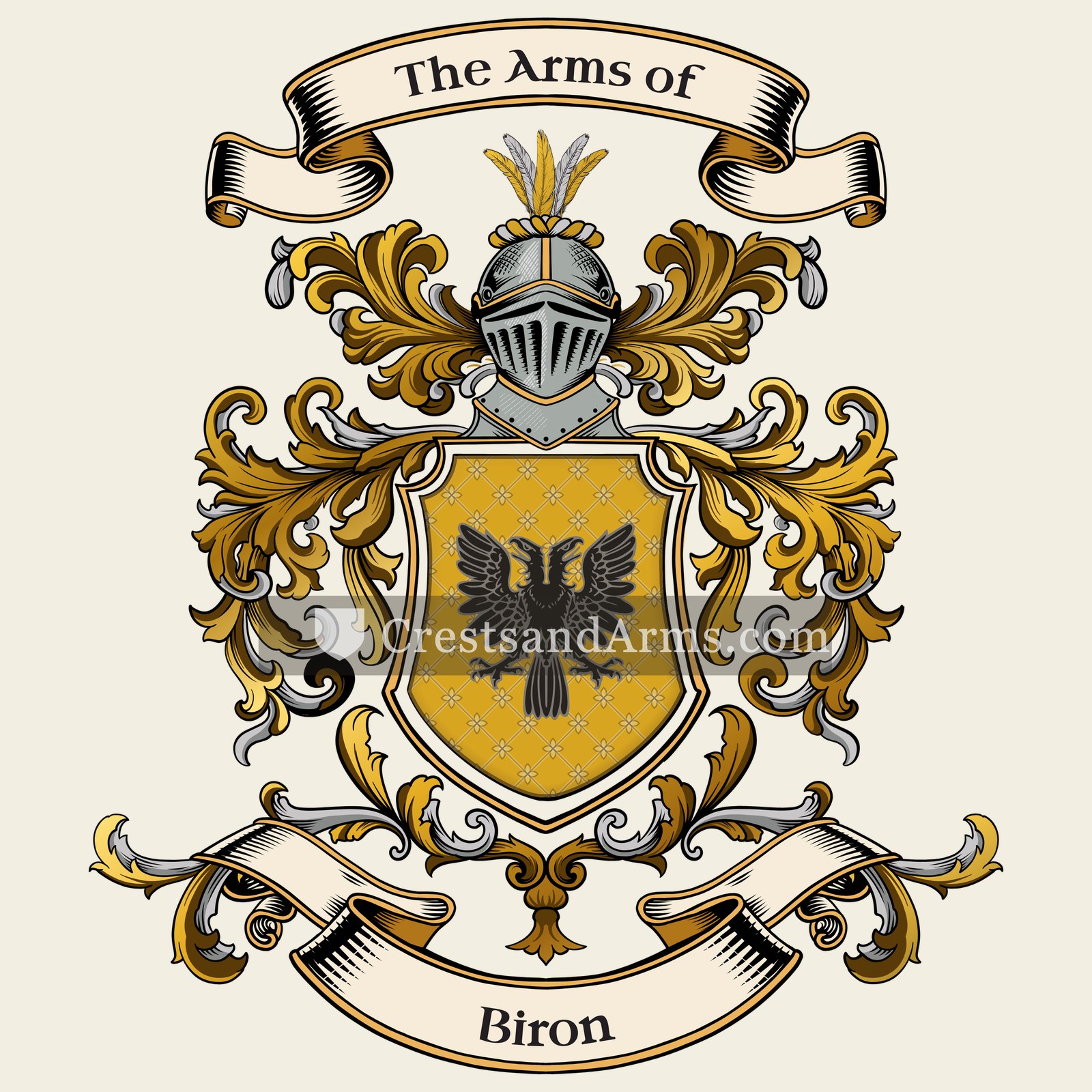




 bendDefence, and the scarf of a commander
 labelThe eldest son, during his father's life