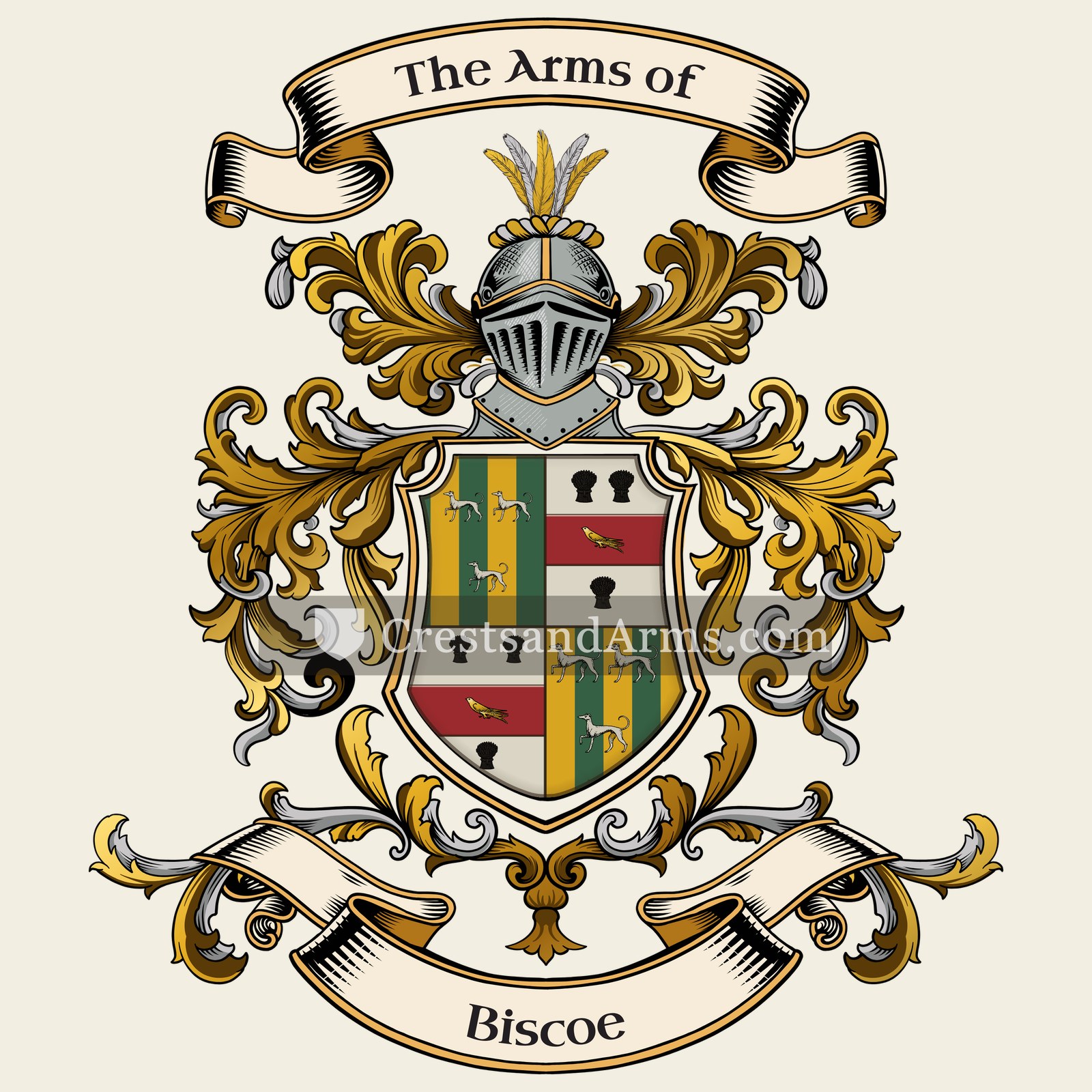
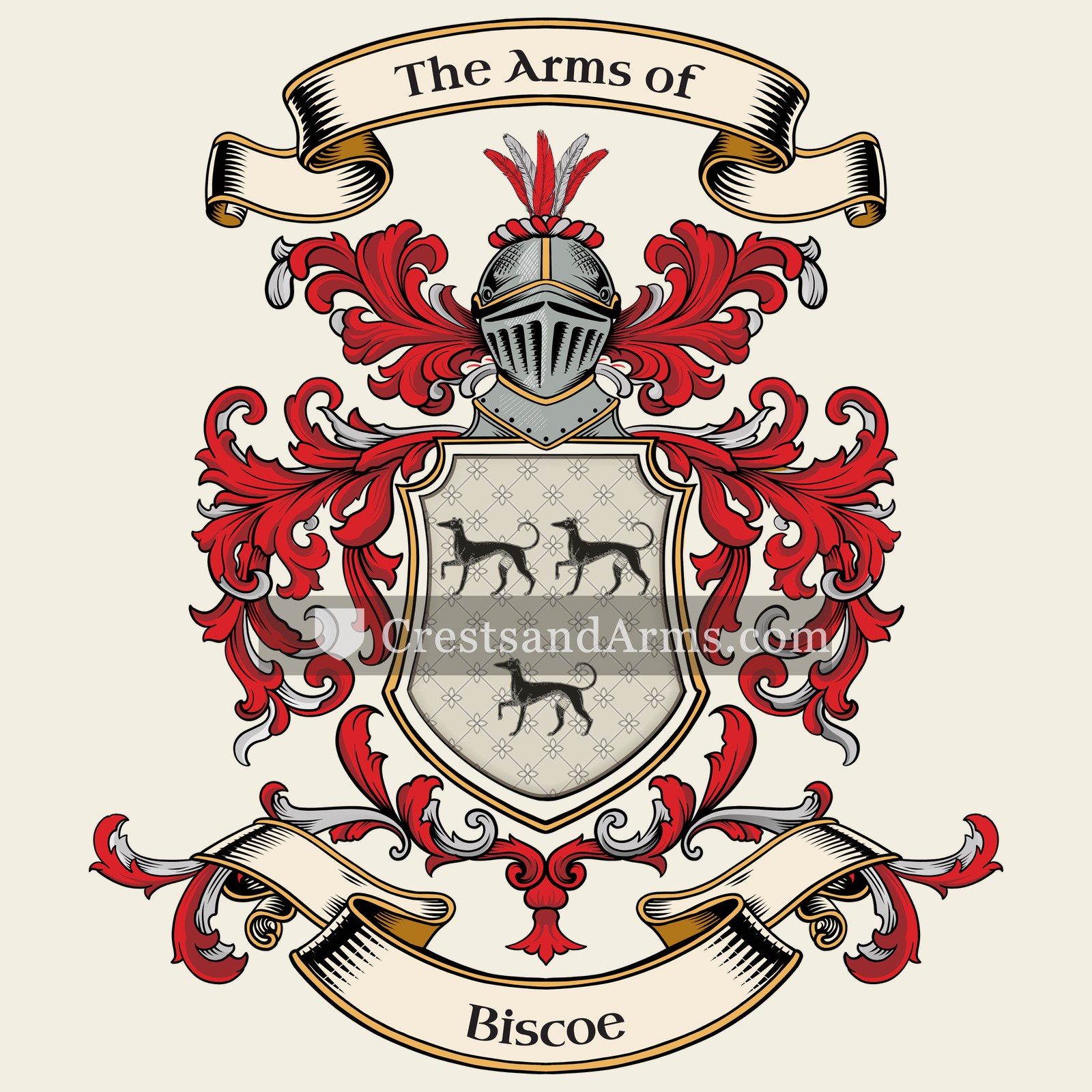
A record of documented arms, meaning and origin, researched for the Biscoe family lines. Documented in 2 countries.
Reg. 8607 · English, A–C
Coat of Arms & Family Crest Details
Symbols on this shield
fessThe military belt, and readiness to serve
greyhoundCourage, vigilance and loyalty
wheatsheafPlenty, and the harvest of one's own labour
martletA younger son, who must win his own land
Colours
Gold (Or)Means: Generosity
Silver (Argent)Means: Peace and sincerity
Red (Gules)Means: Military strength
ErmineMeans: Dignity
Black (Sable)Means: Constancy
Historical info
Source
Sir Bernard Burke, The General Armory of England, Scotland, Ireland and Wales, London: Harrison & Sons, 1884
Blazon (the actual original written record)
“1st and 4th, paly of six or and vert three greyhounds current in pale erm. each gorged with a collar gold, for Biscoe; 2nd and 3rd: Ar. on a fesse gu. betw. three garbs sa. a martlet or, for Tyndale”
OxfordOxford, c. 1866
Digital archive packCoat of arms PNG, gold border print PDF, vector SVG and the certificate of authenticity. Sent to your email in minutes.
Map of England showing where the Biscoe arms are recorded
The Biscoe arms were recorded in Oxford, c. 1866.
Oxfordshire was farming country with the university at its centre, and both produced families of standing. Scholars and lawyers who did well bought manors nearby, and holding a manor was the ordinary route to a coat of arms.
This is where the arms were entered in the register. Families often moved to other parts of the country, so the same name can turn up in more than one region.
The body that granted and recorded arms in England in this period.
Victoria
Sovereign of the period
Victoria
1837–1901
Reigning in England when the Biscoe arms are first recorded.
How Arms Worked in England
English heraldry allowed arms to be shared by all legitimate descendants of the original owner. These symbols were treated as personal property that moved through the generations to all children. While the eldest son kept the original design, other family members could use the same shield without needing to change it or register their own unique versions.
Granting authority
The College of Arms in London has regulated the use of coats of arms throughout England and Wales since 1484.
How they got arms
Families typically obtained their coats of arms through a formal grant from the Crown or by proving their ancient right to them.
Where arms were recorded
All official coats of arms are recorded in the registers kept at the College of Arms, which date back to the fifteenth century.
The family's standing
Recorded among the armigerous families of Oxford.
Origin & History of the Biscoe Family in England
The family name Biscoe is rooted in the landscape of medieval England, likely originating as a topographic surname for people who lived near a specific type of woodland or clearing. While the name appears in various regional records over several centuries, the Biscoe family established a notable presence in the city of Oxford by the mid-19th century. By 1866, members of the family were active participants in the local community, contributing to the social and professional fabric of this historic university town. Their move to Oxford reflects a broader trend of families settling in centers of learning and trade during the Victorian era. Through these early records, we can trace how the family transitioned from their ancestral origins into the established urban life of one of England’s most significant cities.
Coat of Arms & Family Crest Details
Symbols on this shield
greyhoundCourage, vigilance and loyalty
Colours
Silver (Argent)Means: Peace and sincerity
Black (Sable)Means: Constancy
Historical info
Source
Sir Bernard Burke, The General Armory of England, Scotland, Ireland and Wales, London: Harrison & Sons, 1884
Blazon (the actual original written record)
“Ar. three greyhounds courant in pale sa”
InvernessKingillie · Inverness, c. 1748
Digital archive packCoat of arms PNG, gold border print PDF, vector SVG and the certificate of authenticity. Sent to your email in minutes.
Map of Scotland showing where the Biscoe arms are recorded
The Biscoe arms were recorded in Inverness, c. 1748.
Inverness was the largest Highland county, clan country of glens and long sea lochs. Chiefs recorded arms to mark the head of a family, and cadet branches recorded their own to show their place.
This is where the arms were entered in the register. Families often moved to other parts of the country, so the same name can turn up in more than one region.
The body that granted and recorded arms in Scotland in this period.
George II of Great Britain
Sovereign of the period
George II of Great Britain
1727–1760
Reigning in England when the Biscoe arms are first recorded.
How Arms Worked in Scotland
Scottish heraldry is unique because it treats a coat of arms as a piece of personal property protected by law. Only one person can own a specific design at any given time. When a family grows, the head keeps the original shield while other relatives must apply for their own distinct version with slight changes to prove their specific identity.
Granting authority
The Court of the Lord Lyon acts as the official body that regulates and controls all heraldic matters throughout Scotland.
How they got arms
Individuals obtain a legal right to their arms through a formal petition process that confirms their identity and family connection.
Where arms were recorded
All valid coats of arms are officially entered into the Public Register of All Arms and Bearings starting from 1672.
The family's standing
Recorded among the armigerous families of Inverness.
Origin & History of the Biscoe Family in Scotland
The Biscoe family name has deep roots that connect to the rugged landscape of the Scottish Highlands. While the name is often associated with English origins, records confirm that family members were firmly established in Inverness by 1748. During this period, Inverness served as a vital hub for trade and military activity in the north of Scotland. Families living in this region often navigated the complex social and political shifts following the Jacobite rising. The presence of the Biscoe name in such a strategic location suggests that these early ancestors were likely involved in the local merchant class or the professional administration of the town. By settling in Inverness, they became part of a unique cultural tapestry that defined the Highlands during the eighteenth century. Their history reflects the resilience of families who built lives in a region undergoing significant change.
Biscoe Meaning & Related Branches
Root word
Biscop
Old English term for a bishop or a high-ranking church official.
This name
BiscoeA topographic or occupational name referring to someone who worked for or lived on land owned by a bishop.
also spelled
Biscoff
Biskow
Biscoew
Documented Sources
Sir Bernard Burke, The General Armory of England, Scotland, Ireland and Wales, London: Harrison & Sons, 1884
Reaney, P.H. and Wilson, R.M., A Dictionary of English Surnames, 1991
Lower, Mark Antony, Patronymica Britannica: A Dictionary of the Family Names of the United Kingdom, 1860
Oxfordshire History Centre, Oxford City Council Records (1860-1870)
The National Archives, Census Returns of England and Wales, 1861 and 1871
Digital archive packCoat of arms PNG, gold border print PDF, vector SVG and the certificate of authenticity. Sent to your email in minutes.


 fessThe military belt, and readiness to serve
 greyhoundCourage, vigilance and loyalty
 wheatsheafPlenty, and the harvest of one's own labour
 martletA younger son, who must win his own land
 fessThe military belt, and readiness to serve
 greyhoundCourage, vigilance and loyalty
 wheatsheafPlenty, and the harvest of one's own labour
 martletA younger son, who must win his own land