Map of England showing where the Bisset arms are recorded
The Bisset arms were recorded in Yorkshire, c. 1620.
This is where the arms were entered in the register. Families often moved to other parts of the country, so the same name can turn up in more than one region.
The body that granted and recorded arms in England in this period.
James VI and I
Sovereign of the period
James VI and I
1603–1625
Reigning in England when the Bisset arms are first recorded.
How Arms Worked in England
English heraldry allowed arms to be shared by all legitimate descendants of the original owner. These symbols were treated as personal property that moved through the generations to all children. While the eldest son kept the original design, other family members could use the same shield without needing to change it or register their own unique versions.
Granting authority
The College of Arms in London has regulated the use of coats of arms throughout England and Wales since 1484.
How they got arms
Families typically obtained their coats of arms through a formal grant from the Crown or by proving their ancient right to them.
Where arms were recorded
All official coats of arms are recorded in the registers kept at the College of Arms, which date back to the fifteenth century.
The family's standing
Recorded among the armigerous families of Yorkshire.
Origin & History of the Bisset Family in England
The Bisset family name has roots that stretch back to the medieval period, though its presence in England became particularly notable in the northern regions by the early seventeenth century. Records indicate that members of the family were firmly established in Yorkshire by 1620, where they lived as part of the local gentry and landowning classes. The name itself is thought to be of Norman-French origin, likely derived from a nickname describing a person’s physical appearance or temperament. As the family settled into the English countryside, they integrated into the social and economic structures of the time, often appearing in local parish registers and legal documents related to property holdings. This transition from their earlier ancestral ties to a settled life in Yorkshire highlights how families moved and adapted across the landscape of northern England during the Stuart era.
Coat of Arms & Family Crest Details
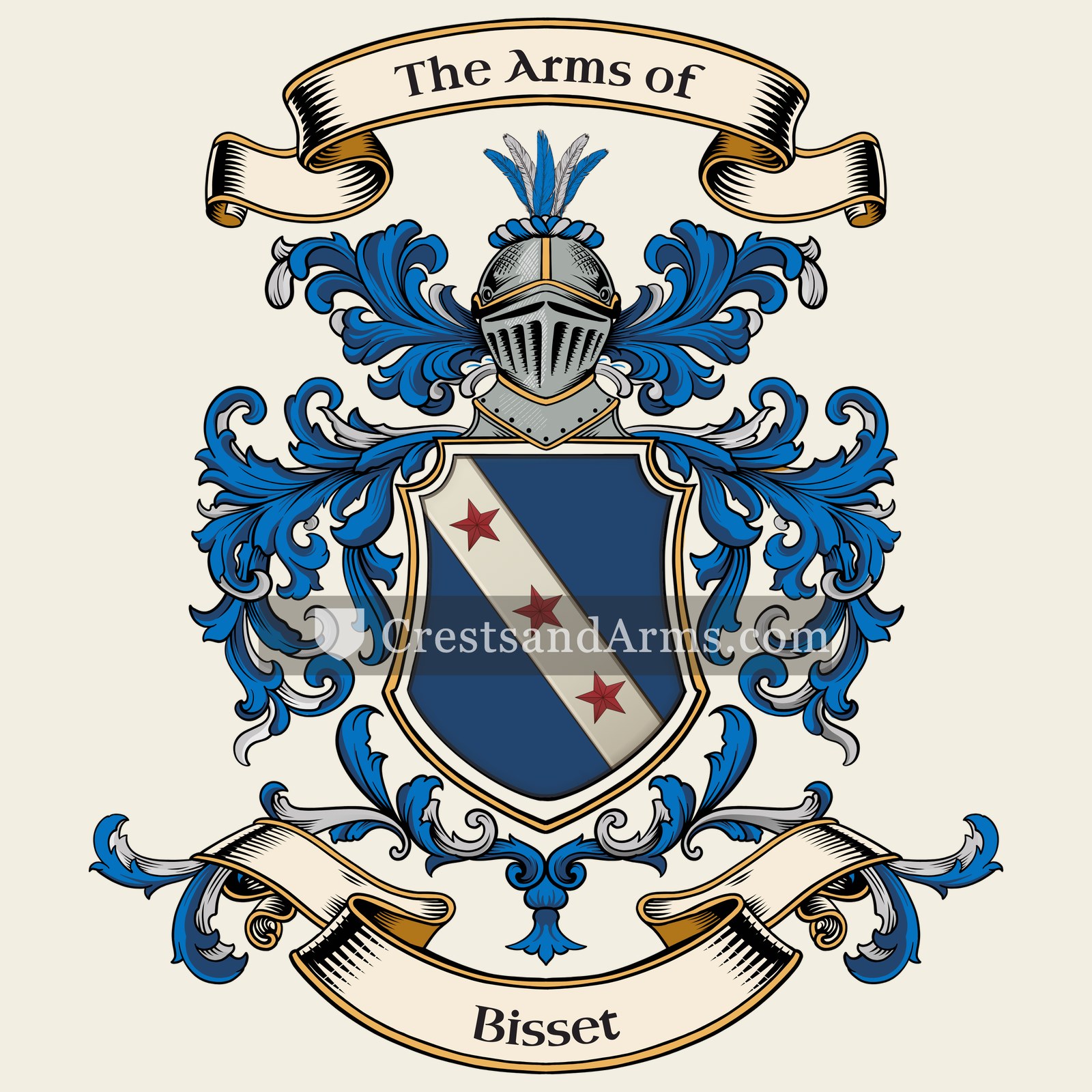
Symbols on this shield
bendDefence, and the scarf of a commander
mulletThe third son, and a divine quality from above
Colours
Blue (Azure)Means: Loyalty and truth
Silver (Argent)Means: Peace and sincerity
Red (Gules)Means: Military strength
Historical info
Source
Sir Bernard Burke, The General Armory of England, Scotland, Ireland and Wales, London: Harrison & Sons, 1884
Blazon (the actual original written record)
“Originally az. on a bend ar. three mullets gu.; afterwards, az. a bend ar”
AberdeenLessendrum · Aberdeen, c. 1748
Digital archive packCoat of arms PNG, gold border print PDF, vector SVG and the certificate of authenticity. Sent to your email in minutes.
Map of Scotland showing where the Bisset arms are recorded
The Bisset arms were recorded in Aberdeen, c. 1748.
Aberdeen was a granite trading town on the north-east coast with farming country behind it. Merchants who prospered bought estates inland, and buying an estate was what brought a family its arms.
This is where the arms were entered in the register. Families often moved to other parts of the country, so the same name can turn up in more than one region.
The body that granted and recorded arms in Scotland in this period.
George II of Great Britain
Sovereign of the period
George II of Great Britain
1727–1760
Reigning in England when the Bisset arms are first recorded.
How Arms Worked in Scotland
Scottish heraldry is unique because it treats a coat of arms as a piece of personal property protected by law. Only one person can own a specific design at any given time. When a family grows, the head keeps the original shield while other relatives must apply for their own distinct version with slight changes to prove their specific identity.
Granting authority
The Court of the Lord Lyon acts as the official body that regulates and controls all heraldic matters throughout Scotland.
How they got arms
Individuals obtain a legal right to their arms through a formal petition process that confirms their identity and family connection.
Where arms were recorded
All valid coats of arms are officially entered into the Public Register of All Arms and Bearings starting from 1672.
The family's standing
Recorded among the armigerous families of Aberdeen.
Origin & History of the Bisset Family in Scotland
The Bisset family name traces its roots back to the arrival of Norman settlers in Scotland during the twelfth century. These early members of the family were granted significant lands in the north, particularly around the region of Aberdeen. By the mid-eighteenth century, the family had firmly established itself in this area, as evidenced by records confirming their presence in Aberdeen by 1748. Throughout the medieval period, the Bissets were influential figures who often served as advisors to the Scottish monarchy and held positions of power within the church and local government. Their history is closely tied to the development of the Scottish Highlands and the northeastern coastal regions, where they played a role in the political and social shifts that defined the nation. Over time, the family name became deeply woven into the local culture of Aberdeen, reflecting a long lineage of landowners and civic leaders who helped shape the community.
Bisset Meaning & Related Branches
Root word
bis
A reference to the color dark gray or brown.
This name
BissetA nickname for someone with dark or swarthy hair or complexion.
also spelled
Bysset
Bissat
Bysett
Byssett
Related arms
Bysettvariant spelling
Byssettvariant spelling
Colquhounrecorded with Bisset, same area
Ochterlonyrecorded with Bisset, same area
Documented Sources
Sir Bernard Burke, The General Armory of England, Scotland, Ireland and Wales, London: Harrison & Sons, 1884
Bardsley, Charles Wareing, A Dictionary of English and Welsh Surnames, 1901
Reaney, P.H., A Dictionary of British Surnames, 1958
The National Archives, Prerogative Court of Canterbury and related Probate Jurisdictions: Will Registers, 1620
Digital archive packCoat of arms PNG, gold border print PDF, vector SVG and the certificate of authenticity. Sent to your email in minutes.


 chiefAuthority, wisdom and dominion
 roundelA coin, and one who has been to the crusades
 chiefAuthority, wisdom and dominion
 roundelA coin, and one who has been to the crusades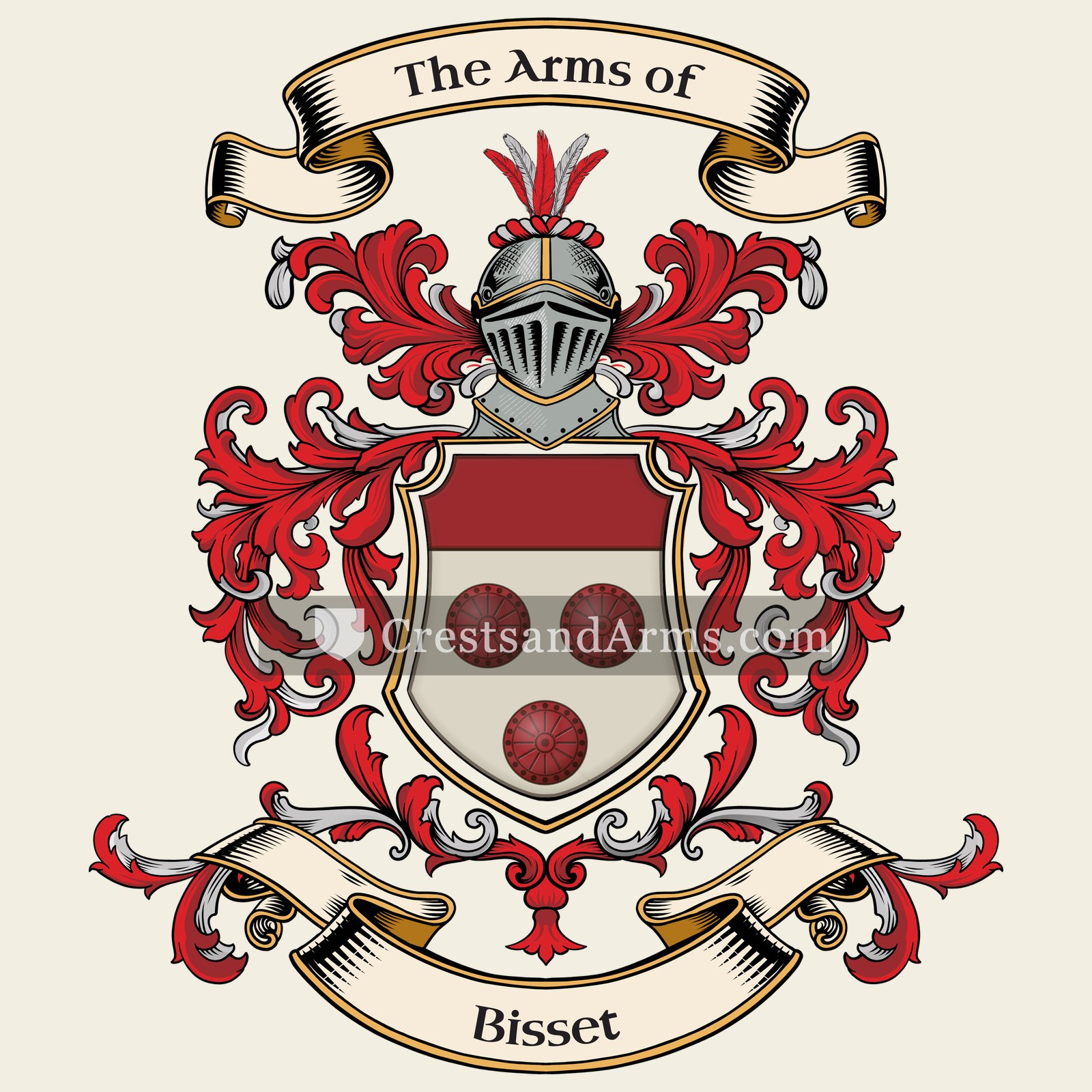


 bendDefence, and the scarf of a commander
 mulletThe third son, and a divine quality from above