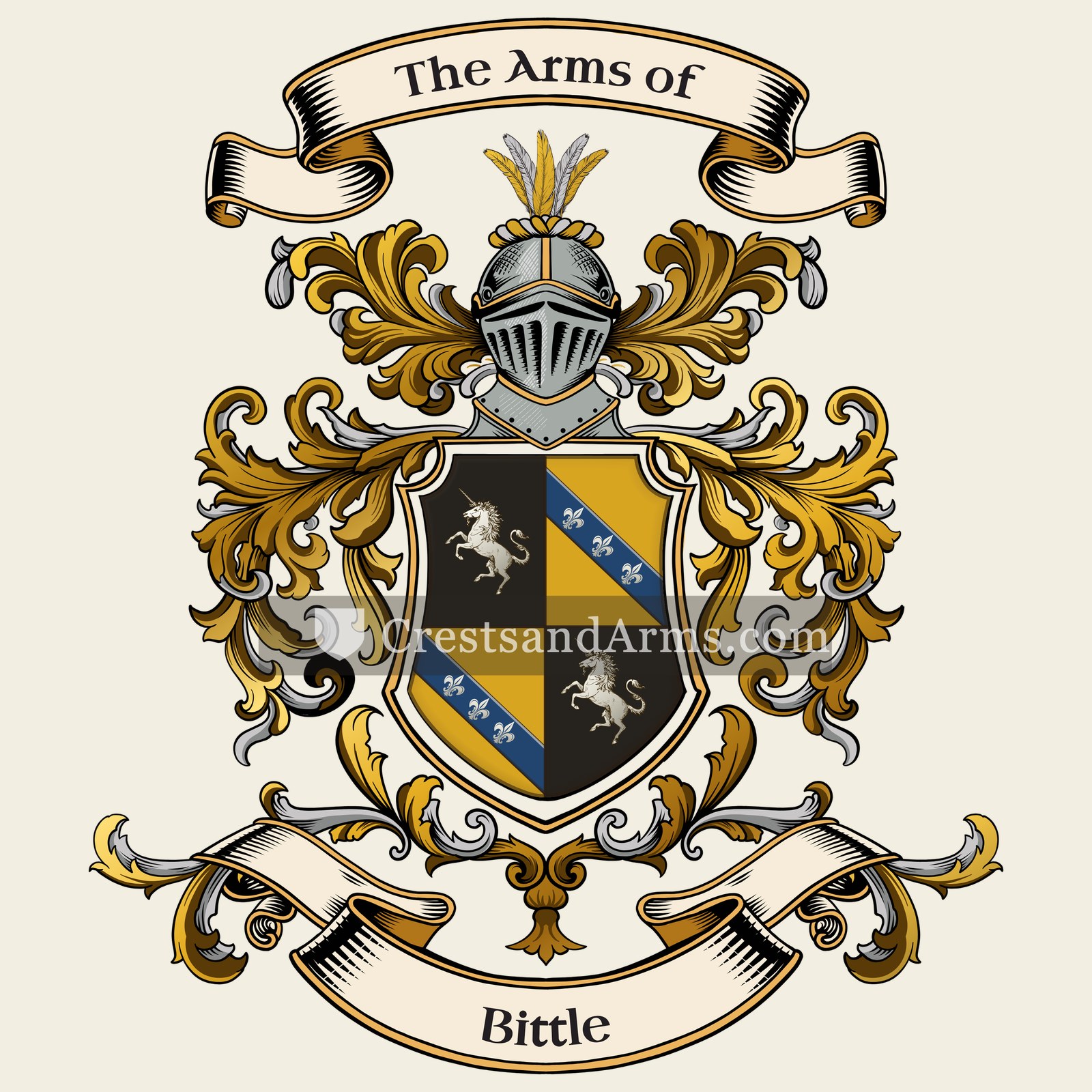
A record of documented arms, meaning and origin, researched for the Bittle family of Germany.
Reg. 1366 · German, A–C
Coat of Arms & Family Crest Details
Symbols on this shield
bendDefence, and the scarf of a commander
unicornPurity, and extreme courage in defence of honour
fleur de lisPurity, light, and the sixth son
Colours
Black (Sable)Means: Constancy
Gold (Or)Means: Generosity
Blue (Azure)Means: Loyalty and truth
Silver (Argent)Means: Peace and sincerity
Historical info
Source
J. B. Rietstap, Armorial Général, Gouda: G. B. van Goor Zonen, 1884–87
Blazon (the actual original written record)
“Ec.: aux 1 et 4 de sa. à la licorne ramp. d'arg.; aux 2 et 3 d'or à la bande d'azur, ch. de trois fleurs-de-lis d'arg., posées en barres. C.: un vol aux armes de l'écu (sur l'aile dextre la bande est transformée en barre.) L. d'or et de sa.”
FranconiaFranconia, c. 1765
Digital archive packCoat of arms PNG, gold border print PDF, vector SVG and the certificate of authenticity. Sent to your email in minutes.
Map of Germany showing where the Bittle arms are recorded
The Bittle arms were recorded in Franconia, c. 1765.
Franconia was a patchwork of small territories in central Germany, full of minor landowners and prosperous market towns. So many separate households held land there that the region produced a great many coats of arms.
This is where the arms were entered in the register. Families often moved to other parts of the country, so the same name can turn up in more than one region.
The body that granted and recorded arms in Germany in this period.
Francis I, Holy Roman Emperor
Sovereign of the period
Francis I, Holy Roman Emperor
1745–1765
Reigning in Germany when the Bittle arms are first recorded.
How Arms Worked in Germany
In the Holy Roman Empire, coats of arms were often granted to individuals by the Emperor or his representatives. These arms were then passed down through the generations to all legitimate descendants of the original holder. Younger branches of a family usually kept the same shield design without needing to change it, as the arms belonged to the entire lineage.
Granting authority
The Holy Roman Emperor held the sole power to grant new coats of arms throughout his vast imperial territories.
How they got arms
Families typically obtained their coats of arms through a formal imperial grant or by proving their noble status to the authorities.
Where arms were recorded
These grants were officially recorded in the Imperial Chancery registers, which began keeping formal records of such honors during the Middle Ages.
The family's standing
Recorded among the armigerous families of Franconia.
Origin & History of the Bittle Family in Germany
The family name Bittle is rooted in the historical region of Franconia, a territory in central Germany known for its deep agricultural traditions and distinct cultural identity. By 1765, records confirm that members of the Bittle family were established residents within this area, likely living as farmers or skilled tradespeople in the small, tight-knit villages that dotted the landscape. During this period, the name was often associated with the German word *büttel*, which historically referred to a local official or a messenger who served the community. As these families lived through the social and political changes of the eighteenth century, many sought new opportunities by migrating across the Atlantic. This movement helped transition the name from its Germanic origins into the broader international context, where it eventually became a part of the diverse tapestry of surnames found in North America today.
Related Branches & Arms
Root word
Bittel
A diminutive form of the Germanic personal name Bodo or Bito.
This name
BittleA patronymic surname derived from a short form of ancient Germanic names meaning messenger or commander.
also spelled
Byttel
Bitel
Documented Sources
J. B. Rietstap, Armorial Général, Gouda: G. B. van Goor Zonen, 1884–87
Bader, Karl Siegfried, Studien zur Rechtsgeschichte des mittelalterlichen Dorfes, 1957


 bendDefence, and the scarf of a commander
 unicornPurity, and extreme courage in defence of honour
 fleur de lisPurity, light, and the sixth son
 bendDefence, and the scarf of a commander
 unicornPurity, and extreme courage in defence of honour
 fleur de lisPurity, light, and the sixth son