A record of documented arms, meaning and origin, researched for the Black family lines. Documented in 3 countries.
Reg. 5800 · Danish, A–C
Meaning of the Black family crest colors & symbols
Symbols on this shield
chequyConstancy, and the counting-board
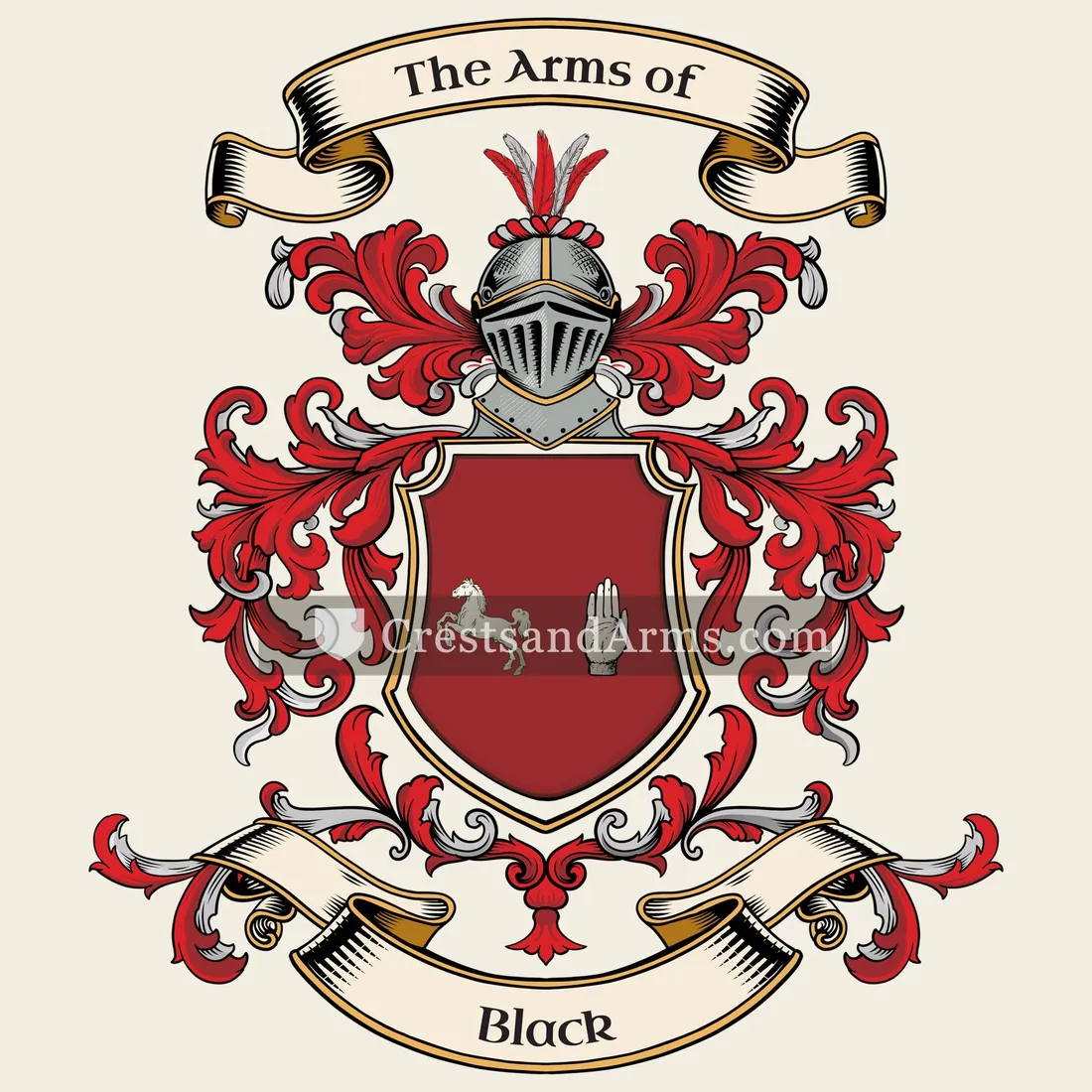
horseReadiness to serve king and country
handFaith, sincerity and justice
Colours
Red (Gules)Means: Military strength
Historical info
Source
J. B. Rietstap, Armorial Général, Gouda: G. B. van Goor Zonen, 1884–87
Blazon (the actual original written record)
“De gu. à une tête et col de cheval à dextre, senestrée d'une main de carn., mouv. du flanc sen. et tenant une épée d'arg., en pal. C.: deux prob. échiq. de sa. et de gu.”
Denmarkc. 1722
Digital archive packCoat of arms PNG, gold border print PDF, vector SVG and the certificate of authenticity. Sent to your email in minutes.
Map of Denmark showing where the Black arms are recorded
The Black arms were recorded in Denmark, c. 1722.
Arms such as these were typically recorded in Sjaælland.
Zealand held the Danish court, the crown's offices and Copenhagen itself. Families who served the king kept estates within reach of it, and royal service was the ordinary route to a coat of arms.
This is where the arms were entered in the register. Families often moved to other parts of the country, so the same name can turn up in more than one region.
The body that granted and recorded arms in Denmark in this period.
Frederik IV of Denmark
Sovereign of the period
Frederik IV of Denmark
1699–1730
Reigning in Denmark when the Black arms are first recorded.
How Arms Worked in Denmark
Danish heraldry during this period was closely tied to noble status and royal favor rather than being open to all citizens. Arms were typically granted by the monarch to individuals, and these symbols were then shared by all members of the noble house. If a family line died out, the right to use those specific arms ended with them.
Granting authority
The Danish royal chancery held the power to issue and regulate official coats of arms for the kingdom.
How they got arms
Families usually received their arms through a formal royal grant that confirmed their noble status and rights.
Where arms were recorded
These grants were officially recorded in the Danish Royal Chancery records starting in the sixteenth century.
The family's standing
Recorded among the armigerous families of Denmark.
Origin & History of the Black Family in Denmark
The history of the Black family in Denmark is rooted in the landscape of Sjælland, where records confirm their presence as early as 1722. During this period, surnames in Denmark were often descriptive or tied to a person’s trade, location, or physical traits rather than being strictly hereditary. The name Black likely emerged as a nickname or a transliteration of local terms used to identify individuals with dark hair or a specific complexion. As the family established themselves in the rural communities of Sjælland, they integrated into the local parish systems, which were the primary way the government tracked citizens at the time. By documenting their lives through church registers and land records, the family became part of the social fabric of the island. Over generations, what began as a simple way to distinguish one neighbor from another evolved into a formal family name that persisted through the centuries.
Meaning of the Black family crest colors & symbols
Symbols on this shield
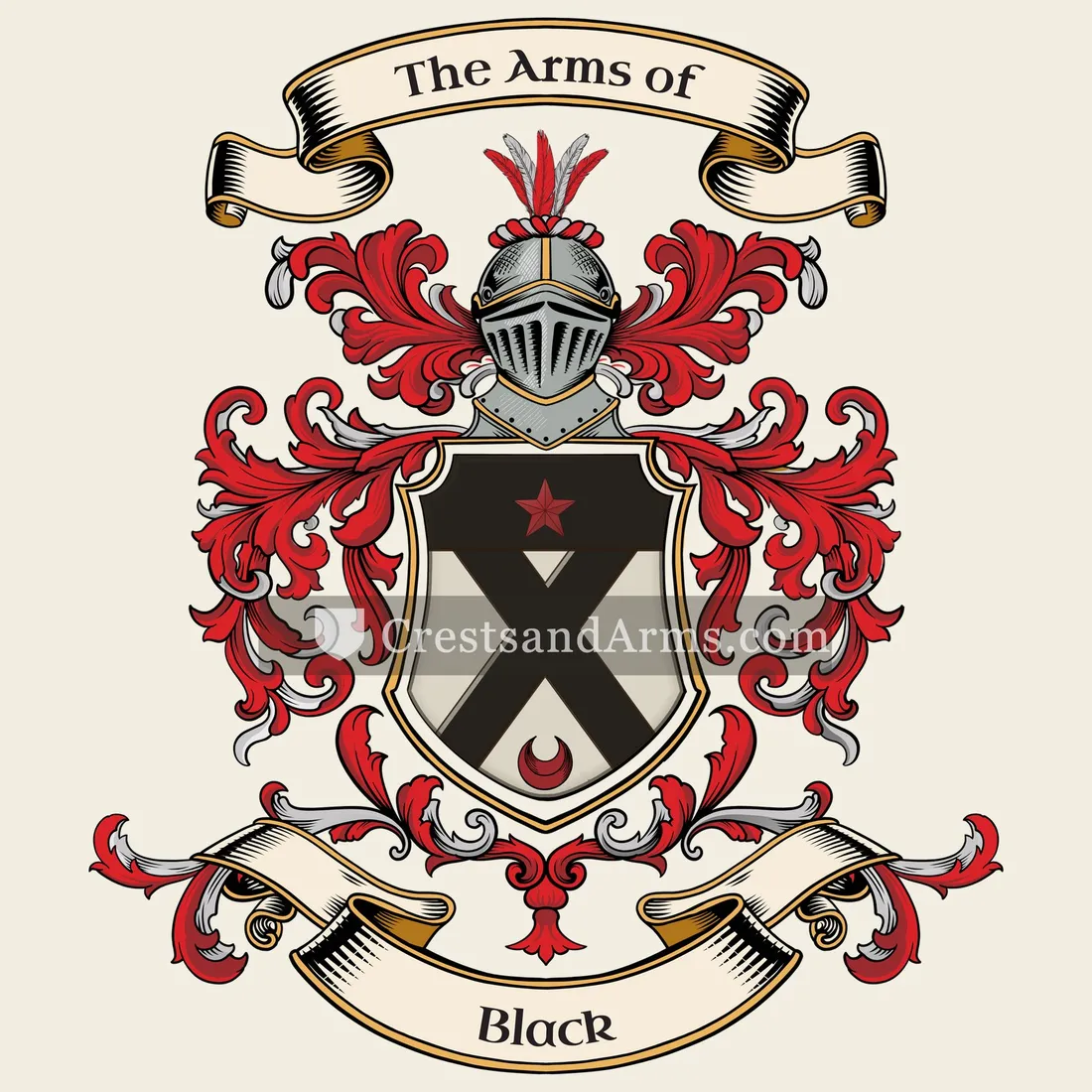
saltireResolution, and St Andrew's cross
chiefAuthority, wisdom and dominion
mulletThe third son, and a divine quality from above
crescentHonour by the sovereign, and the second son
Colours
Silver (Argent)Means: Peace and sincerity
Black (Sable)Means: Constancy
Red (Gules)Means: Military strength
Historical info
Source
Sir Bernard Burke, The General Armory of England, Scotland, Ireland and Wales, London: Harrison & Sons, 1884
Blazon (the actual original written record)
“Ar. a saltire sa. betw. a mullet in chief and a crescent in base gu. a chief of the second”
AberdeenGilbert Black · Aberdeen, c. 1672
Digital archive packCoat of arms PNG, gold border print PDF, vector SVG and the certificate of authenticity. Sent to your email in minutes.
Map of Scotland showing where the Black arms are recorded
The Black arms were recorded in Aberdeen, c. 1672.
Aberdeen was a granite trading town on the north-east coast with farming country behind it. Merchants who prospered bought estates inland, and buying an estate was what brought a family its arms.
This is where the arms were entered in the register. Families often moved to other parts of the country, so the same name can turn up in more than one region.
The body that granted and recorded arms in Scotland in this period.
Charles II of England
Sovereign of the period
Charles II of England
1660–1685
Reigning in Denmark when the Black arms are first recorded.
How Arms Worked in Scotland
Scottish heraldry is unique because it treats a coat of arms as a piece of personal property protected by law. Only one person can own a specific design at any given time. When a family grows, the head keeps the original shield while other relatives must apply for their own distinct version with slight changes to prove their specific identity.
Granting authority
The Court of the Lord Lyon acts as the official body that regulates and controls all heraldic matters throughout Scotland.
How they got arms
Individuals obtain a legal right to their arms through a formal petition process that confirms their identity and family connection.
Where arms were recorded
All valid coats of arms are officially entered into the Public Register of All Arms and Bearings starting from 1672.
The family's standing
Recorded among the armigerous families of Aberdeen.
Origin & History of the Black Family in Scotland
The surname Black is a classic example of a descriptive name that originated in Scotland during the Middle Ages. It was likely used to identify a person by their physical appearance, such as someone with dark hair or a particularly swarthy complexion. By the time the family appears in the official records of Aberdeen in 1672, the name had already become well-established throughout the Scottish Lowlands. During this period, the Black family members in Aberdeen were often involved in the city’s growing merchant and trade guilds. These early ancestors were part of a society that was transitioning from a feudal system to a more urbanized economy. Because the name was based on a common physical trait, it emerged independently in many different regions rather than coming from a single ancestral line. This makes the history of the name a reflection of the diverse and hardworking people who helped shape the early development of Scottish cities.
Meaning of the Black family crest colors & symbols
Symbols on this shield
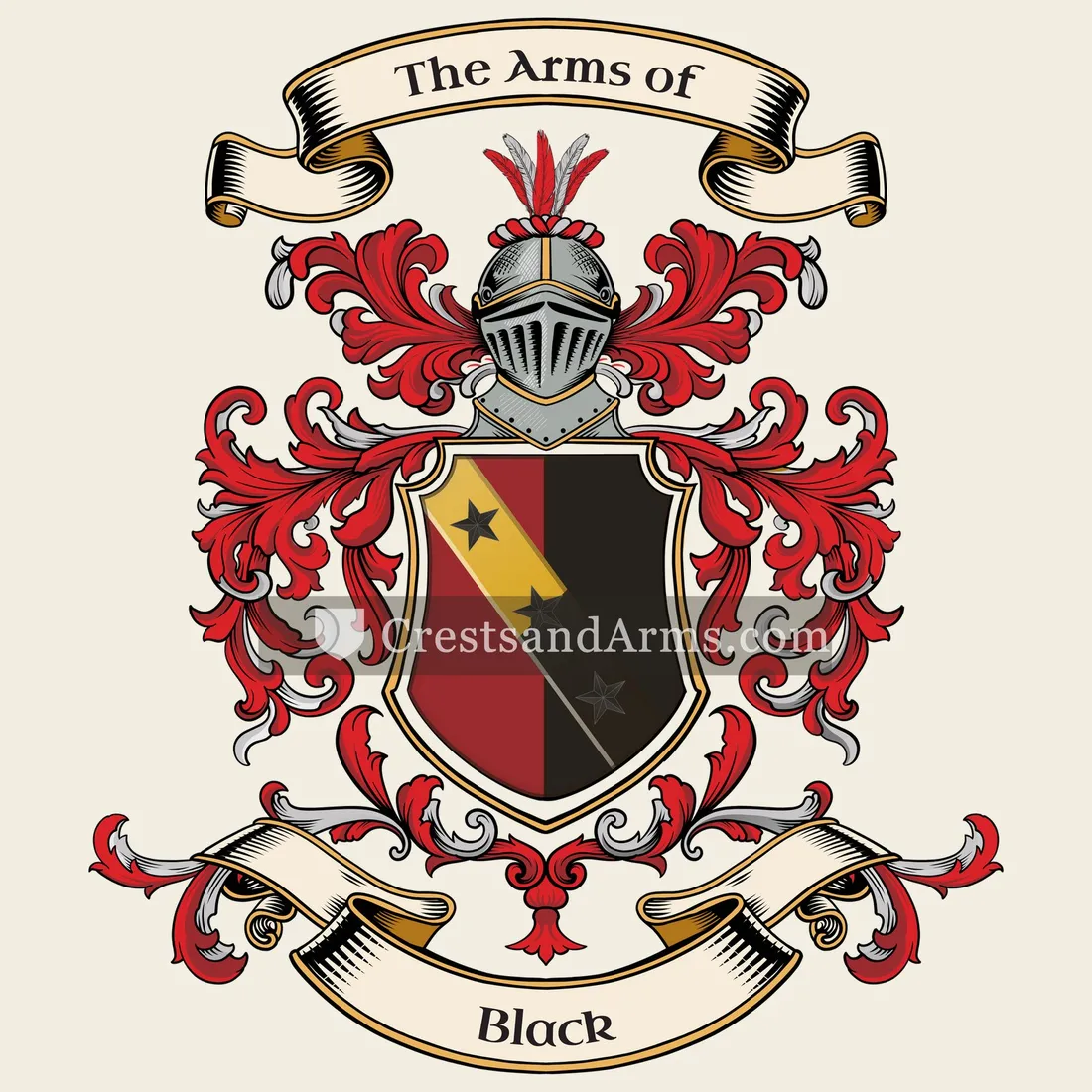
bendDefence, and the scarf of a commander
mulletThe third son, and a divine quality from above
Colours
Red (Gules)Means: Military strength
Black (Sable)Means: Constancy
Gold (Or)Means: Generosity
Historical info
Source
Sir Bernard Burke, The General Armory of England, Scotland, Ireland and Wales, London: Harrison & Sons, 1884
Blazon (the actual original written record)
“Per pale gu. and sa. on a bend or, three mullets of the second”
SuffolkSuffolk, c. 1620
Digital archive packCoat of arms PNG, gold border print PDF, vector SVG and the certificate of authenticity. Sent to your email in minutes.
Map of England showing where the Black arms are recorded
The Black arms were recorded in Suffolk, c. 1620.
Suffolk was wool country, and its cloth towns were among the wealthiest in England. Clothier families bought manors with their profits, and holding a manor was the ordinary route to a coat of arms.
This is where the arms were entered in the register. Families often moved to other parts of the country, so the same name can turn up in more than one region.
The body that granted and recorded arms in England in this period.
James VI and I
Sovereign of the period
James VI and I
1603–1625
Reigning in Denmark when the Black arms are first recorded.
How Arms Worked in England
English heraldry allowed arms to be shared by all legitimate descendants of the original owner. These symbols were treated as personal property that moved through the generations to all children. While the eldest son kept the original design, other family members could use the same shield without needing to change it or register their own unique versions.
Granting authority
The College of Arms in London has regulated the use of coats of arms throughout England and Wales since 1484.
How they got arms
Families typically obtained their coats of arms through a formal grant from the Crown or by proving their ancient right to them.
Where arms were recorded
All official coats of arms are recorded in the registers kept at the College of Arms, which date back to the fifteenth century.
The family's standing
Recorded among the armigerous families of Suffolk.
Origin & History of the Black Family in England
The surname Black originated in England as a descriptive nickname, likely used to identify individuals by their dark hair, swarthy complexion, or the dark clothing they frequently wore. During the Middle Ages, surnames were often adopted based on physical traits or personal habits to help distinguish one person from another in small village communities. By the early 17th century, the name had become well-established across various English counties, including a notable presence in the county of Suffolk by 1620. Families living in this region during that period were often involved in agriculture or local trade, contributing to the steady growth of the name as it passed down through generations. This transition from a simple nickname to a permanent family name reflects the broader social changes occurring in England as people moved and settled into more structured community roles.
Black Meaning & Related Branches
Root word
blakkr
Old Norse term meaning pale, shining, or white.
This name
BlackA descriptive nickname for someone with a pale complexion or light-colored hair.
also spelled
Blak
Blake
Related arms
Arnotsame arms
Inglissimilar arms
Maxwellsimilar arms
Blakvariant spelling
Documented Sources
J. B. Rietstap, Armorial Général, Gouda: G. B. van Goor Zonen, 1884–87
Rigsarkivet (Danish National Archives), Kirkebøger (Parish Registers), Sjælland diocese records
Rigsarkivet (Danish National Archives), Folketællinger (Census Records)
Nielsen, Oluf, Kjøbenhavns Diplomatarium, 1872
Kousgård Sørensen, John, Danske Surnavne, 1996
Digital archive packCoat of arms PNG, gold border print PDF, vector SVG and the certificate of authenticity. Sent to your email in minutes.


 chequyConstancy, and the counting-board
 horseReadiness to serve king and country
 handFaith, sincerity and justice
 chequyConstancy, and the counting-board
 horseReadiness to serve king and country
 handFaith, sincerity and justice


 saltireResolution, and St Andrew's cross
 chiefAuthority, wisdom and dominion
 mulletThe third son, and a divine quality from above
 crescentHonour by the sovereign, and the second son


 bendDefence, and the scarf of a commander