Map of Britain showing where the Blackburn arms are recorded
The Blackburn arms were recorded in Britain, c. 1700.
Arms such as these were typically recorded in Kent.
Kent sits between London and the short crossing to Europe, and the trade passing through made it wealthy. Merchant families bought land with that money, and it was landowners who took coats of arms.
This is where the arms were entered in the register. Families often moved to other parts of the country, so the same name can turn up in more than one region.
The body that granted and recorded arms in Britain in this period.
William III of England
Sovereign of the period
William III of England
1694–1702
Reigning in Britain when the Blackburn arms are first recorded.
How Arms Worked in Britain
English heraldry allowed arms to be shared by all legitimate descendants of the original owner. These symbols were treated as personal property that moved through the generations to all children. While the eldest son kept the original design, other family members could use the same shield without needing to change it or register their own unique versions.
Granting authority
The College of Arms in London has regulated the use of coats of arms throughout England and Wales since 1484.
How they got arms
Families typically obtained their coats of arms through a formal grant from the Crown or by proving their ancient right to them.
Where arms were recorded
All official coats of arms are recorded in the registers kept at the College of Arms, which date back to the fifteenth century.
The family's standing
Recorded among the armigerous families of Britain.
Origin & History of the Blackburn Family in Britain
The surname Blackburn originated as a topographic name, meaning it was used to identify people who lived near a dark-colored stream or river. In Old English, the words blæc and burna combined to describe these specific natural landmarks, which were common features across the British landscape. While the name is famously associated with the town of Blackburn in Lancashire, families carrying this name spread across various regions of England over several centuries. By the year 1700, records confirm that members of the Blackburn family were well-established in the county of Kent. These early ancestors were likely part of the local agricultural or trade communities that defined life in southern England during the late seventeenth century. As families moved, they carried their name with them, turning a simple description of a local creek into a lasting family identity that persisted through generations of English history.
Meaning of the Blackburn family crest colors & symbols
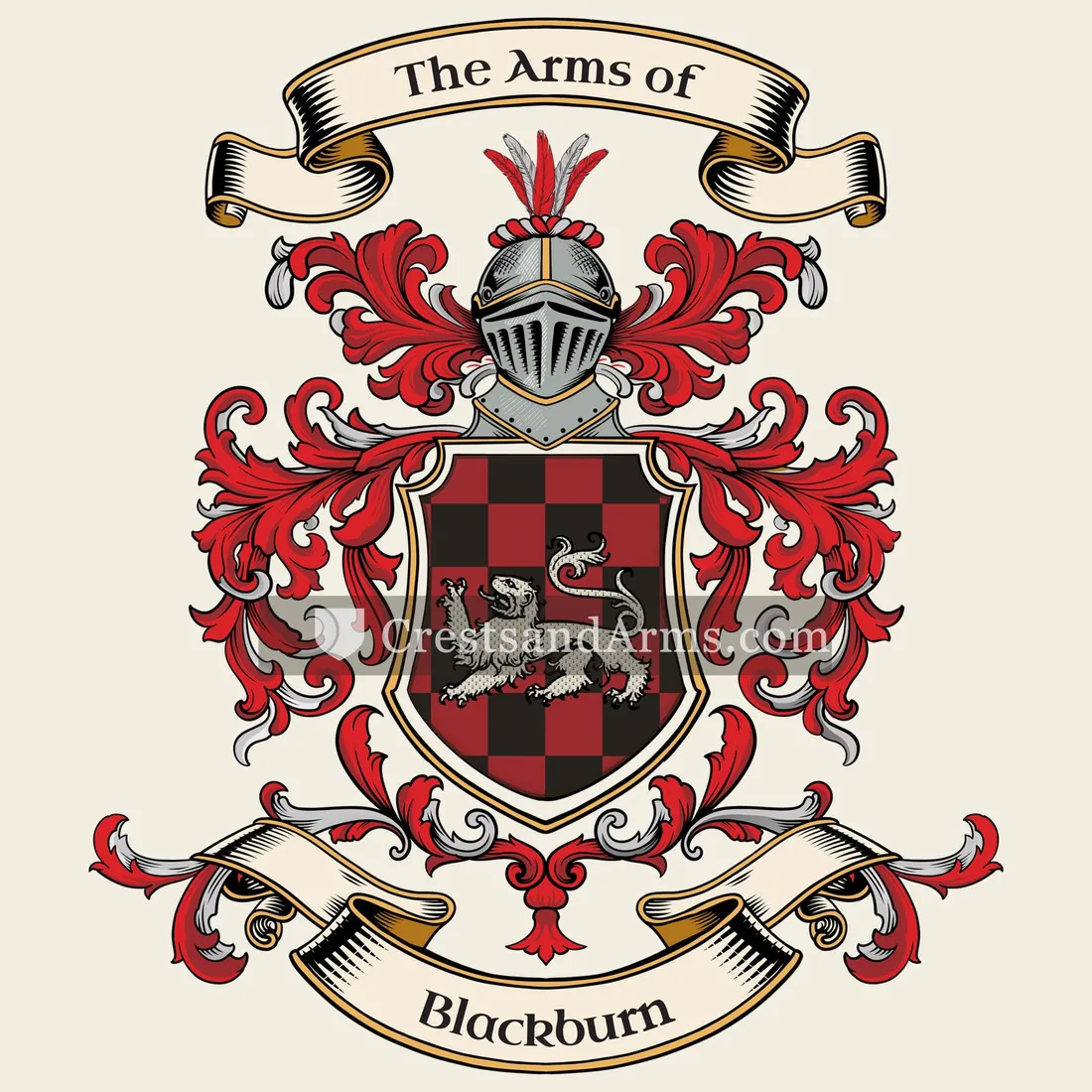
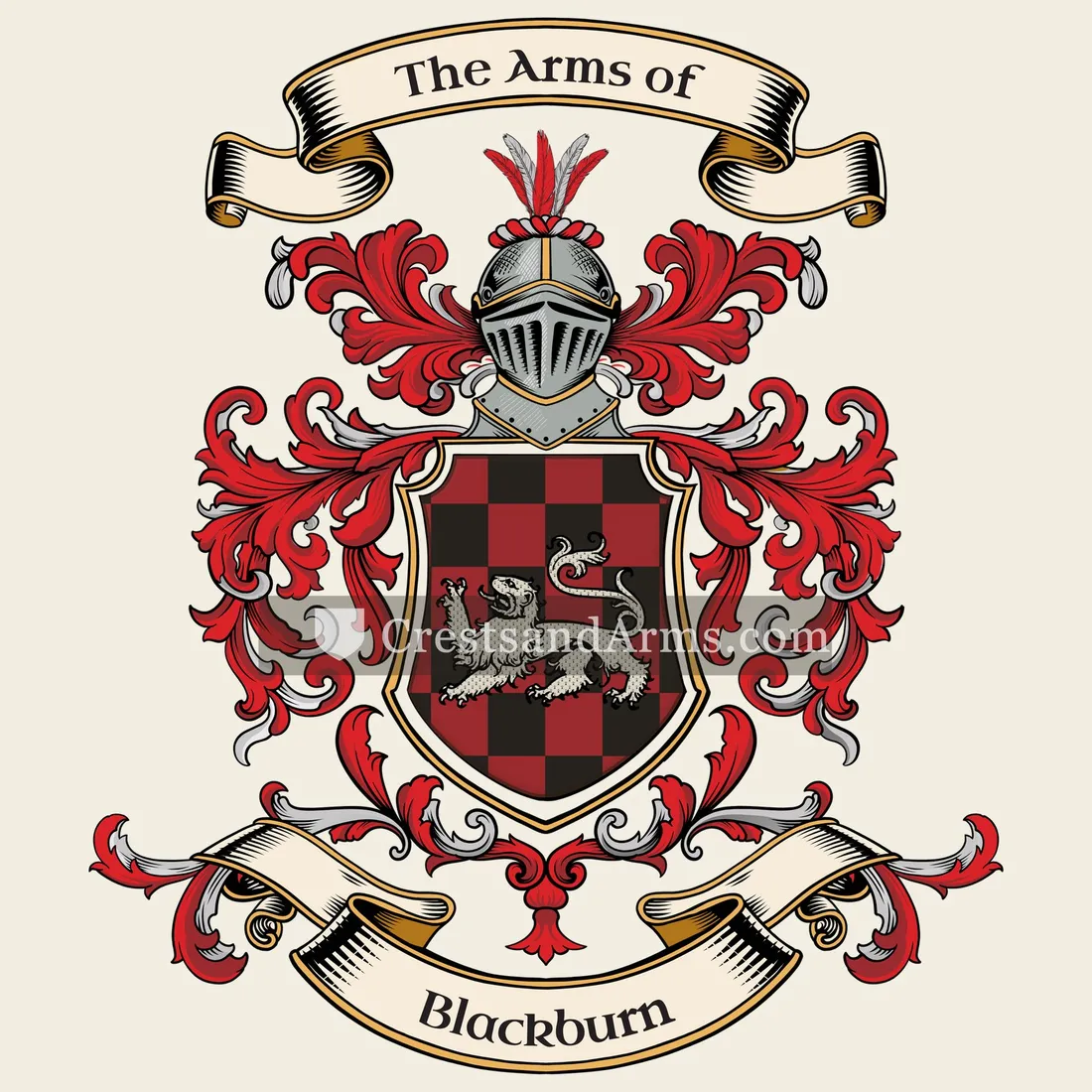
Symbols on this shield
chequyConstancy, and the counting-board
lionCourage, strength and royalty
Colours
Red (Gules)Means: Military strength
ErmineMeans: Dignity
Black (Sable)Means: Constancy
Historical info
Source
Sir Bernard Burke, The General Armory of England, Scotland, Ireland and Wales, London: Harrison & Sons, 1884
Blazon (the actual original written record)
“Gu. a lion ramp. chequy erm. and sa. ducally crowned or”
Englandc. 1620
Digital archive packCoat of arms PNG, gold border print PDF, vector SVG and the certificate of authenticity. Sent to your email in minutes.
Map of England showing where the Blackburn arms are recorded
The Blackburn arms were recorded in England, c. 1620.
Arms such as these were typically recorded in York.
Yorkshire is the largest of the English counties, and it held more gentry families than any other. Land there was split among a great many households rather than a few, so a great many of them carried arms.
This is where the arms were entered in the register. Families often moved to other parts of the country, so the same name can turn up in more than one region.
The body that granted and recorded arms in England in this period.
James VI and I
Sovereign of the period
James VI and I
1603–1625
Reigning in Britain when the Blackburn arms are first recorded.
How Arms Worked in England
English heraldry allowed arms to be shared by all legitimate descendants of the original owner. These symbols were treated as personal property that moved through the generations to all children. While the eldest son kept the original design, other family members could use the same shield without needing to change it or register their own unique versions.
Granting authority
The College of Arms in London has regulated the use of coats of arms throughout England and Wales since 1484.
How they got arms
Families typically obtained their coats of arms through a formal grant from the Crown or by proving their ancient right to them.
Where arms were recorded
All official coats of arms are recorded in the registers kept at the College of Arms, which date back to the fifteenth century.
The family's standing
Recorded among the armigerous families of England.
Origin & History of the Blackburn Family in England
The surname Blackburn is a classic example of a locational name, originating from people who lived near a stream or river with dark, peaty water. In Old English, the name combines the words for black and stream. While the name likely emerged in several different places across northern England where such dark waters were common, it became firmly established in the region around Yorkshire. By 1620, records confirm that members of the Blackburn family were well-settled in the city of York. During this era, families often moved from rural areas into growing urban centers to pursue trades or professional opportunities. These early residents of York were part of a long history of families who took their identity from the physical landscape of their home, helping to preserve the connection between their ancestors and the geography of northern England for generations.
Blackburn Meaning & Related Branches
Root word
Blaec-burna
Old English words for black or dark and a stream or brook.
This name
BlackburnRefers to a person who lived near a dark-colored stream or brook.
also spelled
Blackborn
Blackborne
Related arms
Blakborne, or Blackebornesimilar arms
Blackbornvariant spelling
Blackbornevariant spelling
Blackbournvariant spelling
Documented Sources
J. B. Rietstap, Armorial Général, Gouda: G. B. van Goor Zonen, 1884–87
Bardsley, Charles Wareing, A Dictionary of English and Welsh Surnames, 1901
Ekwall, Eilert, The Concise Oxford Dictionary of English Place-names, 1936
Kent Archives, Archdeaconry Court of Canterbury Wills and Administrations, PRC 32
Digital archive packCoat of arms PNG, gold border print PDF, vector SVG and the certificate of authenticity. Sent to your email in minutes.


 chequyConstancy, and the counting-board
 lionCourage, strength and royalty
 chequyConstancy, and the counting-board
 lionCourage, strength and royalty