Map of England showing where the Blackhall arms are recorded
The Blackhall arms were recorded in Devonshire, c. 1599.
This is where the arms were entered in the register. Families often moved to other parts of the country, so the same name can turn up in more than one region.
The body that granted and recorded arms in England in this period.
Elizabeth I of England
Sovereign of the period
Elizabeth I of England
1558–1603
Reigning in England when the Blackhall arms are first recorded.
How Arms Worked in England
English heraldry allowed arms to be shared by all legitimate descendants of the original owner. These symbols were treated as personal property that moved through the generations to all children. While the eldest son kept the original design, other family members could use the same shield without needing to change it or register their own unique versions.
Granting authority
The College of Arms in London has regulated the use of coats of arms throughout England and Wales since 1484.
How they got arms
Families typically obtained their coats of arms through a formal grant from the Crown or by proving their ancient right to them.
Where arms were recorded
All official coats of arms are recorded in the registers kept at the College of Arms, which date back to the fifteenth century.
The family's standing
Recorded among the armigerous families of Devonshire.
Origin & History of the Blackhall Family in England
The family name Blackhall originates from a locational description, likely referring to a dark-colored manor house or a residence situated near a shaded hall. While the name has strong roots in Scotland, the Blackhall family established a significant presence in the English county of Devonshire by the late sixteenth century. Records confirm that members of the family were living in this region as early as 1599, where they integrated into the local social and economic life of the West Country. During this era, families often took their surnames from the specific landscapes or buildings they occupied, suggesting that the early Blackhalls were associated with a distinct property that earned its name from its appearance or setting. As they settled in Devonshire, these early ancestors contributed to the local community, leaving traces in parish registers and legal documents that highlight their transition from a localized group to a recognized family line within the English countryside.
Coat of Arms & Family Crest Details
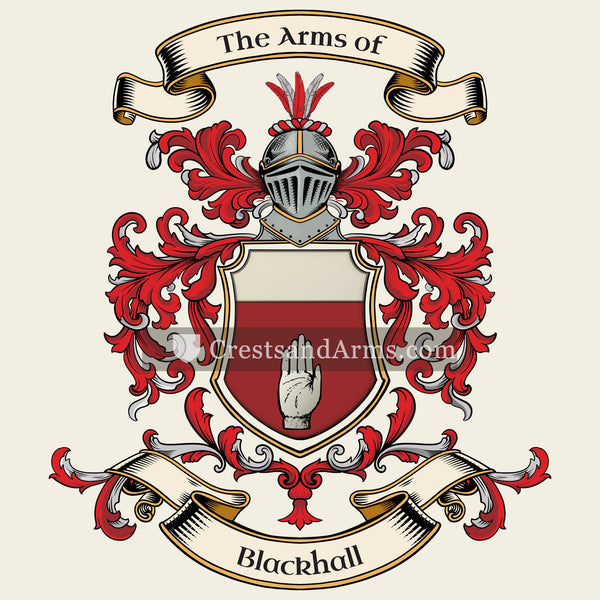
Symbols on this shield
chiefAuthority, wisdom and dominion
handFaith, sincerity and justice
Colours
Red (Gules)Means: Military strength
Silver (Argent)Means: Peace and sincerity
Historical info
Source
Sir Bernard Burke, The General Armory of England, Scotland, Ireland and Wales, London: Harrison & Sons, 1884
Blazon (the actual original written record)
“Gu. a hand issuing out of the sinister flank and thereon a falcon perching and hooded or, on a chief ar. three mullets az”
AberdeenAberdeen, c. 1748
Digital archive packCoat of arms PNG, gold border print PDF, vector SVG and the certificate of authenticity. Sent to your email in minutes.
Map of Scotland showing where the Blackhall arms are recorded
The Blackhall arms were recorded in Aberdeen, c. 1748.
Aberdeen was a granite trading town on the north-east coast with farming country behind it. Merchants who prospered bought estates inland, and buying an estate was what brought a family its arms.
This is where the arms were entered in the register. Families often moved to other parts of the country, so the same name can turn up in more than one region.
The body that granted and recorded arms in Scotland in this period.
George II of Great Britain
Sovereign of the period
George II of Great Britain
1727–1760
Reigning in England when the Blackhall arms are first recorded.
How Arms Worked in Scotland
Scottish heraldry is unique because it treats a coat of arms as a piece of personal property protected by law. Only one person can own a specific design at any given time. When a family grows, the head keeps the original shield while other relatives must apply for their own distinct version with slight changes to prove their specific identity.
Granting authority
The Court of the Lord Lyon acts as the official body that regulates and controls all heraldic matters throughout Scotland.
How they got arms
Individuals obtain a legal right to their arms through a formal petition process that confirms their identity and family connection.
Where arms were recorded
All valid coats of arms are officially entered into the Public Register of All Arms and Bearings starting from 1672.
The family's standing
Recorded among the armigerous families of Aberdeen.
Origin & History of the Blackhall Family in Scotland
The surname Blackhall originates from the lands of Blackhall in the parish of Inverurie, located in the historic county of Aberdeenshire. The name is locative, meaning it was originally taken by individuals who lived on or managed this specific estate. By the mid-eighteenth century, the family had established a firm presence in the city of Aberdeen, where they participated in the local economy and social life of the region. Historical records from 1748 confirm that members of the Blackhall family were active citizens in this area, likely involved in the trade and professional networks that defined the city during the Enlightenment. Over time, the family name became synonymous with the rugged landscape of the northeast of Scotland, reflecting a deep connection to the soil and the local community that persisted for generations.
Blackhall Meaning & Related Branches
Root word
Blaec and Heall
Old English words for dark or black and a stone hall.
This name
BlackhallRefers to a person who lived near a dark-colored manor or stone building.
also spelled
Blackhale
Blackhaul
Related arms
Blackwallsimilar arms
Carewrecorded with Blackhall, same area
Goodridgerecorded with Blackhall, same area
Hackwillrecorded with Blackhall, same area
Documented Sources
Sir Bernard Burke, The General Armory of England, Scotland, Ireland and Wales, London: Harrison & Sons, 1884
Reaney, P.H. and Wilson, R.M., A Dictionary of English Surnames, 1991
Devon Heritage Centre, Parish Registers of Devon, 1599
Bardsley, Charles Wareing, A Dictionary of English and Welsh Surnames, 1901
Digital archive packCoat of arms PNG, gold border print PDF, vector SVG and the certificate of authenticity. Sent to your email in minutes.


 chiefAuthority, wisdom and dominion
 roundelA coin, and one who has been to the crusades
 chiefAuthority, wisdom and dominion
 roundelA coin, and one who has been to the crusades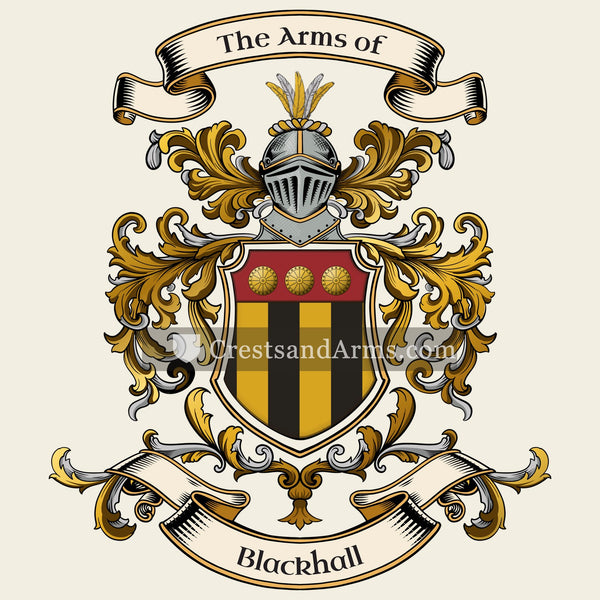


 handFaith, sincerity and justice