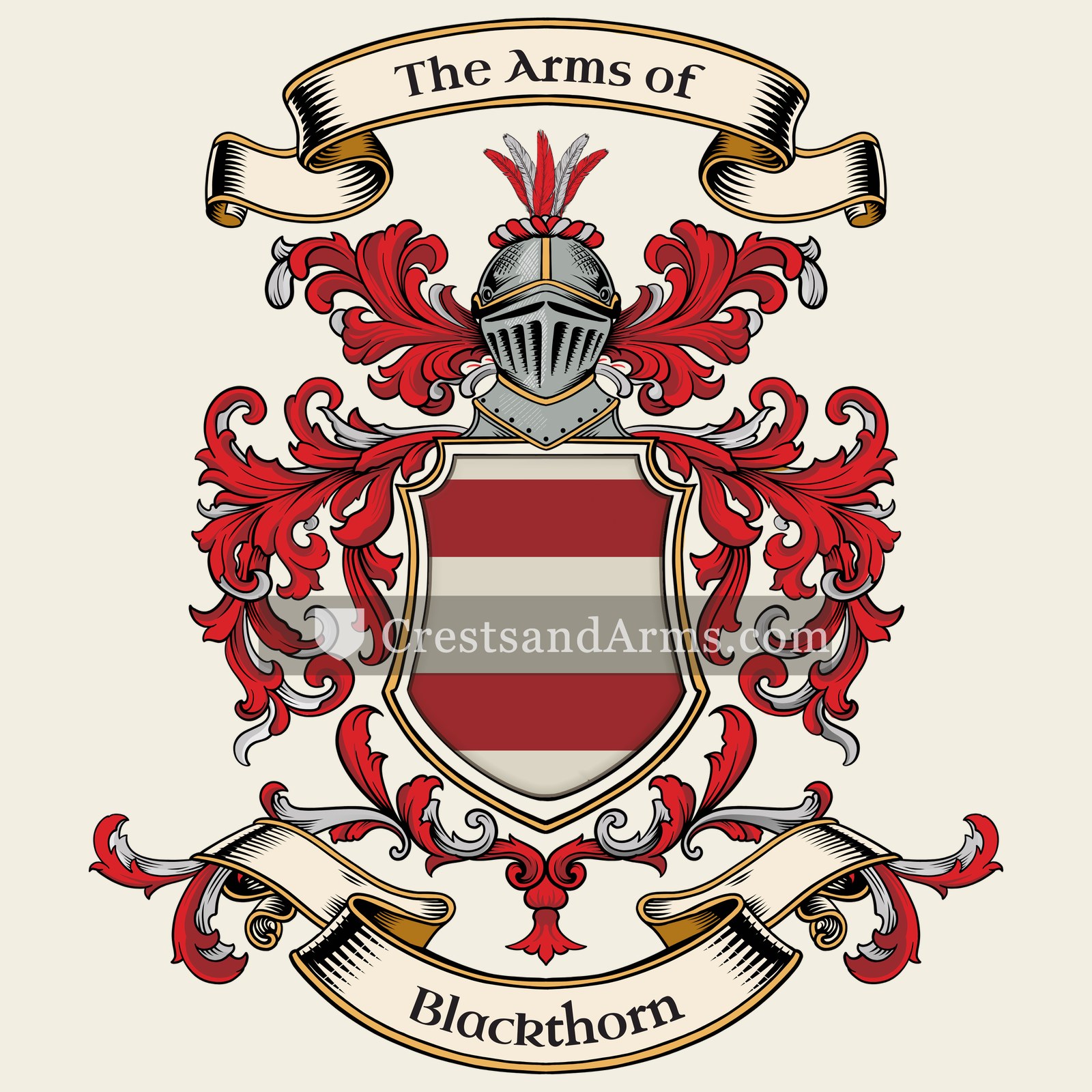
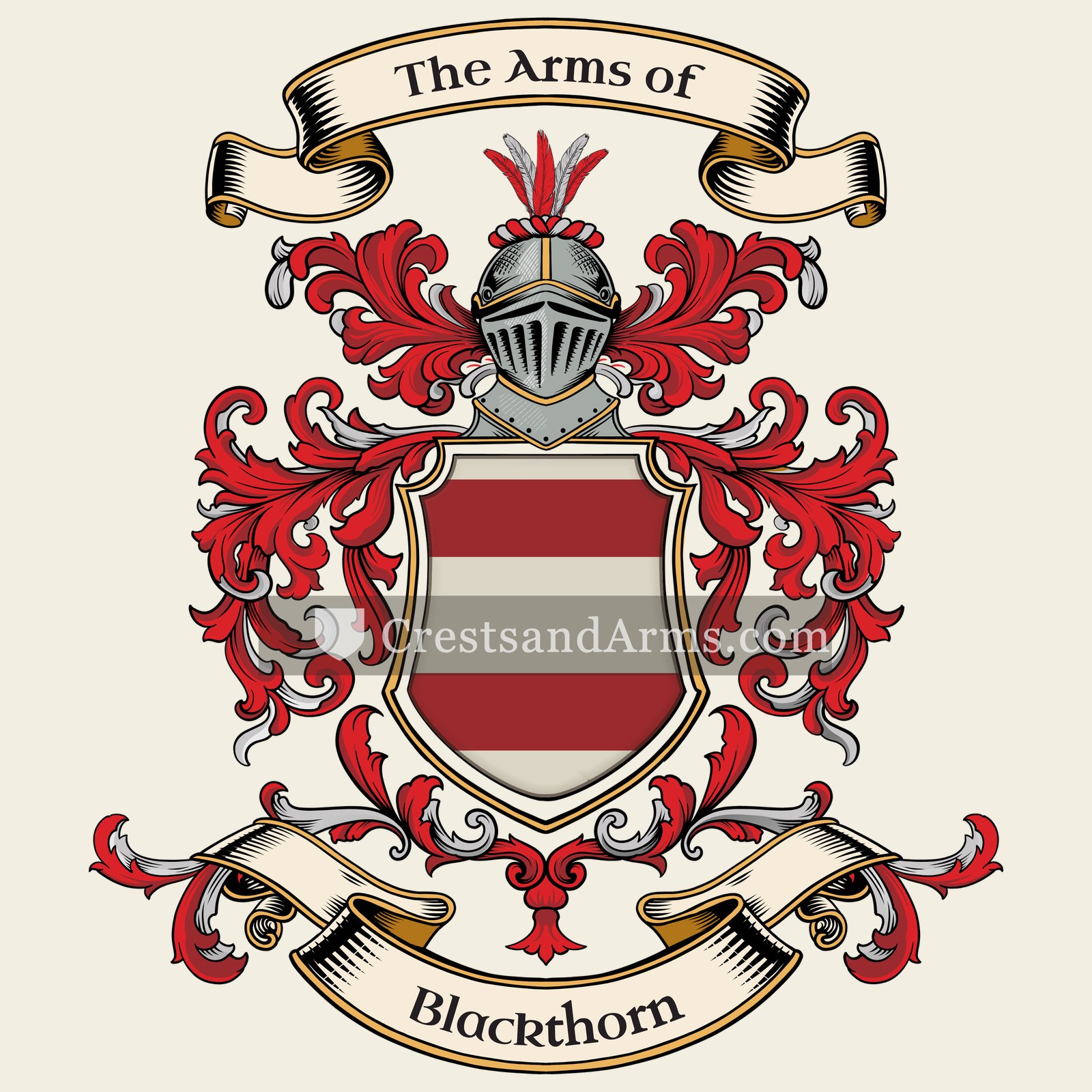
A record of documented arms, meaning and origin, researched for the Blackthorn family lines. Documented in 2 countries.
Reg. 4493 · Britain, A–C
Coat of Arms & Family Crest Details
Symbols on this shield
fessThe military belt, and readiness to serve
cockCourage, vigilance and readiness for battle
Colours
Silver (Argent)Means: Peace and sincerity
Red (Gules)Means: Military strength
Historical info
Source
J. B. Rietstap, Armorial Général, Gouda: G. B. van Goor Zonen, 1884–87
Blazon (the actual original written record)
“D'arg. à deux fasces de gu., acc. de trois coqs du même, rangés en chef. C.: un coq d'or [Armes du commentateur de la législation anglaise, sir William B.]”
BerkshireBerkshire, c. 1700
Digital archive packCoat of arms PNG, gold border print PDF, vector SVG and the certificate of authenticity. Sent to your email in minutes.
Map of Britain showing where the Blackthorn arms are recorded
The Blackthorn arms were recorded in Berkshire, c. 1700.
This is where the arms were entered in the register. Families often moved to other parts of the country, so the same name can turn up in more than one region.
The body that granted and recorded arms in Britain in this period.
William III of England
Sovereign of the period
William III of England
1694–1702
Reigning in Britain when the Blackthorn arms are first recorded.
How Arms Worked in Britain
English heraldry allowed arms to be shared by all legitimate descendants of the original owner. These symbols were treated as personal property that moved through the generations to all children. While the eldest son kept the original design, other family members could use the same shield without needing to change it or register their own unique versions.
Granting authority
The College of Arms in London has regulated the use of coats of arms throughout England and Wales since 1484.
How they got arms
Families typically obtained their coats of arms through a formal grant from the Crown or by proving their ancient right to them.
Where arms were recorded
All official coats of arms are recorded in the registers kept at the College of Arms, which date back to the fifteenth century.
The family's standing
Recorded among the armigerous families of Berkshire.
Origin & History of the Blackthorn Family in Britain
The surname Blackthorn is a classic example of a locative name, which means it was originally derived from a specific place in the landscape. In the early history of Britain, people often took the names of the fields, woods, or landmarks near their homes to distinguish themselves from others in their village. The name likely refers to a family that lived near a prominent thicket of blackthorn bushes, a hardy shrub common throughout the English countryside. By the year 1700, records confirm that members of the Blackthorn family were well-established in the county of Berkshire. During this period, families in rural areas were often closely tied to the land they worked, and the name served as a permanent reminder of their connection to the local geography. As the family grew and moved, the name traveled with them, preserving a link to the specific environment where their ancestors first settled.
Coat of Arms & Family Crest Details
Symbols on this shield
cockCourage, vigilance and readiness for battle
Colours
Silver (Argent)Means: Peace and sincerity
Red (Gules)Means: Military strength
Historical info
Source
Sir Bernard Burke, The General Armory of England, Scotland, Ireland and Wales, London: Harrison & Sons, 1884
Blazon (the actual original written record)
“Ar. two bars gu. in chief three cocks of the second”
BerksCastle Priory · Berks, c. 1620
Digital archive packCoat of arms PNG, gold border print PDF, vector SVG and the certificate of authenticity. Sent to your email in minutes.
Map of England showing where the Blackthorn arms are recorded
The Blackthorn arms were recorded in Berks, c. 1620.
Berkshire sat on the road west from London with the royal castle at Windsor in the middle of it. Court families bought estates within reach, and an estate near the court almost always came with a coat of arms.
This is where the arms were entered in the register. Families often moved to other parts of the country, so the same name can turn up in more than one region.
The body that granted and recorded arms in England in this period.
James VI and I
Sovereign of the period
James VI and I
1603–1625
Reigning in Britain when the Blackthorn arms are first recorded.
How Arms Worked in England
English heraldry allowed arms to be shared by all legitimate descendants of the original owner. These symbols were treated as personal property that moved through the generations to all children. While the eldest son kept the original design, other family members could use the same shield without needing to change it or register their own unique versions.
Granting authority
The College of Arms in London has regulated the use of coats of arms throughout England and Wales since 1484.
How they got arms
Families typically obtained their coats of arms through a formal grant from the Crown or by proving their ancient right to them.
Where arms were recorded
All official coats of arms are recorded in the registers kept at the College of Arms, which date back to the fifteenth century.
The family's standing
Recorded among the armigerous families of Berks.
Origin & History of the Blackthorn Family in England
The surname Blackthorn is a classic example of a locative name, which means it was originally taken from a specific place rather than a trade or a personal trait. Historical records confirm that the family was well-established in the county of Berkshire by 1620, likely residing in or near the village of Blackthorn. The name itself is derived from the Old English words for the dark, thorny shrub that grew in the local hedgerows and woodlands. In early English society, people often identified themselves by the landscape they inhabited, so a family living near a prominent cluster of these bushes would naturally become known as the Blackthorns. As these early ancestors moved through the rural parishes of Berkshire, the name became a permanent marker of their connection to the English countryside and their deep roots in the local community.
Related Branches & Arms
Root word
blaec and thorn
Old English for dark or black and a prickly shrub.
This name
BlackthornA topographic name for someone who lived near a prominent dark-colored hawthorn bush.
also spelled
Blackston
Blackstane
Blacksteyn
Documented Sources
J. B. Rietstap, Armorial Général, Gouda: G. B. van Goor Zonen, 1884–87
Bardsley, Charles Wareing, A Dictionary of English and Welsh Surnames, 1901
Reaney, P.H., A Dictionary of British Surnames, 1958
Berkshire Record Office, Parish Registers of Berkshire, 1700
Digital archive packCoat of arms PNG, gold border print PDF, vector SVG and the certificate of authenticity. Sent to your email in minutes.


 fessThe military belt, and readiness to serve
 cockCourage, vigilance and readiness for battle
 fessThe military belt, and readiness to serve
 cockCourage, vigilance and readiness for battle