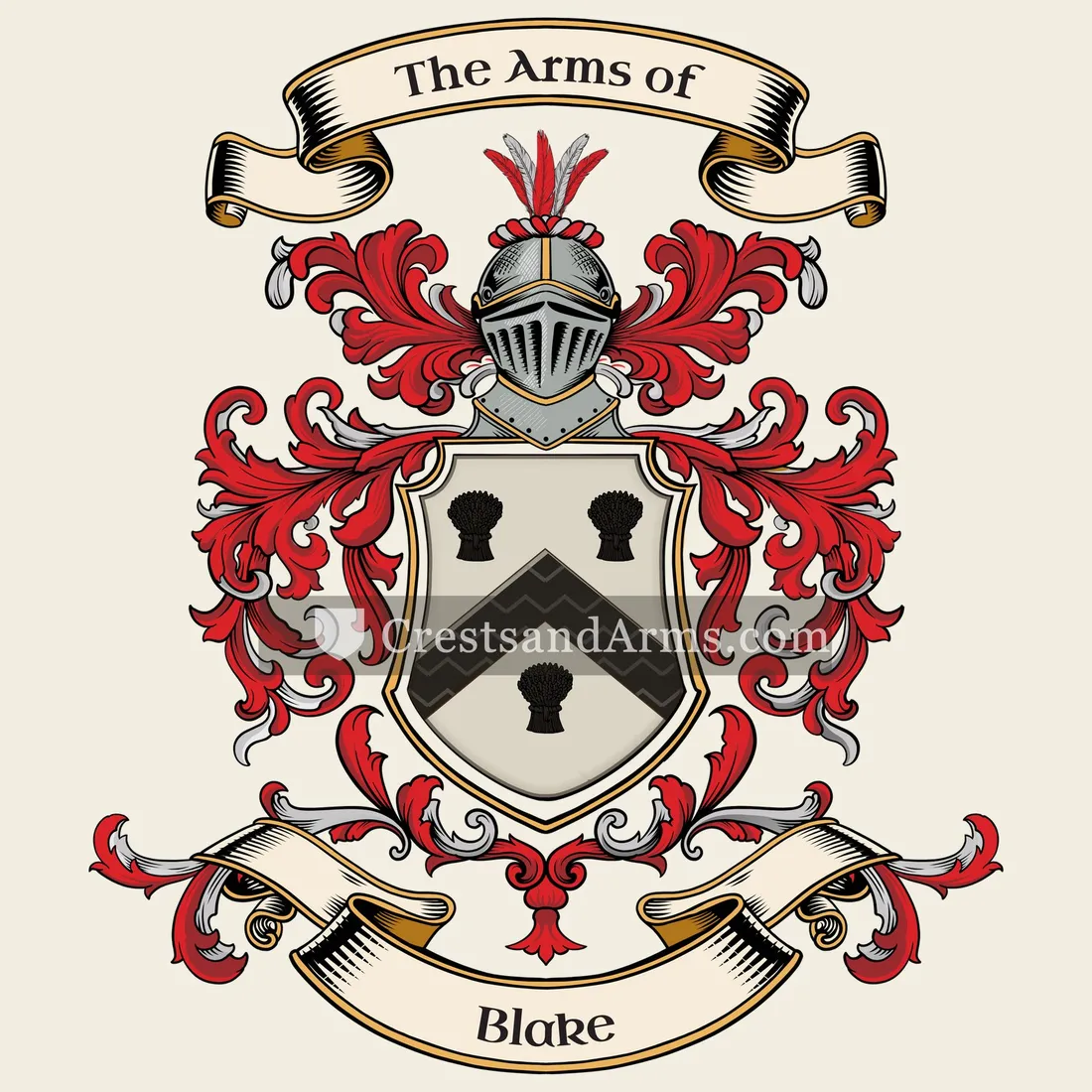
A record of documented arms, meaning and origin, researched for the Blake family lines. Documented in 3 countries.
Reg. 3410 · Britain, A–C
Meaning of the Blake family crest colors & symbols
Symbols on this shield
chevronProtection, and faithful service completed
wheatsheafPlenty, and the harvest of one's own labour
Colours
Silver (Argent)Means: Peace and sincerity
Black (Sable)Means: Constancy
Historical info
Source
J. B. Rietstap, Armorial Général, Gouda: G. B. van Goor Zonen, 1884–87
Blazon (the actual original written record)
“D'arg. au chev. de sa., acc. de trois gerbes du même. C.: un chapeau de tournoi de gu., retr. d'herm. sommé d'un martinet d'arg. [Armes du célèbre amiral Blake, mort en 1657.]”
Britainc. 1700
Digital archive packCoat of arms PNG, gold border print PDF, vector SVG and the certificate of authenticity. Sent to your email in minutes.
Map of Britain showing where the Blake arms are recorded
The Blake arms were recorded in Britain, c. 1700.
Arms such as these were typically recorded in Kent.
Kent sits between London and the short crossing to Europe, and the trade passing through made it wealthy. Merchant families bought land with that money, and it was landowners who took coats of arms.
This is where the arms were entered in the register. Families often moved to other parts of the country, so the same name can turn up in more than one region.
The body that granted and recorded arms in Britain in this period.
William III of England
Sovereign of the period
William III of England
1694–1702
Reigning in Britain when the Blake arms are first recorded.
How Arms Worked in Britain
English heraldry allowed arms to be shared by all legitimate descendants of the original owner. These symbols were treated as personal property that moved through the generations to all children. While the eldest son kept the original design, other family members could use the same shield without needing to change it or register their own unique versions.
Granting authority
The College of Arms in London has regulated the use of coats of arms throughout England and Wales since 1484.
How they got arms
Families typically obtained their coats of arms through a formal grant from the Crown or by proving their ancient right to them.
Where arms were recorded
All official coats of arms are recorded in the registers kept at the College of Arms, which date back to the fifteenth century.
The family's standing
Recorded among the armigerous families of Britain.
Origin & History of the Blake Family in Britain
The surname Blake has deep roots in the British Isles, emerging as a descriptive nickname long before it became a formal family name. In Old English, the word *blæc* could mean either dark or fair, which often led to the name being applied to people with either very dark hair or very light, pale complexions. By the time the name became established in the county of Kent around 1700, families bearing this title were often deeply integrated into the local agricultural and merchant communities. During this period, the name was frequently recorded in parish registers as families moved through the rural landscapes of southern England. These early Blakes were typically common laborers or tradespeople who helped shape the local economy of the region. Their history reflects the broader movement of English families who transitioned from using simple descriptive labels to passing down fixed surnames through generations.
Meaning of the Blake family crest colors & symbols
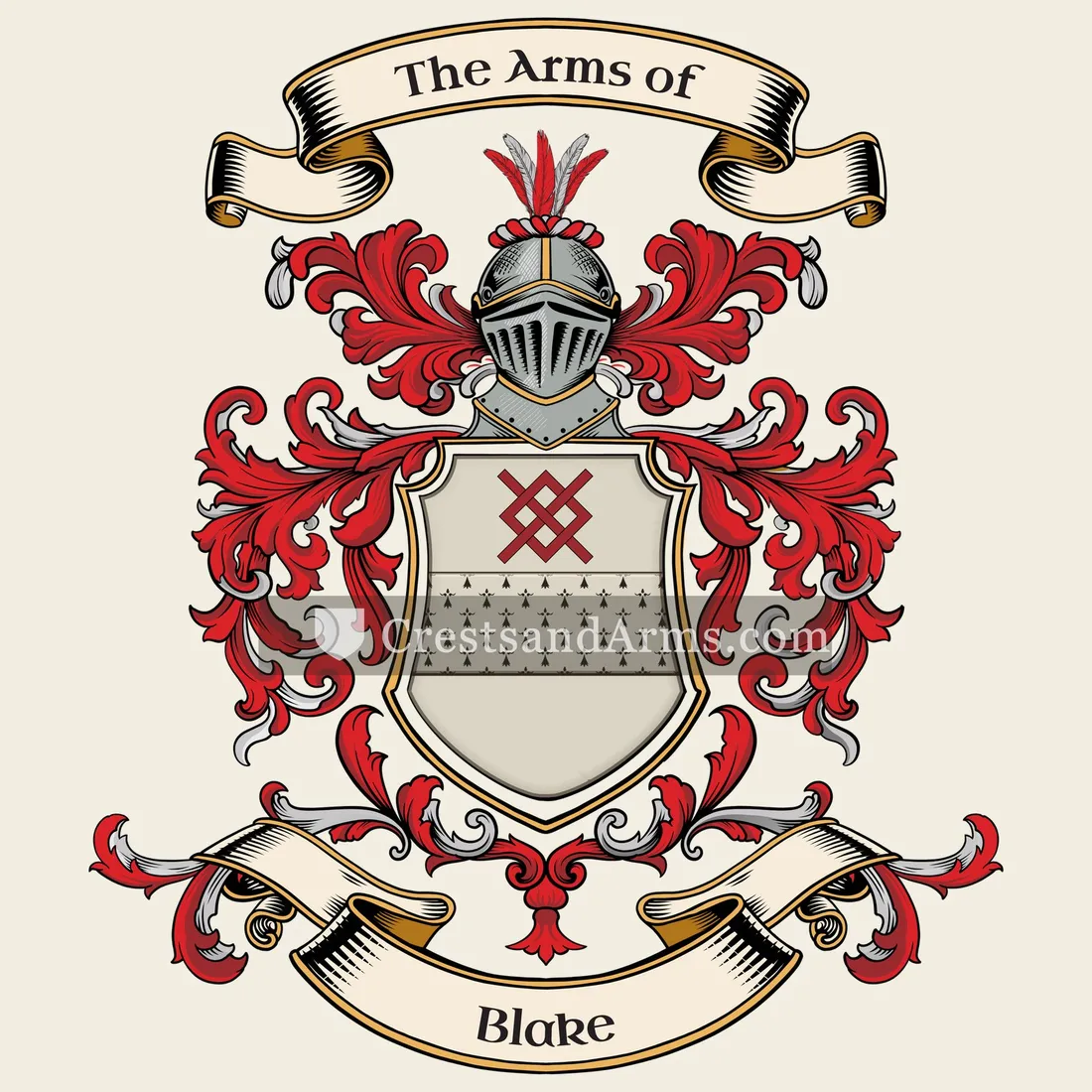
Symbols on this shield
fessThe military belt, and readiness to serve
fretPersuasion, and the net that holds
Colours
Silver (Argent)Means: Peace and sincerity
ErmineMeans: Dignity
Red (Gules)Means: Military strength
Historical info
Source
Sir Bernard Burke, The General Armory of England, Scotland, Ireland and Wales, London: Harrison & Sons, 1884
Blazon (the actual original written record)
“Ar. a fret gu. over all a fess erm”
GalwayMenlough · Galway, c. 1645
Digital archive packCoat of arms PNG, gold border print PDF, vector SVG and the certificate of authenticity. Sent to your email in minutes.
Map of Ireland showing where the Blake arms are recorded
The Blake arms were recorded in Galway, c. 1645.
Galway was western Irish country of poor land and a rich port. A small group of merchant families ran the town for centuries and held estates around it, and both kinds of property carried arms.
This is where the arms were entered in the register. Families often moved to other parts of the country, so the same name can turn up in more than one region.
The body that granted and recorded arms in Ireland in this period.
Charles I of England
Sovereign of the period
Charles I of England
1625–1649
Reigning in Britain when the Blake arms are first recorded.
How Arms Worked in Ireland
The Ulster King of Arms granted coats of arms to individuals who proved their social standing and good character. These symbols were typically inherited by all legitimate descendants of the original holder. If a family branch wanted a unique look, they could apply for a specific change to their design through the office to ensure their identity remained distinct.
Granting authority
The Ulster King of Arms acted as the official body that regulated and issued all coats of arms throughout Ireland.
How they got arms
Families obtained their arms through formal grants issued by the office after proving their eligibility and paying the required fees.
Where arms were recorded
All official grants were recorded in the registers held by the Ulster King of Arms starting from the year 1552.
The family's standing
Recorded among the armigerous families of Galway.
Origin & History of the Blake Family in Ireland
The Blake family name in Ireland is most famously associated with the "Tribes of Galway," a group of fourteen merchant families who dominated the political and economic life of the city for centuries. While the name has roots in England, the Irish branch became firmly established in the west of Ireland during the medieval period. By the time of the mid-seventeenth century, the Blakes were deeply entrenched in the social fabric of Galway, holding significant land and influence. In 1645, the family was well-known as a powerful merchant dynasty that helped shape the city as a major trading hub. They maintained these positions of authority through strategic marriages and successful business ventures that connected Ireland to markets across Europe. Even as political tensions rose in Ireland during the 1600s, the Blakes remained a central force in the governance and development of Galway.
Meaning of the Blake family crest colors & symbols
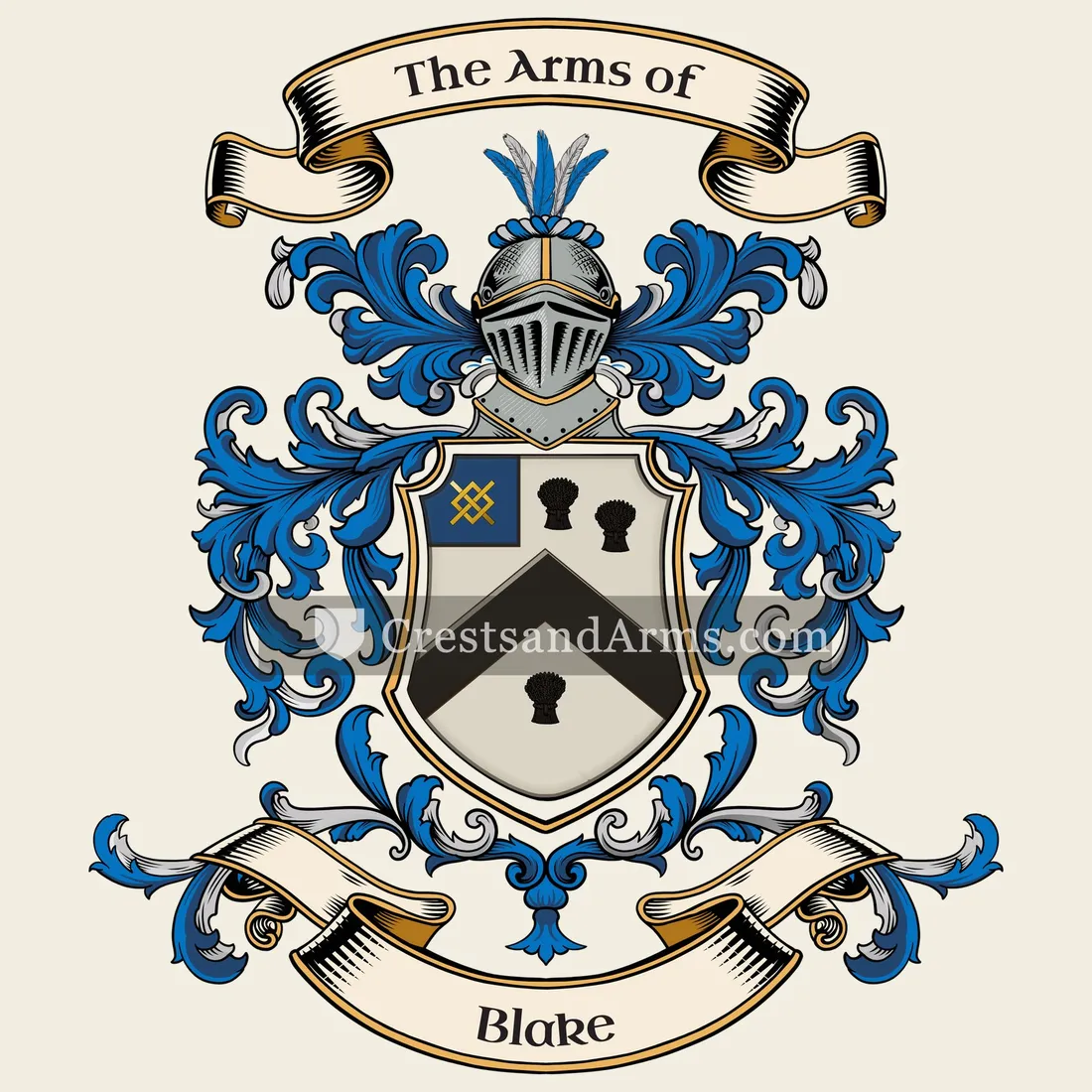
Symbols on this shield
chevronProtection, and faithful service completed
cantonA mark of honour granted by the sovereign
wheatsheafPlenty, and the harvest of one's own labour
fretPersuasion, and the net that holds
Colours
Silver (Argent)Means: Peace and sincerity
Black (Sable)Means: Constancy
Blue (Azure)Means: Loyalty and truth
Gold (Or)Means: Generosity
Historical info
Source
Sir Bernard Burke, The General Armory of England, Scotland, Ireland and Wales, London: Harrison & Sons, 1884
Blazon (the actual original written record)
“Ar. a chev. betw. three garbs sa. on a canton az. a fret or”
DurhamTwisel House · Durham, c. 1620
Digital archive packCoat of arms PNG, gold border print PDF, vector SVG and the certificate of authenticity. Sent to your email in minutes.
Map of England showing where the Blake arms are recorded
The Blake arms were recorded in Durham, c. 1620.
Durham was governed by its bishop rather than the crown for most of its history, with its own courts and its own landed class. That separate world produced a tight group of families, nearly all of whom held arms.
This is where the arms were entered in the register. Families often moved to other parts of the country, so the same name can turn up in more than one region.
The body that granted and recorded arms in England in this period.
James VI and I
Sovereign of the period
James VI and I
1603–1625
Reigning in Britain when the Blake arms are first recorded.
How Arms Worked in England
English heraldry allowed arms to be shared by all legitimate descendants of the original owner. These symbols were treated as personal property that moved through the generations to all children. While the eldest son kept the original design, other family members could use the same shield without needing to change it or register their own unique versions.
Granting authority
The College of Arms in London has regulated the use of coats of arms throughout England and Wales since 1484.
How they got arms
Families typically obtained their coats of arms through a formal grant from the Crown or by proving their ancient right to them.
Where arms were recorded
All official coats of arms are recorded in the registers kept at the College of Arms, which date back to the fifteenth century.
The family's standing
Recorded among the armigerous families of Durham.
Origin & History of the Blake Family in England
The surname Blake has deep roots in the English language, originating from the Old English word *blæc*, which could mean either dark or fair depending on the specific dialect and era. By the time the family was firmly established in Durham by 1620, the name had already been in use for several centuries across various parts of England. Early ancestors often lived in northern regions where they were likely involved in local trade or agriculture. During the seventeenth century, families in Durham were often shaped by the industrial growth of the area, particularly the coal mining and shipping industries that defined the North East. As the name spread through different counties, it became a common identifier for families who were deeply integrated into the local parish life and the changing social structures of early modern England.
Blake Meaning & Related Branches
Root word
blæc
Old English word meaning dark or black in color.
This name
BlakeA descriptive surname originally denoting someone with a dark complexion or dark hair.
also spelled
Blaike
Blayk
Blak
Blaik
Blayke
Related arms
Blackvariant spelling
Blackevariant spelling
Bleakevariant spelling
Batchelorrecorded with Blake, same area
Documented Sources
J. B. Rietstap, Armorial Général, Gouda: G. B. van Goor Zonen, 1884–87
Reaney, P.H., A Dictionary of English Surnames, 1991
Cottle, Basil, The Penguin Dictionary of Surnames, 1967
The National Archives, Parish registers of Kent, series RG 4
Digital archive packCoat of arms PNG, gold border print PDF, vector SVG and the certificate of authenticity. Sent to your email in minutes.


 chevronProtection, and faithful service completed
 wheatsheafPlenty, and the harvest of one's own labour
 chevronProtection, and faithful service completed
 wheatsheafPlenty, and the harvest of one's own labour


 fessThe military belt, and readiness to serve
 fretPersuasion, and the net that holds


 cantonA mark of honour granted by the sovereign