Map of Britain showing where the Blakiston arms are recorded
The Blakiston arms were recorded in Londres, c. 1763.
Arms such as these were typically recorded in Kent.
Kent sits between London and the short crossing to Europe, and the trade passing through made it wealthy. Merchant families bought land with that money, and it was landowners who took coats of arms.
This is where the arms were entered in the register. Families often moved to other parts of the country, so the same name can turn up in more than one region.
The body that granted and recorded arms in Britain in this period.
George III of Great Britain
Sovereign of the period
George III of Great Britain
1760–1801
Reigning in Britain when the Blakiston arms are first recorded.
How Arms Worked in Britain
English heraldry allowed arms to be shared by all legitimate descendants of the original owner. These symbols were treated as personal property that moved through the generations to all children. While the eldest son kept the original design, other family members could use the same shield without needing to change it or register their own unique versions.
Granting authority
The College of Arms in London has regulated the use of coats of arms throughout England and Wales since 1484.
How they got arms
Families typically obtained their coats of arms through a formal grant from the Crown or by proving their ancient right to them.
Where arms were recorded
All official coats of arms are recorded in the registers kept at the College of Arms, which date back to the fifteenth century.
The family's standing
Recorded among the armigerous families of Britain.
Origin & History of the Blakiston Family in Britain
The family name Blakiston originates from the northern regions of England, specifically taking its name from a manor located in the County of Durham. Historical records suggest that the name is topographical in nature, likely derived from the Old English words for a dark or black stone. While the family established deep roots in the north during the medieval period, members of the lineage eventually migrated across the country to seek new opportunities. By the mid-eighteenth century, historical documentation confirms that the family had established a presence in the county of Kent by 1763. This movement reflects the broader patterns of internal migration in Britain, where families often relocated from their ancestral northern estates to the southern counties to engage in trade, agriculture, or professional life.
Coat of Arms & Family Crest Details
Symbols on this shield
cockCourage, vigilance and readiness for battle
Colours
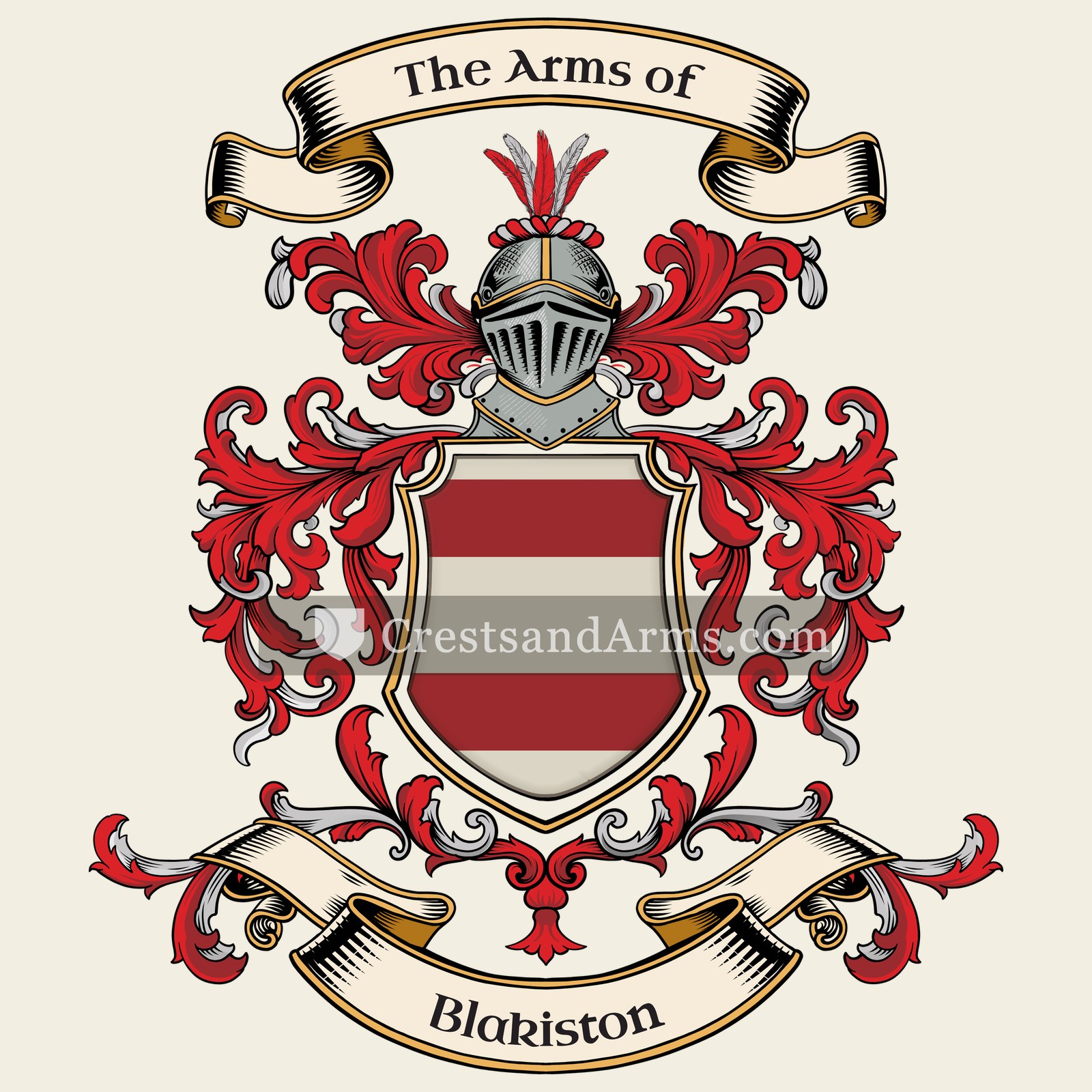
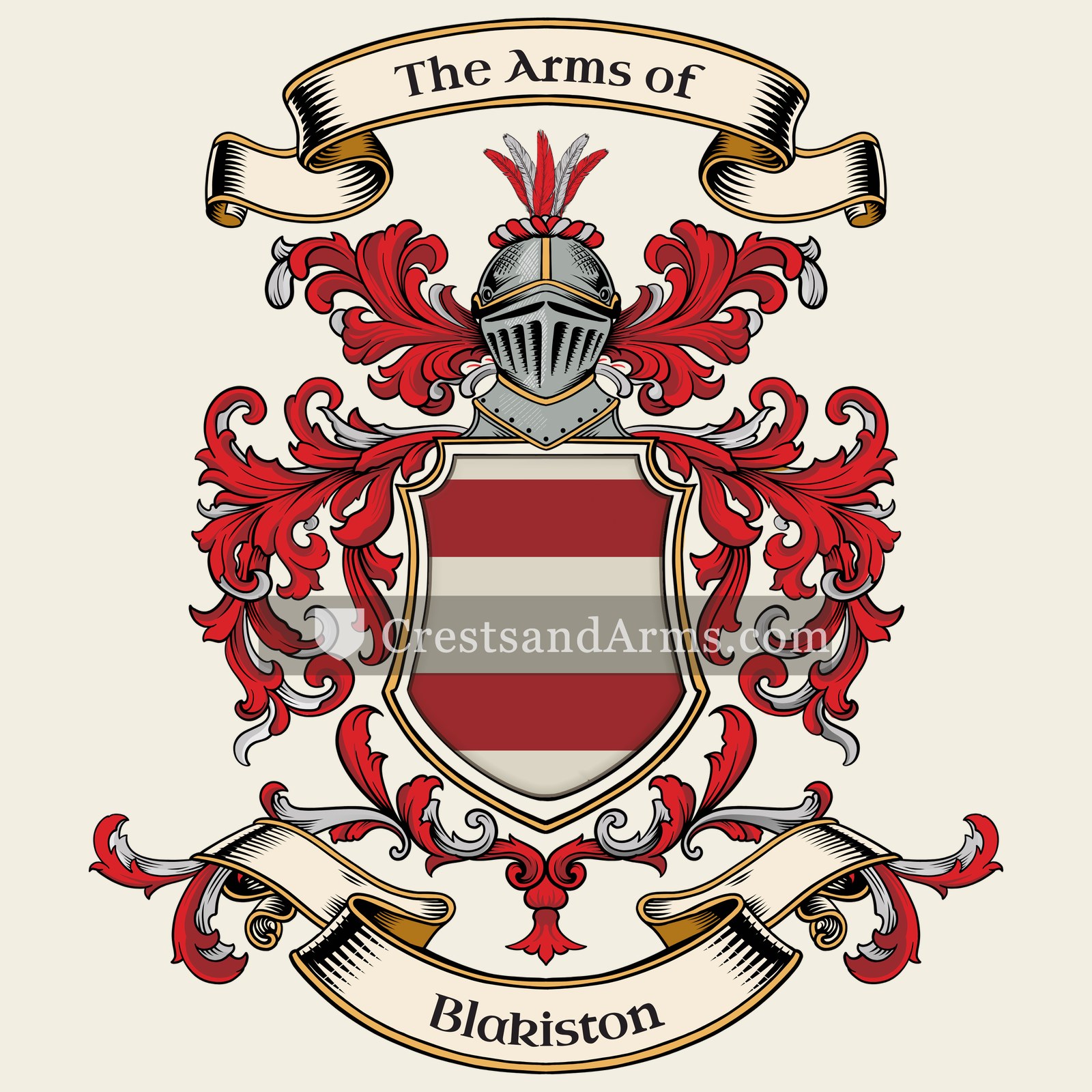
Silver (Argent)Means: Peace and sincerity
Red (Gules)Means: Military strength
Historical info
Source
Sir Bernard Burke, The General Armory of England, Scotland, Ireland and Wales, London: Harrison & Sons, 1884
Blazon (the actual original written record)
“Ar. two bars and in chief three cocks gu”
DurhamBlakiston · Durham, c. 1620
Digital archive packCoat of arms PNG, gold border print PDF, vector SVG and the certificate of authenticity. Sent to your email in minutes.
Map of England showing where the Blakiston arms are recorded
The Blakiston arms were recorded in Durham, c. 1620.
Durham was governed by its bishop rather than the crown for most of its history, with its own courts and its own landed class. That separate world produced a tight group of families, nearly all of whom held arms.
This is where the arms were entered in the register. Families often moved to other parts of the country, so the same name can turn up in more than one region.
The body that granted and recorded arms in England in this period.
James VI and I
Sovereign of the period
James VI and I
1603–1625
Reigning in Britain when the Blakiston arms are first recorded.
How Arms Worked in England
English heraldry allowed arms to be shared by all legitimate descendants of the original owner. These symbols were treated as personal property that moved through the generations to all children. While the eldest son kept the original design, other family members could use the same shield without needing to change it or register their own unique versions.
Granting authority
The College of Arms in London has regulated the use of coats of arms throughout England and Wales since 1484.
How they got arms
Families typically obtained their coats of arms through a formal grant from the Crown or by proving their ancient right to them.
Where arms were recorded
All official coats of arms are recorded in the registers kept at the College of Arms, which date back to the fifteenth century.
The family's standing
Recorded among the armigerous families of Durham.
Origin & History of the Blakiston Family in England
The Blakiston family name originates from the County of Durham in Northern England, where the family established deep roots by the early seventeenth century. The name itself is locative, derived from the manor of Blakiston located in the parish of Norton. During the 1600s, the family became prominent members of the local gentry and played active roles in the regional government and religious life of the North East. Their history is closely tied to the landscape of Durham, as the family held significant land and influence in the area for generations. By the year 1620, the Blakistons were well-established figures who navigated the complex social and political shifts of the Stuart era while maintaining their ancestral connection to the Durham countryside.
Blakiston Meaning & Related Branches
Root word
Blaec-tun
Old English for dark or black settlement or enclosure.
This name
BlakistonDerived from a locational surname referring to a dark-colored farmstead or village.
also spelled
Blakeston
Blakistone
Blackiston
Related arms
Blackstonesimilar arms
Documented Sources
J. B. Rietstap, Armorial Général, Gouda: G. B. van Goor Zonen, 1884–87
Surtees, Robert. The History and Antiquities of the County Palatine of Durham. 1816
The National Archives. Records of the Prerogative Court of Canterbury, PROB 11. 1763
Digital archive packCoat of arms PNG, gold border print PDF, vector SVG and the certificate of authenticity. Sent to your email in minutes.


 fessThe military belt, and readiness to serve
 cockCourage, vigilance and readiness for battle
 fessThe military belt, and readiness to serve
 cockCourage, vigilance and readiness for battle