Map of Britain showing where the Blamer arms are recorded
The Blamer arms were recorded in Britain, c. 1700.
Arms such as these were typically recorded in Kent.
Kent sits between London and the short crossing to Europe, and the trade passing through made it wealthy. Merchant families bought land with that money, and it was landowners who took coats of arms.
This is where the arms were entered in the register. Families often moved to other parts of the country, so the same name can turn up in more than one region.
The body that granted and recorded arms in Britain in this period.
William III of England
Sovereign of the period
William III of England
1694–1702
Reigning in Britain when the Blamer arms are first recorded.
How Arms Worked in Britain
English heraldry allowed arms to be shared by all legitimate descendants of the original owner. These symbols were treated as personal property that moved through the generations to all children. While the eldest son kept the original design, other family members could use the same shield without needing to change it or register their own unique versions.
Granting authority
The College of Arms in London has regulated the use of coats of arms throughout England and Wales since 1484.
How they got arms
Families typically obtained their coats of arms through a formal grant from the Crown or by proving their ancient right to them.
Where arms were recorded
All official coats of arms are recorded in the registers kept at the College of Arms, which date back to the fifteenth century.
The family's standing
Recorded among the armigerous families of Britain.
Origin & History of the Blamer Family in Britain
The family name Blamer first appears in the historical record of Kent during the early eighteenth century, a time when the region was defined by its bustling agricultural trade and proximity to the English Channel. While the name is relatively rare, its presence in Kent suggests that the family likely belonged to the class of independent farmers or skilled tradespeople who supported the local economy. During the 1700s, Kent was a hub for hop growing and maritime commerce, and families like the Blamers were often deeply rooted in their parish communities. Parish registers from this era indicate that these early members were active participants in local life, frequently appearing in church records for baptisms and marriages. By settling in this specific part of England, the family became part of a long tradition of local craftsmanship and rural labor that helped shape the character of the county. Their history reflects the quiet stability of English life during the Georgian period, where families often remained in the same villages for generations to work the land and contribute to the growth of their local towns.
Coat of Arms & Family Crest Details
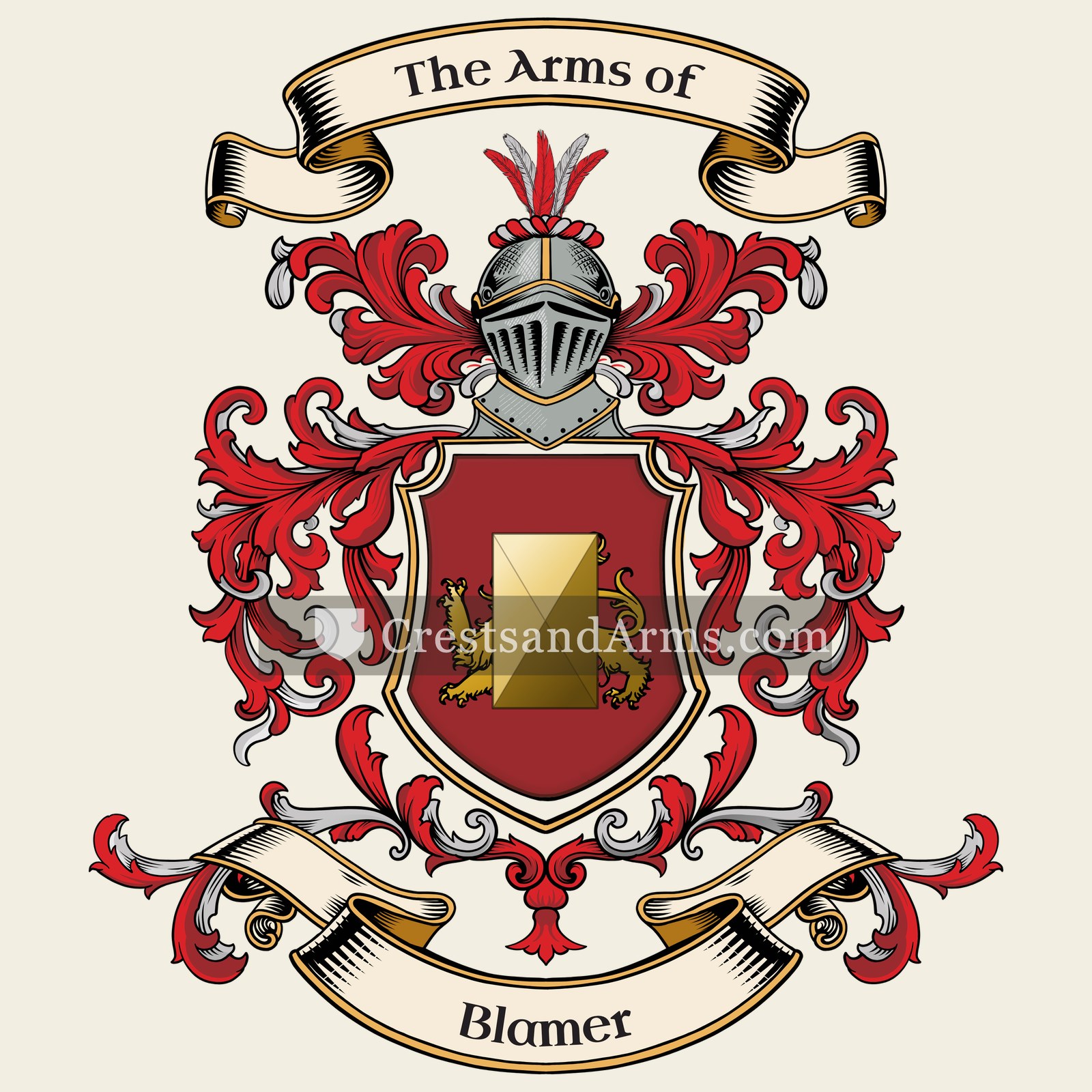
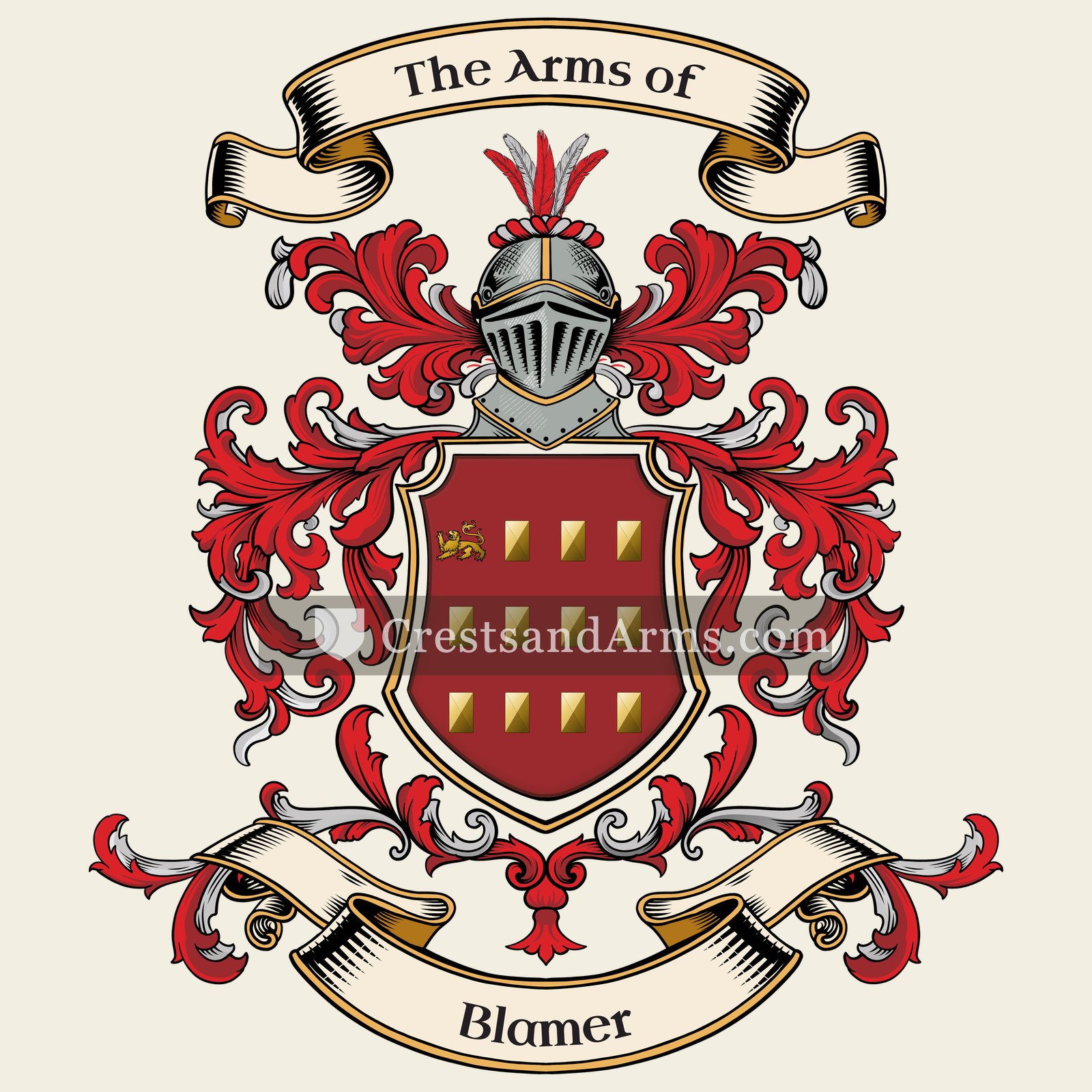
Symbols on this shield
lionCourage, strength and royalty
billetThe sealed letter, and a message delivered
Colours
Red (Gules)Means: Military strength
Gold (Or)Means: Generosity
Historical info
Source
Sir Bernard Burke, The General Armory of England, Scotland, Ireland and Wales, London: Harrison & Sons, 1884
Blazon (the actual original written record)
“Gu. a lion ramp. betw. twelve billets or”
Englandc. 1342
Digital archive packCoat of arms PNG, gold border print PDF, vector SVG and the certificate of authenticity. Sent to your email in minutes.
Map of England showing where the Blamer arms are recorded
The Blamer arms were recorded in England, c. 1342.
Arms such as these were typically recorded in York.
Yorkshire is the largest of the English counties, and it held more gentry families than any other. Land there was split among a great many households rather than a few, so a great many of them carried arms.
This is where the arms were entered in the register. Families often moved to other parts of the country, so the same name can turn up in more than one region.
The body that granted and recorded arms in England in this period.
Edward III of England
Sovereign of the period
Edward III of England
1327–1377
Reigning in Britain when the Blamer arms are first recorded.
How Arms Worked in England
English heraldry allowed arms to be shared by all legitimate descendants of the original owner. These symbols were treated as personal property that moved through the generations to all children. While the eldest son kept the original design, other family members could use the same shield without needing to change it or register their own unique versions.
Granting authority
The College of Arms in London has regulated the use of coats of arms throughout England and Wales since 1484.
How they got arms
Families typically obtained their coats of arms through a formal grant from the Crown or by proving their ancient right to them.
Where arms were recorded
All official coats of arms are recorded in the registers kept at the College of Arms, which date back to the fifteenth century.
The family's standing
Recorded among the armigerous families of England.
Origin & History of the Blamer Family in England
The family name Blamer has deep roots in the northern English city of York, where records confirm members of the family were living as early as 1342. During the fourteenth century, York was a major center for trade and craftsmanship, and families like the Blamers often settled there to participate in the growing urban economy. The name itself likely originated as a descriptive label or a nickname, which was a common practice for identifying individuals before the widespread use of formal surnames. As the family established themselves in the region, they became part of the local social fabric during a time of significant change in England. By living in a prominent city like York, the early Blamers were positioned in a hub of commerce and administration that allowed them to leave behind the historical traces that researchers study today.
Related Branches & Arms
Root word
blame
derived from the Old French word blasmer meaning to reproach or criticize
This name
Blameran occupational or descriptive surname referring to a person known for being critical or fault-finding
also spelled
Bulmar
Documented Sources
J. B. Rietstap, Armorial Général, Gouda: G. B. van Goor Zonen, 1884–87
Kent History and Library Centre, Parish Registers of the Diocese of Canterbury
The National Archives, The Genealogist's Guide to Parish Records
Hasted, Edward, The History and Topographical Survey of the County of Kent, 1797
Digital archive packCoat of arms PNG, gold border print PDF, vector SVG and the certificate of authenticity. Sent to your email in minutes.


 lionCourage, strength and royalty
 billetThe sealed letter, and a message delivered
 lionCourage, strength and royalty
 billetThe sealed letter, and a message delivered