Map of France showing where the Blanc arms are recorded
The Blanc arms were recorded in Normandie, c. 1663.
Normandie held a dense crowd of knightly families on some of the best farmland in France. Its men had fought and settled abroad for generations, and a family that sent sons to war needed a shield they could be recognised by.
This is where the arms were entered in the register. Families often moved to other parts of the country, so the same name can turn up in more than one region.
The body that granted and recorded arms in France in this period.
Louis XIV of France
Sovereign of the period
Louis XIV of France
1643–1715
Reigning in France when the Blanc arms are first recorded.
How Arms Worked in France
In France, a coat of arms was a mark of honor that passed down through the male line to all legitimate descendants. Families often used the same shield without changes to show their shared heritage. If a branch wanted to stand out, they could add a small mark to their shield to show their specific place in the family tree.
Granting authority
The Juge d'armes de France acted as the official authority that regulated and verified coats of arms across the country.
How they got arms
Families typically inherited their arms from ancestors, though they could also receive them through royal grants or by proving their noble status.
Where arms were recorded
Coats of arms were officially recorded in the Armorial Général de France, which began its main collection in the year 1696.
The family's standing
Recorded among the armigerous families of Normandie.
Origin & History of the Blanc Family in France
The surname Blanc is a classic example of a descriptive name that emerged from the linguistic roots of medieval France. Derived from the Old French word for white, the name was originally used as a nickname to describe someone with fair hair, a pale complexion, or perhaps someone who wore light-colored clothing. By the time the family was firmly established in the region of Normandy in 1663, the name had already transitioned from a simple descriptor into a formal hereditary surname passed down through generations. During this period, the Blanc family lived within a society that was rapidly organizing its record-keeping, as the French monarchy sought to better track its subjects for tax and military purposes. Living in Normandy during the seventeenth century placed the family in a region known for its strong agricultural traditions and its deep connection to the maritime history of the English Channel. As the family grew, they became part of the local social fabric, contributing to the rural and provincial life that defined northern France long before the modern era.
Meaning of the Blanc family crest colors & symbols
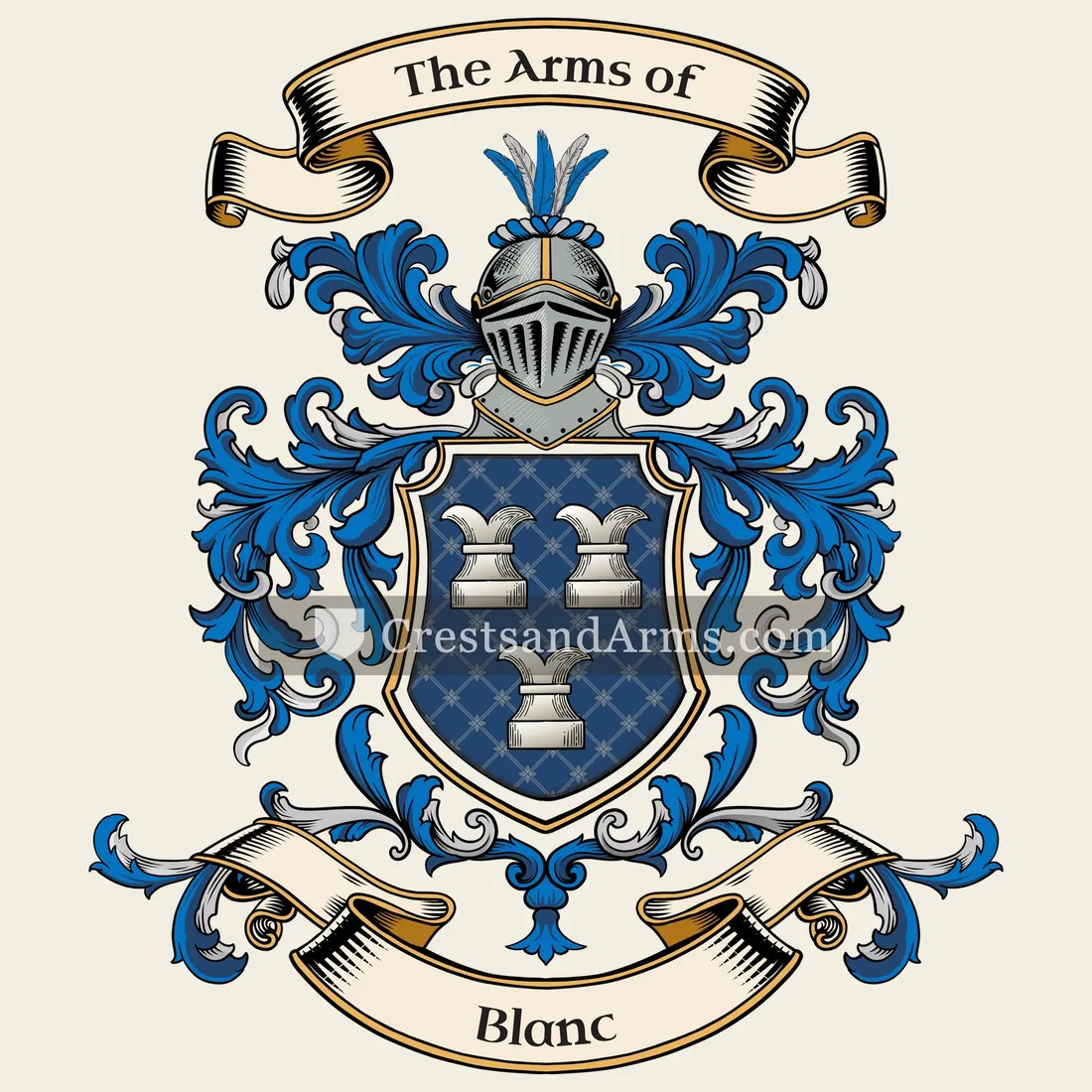
Symbols on this shield
chess rookStrategy, and the defence of a position
Colours
Blue (Azure)Means: Loyalty and truth
Silver (Argent)Means: Peace and sincerity
Historical info
Source
J. B. Rietstap, Armorial Général, Gouda: G. B. van Goor Zonen, 1884–87
Blazon (the actual original written record)
“D'azur à trois fers de pique d'arg., etc., lisez: D'azur à trois rocs d'échiquier d'arg., etc., et ajoutez à la fin: C.: le lion iss., cour. d'or.”
Switzerlandc. 1745
Digital archive packCoat of arms PNG, gold border print PDF, vector SVG and the certificate of authenticity. Sent to your email in minutes.
Map of Switzerland showing where the Blanc arms are recorded
The Blanc arms were recorded in Switzerland, c. 1745.
Arms such as these were typically recorded in Bern.
Bern was the largest of the Swiss cantons and ran itself, with its own council and its own courts. Its governing families held office for generations, and office of that kind carried a shield with it.
This is where the arms were entered in the register. Families often moved to other parts of the country, so the same name can turn up in more than one region.
The body that granted and recorded arms in Switzerland in this period.
How Arms Worked in Switzerland
In Switzerland, coats of arms were not restricted to the nobility and were often adopted by common citizens and families. These symbols were passed down through generations to show family identity. When branches of a family grew, they often changed small details of the design to distinguish their own line from the original group.
Granting authority
Cantonal and civic authorities managed the use of coats of arms within their specific regions and local jurisdictions.
How they got arms
Families typically assumed their own coats of arms based on local custom rather than receiving them from a central monarch.
Where arms were recorded
Arms were recorded in various cantonal and civic registers starting from the fourteenth century throughout the Swiss region.
The family's standing
Recorded among the armigerous families of Switzerland.
Origin & History of the Blanc Family in Switzerland
The surname Blanc is a classic example of a descriptive name that originated in the French-speaking regions of Europe before spreading into neighboring areas like Switzerland. In the context of the Swiss Confederation, the name likely functioned as a nickname for a person with fair hair or a pale complexion. By the time members of the family were documented in the city of Bern in 1745, the name had already established itself as a fixture within the local social structure. During this period, Bern was a powerful city-state where families often held specific roles in trade, agriculture, or civic administration. The presence of the Blanc family in Bern during the mid-eighteenth century suggests they were part of the steady movement of people across linguistic borders within Switzerland. As they settled into the urban environment of Bern, they became integrated into a society that valued record-keeping and community stability. This transition from a descriptive nickname to a formal family name reflects the broader patterns of migration and identity formation that shaped the Swiss population over many centuries.
Blanc Meaning & Related Branches
Root word
blancus
A Late Latin term meaning white or fair-haired.
This name
BlancA descriptive nickname for someone with a pale complexion or light-colored hair.
also spelled
Blanck
Blanch
Blanq
Blan
Blank
Related arms
Jordansimilar arms
Kempesimilar arms
Kleinsimilar arms
Documented Sources
J. B. Rietstap, Armorial Général, Gouda: G. B. van Goor Zonen, 1884–87
Dauzat, Albert. Dictionnaire étymologique des noms et prénoms de France. 1951
Morlet, Marie-Thérèse. Dictionnaire étymologique des noms de famille. 1991
Archives départementales de la Seine-Maritime. Registres paroissiaux et d'état civil. 1663
Digital archive packCoat of arms PNG, gold border print PDF, vector SVG and the certificate of authenticity. Sent to your email in minutes.


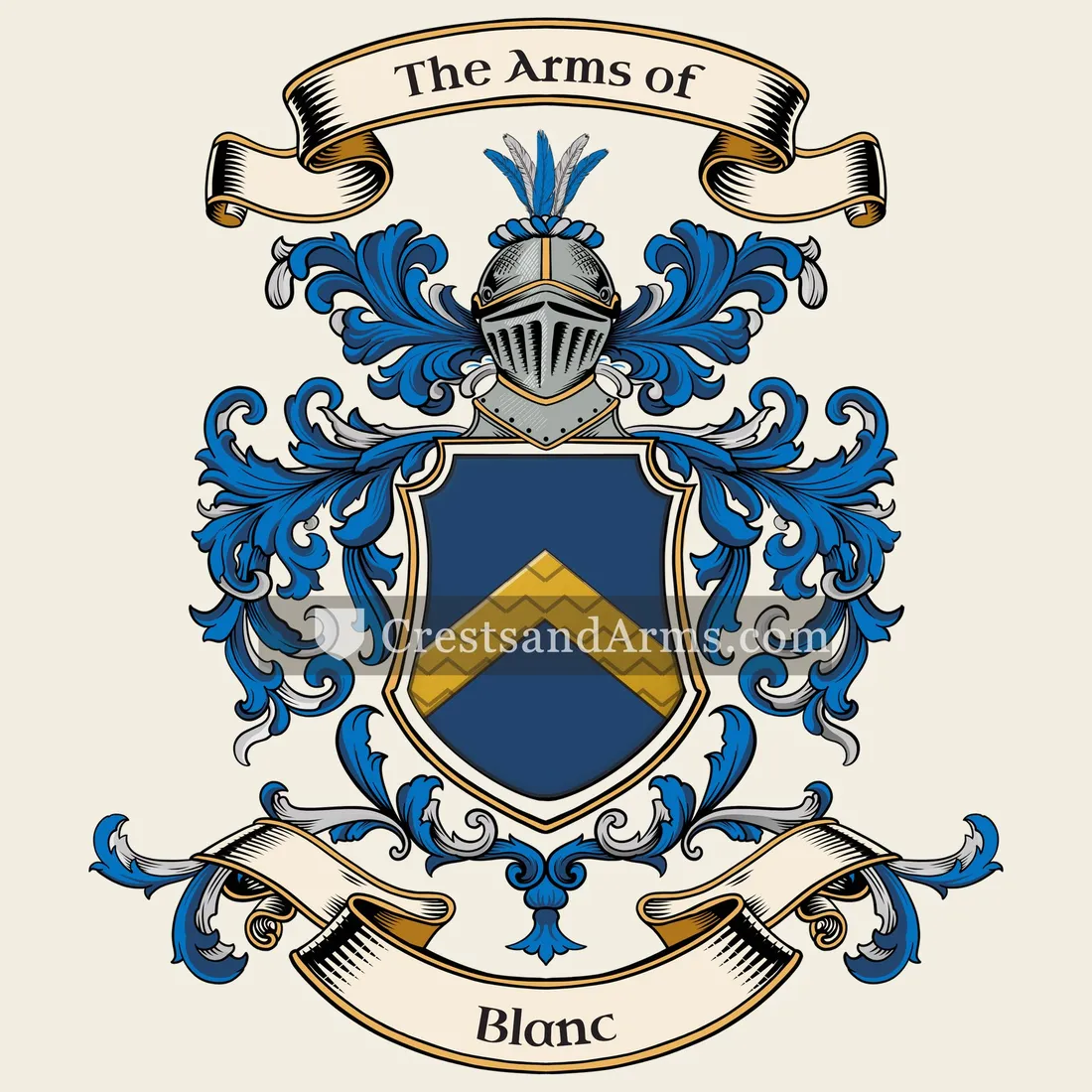
 chevronProtection, and faithful service completed
 chevronProtection, and faithful service completed


 chess rookStrategy, and the defence of a position