Map of Austria showing where the Blanco arms are recorded
The Blanco arms were recorded in Austria, c. 1772.
Arms such as these were typically recorded in Tyrol.
Tyrol was mountain country in western Austria, where the valleys were held by families who had been there a very long time. Old tenure counted for more than money, and old families carried arms.
This is where the arms were entered in the register. Families often moved to other parts of the country, so the same name can turn up in more than one region.
Region
Tyrol
First recorded
1772
Granting Authority for the Blanco Arms
Imperial and Royal chancery
Sodacan · CC BY-SA 3.0
The body that granted and recorded arms in Austria in this period.
Joseph II, Holy Roman Emperor
Sovereign of the period
Joseph II, Holy Roman Emperor
1765–1790
Reigning in Austria when the Blanco arms are first recorded.
How Arms Worked in Austria
Austrian coats of arms were often linked directly to noble titles granted by the Emperor. These symbols belonged to the entire family line rather than just one individual. When a family grew, new branches kept the original design without needing to change it. This system allowed all members of a noble house to share the same identity across many generations.
Granting authority
The Imperial and Royal chancery managed all heraldic matters and controlled the official granting of arms throughout the Austrian lands.
How they got arms
Families typically received their arms through a formal imperial decree that often accompanied the elevation of a person to noble status.
Where arms were recorded
Official records of these grants were kept in the Imperial Register of Nobility which began its formal documentation process in 1453.
The family's standing
Recorded among the armigerous families of Austria.
Origin & History of the Blanco Family in Austria
The surname Blanco is primarily of Spanish origin, functioning as a descriptive nickname derived from the word for white. Historically, this name was often given to individuals with fair hair or a pale complexion, distinguishing them from others within a community. While the name is deeply rooted in the Iberian Peninsula, its presence in the Tyrol region by 1772 suggests a fascinating history of migration and cultural integration. During the eighteenth century, families frequently moved across European borders for trade, military service, or agricultural opportunities. By settling in the mountainous landscape of Tyrol, members of the Blanco family adapted to a new linguistic and social environment while maintaining their ancestral identity. This transition highlights how a simple descriptive name could travel across vast distances, eventually becoming established in regions far from its original linguistic home.
Blanco Meaning & Related Branches
Root word
Blancus
A Latin adjective meaning white, fair, or light-colored.
This name
BlancoRefers to a person with a fair complexion, light hair, or white clothing.
also spelled
Blancoo
Blancoe
Blanko
Documented Sources
J. B. Rietstap, Armorial Général, Gouda: G. B. van Goor Zonen, 1884–87
Hankes, Patrick, Dictionary of American Family Names, 2003


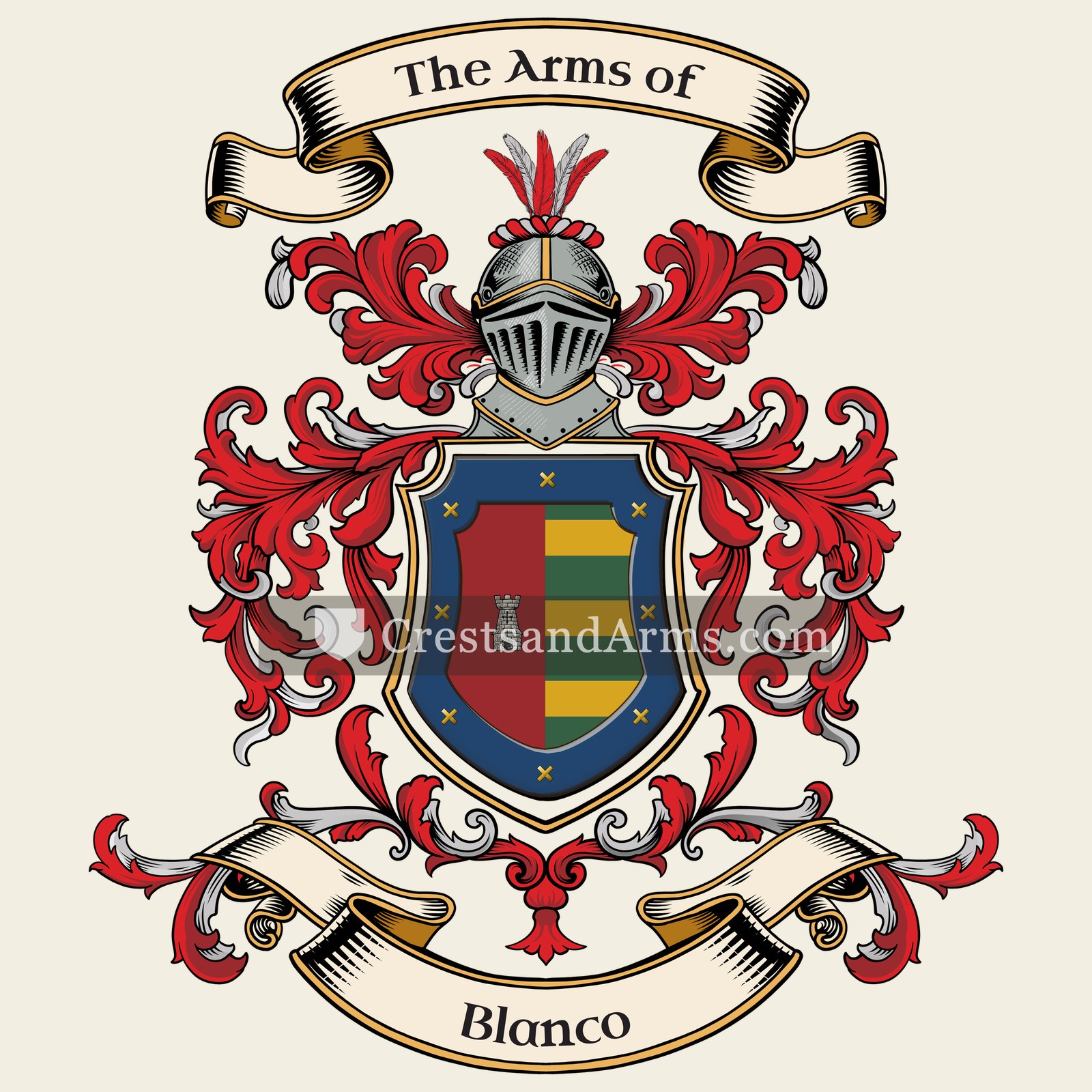
 saltire coupedResolution, and the cross of St Andrew
 towerGrandeur and solidity, and a stronghold defended
 saltire coupedResolution, and the cross of St Andrew
 towerGrandeur and solidity, and a stronghold defended