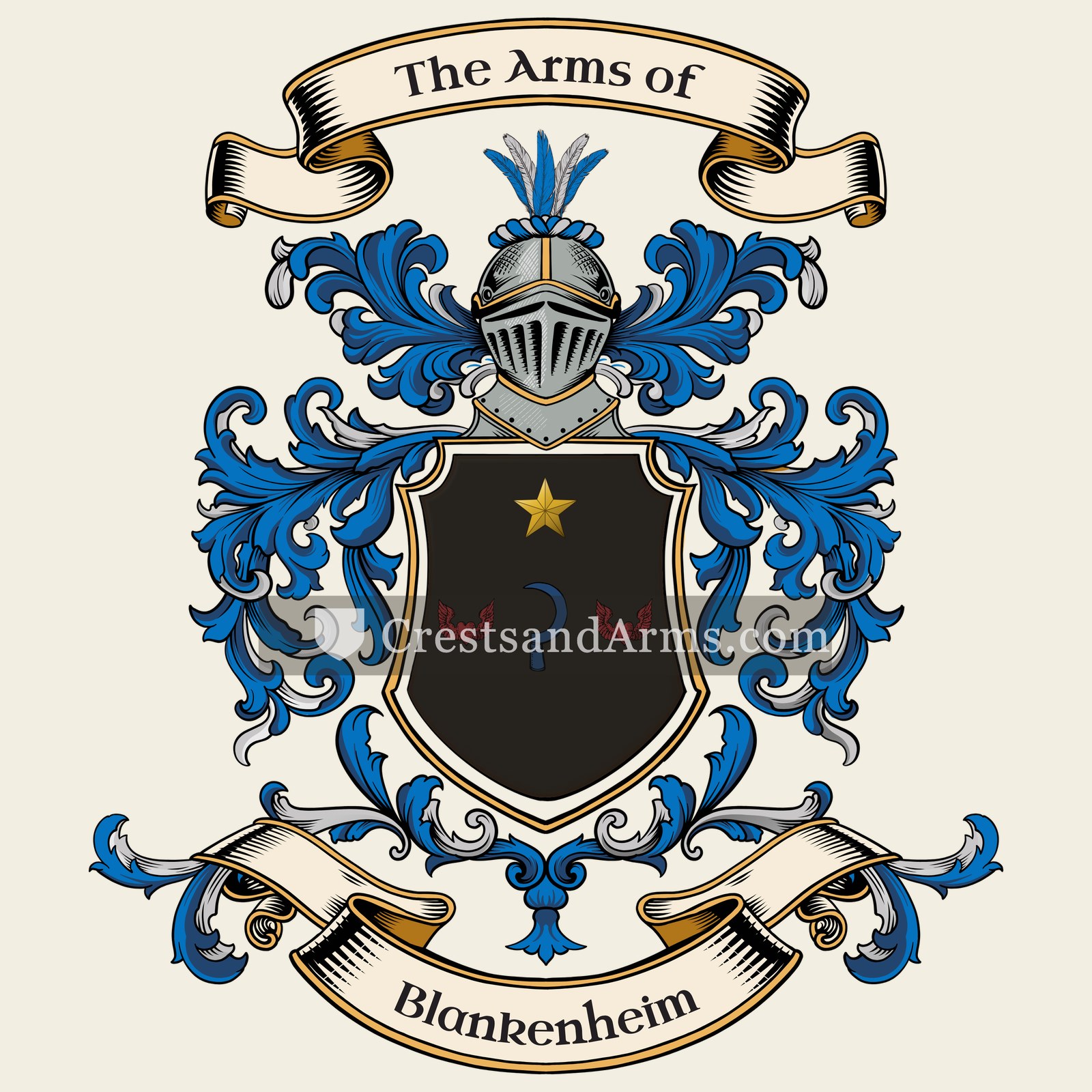
A record of documented arms, meaning and origin, researched for the Blankenheim family of Germany.
Reg. 6741 · German, A–C
Coat of Arms & Family Crest Details
Symbols on this shield
sickleThe harvest, and the reaping of what was sown
mulletThe third son, and a divine quality from above
heartSincerity, charity and true affection
Colours
Black (Sable)Means: Constancy
Blue (Azure)Means: Loyalty and truth
Gold (Or)Means: Generosity
Red (Gules)Means: Military strength
Historical info
Source
J. B. Rietstap, Armorial Général, Gouda: G. B. van Goor Zonen, 1884–87
Blazon (the actual original written record)
“De sa. à une houe et un pic, tous deux d'azur, emm. d'or, passés en saut., acc. en chef d'une étoile d'or et accostés de deux coeurs de gu. C.: une tête de mort d'arg., supp. une tête de griffon de sa., cour. de gu.; le tout renfermé dans un annelet de sa., bordé d'or et ch. de trois coeurs de gu., 1 en chef et 2 en flancs. L.: à dextre d'or et de gu., à sen. d'arg. et de sa.”
GermanyGiessen, c. 1765
Digital archive packCoat of arms PNG, gold border print PDF, vector SVG and the certificate of authenticity. Sent to your email in minutes.
Map of Germany showing where the Blankenheim arms are recorded
The Blankenheim arms were recorded in Giessen, c. 1765.
This is where the arms were entered in the register. Families often moved to other parts of the country, so the same name can turn up in more than one region.
The body that granted and recorded arms in Germany in this period.
Francis I, Holy Roman Emperor
Sovereign of the period
Francis I, Holy Roman Emperor
1745–1765
Reigning in Germany when the Blankenheim arms are first recorded.
How Arms Worked in Germany
In the Holy Roman Empire, coats of arms were often granted to individuals by the Emperor or his representatives. These arms were then passed down through the generations to all legitimate descendants of the original holder. Younger branches of a family usually kept the same shield design without needing to change it, as the arms belonged to the entire lineage.
Granting authority
The Holy Roman Emperor held the sole power to grant new coats of arms throughout his vast imperial territories.
How they got arms
Families typically obtained their coats of arms through a formal imperial grant or by proving their noble status to the authorities.
Where arms were recorded
These grants were officially recorded in the Imperial Chancery registers, which began keeping formal records of such honors during the Middle Ages.
The family's standing
Recorded among the armigerous families of Germany.
Origin & History of the Blankenheim Family in Germany
The family name Blankenheim traces its roots to the regions surrounding the Rhine and the central German highlands. While the name is famously associated with a historic lordship in the Eifel mountains, families carrying this surname eventually spread into various German territories, including the region of Hesse. By 1765, records confirm that members of the Blankenheim family were established in the city of Giessen. During this era, families in Giessen were often deeply integrated into the local guild systems or agricultural life of the university town. The name itself is topographic in origin, likely derived from the combination of the German words for white and home or enclosure, suggesting that the earliest ancestors may have lived near a prominent white stone structure or a distinctively light-colored clearing in the forest. As the family moved into urban centers like Giessen, they contributed to the steady growth of the local population during a period of significant social and economic transition in central Germany.
Blankenheim Meaning & Related Branches
Root word
blank and heim
white or bare and a home, settlement, or village
This name
Blankenheimrefers to a settlement located on bare or white land
also spelled
Blankenheimm
Blankenheime
Blankenhime
Related arms
Blankenheymvariant spelling
Documented Sources
J. B. Rietstap, Armorial Général, Gouda: G. B. van Goor Zonen, 1884–87
Hessisches Staatsarchiv Marburg, Kirchenbücher der Stadt Gießen (1765)
Stadtarchiv Gießen, Bürgeraufnahmen und Einwohnerverzeichnisse
Bahlow, Hans, Deutsches Namenlexikon: Familien- und Vornamen nach Ursprung und Sinn erklärt, 1972
Gottschald, Max, Deutsche Namenkunde: Unsere Familiennamen, 1971
Digital archive packCoat of arms PNG, gold border print PDF, vector SVG and the certificate of authenticity. Sent to your email in minutes.


 sickleThe harvest, and the reaping of what was sown
 mulletThe third son, and a divine quality from above
 heartSincerity, charity and true affection
 sickleThe harvest, and the reaping of what was sown
 mulletThe third son, and a divine quality from above
 heartSincerity, charity and true affection