Map of Spain showing where the Blasko arms are recorded
The Blasko arms were recorded in Aragon, c. 1722.
Aragon was mountain and river country in north-eastern Spain, with a strong tradition of small independent landholders. A great many families counted as gentry there, and each one needed a shield to be told apart.
This is where the arms were entered in the register. Families often moved to other parts of the country, so the same name can turn up in more than one region.
The body that granted and recorded arms in Spain in this period.
Philip V of Spain
Sovereign of the period
Philip V of Spain
1714–1724
Reigning in Spain when the Blasko arms are first recorded.
How Arms Worked in Spain
In Spain, a coat of arms was considered a form of property that belonged to the entire family line. These arms were passed down from a father to all his children equally. Younger branches of the family usually kept the original design without needing to add any special marks to distinguish their specific line.
Granting authority
The Cronista Rey de Armas was the official body that regulated and granted coats of arms throughout Spain.
How they got arms
Families often obtained their arms through royal grants or by proving their noble status to the official heraldic authority.
Where arms were recorded
Coats of arms were officially recorded in the registers of the Cronista Rey de Armas starting in 1496.
The family's standing
Recorded among the armigerous families of Aragon.
Origin & History of the Blasko Family in Spain
The name Blasko, often spelled Blasco in its traditional Spanish form, finds its deep roots in the medieval history of the Iberian Peninsula. It is derived from the Basque name Belasko, which likely originated as a diminutive form of the word for raven. By the time the family was firmly established in the Kingdom of Aragon in 1722, they were part of a long lineage of people who had moved across northern Spain during the Middle Ages. These early families were often associated with the agricultural and administrative life of the Aragonese countryside. As the name spread through the region, it became linked to the local customs and social structures of the time. The presence of the family in 18th-century Aragon reflects a history of stability and integration within a society that was shaped by centuries of regional tradition and cultural exchange.
Coat of Arms & Family Crest Details
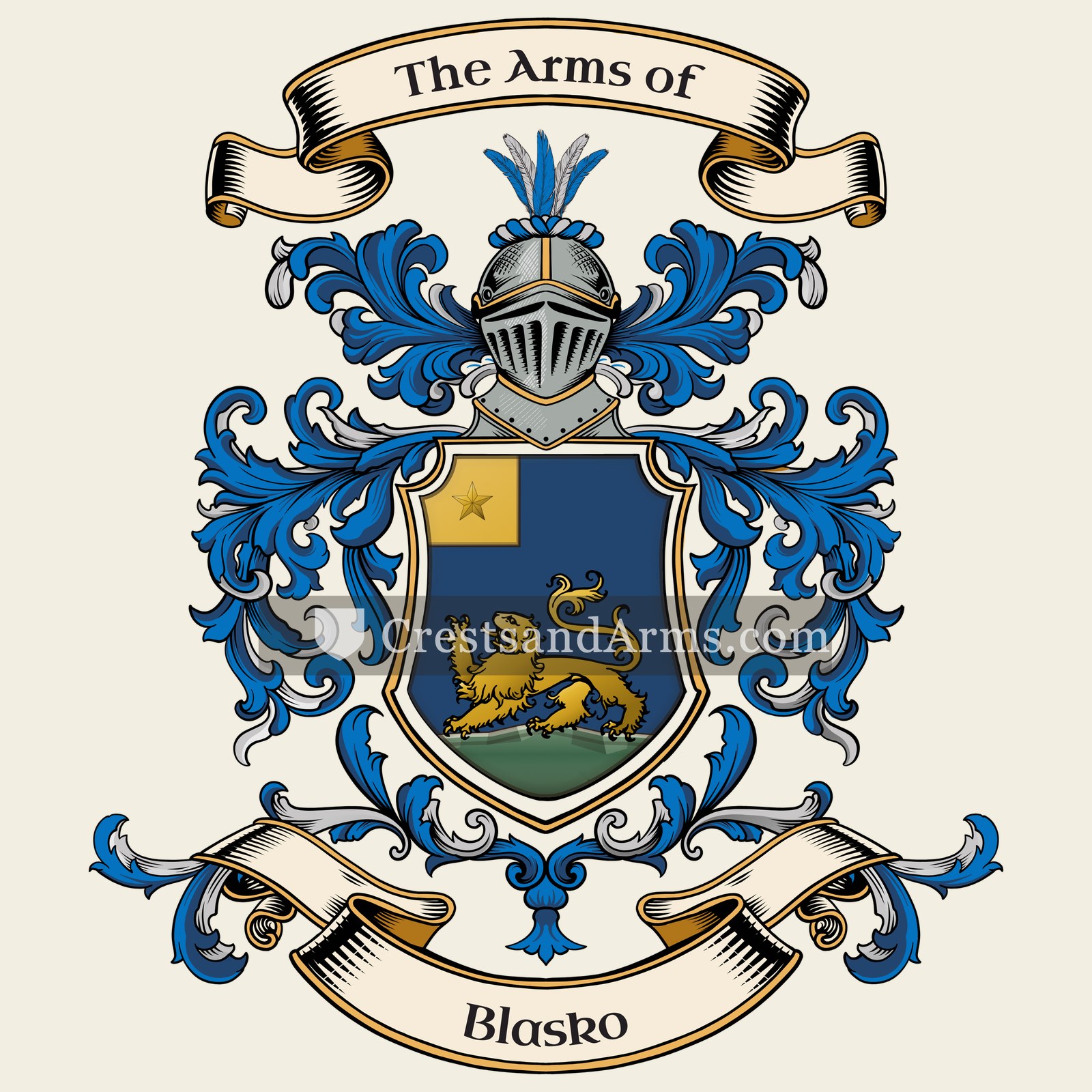
Symbols on this shield
mountThe ground held, and steadfastness upon it
cantonA mark of honour granted by the sovereign
lionCourage, strength and royalty
mulletThe third son, and a divine quality from above
Colours
Blue (Azure)Means: Loyalty and truth
Gold (Or)Means: Generosity
Green (Vert)Means: Hope
Historical info
Source
J. B. Rietstap, Armorial Général, Gouda: G. B. van Goor Zonen, 1884–87
Blazon (the actual original written record)
“D'azur au lion sautant et regardant d'or, soutenu d'une terrasse de sin., acc. au canton dextre du chef d'une étoile (8) du sec. C.: un lion iss. d'or.”
ItalyMilan, c. 1775
Digital archive packCoat of arms PNG, gold border print PDF, vector SVG and the certificate of authenticity. Sent to your email in minutes.
Map of Italy showing where the Blasko arms are recorded
The Blasko arms were recorded in Milan, c. 1775.
This is where the arms were entered in the register. Families often moved to other parts of the country, so the same name can turn up in more than one region.
The body that granted and recorded arms in Italy in this period.
Alvise Giovanni Mocenigo
Sovereign of the period
Alvise Giovanni Mocenigo
1763–1778
Reigning in Spain when the Blasko arms are first recorded.
How Arms Worked in Italy
In the Italian states, coats of arms were often used by noble families to show their status and history. These symbols were passed down through the generations to all legitimate male descendants. Younger branches of a family usually kept the original design but sometimes added small changes to distinguish their specific line from the main branch.
Granting authority
Various local rulers and city governments controlled the use of coats of arms across the different Italian states.
How they got arms
Families often assumed their own arms or received them as official grants from local lords, popes, or city councils.
Where arms were recorded
Arms were recorded in local city archives or private family books rather than in one single national register.
The family's standing
Recorded among the armigerous families of Italy.
Origin & History of the Blasko Family in Italy
The surname Blasko carries a rich history that reflects the movement of people across European borders, particularly within the cultural landscape of Northern Italy. By the late 18th century, the family was firmly established in the bustling city of Milan, a major center for trade and intellectual exchange during the Enlightenment. Records from 1775 confirm their presence in this region, suggesting that the family likely integrated into the local urban economy during a period of significant social transition under Austrian rule. While the name itself often points to Slavic roots, its adoption in Milan indicates a history of migration and assimilation, where families moved across the Alps to seek new opportunities in Italian city-states. These early ancestors were part of a diverse population that helped shape the modern identity of Milan, contributing to the city's growth as a hub for commerce and craftsmanship long before the unification of Italy.
Related Branches & Arms
Root word
Blasius
Latin name meaning stammering or lisping.
This name
BlaskoA Spanish patronymic surname derived from the name Blaise, signifying one who stammers.
also spelled
Blasko
Blasquo
Blascon
Documented Sources
J. B. Rietstap, Armorial Général, Gouda: G. B. van Goor Zonen, 1884–87
Michelena, Luis. Apellidos vascos. 1953
Pescador Medrano, Aitor. Los apellidos en Álava, Guipúzcoa y Vizcaya. 1999
Archivo de la Corona de Aragón. Censo de población de la Corona de Aragón. 1722
Digital archive packCoat of arms PNG, gold border print PDF, vector SVG and the certificate of authenticity. Sent to your email in minutes.


 bullValour and generosity
 bullValour and generosity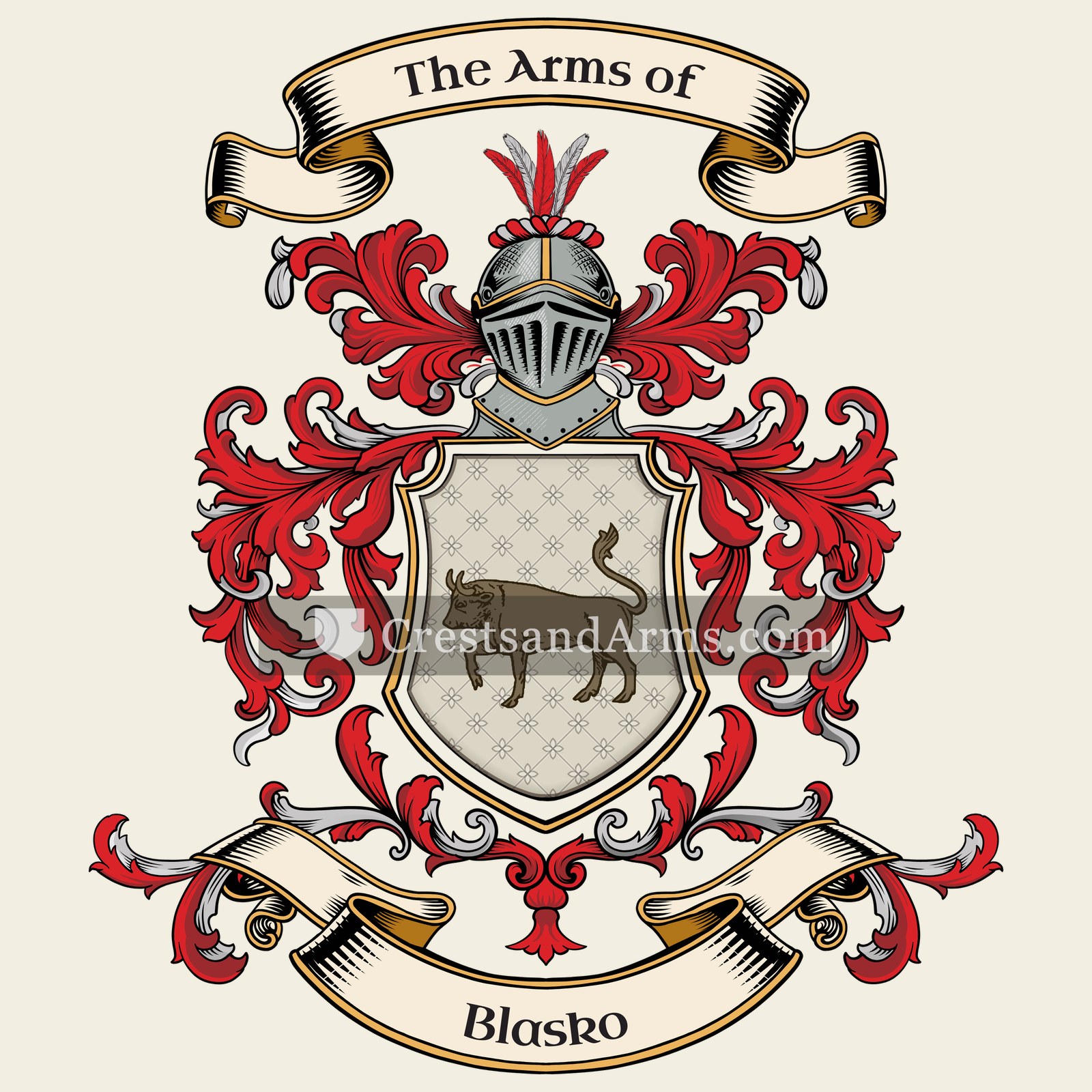


 mountThe ground held, and steadfastness upon it
 cantonA mark of honour granted by the sovereign
 lionCourage, strength and royalty
 mulletThe third son, and a divine quality from above