A record of documented arms, meaning and origin, researched for the Blau family lines. Documented in 3 countries.
Reg. 8559 · Dutch, A–C
Coat of Arms & Family Crest Details
Symbols on this shield
acornAntiquity and strength from small beginnings
bullValour and generosity
Colours
Blue (Azure)Means: Loyalty and truth
Gold (Or)Means: Generosity
Historical info
Source
J. B. Rietstap, Armorial Général, Gouda: G. B. van Goor Zonen, 1884–87
Blazon (the actual original written record)
“D'azur à deux glands effeuillés accostés d'or, les queues en bas, abaissés sous un rencontre de boeuf du même. C.: un senestrochère, arm. d'arg., le coude reposant sur le cq., tenant une épée d'arg., garnie d'or.”
Netherlandsc. 1815
Digital archive packCoat of arms PNG, gold border print PDF, vector SVG and the certificate of authenticity. Sent to your email in minutes.
Map of Netherlands showing where the Blau arms are recorded
The Blau arms were recorded in Netherlands, c. 1815.
Arms such as these were typically recorded in Friesland.
Friesland was low, wet country on the northern coast of the Netherlands, farmed by families who had held the same land for centuries. Free landholders were unusually common there, and a free landholder could carry arms.
This is where the arms were entered in the register. Families often moved to other parts of the country, so the same name can turn up in more than one region.
Region
Friesland
First recorded
1815
Granting Authority for the Blau Arms
Hoge Raad van Adel
Photograph made by me · CC BY-SA 3.0
The body that granted and recorded arms in Netherlands in this period.
William I of the Netherlands
Sovereign of the period
William I of the Netherlands
1815–1840
Reigning in Netherlands when the Blau arms are first recorded.
How Arms Worked in Netherlands
In the Netherlands, coats of arms were often used by noble families and those who held specific public offices. These arms were passed down through the generations to legitimate descendants. Younger branches of a family usually kept the original design without needing to add special marks. This system ensured that the family identity remained clear and consistent over many years.
Granting authority
The Hoge Raad van Adel is the official body that regulates and manages noble titles and coats of arms in the Netherlands.
How they got arms
Families typically obtained their coats of arms through official royal grants or by proving their long-standing historical use of the symbols.
Where arms were recorded
Coats of arms are officially recorded in the registers held by the Hoge Raad van Adel, which began its work in 1814.
The family's standing
Recorded among the armigerous families of Netherlands.
Origin & History of the Blau Family in Netherlands
The surname Blau is rooted in the descriptive naming traditions common throughout the Low Countries, where it likely originated as a nickname for someone with blue eyes, dark hair, or a penchant for wearing blue clothing. By the early 19th century, the family established a notable presence in the northern province of Friesland. This region was historically distinct due to its unique language and legal customs, which often encouraged families to maintain strong local ties across generations. In 1811, the French administration under Napoleon mandated that all Dutch citizens adopt fixed surnames for official civil registration. This requirement solidified the name Blau within the regional records, allowing historians to trace the family’s movement and professional activities through the provincial archives of the era. These early records suggest that the family integrated into the local agrarian and maritime economy, reflecting the broader social shifts occurring in the Netherlands during the transition from the Napoleonic period into the formation of the United Kingdom of the Netherlands in 1815.
Coat of Arms & Family Crest Details
Symbols on this shield
mountThe ground held, and steadfastness upon it
fleur de lisPurity, light, and the sixth son
mulletThe third son, and a divine quality from above
Colours
Blue (Azure)Means: Loyalty and truth
Green (Vert)Means: Hope
Gold (Or)Means: Generosity
Red (Gules)Means: Military strength
Historical info
Source
J. B. Rietstap, Armorial Général, Gouda: G. B. van Goor Zonen, 1884–87
Blazon (the actual original written record)
“D'azur à une fleur-de-lis d'or, acc. en chef de deux étoiles de gu. et en p. d'un tertre de sin. C.: la fleur-de-lis.”
SwitzerlandBerne, c. 1745
Digital archive packCoat of arms PNG, gold border print PDF, vector SVG and the certificate of authenticity. Sent to your email in minutes.
Map of Switzerland showing where the Blau arms are recorded
The Blau arms were recorded in Berne, c. 1745.
This is where the arms were entered in the register. Families often moved to other parts of the country, so the same name can turn up in more than one region.
The body that granted and recorded arms in Switzerland in this period.
How Arms Worked in Switzerland
In Switzerland, coats of arms were not restricted to the nobility and were often adopted by common citizens and families. These symbols were passed down through generations to show family identity. When branches of a family grew, they often changed small details of the design to distinguish their own line from the original group.
Granting authority
Cantonal and civic authorities managed the use of coats of arms within their specific regions and local jurisdictions.
How they got arms
Families typically assumed their own coats of arms based on local custom rather than receiving them from a central monarch.
Where arms were recorded
Arms were recorded in various cantonal and civic registers starting from the fourteenth century throughout the Swiss region.
The family's standing
Recorded among the armigerous families of Switzerland.
Origin & History of the Blau Family in Switzerland
The surname Blau has deep roots in Switzerland, where it functioned as a descriptive name for individuals living in the German-speaking regions. In the mid-eighteenth century, the family established a notable presence in the city of Berne, with records confirming their residency there by 1745. During this era, families with this name were often integrated into the local urban economy, working as tradespeople or craftsmen within the guild systems that defined Swiss city life. Because the name translates to the color blue, it likely originated as a nickname for someone who frequently wore blue clothing or perhaps worked as a dyer of fabrics. As the family grew in Berne, they became part of the long-standing tradition of Swiss citizenship, which was highly regulated and tied to specific municipalities. By settling in such a prominent administrative hub, the Blau family participated in the social and political evolution of the Swiss Confederation during a time of significant transition.
Coat of Arms & Family Crest Details
Symbols on this shield
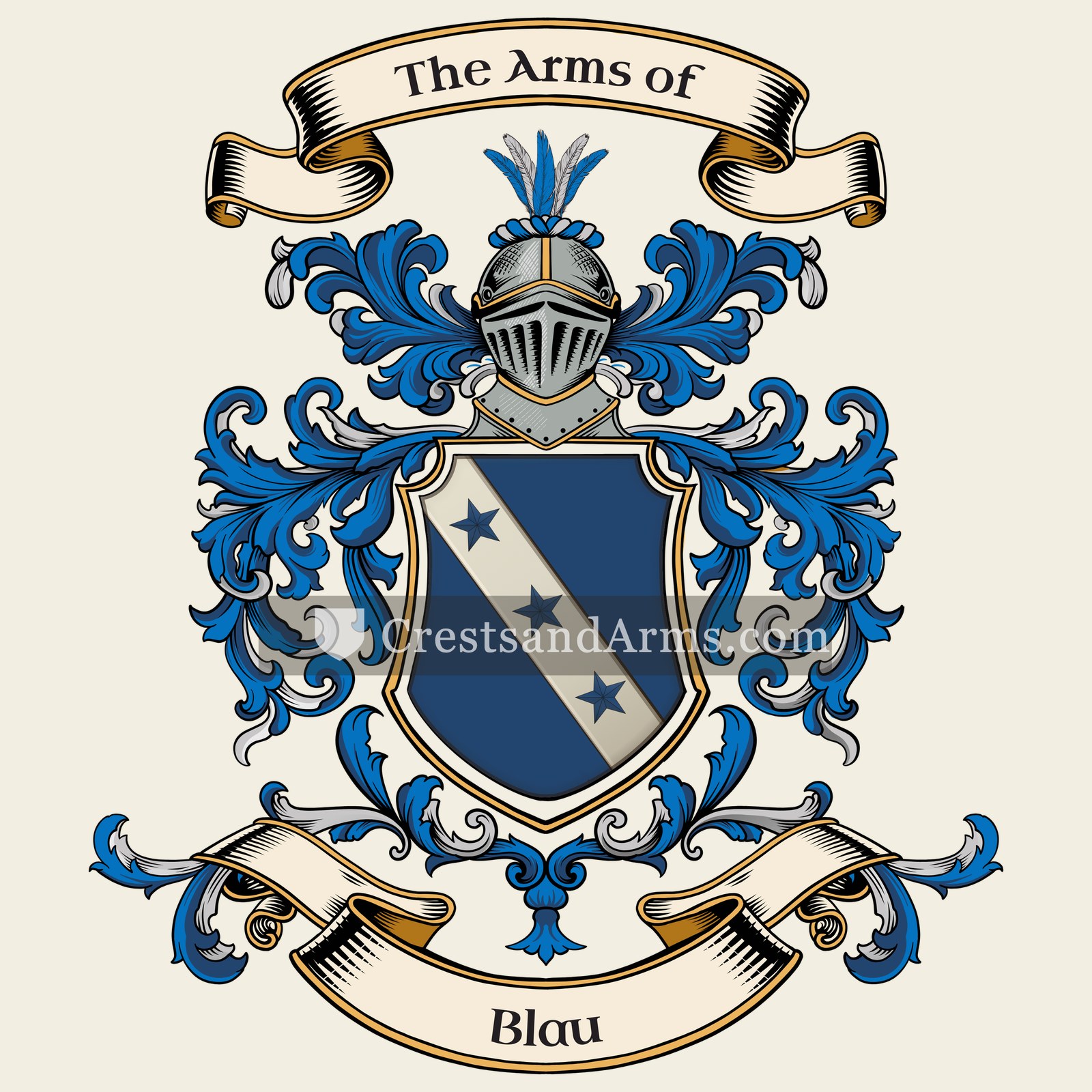
bendDefence, and the scarf of a commander
mulletThe third son, and a divine quality from above
Colours
Blue (Azure)Means: Loyalty and truth
Silver (Argent)Means: Peace and sincerity
Historical info
Source
J. B. Rietstap, Armorial Général, Gouda: G. B. van Goor Zonen, 1884–87
Blazon (the actual original written record)
“D'azur à la bande d'arg., ch. de trois étoiles du champ.”
AuvergneAuvergne, c. 1663
Digital archive packCoat of arms PNG, gold border print PDF, vector SVG and the certificate of authenticity. Sent to your email in minutes.
Map of France showing where the Blau arms are recorded
The Blau arms were recorded in Auvergne, c. 1663.
Auvergne was mountain country in the middle of France, poor in money but thick with old families. Estates were small and held for a very long time, and long tenure counted for more than wealth when it came to arms.
This is where the arms were entered in the register. Families often moved to other parts of the country, so the same name can turn up in more than one region.
The body that granted and recorded arms in France in this period.
Louis XIV of France
Sovereign of the period
Louis XIV of France
1643–1715
Reigning in Netherlands when the Blau arms are first recorded.
How Arms Worked in France
In France, a coat of arms was a mark of honor that passed down through the male line to all legitimate descendants. Families often used the same shield without changes to show their shared heritage. If a branch wanted to stand out, they could add a small mark to their shield to show their specific place in the family tree.
Granting authority
The Juge d'armes de France acted as the official authority that regulated and verified coats of arms across the country.
How they got arms
Families typically inherited their arms from ancestors, though they could also receive them through royal grants or by proving their noble status.
Where arms were recorded
Coats of arms were officially recorded in the Armorial Général de France, which began its main collection in the year 1696.
The family's standing
Recorded among the armigerous families of Auvergne.
Origin & History of the Blau Family in France
The family name Blau has deep roots in the rugged landscape of the Auvergne region in central France. By 1663, records confirm that members of the family were already established in this area, living among the volcanic mountains and high plateaus. The name itself is thought to be a descriptive term, likely originating from the Old French or Germanic words for the color blue, which may have been used as a nickname for an ancestor with blue eyes or one who frequently wore blue clothing. Life in seventeenth-century Auvergne was defined by agriculture and the challenging climate of the Massif Central, where families often stayed in the same villages for generations. As the family grew, they became part of the local social fabric, contributing to the rural economy and the unique cultural identity of the French highlands. This early presence in the region suggests that the Blau family was well-integrated into the local community long before modern records began to track migration patterns across the country.
Blau Meaning & Related Branches
Root word
Blauw
A Middle Dutch word referring to the color blue.
This name
BlauA topographic or descriptive surname originally identifying someone who wore blue clothing or lived near a blue-colored landmark.
also spelled
Blaue
Blauw
Blao
Blow
Related arms
de Perrotsimilar arms
Parissimilar arms
Pire (du) d'Hingessimilar arms
Roorda van Tjummarumsimilar arms
Documented Sources
J. B. Rietstap, Armorial Général, Gouda: G. B. van Goor Zonen, 1884–87
Fries Historisch en Letterkundig Centrum Tresoar, Burgerlijke Stand van Friesland 1811-1950
Meertens Instituut, Nederlandse Familienamenbank
Van der Schaar, J., Woordenboek van voornamen, 1964
Digital archive packCoat of arms PNG, gold border print PDF, vector SVG and the certificate of authenticity. Sent to your email in minutes.


 acornAntiquity and strength from small beginnings
 bullValour and generosity
 acornAntiquity and strength from small beginnings
 bullValour and generosity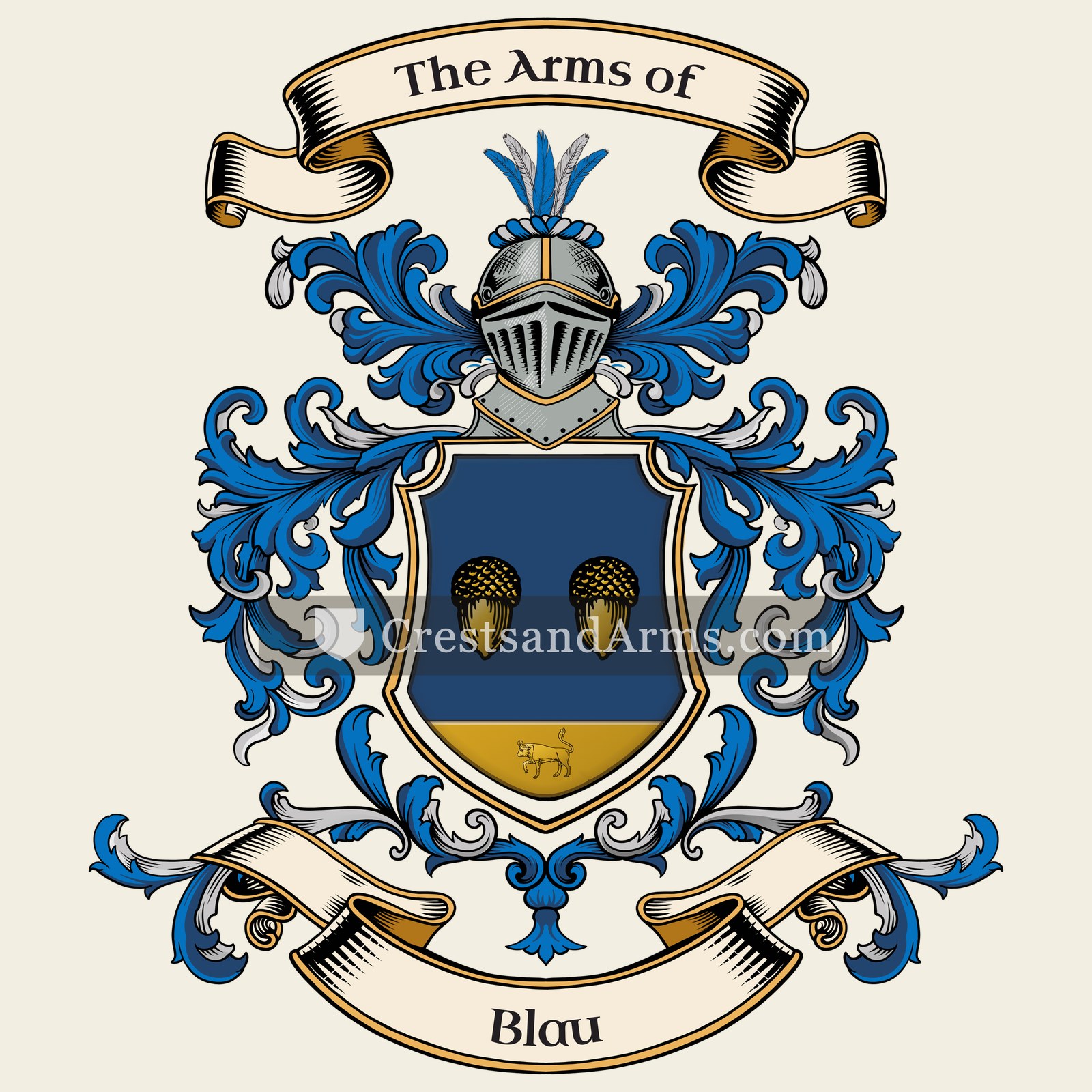


 mountThe ground held, and steadfastness upon it
 fleur de lisPurity, light, and the sixth son
 mulletThe third son, and a divine quality from above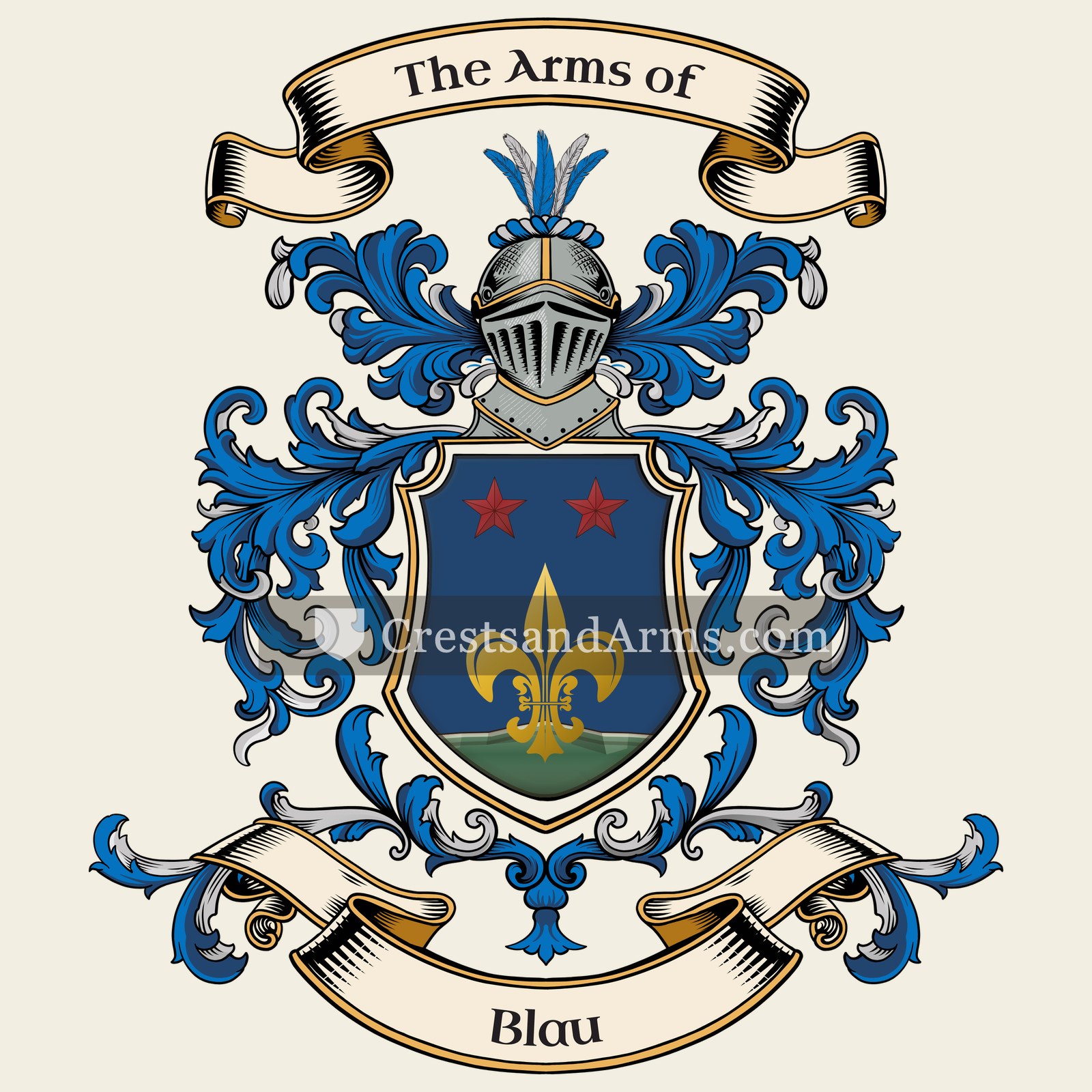

 bendDefence, and the scarf of a commander