A record of documented arms, meaning and origin, researched for the Blayney family lines. Documented in 3 countries.
Reg. 6955 · Britain, A–C
Coat of Arms & Family Crest Details
Symbols on this shield
horseReadiness to serve king and country
Colours
Black (Sable)Means: Constancy
Silver (Argent)Means: Peace and sincerity
Historical info
Source
J. B. Rietstap, Armorial Général, Gouda: G. B. van Goor Zonen, 1884–87
Blazon (the actual original written record)
“De sa. à trois têtes de cheval d'arg. C.: une tête de cheval d'arg., bridée de gu., portant au front une pointe de fer. S.: deux chevaux d'arg., crinés, bridés, sellés et onglés d'or. D.: INTEGRA MENS AUGUSTISSIMA POSSESSIO.”
Britainc. 1621
Digital archive packCoat of arms PNG, gold border print PDF, vector SVG and the certificate of authenticity. Sent to your email in minutes.
Map of Britain showing where the Blayney arms are recorded
The Blayney arms were recorded in Britain, c. 1621.
Arms such as these were typically recorded in Kent.
Kent sits between London and the short crossing to Europe, and the trade passing through made it wealthy. Merchant families bought land with that money, and it was landowners who took coats of arms.
This is where the arms were entered in the register. Families often moved to other parts of the country, so the same name can turn up in more than one region.
The body that granted and recorded arms in Britain in this period.
James VI and I
Sovereign of the period
James VI and I
1603–1625
Reigning in Britain when the Blayney arms are first recorded.
How Arms Worked in Britain
English heraldry allowed arms to be shared by all legitimate descendants of the original owner. These symbols were treated as personal property that moved through the generations to all children. While the eldest son kept the original design, other family members could use the same shield without needing to change it or register their own unique versions.
Granting authority
The College of Arms in London has regulated the use of coats of arms throughout England and Wales since 1484.
How they got arms
Families typically obtained their coats of arms through a formal grant from the Crown or by proving their ancient right to them.
Where arms were recorded
All official coats of arms are recorded in the registers kept at the College of Arms, which date back to the fifteenth century.
The family's standing
Recorded among the armigerous families of Britain.
Origin & History of the Blayney Family in Britain
The surname Blayney has roots that stretch back into the medieval period, primarily associated with the Welsh borders and the shifting political landscape of the British Isles. While the name is deeply connected to ancient Welsh lineages, historical records confirm that members of the family had established a presence in the English county of Kent by 1621. During this era, families often moved across regional boundaries to pursue new opportunities in trade, agriculture, or administrative roles within the growing English state. The migration of the Blayney name into Kent reflects a broader pattern of social mobility during the seventeenth century, as individuals sought to integrate into new communities while maintaining their ancestral identity. By settling in the southeast of England, these early family members became part of the local fabric of the region, contributing to the diverse cultural history that defined the early modern period.
Coat of Arms & Family Crest Details
Symbols on this shield
trefoilPerpetuity, and the Trinity
horseReadiness to serve king and country
Colours
Black (Sable)Means: Constancy
Gold (Or)Means: Generosity
Silver (Argent)Means: Peace and sincerity
Historical info
Source
Sir Bernard Burke, The General Armory of England, Scotland, Ireland and Wales, London: Harrison & Sons, 1884
Blazon (the actual original written record)
“Sa. a trefoil or, betw. three horses' heads erased ar”
EnglandLondon, c. 1620
Digital archive packCoat of arms PNG, gold border print PDF, vector SVG and the certificate of authenticity. Sent to your email in minutes.
Map of England showing where the Blayney arms are recorded
The Blayney arms were recorded in London, c. 1620.
This is where the arms were entered in the register. Families often moved to other parts of the country, so the same name can turn up in more than one region.
The body that granted and recorded arms in England in this period.
James VI and I
Sovereign of the period
James VI and I
1603–1625
Reigning in Britain when the Blayney arms are first recorded.
How Arms Worked in England
English heraldry allowed arms to be shared by all legitimate descendants of the original owner. These symbols were treated as personal property that moved through the generations to all children. While the eldest son kept the original design, other family members could use the same shield without needing to change it or register their own unique versions.
Granting authority
The College of Arms in London has regulated the use of coats of arms throughout England and Wales since 1484.
How they got arms
Families typically obtained their coats of arms through a formal grant from the Crown or by proving their ancient right to them.
Where arms were recorded
All official coats of arms are recorded in the registers kept at the College of Arms, which date back to the fifteenth century.
The family's standing
Recorded among the armigerous families of England.
Origin & History of the Blayney Family in England
The Blayney family name carries a history deeply rooted in the social and professional shifts of seventeenth-century England. While the name has ancient origins in the Welsh borderlands, records confirm that members of the family were well-established in London by 1620. During this period, London was a bustling center of trade and government, and families like the Blayneys often moved to the capital to pursue careers in law, commerce, or service to the royal court. As the city grew into a global hub, these early residents helped shape the family’s identity by integrating into the urban middle class. Their presence in the capital during the early 1600s suggests they were part of the rising professional groups that navigated the complex political and economic landscape of the Stuart era. By settling in London, the family transitioned from their regional roots into the heart of English national life, leaving behind a trail of legal and parish documents that highlight their steady influence in the city.
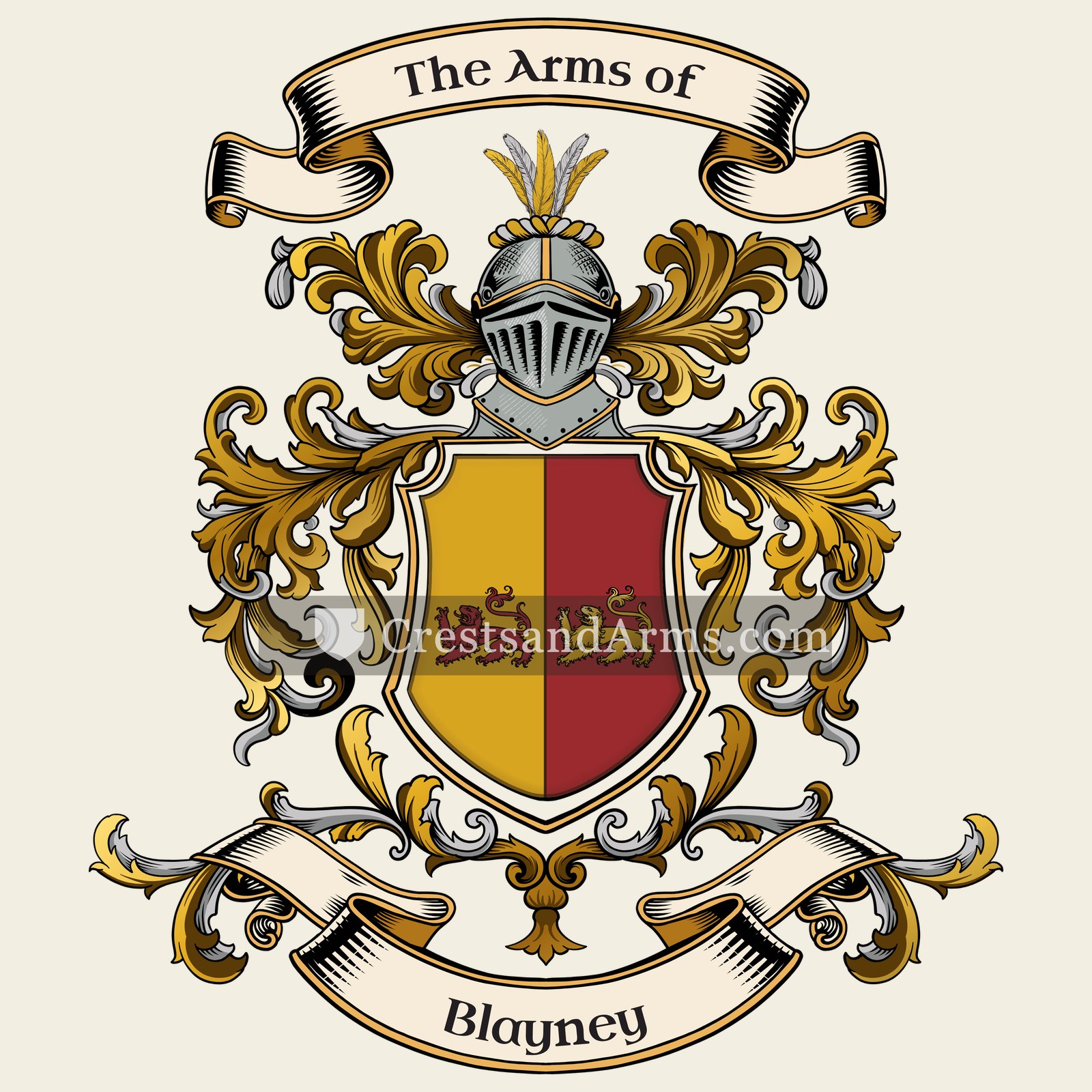
Coat of Arms & Family Crest Details
Symbols on this shield
lionCourage, strength and royalty
Colours
Gold (Or)Means: Generosity
Red (Gules)Means: Military strength
Historical info
Source
Sir Bernard Burke, The General Armory of England, Scotland, Ireland and Wales, London: Harrison & Sons, 1884
Blazon (the actual original written record)
“Per pale or and gu two lions endorsed counterchanged”
MontgomeryshireMontgomeryshire, c. 1647
Digital archive packCoat of arms PNG, gold border print PDF, vector SVG and the certificate of authenticity. Sent to your email in minutes.
Map of Wales showing where the Blayney arms are recorded
The Blayney arms were recorded in Montgomeryshire, c. 1647.
This is where the arms were entered in the register. Families often moved to other parts of the country, so the same name can turn up in more than one region.
The body that granted and recorded arms in Wales in this period.
Charles I of England
Sovereign of the period
Charles I of England
1625–1649
Reigning in Britain when the Blayney arms are first recorded.
How Arms Worked in Wales
English heraldry allowed arms to be shared by all legitimate descendants of the original owner. These symbols were treated as personal property that moved through the generations to all children. While the eldest son kept the original design, other family members could use the same shield without needing to change it or register their own unique versions.
Granting authority
The College of Arms in London has regulated the use of coats of arms throughout England and Wales since 1484.
How they got arms
Families typically obtained their coats of arms through a formal grant from the Crown or by proving their ancient right to them.
Where arms were recorded
All official coats of arms are recorded in the registers kept at the College of Arms, which date back to the fifteenth century.
The family's standing
Recorded among the armigerous families of Montgomeryshire.
Origin & History of the Blayney Family in Wales
The Blayney family name is deeply rooted in the history of Montgomeryshire, Wales, where it emerged as a prominent surname during the medieval and early modern periods. The name is derived from the Welsh personal name Bleddyn, which translates to wolf, reflecting the martial and independent spirit often associated with the local gentry of the region. By the mid-seventeenth century, the family had established a significant presence in the area, particularly around the town of Gregynog. Records from 1647 highlight their involvement in the local social and political landscape, showing that they were well-integrated into the landowning class of mid-Wales. Over time, the family became influential figures in their community, often serving in local government roles and managing large estates that defined the rural economy of Montgomeryshire. Their history serves as a window into how Welsh families transitioned from traditional naming customs to the adoption of fixed surnames while maintaining their connection to the rugged landscape of their ancestors.
Blayney Meaning & Related Branches
Root word
Blaidd
A Welsh term meaning wolf.
This name
BlayneyDerived from a nickname for a person with the characteristics of a wolf.
also spelled
Blaynie
Blaynee
Blayny
Blaney
Blaine
Related arms
Milletsame arms
Blaneyvariant spelling
Blaynevariant spelling
Ballardrecorded with Blayney, same area
Documented Sources
J. B. Rietstap, Armorial Général, Gouda: G. B. van Goor Zonen, 1884–87
The National Archives, Prerogative Court of Canterbury and related Probate Jurisdictions: Will Registers, 1621
Kent Archives and Local History Service, Parish Registers of Kent, 1621
Morgan, Prys, A Study of Welsh Surnames, 1987
Reaney, Percy Hide, A Dictionary of British Surnames, 1958
Digital archive packCoat of arms PNG, gold border print PDF, vector SVG and the certificate of authenticity. Sent to your email in minutes.


 horseReadiness to serve king and country
 horseReadiness to serve king and country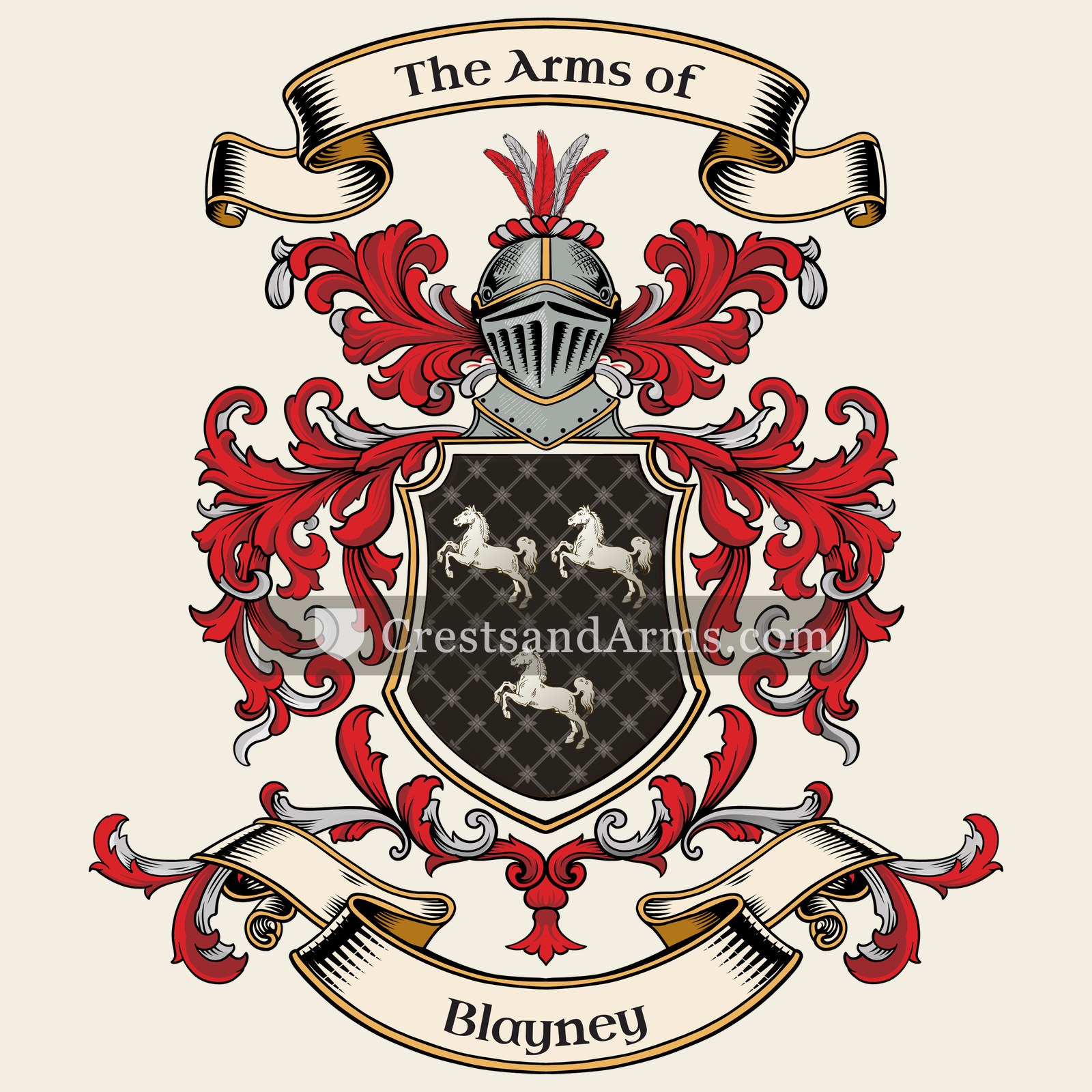


 trefoilPerpetuity, and the Trinity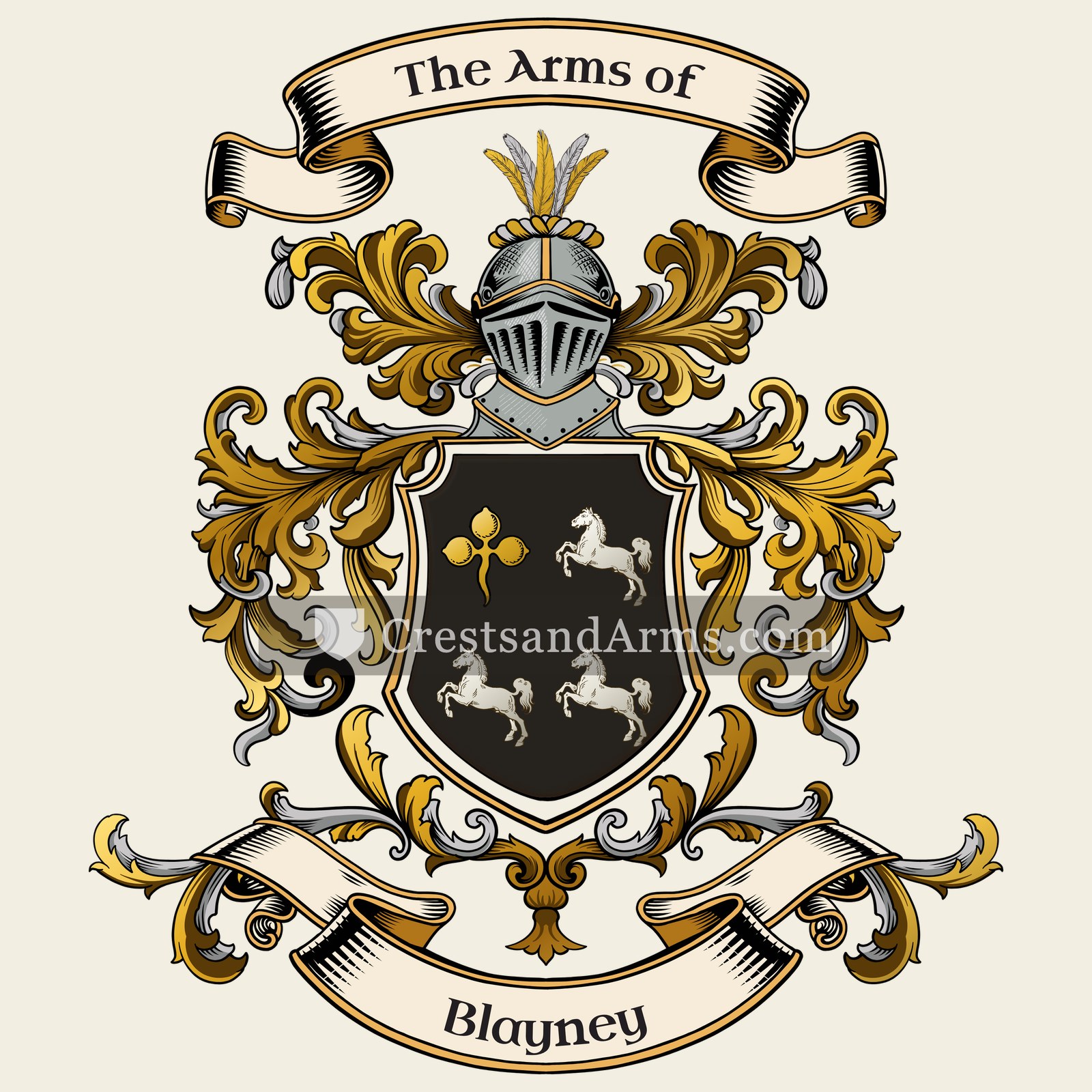
 lionCourage, strength and royalty