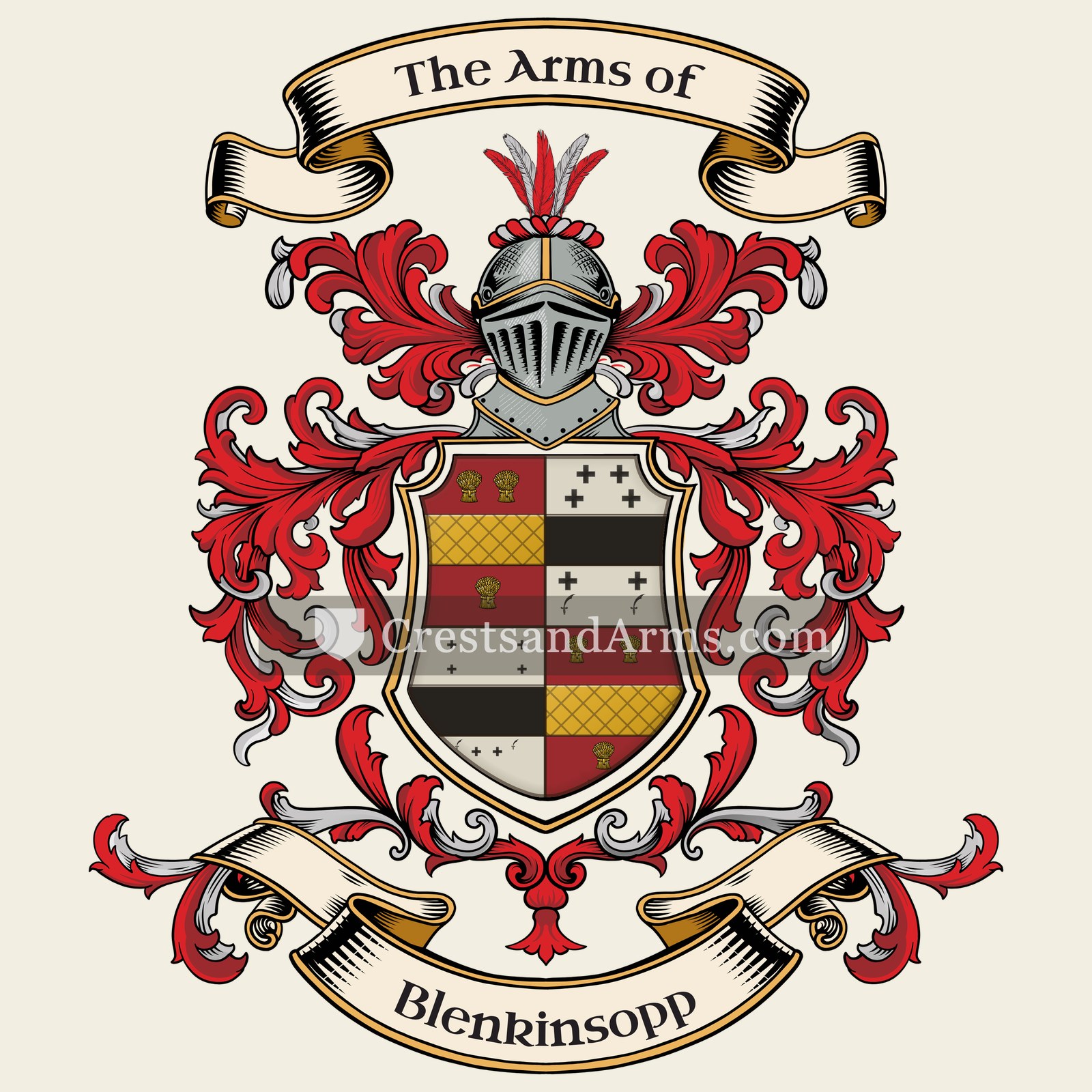
A record of documented arms, meaning and origin, researched for the Blenkinsopp family of England.
Reg. 6105 · English, A–C
Coat of Arms & Family Crest Details
Symbols on this shield
fessThe military belt, and readiness to serve
cross symbolChristian faith and service
wheatsheafPlenty, and the harvest of one's own labour
swordJustice, and military honour
Colours
Red (Gules)Means: Military strength
Silver (Argent)Means: Peace and sincerity
Gold (Or)Means: Generosity
Black (Sable)Means: Constancy
Historical info
Source
Sir Bernard Burke, The General Armory of England, Scotland, Ireland and Wales, London: Harrison & Sons, 1884
Blazon (the actual original written record)
“Quarterly, 1st and 4th, gu. a fesse betw. three garbs or, for Blenkinsopp; 2nd and 3rd, quarterly, 1st and 4th, ar. a fesse betw. six crosses crosslet fitchée sa., for Layton, or Leaton; 2nd, and 3rd, sa. three swords in fesse ar two with their points in base, and the middle one in chief, for Rawlins”
DurhamHoppyland Park · Durham, c. 1620
Digital archive packCoat of arms PNG, gold border print PDF, vector SVG and the certificate of authenticity. Sent to your email in minutes.
Map of England showing where the Blenkinsopp arms are recorded
The Blenkinsopp arms were recorded in Durham, c. 1620.
Durham was governed by its bishop rather than the crown for most of its history, with its own courts and its own landed class. That separate world produced a tight group of families, nearly all of whom held arms.
This is where the arms were entered in the register. Families often moved to other parts of the country, so the same name can turn up in more than one region.
The body that granted and recorded arms in England in this period.
James VI and I
Sovereign of the period
James VI and I
1603–1625
Reigning in England when the Blenkinsopp arms are first recorded.
How Arms Worked in England
English heraldry allowed arms to be shared by all legitimate descendants of the original owner. These symbols were treated as personal property that moved through the generations to all children. While the eldest son kept the original design, other family members could use the same shield without needing to change it or register their own unique versions.
Granting authority
The College of Arms in London has regulated the use of coats of arms throughout England and Wales since 1484.
How they got arms
Families typically obtained their coats of arms through a formal grant from the Crown or by proving their ancient right to them.
Where arms were recorded
All official coats of arms are recorded in the registers kept at the College of Arms, which date back to the fifteenth century.
The family's standing
Recorded among the armigerous families of Durham.
Origin & History of the Blenkinsopp Family in England
The family name Blenkinsopp originates from a specific place in the northern English county of Northumberland. The name is derived from the Old English words for a lead-colored hill and a small valley, which describes the rugged landscape where the family first established their roots. By the year 1620, members of the family had moved into the neighboring county of Durham, likely seeking new opportunities in the region's growing agricultural and industrial sectors. During this period, the family became part of the local social fabric in Durham, appearing in parish registers and legal documents as they integrated into the community. Their migration reflects a common pattern of movement for northern families who traveled between the border counties to manage land or pursue trade. Over time, the name became firmly associated with the northern landscape, marking the family as a long-standing part of the history of the English borderlands.
Blenkinsopp Meaning & Related Branches
Root word
Blenkin-sopp
Derived from the Old English personal name Blencan and Old Norse soppr.
This name
BlenkinsoppRefers to the settlement or valley belonging to a man named Blencan.
also spelled
Blenkinshop
Documented Sources
Sir Bernard Burke, The General Armory of England, Scotland, Ireland and Wales, London: Harrison & Sons, 1884
Ekwall, Eilert, The Concise Oxford Dictionary of English Place-names, 1960
Reaney, P.H., A Dictionary of British Surnames, 1958
Durham County Record Office, Parish Registers of the Diocese of Durham, 1620
Digital archive packCoat of arms PNG, gold border print PDF, vector SVG and the certificate of authenticity. Sent to your email in minutes.


 fessThe military belt, and readiness to serve
 cross symbolChristian faith and service
 wheatsheafPlenty, and the harvest of one's own labour
 swordJustice, and military honour
 fessThe military belt, and readiness to serve
 cross symbolChristian faith and service
 wheatsheafPlenty, and the harvest of one's own labour
 swordJustice, and military honour