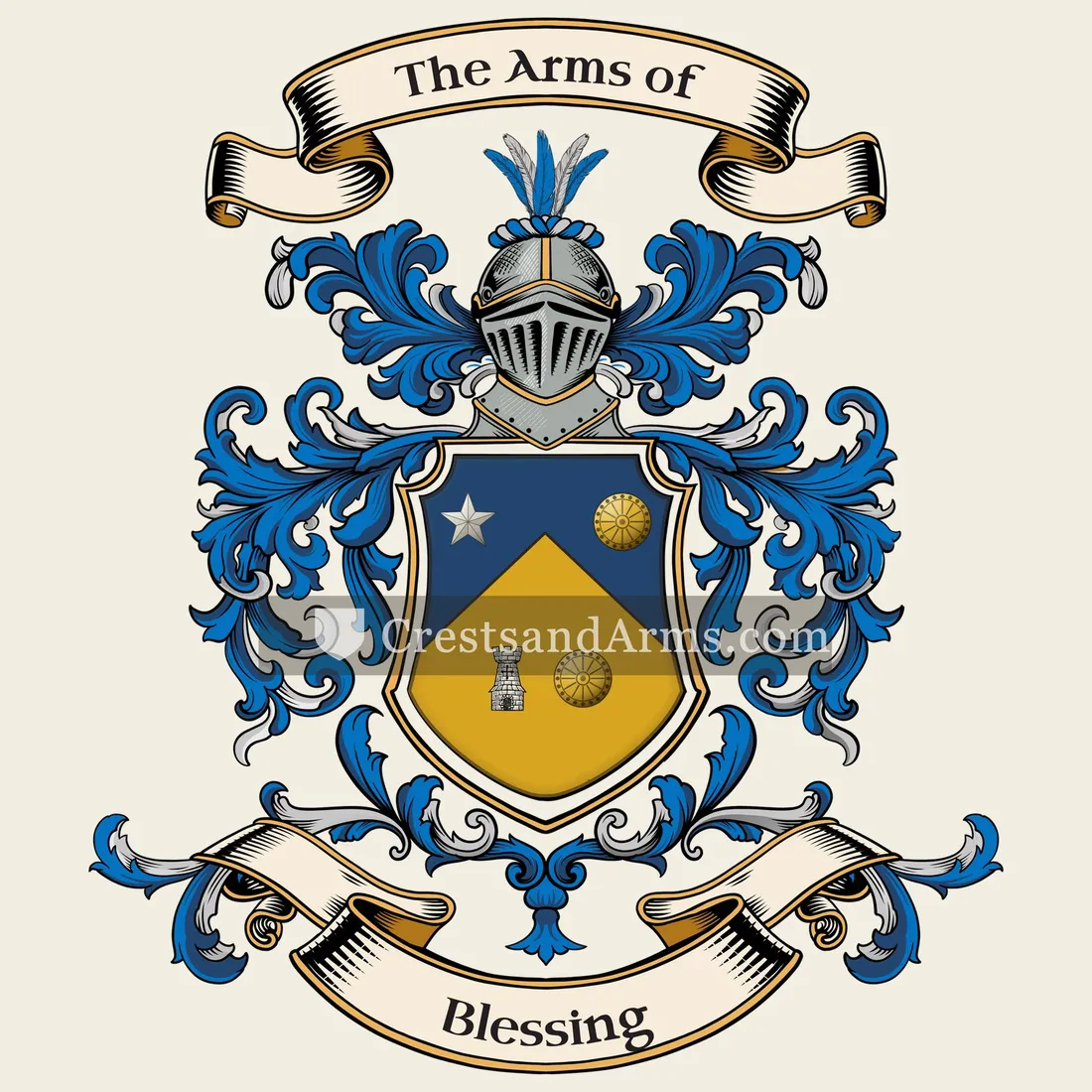
A record of documented arms, meaning and origin, researched for the Blessing family of Sweden.
Reg. 9874 · Swedish, A–C
Meaning of the Blessing family crest colors & symbols
Symbols on this shield
towerGrandeur and solidity, and a stronghold defended
mulletThe third son, and a divine quality from above
roundelA coin, and one who has been to the crusades
Colours
Blue (Azure)Means: Loyalty and truth
Gold (Or)Means: Generosity
Silver (Argent)Means: Peace and sincerity
Historical info
Source
J. B. Rietstap, Armorial Général, Gouda: G. B. van Goor Zonen, 1884–87
Blazon (the actual original written record)
“D'azur au château sommé d'une tour à coupole, d'arg., la tour surm. d'une étoile du même; le champ chapé-ployé d'or, à deux boules d'azur. C.: un lion iss. d'arg., lamp. de gu., tenant de sa patte dextre un gobelet de sa.; entre quatre bannières, les deux ext. d'azur, les deux autres d'or. L. d'or et d'azur.”
PomeraniaPomerania, c. 1700
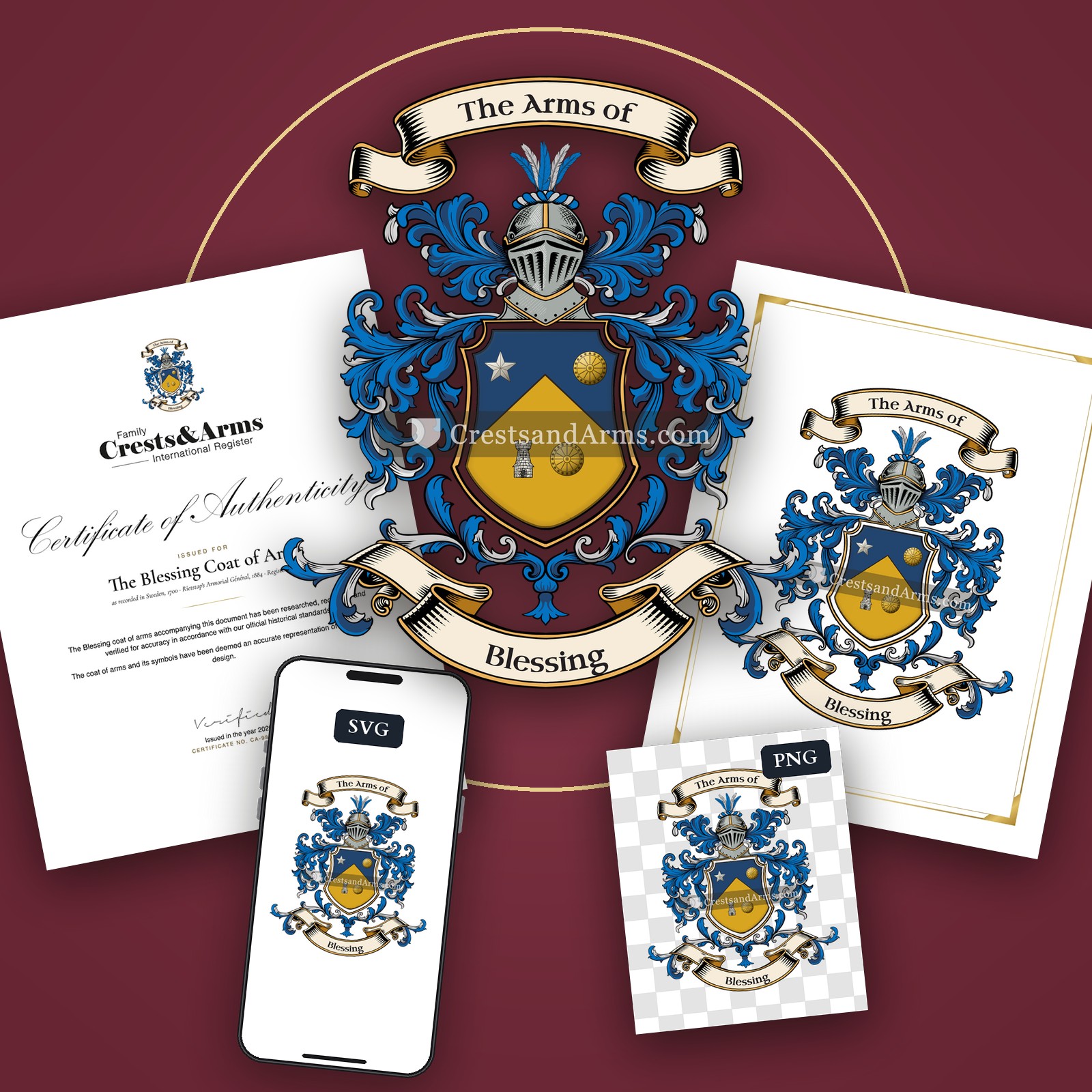
Digital archive packCoat of arms PNG, gold border print PDF, vector SVG and the certificate of authenticity. Sent to your email in minutes.
Map of Sweden showing where the Blessing arms are recorded
The Blessing arms were recorded in Pomerania, c. 1700.
Pomerania was flat farming country on the Baltic coast, held in large estates by a small number of families. They kept their land for generations, and generations of landholding is what fills the registers.
This is where the arms were entered in the register. Families often moved to other parts of the country, so the same name can turn up in more than one region.
The body that granted and recorded arms in Sweden in this period.
Carl XII of Sweden
Sovereign of the period
Carl XII of Sweden
1697–1718
Reigning in Sweden when the Blessing arms are first recorded.
How Arms Worked in Sweden
In Sweden, a coat of arms belonged to a noble family as a whole rather than just one individual. These arms were passed down through the generations to all legitimate descendants. Younger branches of the family used the same shield without needing to change it. This system ensured that the entire lineage shared the same identity and status under the law.
Granting authority
The Riddarhuset, or House of Nobility, regulated all noble coats of arms in Sweden under royal authority.
How they got arms
Families received their coats of arms through royal grants of nobility which were then officially registered with the House.
Where arms were recorded
Coats of arms were officially recorded in the Swedish House of Nobility register starting in the year 1626.
The family's standing
Recorded among the armigerous families of Pomerania.
Origin & History of the Blessing Family in Sweden
The surname Blessing has deep roots in the historical region of Pomerania, where families bearing this name were well-established by the early 1700s. The name itself is likely derived from the Middle High German word *blide*, which relates to feelings of joy, happiness, or a cheerful disposition. In the social structure of the eighteenth century, such names often began as nicknames or descriptive terms used to identify individuals within a small village or rural community. As record-keeping became more formal in the Prussian territories, these descriptive names transitioned into permanent family surnames that were passed down through generations. Families with this name were typically involved in the agrarian life of the Baltic coast, working the land or participating in the local trades that supported the economy of the Pomeranian duchies and later the Kingdom of Prussia.
Blessing Meaning & Related Branches
Root word
Benedictio
A Latin term referring to the act of invoking divine favor.
This name
BlessingRefers to a person who is considered a gift from God or brings divine favor.
also spelled
Blessing
Blesing
Documented Sources
J. B. Rietstap, Armorial Général, Gouda: G. B. van Goor Zonen, 1884–87
Bahlow, Hans, Deutsches Namenlexikon: Familien- und Vornamen nach Ursprung und Sinn erklärt, 1967
Heintze, Albert, Die deutschen Familien-Namen: geschichtlich, geographisch, sprachlich, 1903
Landesarchiv Greifswald, Kirchenbücher der Provinz Pommern, 1700–1800
Digital archive packCoat of arms PNG, gold border print PDF, vector SVG and the certificate of authenticity. Sent to your email in minutes.


 towerGrandeur and solidity, and a stronghold defended
 mulletThe third son, and a divine quality from above
 roundelA coin, and one who has been to the crusades
 towerGrandeur and solidity, and a stronghold defended
 mulletThe third son, and a divine quality from above
 roundelA coin, and one who has been to the crusades