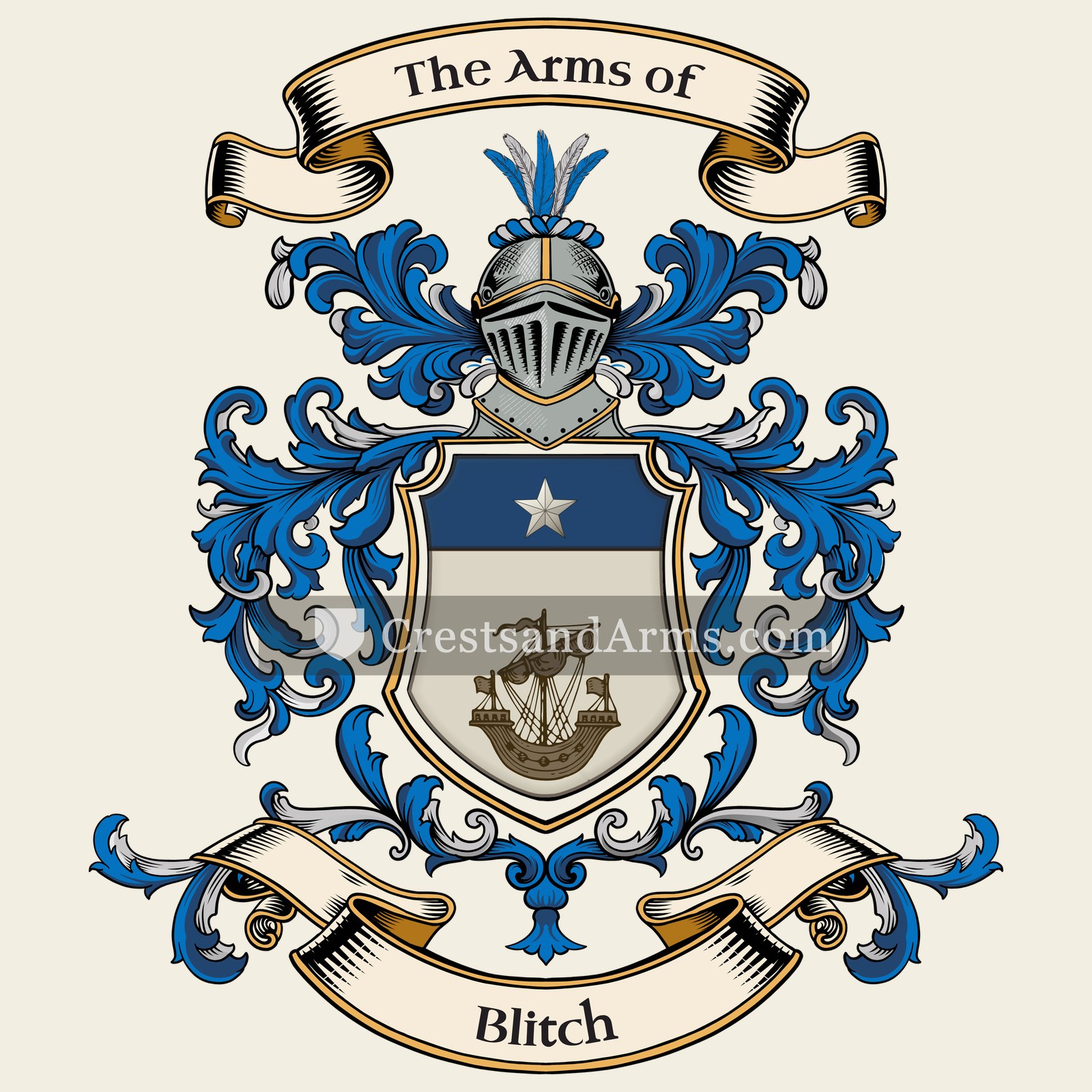
A record of documented arms, meaning and origin, researched for the Blitch family of Russia.
Reg. 0073 · Russian, A–C
Coat of Arms & Family Crest Details
Symbols on this shield
chiefAuthority, wisdom and dominion
shipEnterprise, and a great voyage undertaken
mulletThe third son, and a divine quality from above
Colours
Silver (Argent)Means: Peace and sincerity
Blue (Azure)Means: Loyalty and truth
Historical info
Source
J. B. Rietstap, Armorial Général, Gouda: G. B. van Goor Zonen, 1884–87
Blazon (the actual original written record)
“D'arg. à une galère au nat., voguante sur une mer au nat. et ramée par six rameurs contournés, assis à dextre du mât d'arg. orné d'une banderole d'or, tortillée autour du mât; ladite galère portant sur la poupe (à sen.) un drapeau de sin., flottant vers sen. et ch. d'un croiss. cont. d'arg.; au chef d'azur, ch. d'une étoile (5) d'arg. C.: trois pl. d'aut.”
Russiac. 1784
Digital archive packCoat of arms PNG, gold border print PDF, vector SVG and the certificate of authenticity. Sent to your email in minutes.
Map of Russia showing where the Blitch arms are recorded
The Blitch arms were recorded in Russia, c. 1784.
Arms such as these were typically recorded in Moscow.
Moscow held the Russian court, and rank there came from service rather than land. Families who served the Tsar were entered in the registers of nobility, and that entry is where their arms are recorded.
This is where the arms were entered in the register. Families often moved to other parts of the country, so the same name can turn up in more than one region.
The body that granted and recorded arms in Russia in this period.
Catherine II of Russia
Sovereign of the period
Catherine II of Russia
1762–1796
Reigning in Russia when the Blitch arms are first recorded.
How Arms Worked in Russia
Russian heraldry was strictly tied to the nobility and the state service system. Families proved their ancient status or earned new rank to receive an official grant from the Tsar. These symbols were then inherited by all legitimate children of the noble line. If a family lacked proof of their status, they were often excluded from the official records entirely.
Granting authority
The Herald Master's Office acted as the central state body that strictly regulated and verified all noble heraldic symbols.
How they got arms
Families typically received their arms through a formal state grant or by proving their noble status to the government authorities.
Where arms were recorded
All approved coats of arms were officially recorded in the General Armorial of the Noble Families of the Russian Empire starting in 1797.
The family's standing
Recorded among the armigerous families of Russia.
Origin & History of the Blitch Family in Russia
The history of the Blitch family name is deeply connected to the movement of people across Eastern Europe during the late eighteenth century. Records confirm that members of the family were established in Moscow by 1784, a time when the city was a major center for trade and social change under the Russian Empire. The name likely evolved as families migrated through various regions, adapting to local languages and record-keeping styles as they settled into new communities. Because surnames were often recorded phonetically by government clerks, the spelling of Blitch may have shifted slightly as the family moved between different administrative districts. By the time they were documented in Moscow, the family had already integrated into the local urban landscape, participating in the professional and social life of the city during a period of significant imperial growth.
Related Branches & Arms
Root word
Blych
Derived from the Slavic word for a pale or light-colored person.
This name
BlitchA surname historically associated with individuals of fair complexion or light hair from Eastern European regions.
also spelled
Belich
Documented Sources
J. B. Rietstap, Armorial Général, Gouda: G. B. van Goor Zonen, 1884–87
Russian State Archive of Ancient Acts (Rossiyskiy gosudarstvennyy arkhiv drevnikh aktov), Fond 350: Records of the First Revision Census
Central State Archive of Moscow (Tsentral'nyy gosudarstvennyy arkhiv Moskvy), Fond 203: Records of the Moscow Consistory
Unbegaun, Boris Ottokar, Russkiye familii (Russian Surnames), 1972
Petrov, Pyotr Nikolayevich, Istoriya rodov russkogo dvoryanstva (History of the Families of the Russian Nobility), 1886
Digital archive packCoat of arms PNG, gold border print PDF, vector SVG and the certificate of authenticity. Sent to your email in minutes.


 chiefAuthority, wisdom and dominion
 shipEnterprise, and a great voyage undertaken
 mulletThe third son, and a divine quality from above
 chiefAuthority, wisdom and dominion
 shipEnterprise, and a great voyage undertaken
 mulletThe third son, and a divine quality from above