Map of Netherlands showing where the Block arms are recorded
The Block arms were recorded in Amsterdam, c. 1815.
This is where the arms were entered in the register. Families often moved to other parts of the country, so the same name can turn up in more than one region.
Region
Amsterdam
Town
Amsterdam
First recorded
1815
Granting Authority for the Block Arms
Hoge Raad van Adel
Photograph made by me · CC BY-SA 3.0
The body that granted and recorded arms in Netherlands in this period.
William I of the Netherlands
Sovereign of the period
William I of the Netherlands
1815–1840
Reigning in Netherlands when the Block arms are first recorded.
How Arms Worked in Netherlands
In the Netherlands, coats of arms were often used by noble families and those who held specific public offices. These arms were passed down through the generations to legitimate descendants. Younger branches of a family usually kept the original design without needing to add special marks. This system ensured that the family identity remained clear and consistent over many years.
Granting authority
The Hoge Raad van Adel is the official body that regulates and manages noble titles and coats of arms in the Netherlands.
How they got arms
Families typically obtained their coats of arms through official royal grants or by proving their long-standing historical use of the symbols.
Where arms were recorded
Coats of arms are officially recorded in the registers held by the Hoge Raad van Adel, which began its work in 1814.
The family's standing
Recorded among the armigerous families of Netherlands.
Origin & History of the Block Family in Netherlands
The surname Block has deep roots in the Netherlands, where it functioned as a descriptive name for individuals who lived near a large wooden structure or a sturdy block of stone. By the early nineteenth century, the family was well-established in the bustling city of Amsterdam. During this period, the city served as a major global center for trade and finance, which provided many opportunities for families to build stable lives. Records from 1815 confirm that members of the Block family were active participants in the social and economic life of the Dutch capital. As the nation transitioned into the United Kingdom of the Netherlands following the Napoleonic era, these families often worked as merchants or skilled craftsmen. This era of Dutch history was defined by rapid urban growth, and the Block family was part of the demographic shift that helped shape the modern identity of Amsterdam.
Coat of Arms & Family Crest Details
Symbols on this shield
acornAntiquity and strength from small beginnings
Colours
Silver (Argent)Means: Peace and sincerity
Gold (Or)Means: Generosity
Historical info
Source
J. B. Rietstap, Armorial Général, Gouda: G. B. van Goor Zonen, 1884–87
Blazon (the actual original written record)
“D'arg. à deux glands d'or, tigés et feuillés chacun de deux pièces de sin., les tiges passées en double saut., les pieds embrassant un chicot au nat., posé en fasce. Cq. cour. C.: les meubles de l'écu. L. d'arg. et de sa.”
GermanyHan, c. 1765
Digital archive packCoat of arms PNG, gold border print PDF, vector SVG and the certificate of authenticity. Sent to your email in minutes.
Map of Germany showing where the Block arms are recorded
The Block arms were recorded in Han, c. 1765.
This is where the arms were entered in the register. Families often moved to other parts of the country, so the same name can turn up in more than one region.
The body that granted and recorded arms in Germany in this period.
Francis I, Holy Roman Emperor
Sovereign of the period
Francis I, Holy Roman Emperor
1745–1765
Reigning in Netherlands when the Block arms are first recorded.
How Arms Worked in Germany
In the Holy Roman Empire, coats of arms were often granted to individuals by the Emperor or his representatives. These arms were then passed down through the generations to all legitimate descendants of the original holder. Younger branches of a family usually kept the same shield design without needing to change it, as the arms belonged to the entire lineage.
Granting authority
The Holy Roman Emperor held the sole power to grant new coats of arms throughout his vast imperial territories.
How they got arms
Families typically obtained their coats of arms through a formal imperial grant or by proving their noble status to the authorities.
Where arms were recorded
These grants were officially recorded in the Imperial Chancery registers, which began keeping formal records of such honors during the Middle Ages.
The family's standing
Recorded among the armigerous families of Germany.
Origin & History of the Block Family in Germany
The surname Block originated in medieval Germany as a descriptive nickname for a person of sturdy build or someone who lived near a prominent wooden landmark. During the Middle Ages, the name became common across various German-speaking regions as families adopted permanent surnames to distinguish themselves in growing towns. By the mid-eighteenth century, the family had established a documented presence in the village of Han, which is located in the modern-day state of Hesse. Records from 1765 confirm that members of the Block family were active participants in this rural community, likely working as farmers or skilled tradespeople. This period was a time of transition for many German families, as local church and civil registers began to track residents more consistently, helping to preserve the history of families like the Blocks as they navigated the social and economic shifts of the eighteenth century.
Coat of Arms & Family Crest Details
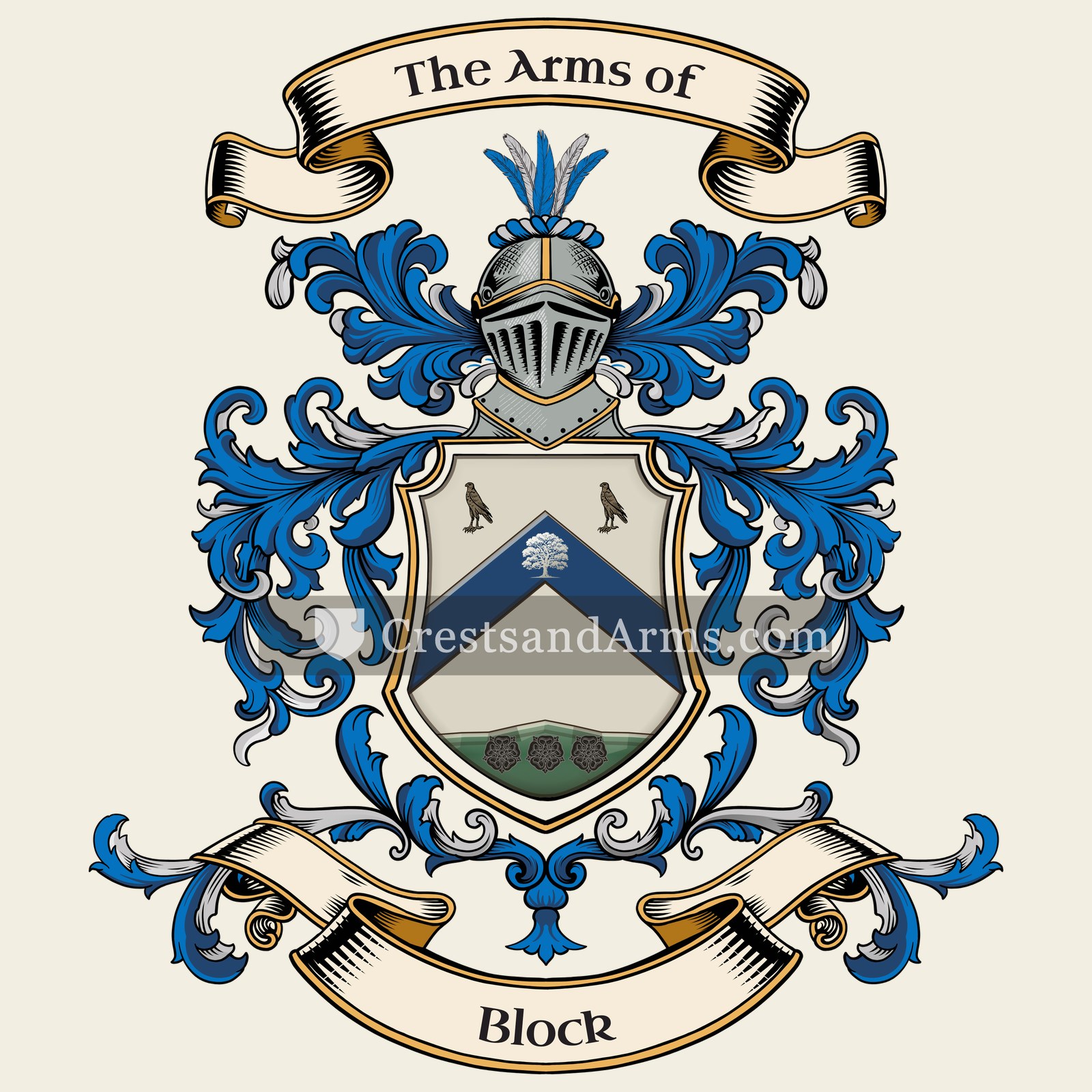
Symbols on this shield
chevronProtection, and faithful service completed
mountThe ground held, and steadfastness upon it
falconOne eager and quick in pursuit
treeLife, endurance and deep roots
roseThe seventh son, and beauty with grace
Colours
Silver (Argent)Means: Peace and sincerity
Blue (Azure)Means: Loyalty and truth
Green (Vert)Means: Hope
Historical info
Source
Sir Bernard Burke, The General Armory of England, Scotland, Ireland and Wales, London: Harrison & Sons, 1884
Blazon (the actual original written record)
“Ar. on a chev. az. betw. two falcons in chief ppr. belled or, and a mount vert, thereon the stump of an oak tree sprouting out a branch to the sinister also ppr., in base three roses of the field, barbed of the fourth, and seeded gold”
MiddlesexLondon · Middlesex, c. 1620
Digital archive packCoat of arms PNG, gold border print PDF, vector SVG and the certificate of authenticity. Sent to your email in minutes.
Map of England showing where the Block arms are recorded
The Block arms were recorded in Middlesex, c. 1620.
Middlesex was the county around London, and City money flowed straight into it. Merchants and officials bought estates within reach of the capital, and a new estate brought a coat of arms with it.
This is where the arms were entered in the register. Families often moved to other parts of the country, so the same name can turn up in more than one region.
The body that granted and recorded arms in England in this period.
James VI and I
Sovereign of the period
James VI and I
1603–1625
Reigning in Netherlands when the Block arms are first recorded.
How Arms Worked in England
English heraldry allowed arms to be shared by all legitimate descendants of the original owner. These symbols were treated as personal property that moved through the generations to all children. While the eldest son kept the original design, other family members could use the same shield without needing to change it or register their own unique versions.
Granting authority
The College of Arms in London has regulated the use of coats of arms throughout England and Wales since 1484.
How they got arms
Families typically obtained their coats of arms through a formal grant from the Crown or by proving their ancient right to them.
Where arms were recorded
All official coats of arms are recorded in the registers kept at the College of Arms, which date back to the fifteenth century.
The family's standing
Recorded among the armigerous families of Middlesex.
Origin & History of the Block Family in England
The surname Block is rooted in the linguistic traditions of medieval England, where it likely originated as a descriptive nickname. In Middle English, the word often referred to a sturdy or thickset person, or it may have been used to identify someone who lived near a prominent landmark like a large tree stump or a wooden block. By the time the family established a documented presence in Middlesex in 1620, the name had already become a fixed identifier passed down through generations. During this period, families in the region were often tied to the local agricultural economy or the growing trade networks surrounding London. The presence of the Block family in Middlesex suggests they were part of the stable population that helped shape the social and economic landscape of the area during the early seventeenth century. As the name became more common, it reflected the transition from simple descriptive labels to formal family identities that defined one's place in the community.
Block Meaning & Related Branches
Root word
bloke
A Middle Dutch term referring to a block of wood or log.
This name
BlockOriginally a nickname for a person who was thickset, sturdy, or resembled a block of wood.
also spelled
Blok
Bloke
Related arms
Bibran (von) et Modlausimilar arms
Caldorinussimilar arms
Diganitisimilar arms
Blokvariant spelling
Documented Sources
J. B. Rietstap, Armorial Général, Gouda: G. B. van Goor Zonen, 1884–87
Stadsarchief Amsterdam, Bevolkingsregister van Amsterdam
Nationaal Archief, Burgerlijke Stand van de Provincie Noord-Holland
Debrabandere, Frans. Woordenboek van de familienamen in België en Noord-Frankrijk. 2003
Van der Schaar, J. Woordenboek van voornamen. 2010
Digital archive packCoat of arms PNG, gold border print PDF, vector SVG and the certificate of authenticity. Sent to your email in minutes.


 cross symbolChristian faith and service
 cross symbolChristian faith and service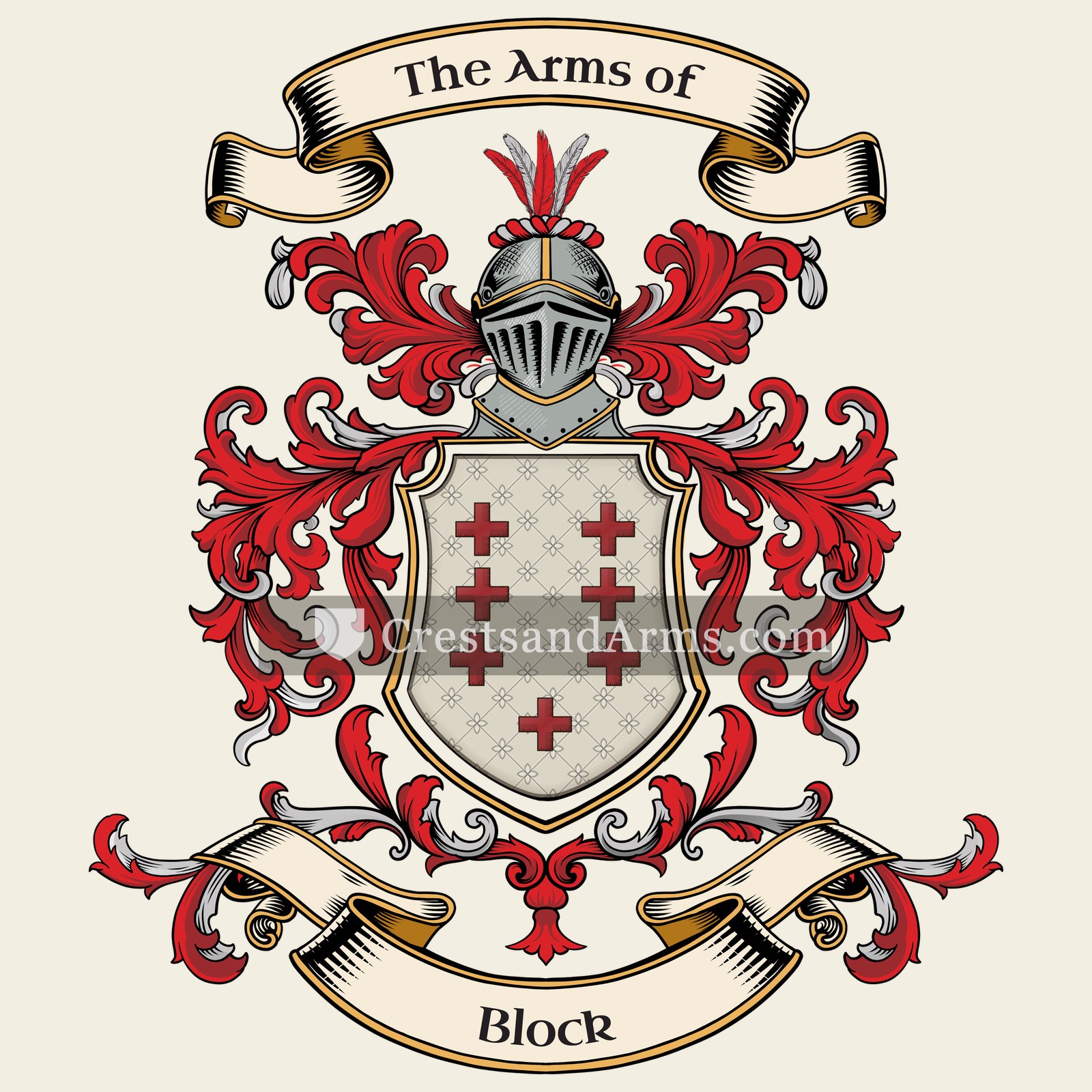


 acornAntiquity and strength from small beginnings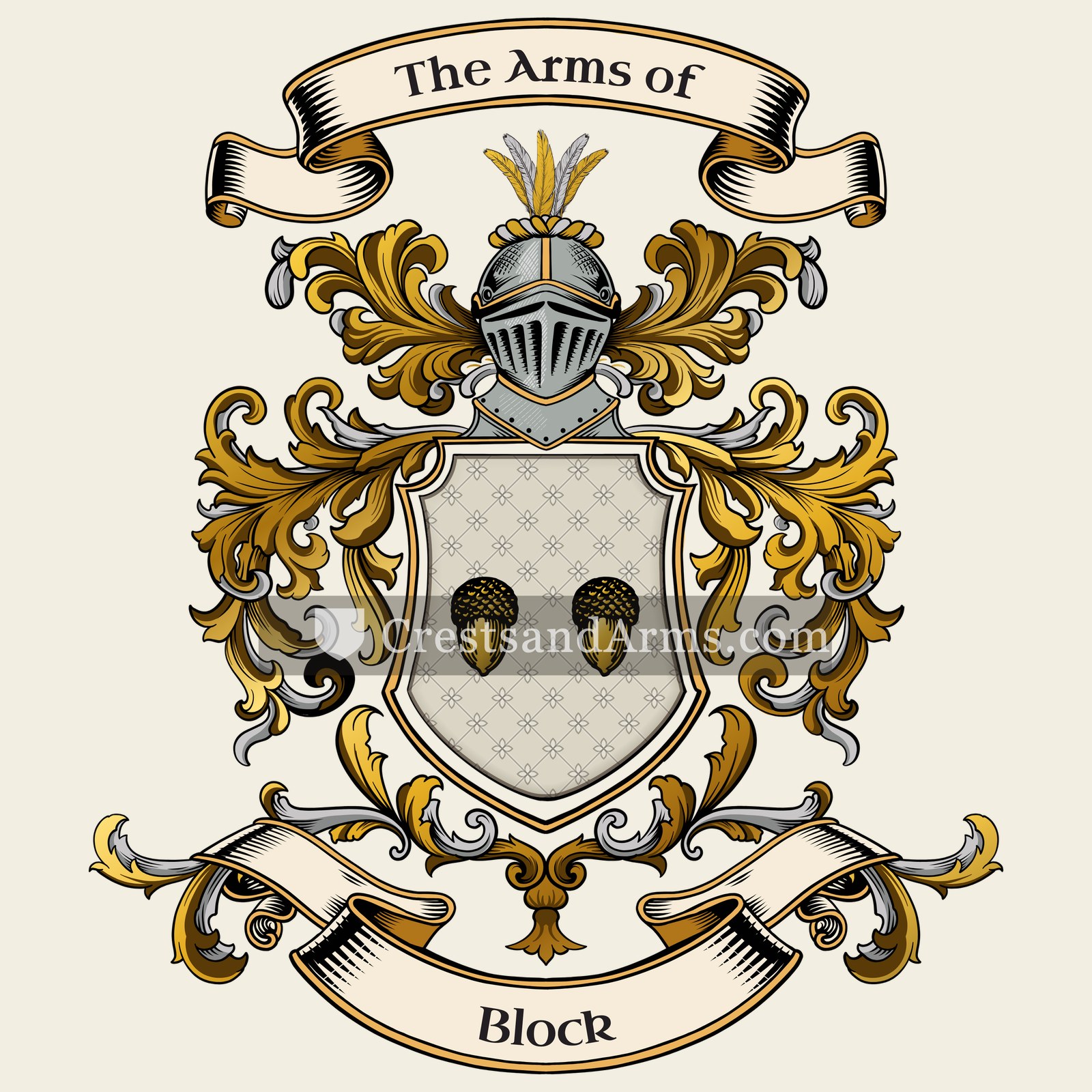


 chevronProtection, and faithful service completed
 mountThe ground held, and steadfastness upon it
 falconOne eager and quick in pursuit
 treeLife, endurance and deep roots
 roseThe seventh son, and beauty with grace