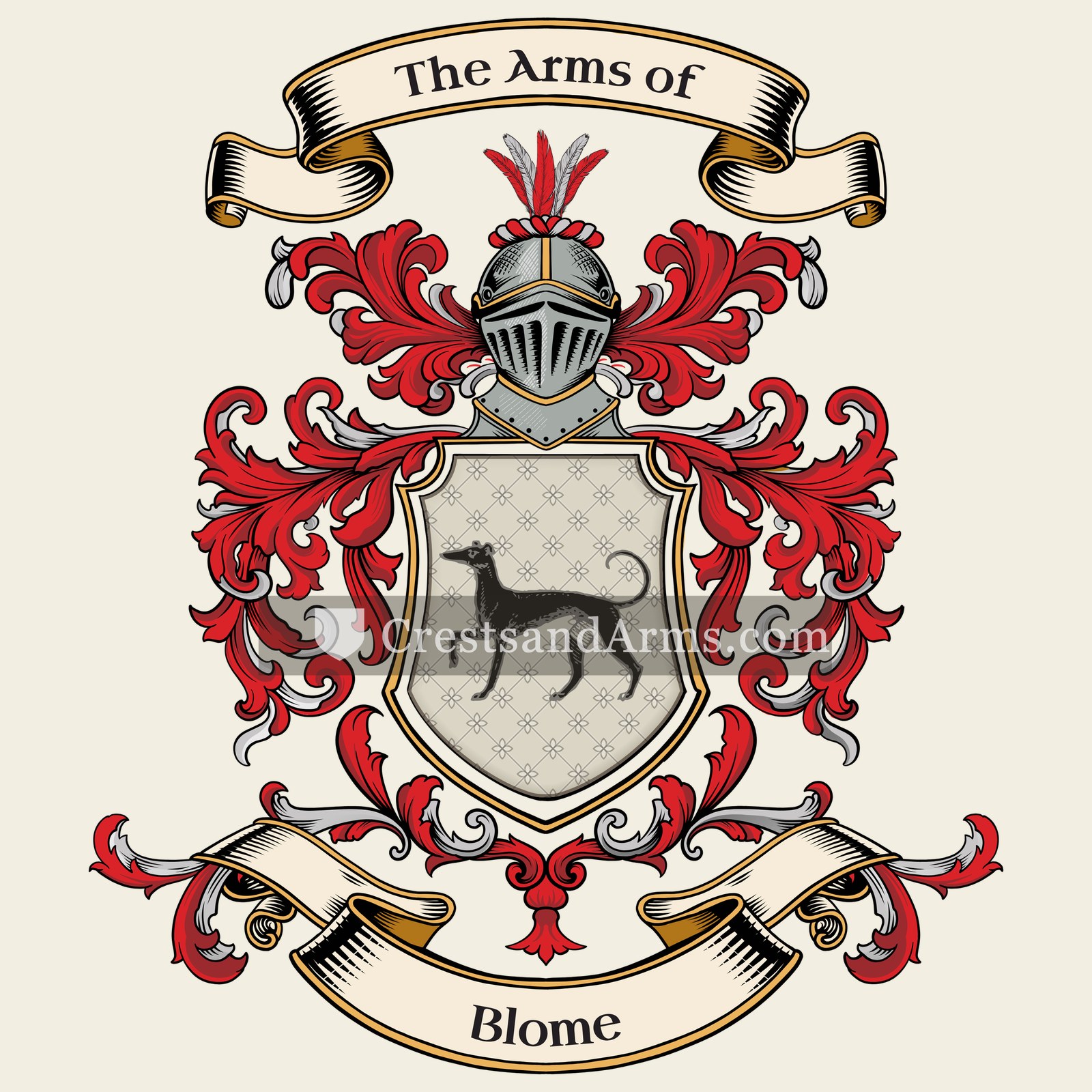
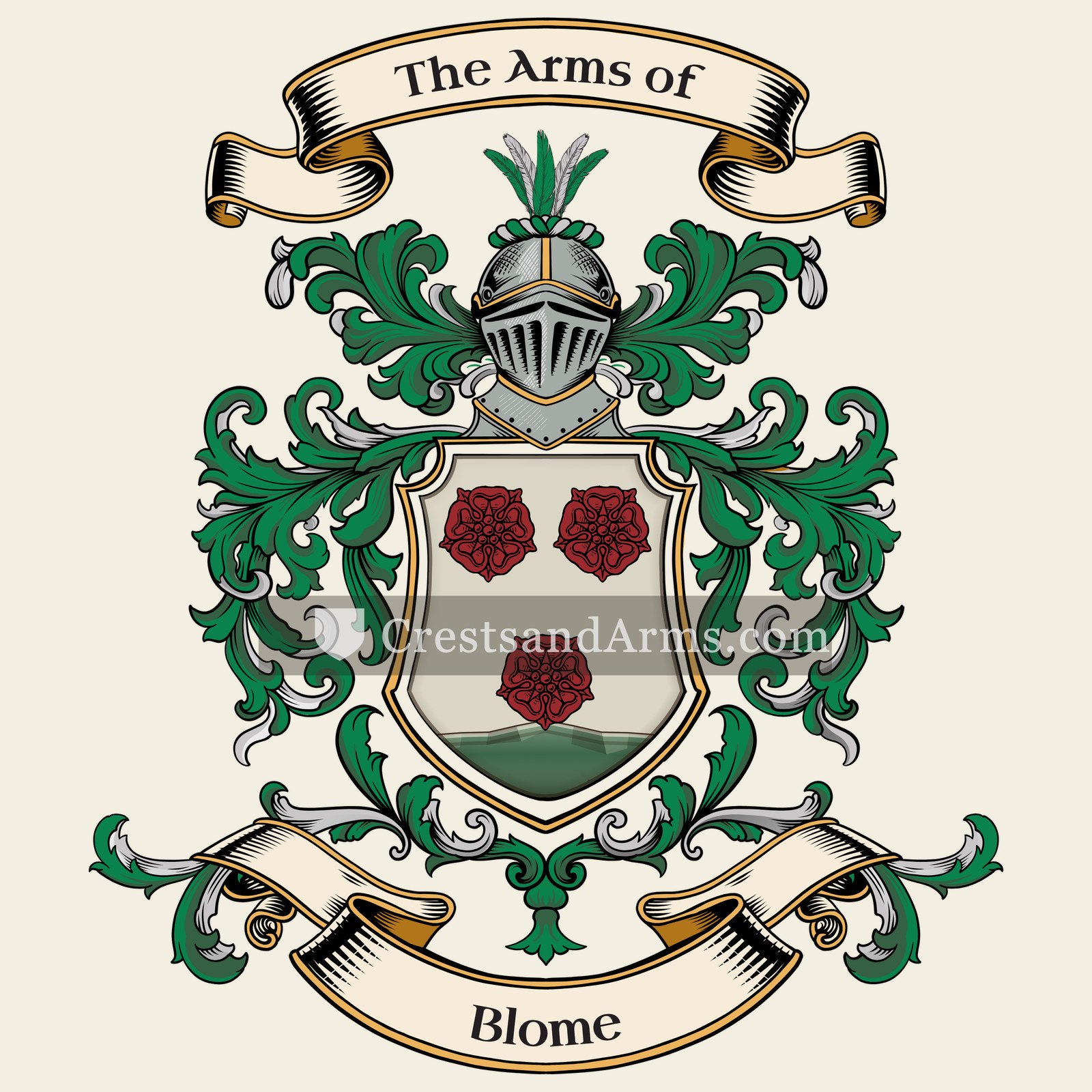
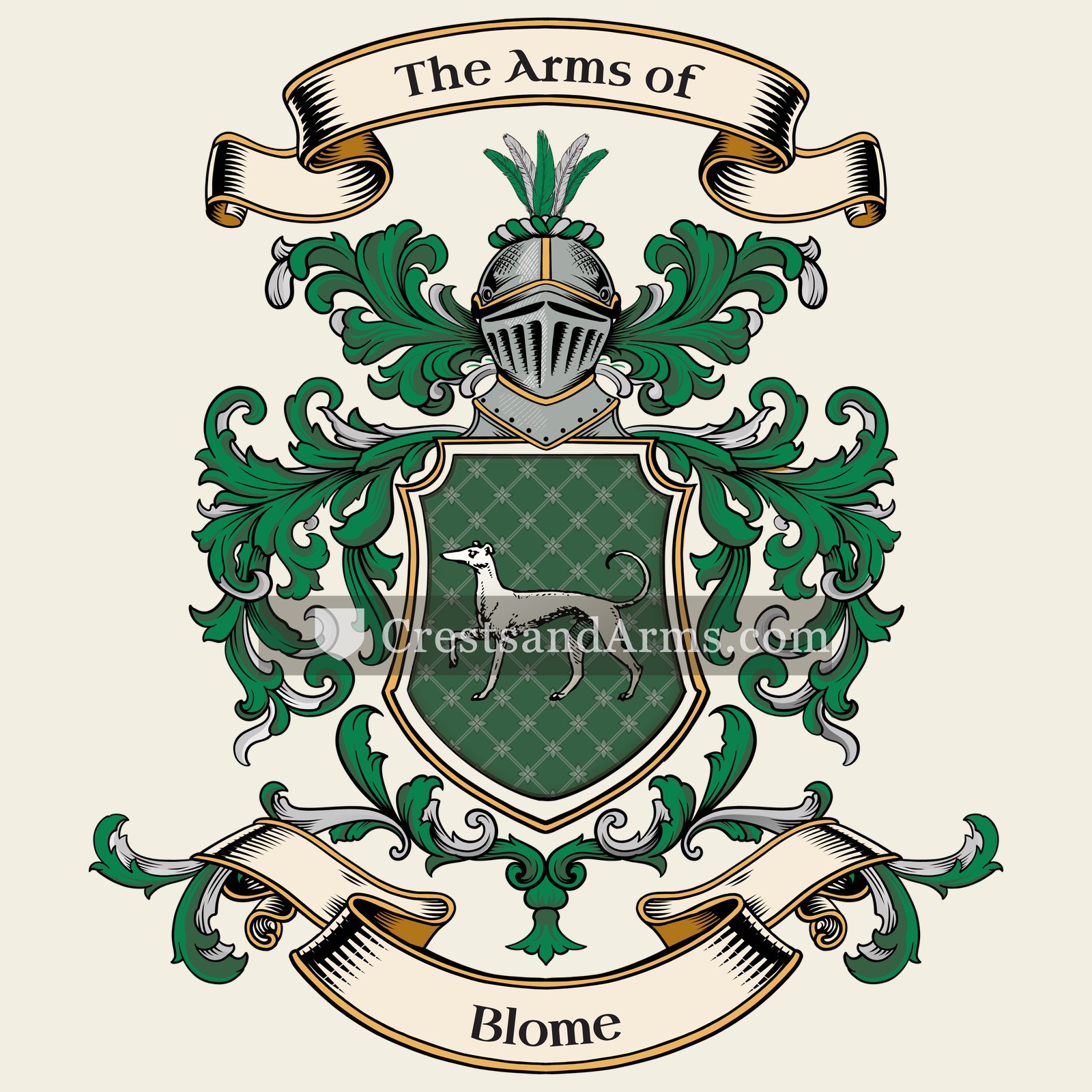
A record of documented arms, meaning and origin, researched for the Blome family lines. Documented in 3 countries.
Reg. 9493 · Polish, A–C
Coat of Arms & Family Crest Details
Symbols on this shield
greyhoundCourage, vigilance and loyalty
Colours
Silver (Argent)Means: Peace and sincerity
Black (Sable)Means: Constancy
Historical info
Source
J. B. Rietstap, Armorial Général, Gouda: G. B. van Goor Zonen, 1884–87
Blazon (the actual original written record)
“D'arg. au lévrier ramp. de sa., coll. d'or. Cq. cour. C.: une queue de paon, au nat.”
CourlandCourland, c. 1772
Where the Blome Arms Were Recorded
Map of Poland showing where the Blome arms are recorded
The Blome arms were recorded in Courland, c. 1772.
Courland was Baltic coast country held in large estates by a small number of families. They kept their land for generations and served as officers abroad, and both landholding and service brought arms with them.
This is where the arms were entered in the register. Families often moved to other parts of the country, so the same name can turn up in more than one region.
Region
Courland
First recorded
1772
Granting Authority for the Blome Arms
Ennoblement by the Sejm
Author: Olek Remesz · CC BY-SA 3.0
The body that granted and recorded arms in Poland in this period.
Stanisław August Poniatowski
Sovereign of the period
Stanisław August Poniatowski
1764–1795
Reigning in Poland when the Blome arms are first recorded.
How Arms Worked in Poland
Polish noble families shared a single coat of arms across many different surnames, creating large clans rather than individual designs. These symbols were held collectively by all members of the clan regardless of their specific family name. When a new family joined the nobility, they were adopted into an existing clan and began using that group's established shield.
Granting authority
The Sejm, which was the Polish parliament, held the power to grant noble status and the right to bear arms.
How they got arms
Families typically received their coat of arms through a formal act of ennoblement granted by the Sejm for distinguished service.
Where arms were recorded
These grants were officially recorded in the Crown Metrica, which served as the central archive for state documents starting in the sixteenth century.
The family's standing
Recorded among the armigerous families of Courland.
Origin & History of the Blome Family in Poland
The history of the Blome family in the Baltic region is deeply tied to the shifting borders and cultural exchanges between Poland, Prussia, and the Duchy of Courland. By the late 18th century, the family had established a notable presence in Courland, a territory that maintained complex political and economic links to the Polish-Lithuanian Commonwealth. The name itself reflects the linguistic blending common in this area, where Germanic roots often merged with the administrative and social structures of the Polish frontier. As the region experienced the political turbulence of the partitions of Poland in 1772, families like the Blomes often served as bridge figures between different local authorities. Their presence in Courland during this era suggests they were part of a mobile class of landowners or officials who navigated the changing loyalties of the Baltic provinces. This period of history highlights how the family name became embedded in the administrative records of a region caught between the influence of powerful neighboring empires.
Coat of Arms & Family Crest Details
Symbols on this shield
mountThe ground held, and steadfastness upon it
roseThe seventh son, and beauty with grace
Colours
Silver (Argent)Means: Peace and sincerity
Green (Vert)Means: Hope
Red (Gules)Means: Military strength
Historical info
Source
J. B. Rietstap, Armorial Général, Gouda: G. B. van Goor Zonen, 1884–87
Blazon (the actual original written record)
“D'arg. à trois tulipes, celle du milieu de gu., les deux autres d'or, tigées et feuillées au nat., posées sur une terrasse de sin. C.: les trois tulipes.”
Denmarkc. 1642
Where the Blome Arms Were Recorded
Sjaælland
Map of Denmark showing where the Blome arms are recorded
The Blome arms were recorded in Denmark, c. 1642.
Arms such as these were typically recorded in Sjaælland.
Zealand held the Danish court, the crown's offices and Copenhagen itself. Families who served the king kept estates within reach of it, and royal service was the ordinary route to a coat of arms.
This is where the arms were entered in the register. Families often moved to other parts of the country, so the same name can turn up in more than one region.
The body that granted and recorded arms in Denmark in this period.
Christian IV of Denmark
Sovereign of the period
Christian IV of Denmark
1588–1648
Reigning in Poland when the Blome arms are first recorded.
How Arms Worked in Denmark
Danish heraldry during this period was closely tied to noble status and royal favor rather than being open to all citizens. Arms were typically granted by the monarch to individuals, and these symbols were then shared by all members of the noble house. If a family line died out, the right to use those specific arms ended with them.
Granting authority
The Danish royal chancery held the power to issue and regulate official coats of arms for the kingdom.
How they got arms
Families usually received their arms through a formal royal grant that confirmed their noble status and rights.
Where arms were recorded
These grants were officially recorded in the Danish Royal Chancery records starting in the sixteenth century.
The family's standing
Recorded among the armigerous families of Denmark.
Origin & History of the Blome Family in Denmark
The history of the Blome family in Denmark is deeply rooted in the island of Zealand, where records confirm their presence as early as 1642. During the seventeenth century, the name was associated with individuals who navigated the complex social and administrative structures of the Danish realm. The family likely lived during a period of significant transition for Denmark, as the nation moved from the Renaissance into an era of absolute monarchy. Members of the family were often involved in the local governance and agricultural management that defined life on Zealand at the time. By establishing themselves in this region, the Blome family became part of the long-standing tradition of families who helped shape the rural and social landscape of the Danish islands. Their presence in the historical record provides a window into the lives of citizens who lived through the wars and political shifts that characterized seventeenth-century Scandinavia.
Coat of Arms & Family Crest Details
Symbols on this shield
greyhoundCourage, vigilance and loyalty
Colours
Green (Vert)Means: Hope
Silver (Argent)Means: Peace and sincerity
Historical info
Source
Sir Bernard Burke, The General Armory of England, Scotland, Ireland and Wales, London: Harrison & Sons, 1884
Blazon (the actual original written record)
“Vert, a greyhound courant in bend, ar. collared gu. studded or”
KentSeven Oaks · Kent, c. 1620
Where the Blome Arms Were Recorded
Kent
Map of England showing where the Blome arms are recorded
The Blome arms were recorded in Kent, c. 1620.
Kent sits between London and the short crossing to Europe, and the trade passing through made it wealthy. Merchant families bought land with that money, and it was landowners who took coats of arms.
This is where the arms were entered in the register. Families often moved to other parts of the country, so the same name can turn up in more than one region.
The body that granted and recorded arms in England in this period.
James VI and I
Sovereign of the period
James VI and I
1603–1625
Reigning in Poland when the Blome arms are first recorded.
How Arms Worked in England
English heraldry allowed arms to be shared by all legitimate descendants of the original owner. These symbols were treated as personal property that moved through the generations to all children. While the eldest son kept the original design, other family members could use the same shield without needing to change it or register their own unique versions.
Granting authority
The College of Arms in London has regulated the use of coats of arms throughout England and Wales since 1484.
How they got arms
Families typically obtained their coats of arms through a formal grant from the Crown or by proving their ancient right to them.
Where arms were recorded
All official coats of arms are recorded in the registers kept at the College of Arms, which date back to the fifteenth century.
The family's standing
Recorded among the armigerous families of Kent.
Origin & History of the Blome Family in England
The surname Blome is rooted in the linguistic traditions of Northern Europe, where it originally functioned as a descriptive term for someone who lived near a flower or perhaps someone with a cheerful disposition. By the early 17th century, the name had firmly established itself within the social fabric of England. Historical records confirm that members of the Blome family were living in the county of Kent by 1620. During this period, Kent served as a vital hub for trade and agriculture, placing the family in a region that was experiencing significant economic growth and social change. As the family settled into the local community, they participated in the typical life of the era, which included farming, local commerce, and the development of parish ties. This early presence in Kent suggests that the family was part of the steady migration and settlement patterns that defined the English countryside during the reign of King James I.
Related Branches & Arms
Root word
Blume
A Middle High German term referring to a flower or blossom.
This name
BlomeA topographic or habitational name for someone living near a flower garden or meadow.
also spelled
Bloeme
Blomm
Blom
Bloom
Related arms
Blomvariant spelling
Bloomvariant spelling
Baudissinrecorded with Blome, same area
Bettensonrecorded with Blome, same area
Documented Sources
J. B. Rietstap, Armorial Général, Gouda: G. B. van Goor Zonen, 1884–87
Dunsdorfs, Edgars, Latvijas vēsture 1710–1800, 1973
Latvian State Historical Archives (Latvijas Valsts vēstures arhīvs), Fond 214: Courland Nobility Records
Strazdas, A., Baltijas muižniecība un Polijas-Lietuvas kopvalsts, 1998
Digital archive packCoat of arms PNG, gold border print PDF, vector SVG and the certificate of authenticity. Sent to your email in minutes.


 greyhoundCourage, vigilance and loyalty
 greyhoundCourage, vigilance and loyalty

 mountThe ground held, and steadfastness upon it
 roseThe seventh son, and beauty with grace